Author: it@arcticportal.org

  • Post-doctoral position available

    Post-doctoral position available

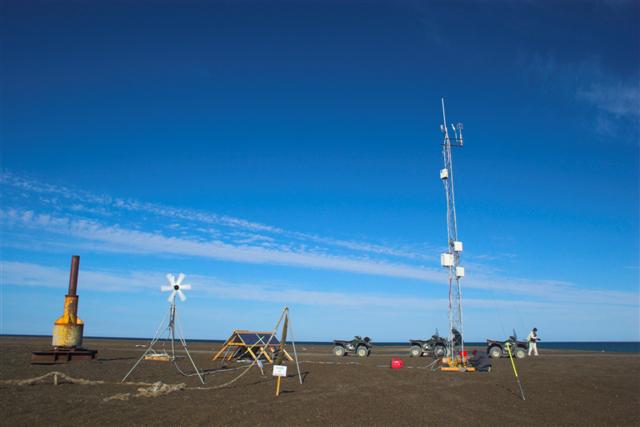
    research site

    A Post-doctoral position on high-latitude land surface modelling within the Department of Applied Environmental Science (ITM) and the Bolin Centre for Climate Research is open for applications. The deadline is the 3rd of September.

    The main focus of the work will be on including near-surface vegetation functions into the terrestrial ecosystem model JSBACH. Two aspects are important: The representation of plant physiological processes being responsible for the vegetation distribution as well as hydrological processes in the moss layer which have impacts on the soil hydrological and thermal regime.

    Field observations (e.g. physical properties and carbon profile data, eddy covariance heat and carbon fluxes) and large-scale observational datasets (e.g. remote sensing products, atmospheric inversion of trace gas fluxes) will be important for a calibration and validation of the model. Then, such new modelling tool can be used to investigate past, current and future ecosystem functions in relation to environmental change.

    This is a full-time, initial 1-year position with the possibility of one year extension. The expected starting date is after agreement.

    More information available here.

  • Start of the NRF Open Assembly

    Start of the NRF Open Assembly

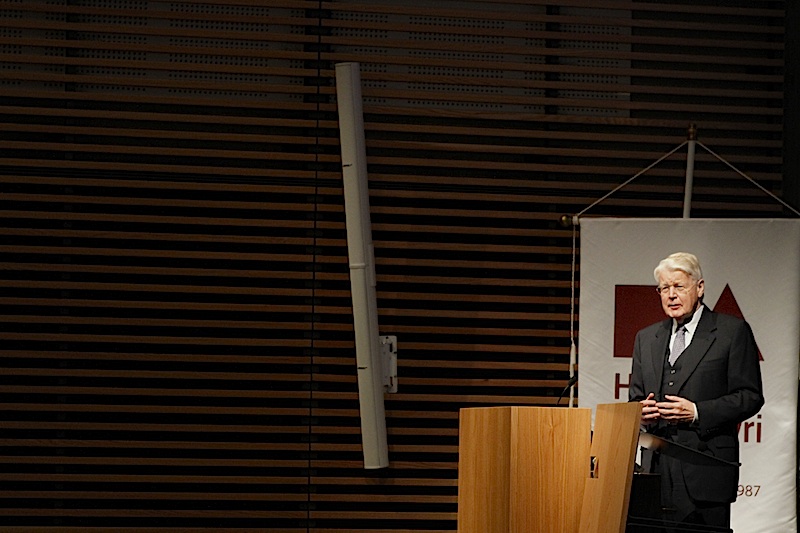
    Ólafur Ragnar Grímsson at the NRF Open Assembly

    The NRF Open Assembly started in Akureyri this morning. Its theme is: Climate Change in Northern Territories, Sharing Experiences, Exploring New Methods and Assessing Socio-Economic Impacts.

    Click here to see the conference program.

    Pictures from day 1.

    The conference started with words of welcome from Rector Stefán B. Sigurðsson, Professor Lassi Heininen and Professor Grétar Þór Eyþórsson.

    But one of the highlights was the opening speech of Mr. Ólafur Ragnar Grímsson, president of Iceland.

    He mentioned that now the eleven biggest economies in the world are now linked to the Arctic through the Arctic Council, amongst them the biggest Co2 emission countries in the world.

    He also welcomed interest from Arctic outsiders due to their work on climate change and their resource knowledge on related issues.

    He demonstrated that China sent an icebreaker across the Arctic in 2012, conducting scientific research, confirming severe consequences of climate change. Consequently the weather in China in January and February was one of the worst in recent years, directly impacted by the Arctic changes.

    Keynote sessions will continue over the two-day conference.

    Recording will be available after the conference.

  • Chinese merchant ship crosses Arctic

    Chinese merchant ship crosses Arctic

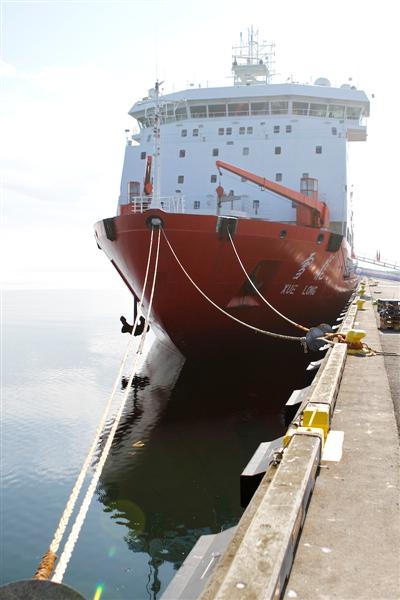
    Xue Long - The Snow Dragon

    Arctic shipping is reaching its peak this year, now in late summer. Earlier a 19.000 ton cargo vessel from China became the first Chinese merchant ship to travel from its homeland to Europe via the Northern sea route.

    The Yong Sheng, a 19,000-tonne vessel operated by state-owned Cosco Group, set sail on August 8 from Dalian, a port in northeastern China, bound for Rotterdam. According to an announcement on Cosco’s website, the journey via the Bering Strait could shave as much as 15 days off the traditional route through the Suez Canal and Mediterranean Sea.

    There are three main shipping routes through the Arctic, the Norhern Sea route, the Western sea route and the Central shipping route.

    The longer Northeast Passage, the Financial Times writes, at approximately 5,400km, has the advantage of offering a relatively straight journey over the top of the Eurasian landmass. Its shorter North American rival, by contrast, twists and turns through narrow, dangerous channels in the Canadian Arctic. The Northwest Passage claimed the life of explorer Sir John Franklin and the crews of his two ships, HMS Erebus and HMS Terror, in 1847.

    But China has already demonstrated that the Central sea route might be the best route, as the ice gets thinner by the years, with the Chinare5 expedition in 2012.
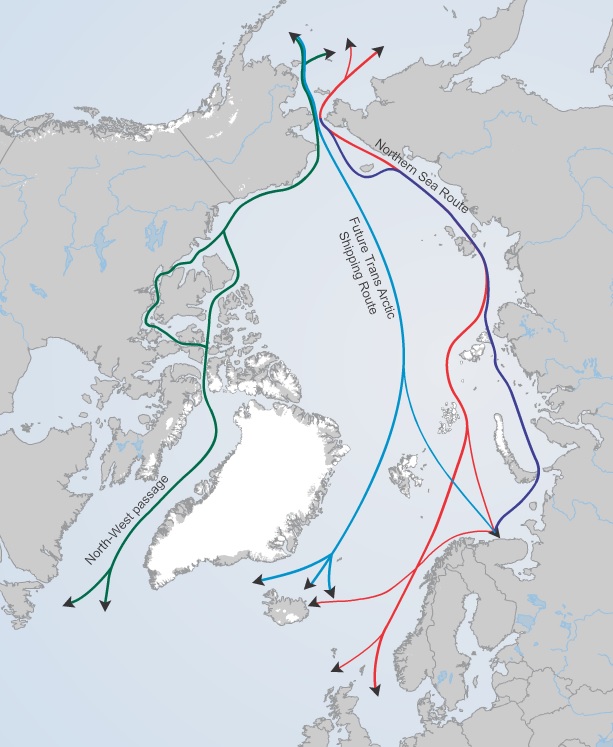
    The arctic shipping routes - map

    Arctic shipping is taking off faster than the other big economic prospect for the polar region, oil exploration, where companies such as Royal Dutch Shell and Cairn Energy have been plagued by delays.

    But analysts caution that it will be years before the route, which is only passable for a few months, is commercially viable let alone a rival to the Suez Canal, which handled more than 17,000 ships in 2012.

    “Climate change is certainly opening new Arctic shipping routes,” said Cameron Dueck, a Canadian author who sailed the Northwest Passage in 2009. “But the most common routes through the [Arctic] continue to have ice even in the warmest years, meaning shipping companies will have to be selective and opportunistic in using them.”

    Valentin Davydants, captain of Russia’s Atomflot fleet of nuclear-powered icebreakers, estimates that by 2021 15m tonnes of cargo will use the full route. In addition, 15m tonnes of liquefied natural gas and 10m tonnes of oil will use the route partially to leave Russia’s northern Arctic shore.

    That pales into insignificance compared with sea freight in the Suez Canal where in 2011 almost 18,000 vessels transported 929m tonnes of cargo.

    “You might see some oil and gas leave Russia – but I think the day that container ships will choose to use the northern sea route for economic reasons is quite a long way off,” said one of Norway’s biggest shipowners.

    But some see great potential if the Arctic route can bring its costs down, which is indeed happening as the melting sea ice means icebreakers are no longer required under Russian rules for all journeys

    Besides the Suez Canal, the traditional maritime route linking China to the EU passes through the contested South China Sea, the Strait of Malacca and pirate-infested waters in the Indian Ocean.

    The voyage between Dalian and Rotterdam along this southerly route takes 48 days. By sailing the Northeast Passage, the Yong Sheng is expected to reach its destination on September 11 – a transit time of only 35 days.

    China, which claims to be a “near-Arctic state”, has become more aggressive in asserting its interests in the northern Pacific and Arctic oceans. In May, Beijing secured “permanent observer” status at the Arctic Council, a group uniting the eight countries with territory in the polar region.

    Source

    Financial Times
  • Arctic sea ice disappearing faster than ever

    Arctic sea ice disappearing faster than ever

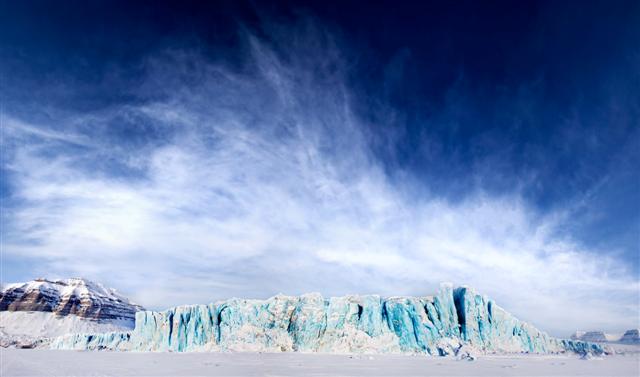
    arctic landscape

    The Arctic lost record amounts of sea ice last year and is changing at an unprecedented pace due to climate change, a landmark climate study says.

    Last year was among the 10 warmest years on record – ranking eighth or ninth depending on the data set, according to a report led by the National Oceanic and Atmospheric Administration (Noaa). The year 2012 also saw record greenhouse gas emissions, with concentrations of carbon dioxide and other warming gasses reaching a global average of 392.7 parts per million for the year.

    “The findings are striking,” Kathryn Sullivan, Noaa’s acting administrator, said on a conference call. “Our planet as a whole is becoming a warmer place.”

    The scientists were reluctant to point directly to the cause of the striking changes in the climate. But the annual reports are typically used by the federal government to prepare for the future, and in June president Barack Obama used his climate address to direct government agencies to begin planning for decades of warming atmosphere and rising seas.

    The biggest changes in the climate in 2012 were in the Arctic and in Greenland, said the report, which is an annual exercise by a team of American and British scientists. The Arctic warmed at about twice the rate of lower latitudes, the report found. By June 2012, snow cover had fallen to its lowest levels since the record began. By September 2012, sea-ice cover had retreated to its lowest levels since the beginning of satellite records, falling to 1.32 million square miles.

    That was, the report noted, a whopping 18% lower than the previous low, set in 2007, and a staggering 54% lower than the mark for 1980.

    The changes were widespread on land as well, with record warm permafrost temperatures in Alaska and in the Canadian Arctic, the report’s authors noted. On 11 July last year, Greenland experienced surface melting on 97% of the ice sheet. The record-breaking events indicate an era of “new normal” for the climate, the researchers said.

    “The record or near-records being reported from year to year in the Arctic are no longer anomalies or exceptions,” said Jackie Richter-Menge, a civil engineer with the US army corps of engineers. “Really they have become the rule for us, or the norm that we see in the Arctic and that we expect to see for the forseeable future.”

    That ice melt was also a major cause of sea-level rise, the report found. Global sea levels rose to record highs last year, after being depressed during the first half of 2011 because of the effects of La Niña. The average global sea level last year was 1.4in above the 1993-2010 average.

    “Over the past seven years of so, it appears that the ice melt is contributing more than twice as much to the global sea level rise compared with warming waters,” said Jessica Blunden, a climatologist at Noaa’s national climactic data centre.

    Source

    Guardian

  • Starved polar bear perished in Svalbard

    Starved polar bear perished in Svalbard

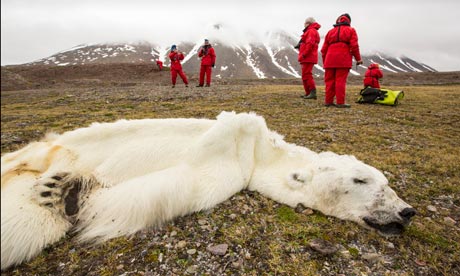
    Polar bear dead of starvation

    A starved polar bear found found dead in Svalbard as “little more than skin and bones” perished due to a lack of sea ice on which to hunt seals, according to a renowned polar bear expert.

    Climate change has reduced sea ice in the Arctic to record lows in the last year and Dr Ian Stirling, who has studied the bears for almost 40 years and examined the animal, said the lack of ice forced the bear into ranging far and wide in an ultimately unsuccessful search for food.

    “From his lying position in death the bear appears to simply have starved and died where he dropped,” Stirling said. “He had no external suggestion of any remaining fat, having been reduced to little more than skin and bone.”

    The bear had been examined by scientists from the Norwegian Polar Institute in April in the southern part of Svalbard, an Arctic island archipelago, and appeared healthy. The same bear had been captured in the same area in previous years, suggesting that the discovery of its body, 250km away in northern Svalbard in July, represented an unusual movement away from its normal range. The bear probably followed the fjords inland as it trekked north, meaning it may have walked double or treble that distance.

    Polar bears feed almost exclusively on seals and need sea ice to capture their prey. But 2012 saw the lowest level of sea ice in the Arctic on record. Prond Robertson, at the Norwegian Meteorological Institute, said: “The sea ice break up around Svalbard in 2013 was both fast and very early.” He said recent years had been poor for ice around the islands: “Warm water entered the western fjords in 2005-06 and since then has not shifted.”

    Stirling, now at Polar Bears International and previously at the University of Alberta and the Canadian Wildlife Service, said: “Most of the fjords and inter-island channels in Svalbard did not freeze normally last winter and so many potential areas known to that bear for hunting seals in spring do not appear to have been as productive as in a normal winter. As a result the bear likely went looking for food in another area but appears to have been unsuccessful.”

    Research published in May showed that loss of sea ice was harming the health, breeding success and population size of the polar bears of Hudson Bay, Canada, as they spent longer on land waiting for the sea to refreeze. Other work has shown polar bear weights are declining. In February a panel of polar bear experts published a paper stating that rapid ice loss meant options such the feeding of starving bears by humans needed to be considered to protect the 20,000-25,000 animals thought to remain.

    The International Union for the Conservation of Nature, the world’s largest professional conservation network, states that of the 19 populations of polar bear around the Arctic, data is available for 12. Of those, eight are declining, three are stable and one is increasing.

    The IUCN predicts that increasing ice loss will mean between one-third and a half of polar bears will be lost in the next three generations, about 45 years. But the US and Russian governments said in March that faster-than-expected ice losses could mean two-thirds are lost.

    Attributing a single incident to climate change can be controversial, but Douglas Richardson, head of living collections at the Highland Wildlife Park near Kingussie, said: “It’s not just one bear though. There are an increasing number of bears in this condition: they are just not putting down enough fat to survive their summer fast. This particular polar bear is the latest bit of evidence of the impact of climate change.”

    Ice loss due to climate change is “absolutely, categorically and without question” the cause of falling polar bear populations, said Richardson, who cares for the UK’s only publicly kept polar bears. He said 16 years was not particularly old for a wild male polar bear, which usually live into their early 20s. “There may have been some underlying disease, but I would be surprised if this was anything other than starvation,” he said. “Once polar bears reach adulthood they are normally nigh on indestructible, they are hard as nails.”

    Jeff Flocken, at the International Fund for Animal Welfare, said: “While it is difficult to ascribe a single death or act to climate change it couldn’t be clearer that drastic and long-term changes in their Arctic habitat threaten the survival of the polar bear. The threat of habitat loss from climate change, exacerbated by unsustainable killing for commercial trade in Canada, could lead to the demise of one of the world’s most iconic animals, and this would be a true tragedy.

    Source

    Guardian

  • 2012 one of the 10 warmest years

    2012 one of the 10 warmest years

    Arctic ice

    Worldwide, 2012 was among the 10 warmest years on record according to the 2012 State of the Climate report released online today by the American Meteorological Society (AMS). The peer-reviewed report, with scientists from NOAA’s National Climatic Data Center in Asheville, N.C., serving as lead editors, was compiled by 384 scientists from 52 countries.

    See the full report here.

    It provides a detailed update on global climate indicators, notable weather events, and other data collected by environmental monitoring stations and instruments on land, sea, ice, and sky.

    “Many of the events that made 2012 such an interesting year are part of the long-term trends we see in a changing and varying climate — carbon levels are climbing, sea levels are rising, Arctic sea ice is melting, and our planet as a whole is becoming a warmer place,” said Acting NOAA Administrator Kathryn D. Sullivan, Ph.D. “This annual report is well-researched, well-respected, and well-used; it is a superb example of the timely, actionable climate information that people need from NOAA to help prepare for extremes in our ever-changing environment.”

    Conditions in the Arctic were a major story of 2012, with the region experiencing unprecedented change and breaking several records. Sea ice shrank to its smallest “summer minimum” extent since satellite records began 34 years ago. In addition, more than 97 percent of the Greenland ice sheet showed some form of melt during the summer, four times greater than the 1981–2010 average melt extent.Temperature in 2012 compared to the 1981-2010 average.

    The report used dozens of climate indicators to track and identify changes and overall trends to the global climate system.

    These indicators include greenhouse gas concentrations, temperature of the lower and upper atmosphere, cloud cover, sea surface temperature, sea-level rise, ocean salinity, sea ice extent and snow cover. Each indicator includes thousands of measurements from multiple independent datasets.

    Highlights:

    • Warm temperature trends continue near Earth’s surface: Four major independent datasets show 2012 was among the 10 warmest years on record, ranking either 8th or 9th, depending upon the dataset used. The United States and Argentina had their warmest year on record.
    • La Niña dissipates into neutral conditions: A weak La Niña dissipated during spring 2012 and, for the first time in several years, neither El Niño nor La Niña, which can dominate regional weather and climate conditions around the globe, prevailed for the majority of the year.
    • The Arctic continues to warm; sea ice extent reaches record low: The Arctic continued to warm at about twice the rate compared with lower latitudes. Minimum Arctic sea ice extent in September and Northern Hemisphere snow cover extent in June each reached new record lows. Arctic sea ice minimum extent (1.32 million square miles, September 16) was the lowest of the satellite era. This is 18 percent lower than the previous record low extent of 1.61 million square miles that occurred in 2007 and 54 percent lower than the record high minimum ice extent of 2.90 million square miles that occurred in 1980. The temperature of permafrost, or permanently frozen land, reached record-high values in northernmost Alaska. A new melt extent record occurred July 11–12 on the Greenland ice sheet when 97 percent of the ice sheet showed some form of melt, four times greater than the average melt this time of year.
    • Antarctica sea ice extent reaches record high: The Antarctic maximum sea ice extent reached a record high of 7.51 million square miles on September 26. This is 0.5 percent higher than the previous record high extent of 7.47 million square miles that occurred in 2006 and seven percent higher than the record low maximum sea ice extent of 6.96 million square miles that occurred in 1986.
    • Sea surface temperatures increase: Four independent datasets indicate that the globally averaged sea surface temperature for 2012 was among the 11 warmest on record. After a 30-year period from 1970 to 1999 of rising global sea surface temperatures, the period 2000–2012 exhibited little trend. Part of this difference is linked to the prevalence of La Niña-like conditions during the 21st century, which typically lead to lower global sea surface temperatures
    • Ocean heat content remains near record levels: Heat content in the upper 2,300 feet, or a little less than one-half mile, of the ocean remained near record high levels in 2012. Overall increases from 2011 to 2012 occurred between depths of 2,300 to 6,600 feet and even in the deep ocean.
    • Sea level reaches record high: Following sharp decreases in global sea level in the first half of 2011 that were linked to the effects of La Niña, sea levels rebounded to reach record highs in 2012. Globally, sea level has been increasing at an average rate of 3.2 ± 0.4 mm per year over the past two decades.
    • Sea ice concentration reached a new record low in mid-September 2012.
    • Sea ice concentration reached a new record low in mid-September 2012. Credit: NOAA Climate.gov, based on NSIDC data.
    • Ocean salinity trends continue: Continuing a trend that began in 2004, oceans were saltier than average in areas of high evaporation, including the central tropical North Pacific, and fresher than average in areas of high precipitation, including the north central Indian Ocean, suggesting that precipitation is increasing in already rainy areas and evaporation is intensifying in drier locations.
    • Tropical cyclones near average: Global tropical cyclone activity during 2012 was near average, with a total of 84 storms, compared with the 1981–2010 average of 89. Similar to 2010 and 2011, the North Atlantic was the only hurricane basin that experienced above-normal activity.
    • Greenhouse gases climb: Major greenhouse gas concentrations, including carbon dioxide, methane, and nitrous oxide, continued to rise during 2012. Following a slight decline in manmade emissions associated with the global economic downturn, global CO2 emissions from fossil fuel combustion and cement production reached a record high in 2011 of 9.5 ± 0.5 petagrams (1,000,000,000,000,000 grams) of carbon , and a new record of 9.7 ± 0.5 petagrams of carbon is estimated for 2012. Atmospheric CO2 concentrations increased by 2.1 ppm in 2012, reaching a global average of 392.6 ppm for the year. In spring 2012, for the first time, the atmospheric CO2concentration exceeded 400 ppm at several Arctic observational sites.
    • Cool temperature trends continue in Earth’s lower stratosphere: The average lower stratospheric temperature, about six to ten miles above the Earth’s surface, for 2012 was record to near-record cold, depending on the dataset. Increasing greenhouse gases and decline of stratospheric ozone tend to cool the stratosphere while warming the planet near-surface layers.

    The 2012 State of the Climate report is peer-reviewed and published annually as a special supplement to the Bulletin of the American Meteorological Society. This year marks the 23rd edition of the report, which is part of the suite of climate services NOAA provides to government, the business sector, academia, and the public to support informed decision-making. The full report can be viewed online.

    Source

    NOAA

  • 5th Polar Shipping Summit coming soon

    5th Polar Shipping Summit coming soon

    5th Polar Shipping Summit

    The Arctic Polar Shipping Summit will take place 26th -27th of February 2014 in London.

    The ACI’s 5th Polar Shipping Summit will help its participants to prepare their ship and crew for another successful year of polar navigation.

    The forum will enable its participants to meet Arctic experts from Canada, Russia, USA and Europe, who will share their views on the best solutions for the current operational challenges as well as the strategy and the recent design and technology innovations.

    The governmental officials attending will inform you of the policy and regulatory changes for the upcoming years and promote understanding for the government’s strategy for the Arctic development in polar circles.

    The Summit will focus on technological, operational, and logistical challenges encountered by ship owners in harsh Arctic conditions.

    It will address key developments in transport and regulation in the Arctic as well as; commercial, communication and safety issues. Particular emphasis will be put on evaluating potential opportunities in the region.

    This summit, through presentations, round table discussion and case studies will examine practical solutions to Arctic shipping issues and present the latest innovations of technology in this specialized area.

    Click here for more information abot the event.

    Source

    5th Polar Shipping Summit

  • Students from DUT design icebreaker

    Students from DUT design icebreaker

    Ice covered waters in the Arctic

    Five maritime engineering bachelor students of the Delft University of Technology produced a design for an Arctic modular towing supply vessel (AMTSV) as part of their minor on Arctic Engineering. In cooperation with Dutch shipyard Damen this has now culminated in an offering of a 100m double acting supply ship is capable of operating in the Barents Sea year round and in the Baffin Bay and Beaufort Sea for 8 months.

    The vessel actually has two bows; when she sails through open water the accommodation will be in the front.

    Through ice however, she will sail with her thrusters first. The ‘stern first’ concept is not new in Arctic shipping.

    However, in this case it’s a veritable ‘double-bow’ vessel, a concept which is incorporated in the structural lay-out of the ship. This means the AMTVS could be classed as such.

    The AMTSV has the ability to sail through 1.6m of level ice at 3kn. Research showed this to be an optimal solution, because the shape of an ice bow is completely different compared to an open water bow.

    When using two bows no compromises have to be made. Another argument for this concept is that, while sailing through ice, the thrusters will create a flow around the hull which decreases friction.

    Because the vessel can sail in both directions, she also has to be capable of towing in both directions. Hence a double acting winch of 300t is installed. This winch is installed inside the accommodation so the harsh weather will not affect it.

    There are no compromises on crew conditions as they can work in the enclosed superstructure (ESS) located behind the conventional superstructure. This superstructure can be kept up above zero degrees with an outside temperature of -55°C. Temperature sensitive cargo can also be kept in this area.

    This Arctic concept vessel will be running on LNG, with dual fuel engines, in an effort to make it more environmentally friendly.

    The main disadvantage of LNG is that it requires a lot of storage capacity. However, ice strengthened vessels have a lot steel weight in the hull compared to open water vessels and this means that the centre of gravity is relatively low. Therefore the disadvantage is negated by placing the LNG tanks on top of the ESS.

    The project has not officially been implemented yet, however such a possibilities are being researched.

    Source

    IMAREST

  • Greenland rare earth potential noticed

    Greenland rare earth potential noticed

    Sea ice is largely present in Greenland

    Various actors to include both Arctic and non – Arctic states, have now recognized Greenland´s increasing presence in the rare earth field, according to economy analysts.

    Greenland, which is self – governing dependency of Denmark, owns some of the largest amounts of rare earth elements in the world.

    European Commission data indicates Greenland has “strong potential” in six out of the 14 elements listed on the union’s critical raw material list. These include rare earths, tantalum and niobium as well as the platinum group metals. Greenland’s rare earth resources currently amount to around 10 million tonnes (nine per cent of the earth’s total).

    Analysts point out that a number of Greenland’s significant deposits, such as Kvanefjeld, are in the advanced stage of exploration, meaning the dependency could well be set to become a medium-size supplier.

    In recognition of the increased role Greenland is likely to play in the field, London Mining – a company backed by Chinese steelmakers – has sought permission to build a US$2.35bn iron ore mine near the country’s capital Nuuk which, if given the green light, would be the biggest industrial development to take place in Greenland.

    Source

    IceNews

  • Arctic Energy Summit agenda ready

    Arctic Energy Summit agenda ready

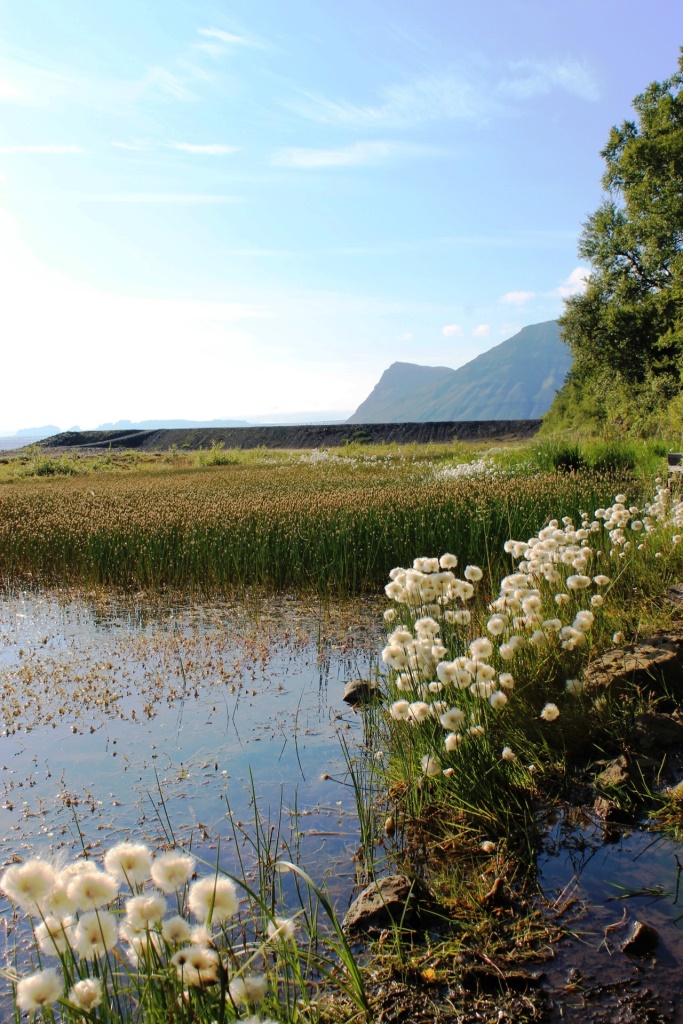
    Summer in Southern Iceland

    We are excited to remind the agenda for the 2013 Arctic Energy Summit! It is filled with speakers who are leaders in the industry, academic, government and non-profit sectors around the world.

    These speakers will help us explore key questions related to areas of interest including:

    • New energy resources and a region that is rich in assets
    • Strategies for northern resilience – maintaining valuable cultural traditions in times of immense economic and environmental change
    • Technological and project advancements for increasing system lifespans
    • Public sector incentives and development of a positive investment climate
    • Global market trends that impact policy or create pressures on development.

    To find out more about the speakers, check out the speaker section of the Arctic Energy Summit website.

    You can see other speakers and presenters by visiting the agenda section.

    The 2013 Arctic Energy Summit is a multi – disciplinary event expected to draw several hundred industry officials, scientists, academics, policy makers, energy professionals and community leaders together to collaborate and share leading approaches on Arctic energy issues.

    Source:

    Arctic Energy Summit