Category: News & Press Releases

Arctic Portal News Portlet

  • CAFF XIII Biennial

    Conservation of Arctic Flora and Fauna

    The Thirteenth meeting of the Conservation of Arctic Flora and Fauna Working Group (CAFF XIII), is to be held in Akureyri, Iceland on February 1 – 3rd 2011. Every two years, the Arctic Council Working Group on Conservation of Arctic Flora and Fauna schedules a large meeting in advance of the AC Ministerial meeting.

    CAFF is a Working Group of the Arctic Council and a forum of Arctic professionals, indigenous peoples representatives, and observer countries and organisations. The aim of CAFF is to discussing circumpolar Arctic conservation issues. The major task is to advise the Arctic governments (Canada, Denmark/Greenland, Finland, Iceland, Norway, Russia, Sweden and the United States) on conservation matters.

    The CAFF Program is guided by the CAFF Strategic Plan for the Conservation of Arctic Biological Diversity and biennial CAFF Work Plans. CAFF has four Guiding Principles:

    • The involvement of indigenous and local people and use of traditional ecological knowledge;
    • The use of broad, ecosystem-based approach to conservation and management;
    • Cooperation with other conservation initiatives to minimise duplication and increase effectiveness;
    • Communication of CAFF program activities.

    The CAFF 2006-2008 Work Plan emphasizes cooperation and collaboration with other Arctic Council Working Groups, and organizations outside of the Arctic Council, and makes efforts to actively contribute to the global conservation agenda. This Work Plan responds to the findings and recommendations of the Arctic Climate Impact Assessment, the Arctic Marine Strategic Plan and CAFFs Arctic Flora: Status and Trends.
  • Polar bear swims 687 km in search of ice

    Polar bear swims 687 km in search of ice

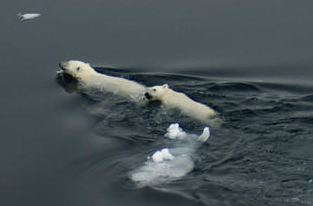
    Polar Bear swimming in the ocean

    A female polar bear swam for nine days straight to find hunting grounds in the Beaufort Sea.

    Her cub died during the 687-kilometre search for pack ice.

    Researchers, who tracked the bear with a radio collar in the summer of 2008, published their findings in the scientific journal Polar Biology.

    The article raises concerns that climate change is decreasing the amount of pack ice in the Arctic and is affecting polar bears’ hunting patterns.

    “The extraordinary long distance swimming ability of polar bears, which we confirm here, may help them cope with reduced Arctic sea ice,” researchers concluded.

    Source: The Star

  • Trapped in Ice since New Year’s Eve

    Trapped in Ice since New Year’s Eve

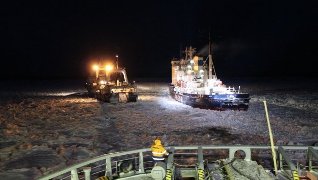
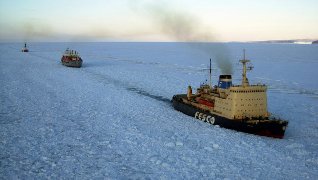
    Russian Icebreaker - Sodruzhestvo

    The Sodruzhestvo mother fishery ship has been stuck in thick ice in Russia’s Far East Sea of Okhotsk since 31st of December. The Bereg Nadezhdy ship and the Professor Kizevetter research vessel, got also stuck in two-meter-thick ice in the Sea of Okhotsk on the same day, but have been rescued.

    Two other ships, the Mys Yelizavety and the Anton Gurin, became trapped later. The Icebreaker, Admiral Makarov released the Professor Kizevetter and the Mys Yelizavety vessels from the ice trap, while the ship Anton Gurin managed to cope on its own. The Bereg Nadezhdy has also been successfully towed to clear water.

    Russian Icebreaker - Admiral Makarov and the Krasin

    Russian icebreakers the Krasin and the Admiral Makarov resumed their operation to rescue the ice-trapped mother fishery ship Sodruzhestvo, which was the hardest to tow due to its wide body. The icebreakers have to coordinate their efforts to clear a wide enough canal in the thick ice for the vessel to finally reach open waters. The two icebreakers had encountered problems on the way due to harsh conditions. At one point, the ships only moved 1,8 nautical miles in 24 hours. The icebreakers have reached the Sodruzhestvo and started towing the vessel into safe waters. The Krasin icebreaker is towing the mother ship, while the Admiral Makarov is leading the convoy forcing its way through the ice.

  • New research report on global perceptions of Arctic security

    New research report on global perceptions of Arctic security

    Munk School of Global Affairs

    The Canada Centre for Global Security Studies at the Munk School of Global Affairs in cooperation with the Walter and Duncan Gordon Foundation released on Tuesday public opinion research report on global perceptions of Arctic security titled: Rethinking the Top of the World: Arctic Security Public Opinion Survey.

    The research concentrated on finding out how publics from the eight member states of the Arctic Council understand and frame Arctic issues and how they comprehend the issue of Arctic security. The research found out that the concept of Arctic security is no longer understood in terms of traditional definition of security, namely guarding against international threats, but is rather comprehended in terms of environmental protection and healthy, educated population.

    To download the report, please click HERE

  • European Parliament´s Report on a Sustainable EU policy for the High North

    European Parliament´s Report on a Sustainable EU policy for the High North

    EU Arctic Policy

    The European Parliament newly adopted a Report on Sustainable EU Policy for the High North – The Gahler report.

    The report is the Parliaments response to the accelerating activities in the Arctic and demonstrates the European Unions increased interest in the region.

    The Report emphasizes the European Unions role in the Arctic through its Arctic member states; Denmark, Sweden and Finland, but also recognizes the ongoing work in several other partnerships through the EU Northern Dimension, a common policy of the EU with Russia, Norway and Iceland, all of which are Arctic Council member states. It is especially interesting that the Report notices the Iceland’s status as a candidate country for accession to the EU and underlines the need for a coordinated Arctic policy at EU level for that reason. The report represents Iceland as a strategic opportunity for the EU to assume a more active role and contribute to multilateral governance in the Arctic region; considering that Iceland’ s accession to the EU would further consolidate the EU’s presence in the Arctic Council.

    The Report further recognizes the importance of new world transport routes through the Arctic Ocean, underlining the development of safety and security framework for the Arctic shipping and freedom of the seas and the right to free passage through international waterways for the EU and its Member States. Natural resources, Climate change and pollution, Sustainable socioeconomic development and institutional developments are also among the subjects of the Report, it acknowledging the importance of the establishment of an EU Arctic Information Centre as a forum of organizing permanent EU outreach to the major actors relevant to the Arctic and of channeling Arctic information and services towards the EU’s Institutions and stakeholders.

    To read the original Report, please go to the relevant section at the homepage of the European Parliament.

    For further information on Arctic matters in the European Union, please see the The EU-ARCTIC-Forum January 2011 Newsletter. The EU-ARCTIC-Forum is the European Parliament’s platform on issues concerning the Arctic providing exchange and input of information for the often fragmented discourse on the Arctic matters within the European context.

  • Mercury Assessment report handout

    Mercury Assessment report handout

    AMAP

    The Arctic Monitoring and Assessment Working Group (AMAP) have released a handout showing key scientific findings from their 2011 Mercury Assessment report. The hand-out describes why mercury is a concern in the region and key scientific findings from the 2011 Mercury Assessment report are listed, showcasing the Arctic region as a major area of impact.

    The hand-out describes why mercury is a concern in the region, how and why mercury continues to present risks to the health of Arctic peoples and wildlife; where mercury in the Arctic environment comes from, how it gets there, and what controls mercury levels in the Arctic. A particular concern is the fact that—despite reductions in emissions from human activities—in large areas of the Arctic, mercury levels continue to rise in some Arctic wildlife.

    Based on the results of the AMAP Mercury Assessment, the Arctic Council confirms the need for urgent global action to reduce mercury levels in the Arctic and in the rest of the world.

    Further information in the Feature of the week

    AMAP

    Arctic Council Webpage

  • Air Greenland stays on the ground

    Air Greenland stays on the ground

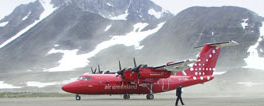
    Air Greenland jet

    Air Greenland has announces a lockout of its pilots and cabin crew due to a collapse in the negotiations of the wage dispute. This means that all Air Greenland’s flights are cancelled for the rest of the week.

    This is a huge set off in the country’s transportation system, where little or none on land transportation infrastructure exists, leaving many villages isolated. Greenland has population of roughly 56.000 people in a land area that is over 2 million square kilometers (about 840.000 square miles), giving it the status of one of the most sparsely populated country in the world.

    Air Greenland website

  • Air Greenland pilots threaten strike due to wage dispute.

    Air Greenland pilots threaten strike due to wage dispute.

    Air Greenland jet

    According to an announcement from Air Greenland a strike is in the air on Sunday, 9th of January due to wage dispute of pilots of the company.

    Negotiations of the two parties have stranded which may affect over 1000 passengers that have scheduled flight with Air Greenland. The director of Air Greenland has announced that wage increase is not an option since the company cannot endure any wage increase due to increasing competition in the market. Last year, revenue of the company reduced which is one of the reasons that the company cannot meet the demands of the Air Greenland pilots. Air Greenland is owned by the Greenlandic Home Rule, Scandinavian Airlines and the Danish state. The company owns 37 aircrafts, thereof 26 helicopters. Michael Binzer, director of Air Greenland states that the air company has made plans to take care of all emergency flights that might be affected due to the strike. A mediator has been brought into the negotiations, which have been paused and will be brought up again. It is hoped by the Air Greenland officials that the strike will not be enforced

  • Tourists encouraged boycotting Iceland due to its whaling policy.

    Tourists encouraged boycotting Iceland due to its whaling policy.

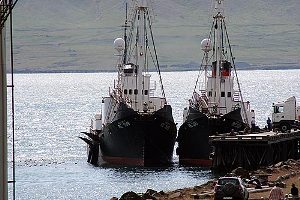
    Icelandic whaling boats

    A website has been launched where tourists are encouraged to boycott Iceland as their vacation destination due to the country’s whaling policy.

    Iceland is among other nations, such as Canada, Norway, Japan and the United States that carry out whaling. The website “rescuethewhales.org” maintains that Iceland is whaling endangered species. The misunderstanding might arrive from the hunt of fin whales in Icelandic and adjacent waters. According to the International Whaling Commission (IWC) fin whales are endangered in the Southern Hemisphere but not in the North Atlantic Ocean. Assessments of the population status in the central North Atlantic and off West Greenland have shown populations to be in a healthy state.

    The aim of the group behind the website, rescuethewhales.org is to damage Icelandic economy by appealing to the public not to visit the country and therefore try to undermine its tourism. It is stated in the website that Iceland is a small country where the economy is small and dependent on few large industries, such as tourism. Icelandic economy is similar to other small economies within the Arctic region, being dependent on natural resources and increasingly on tourism. Actions based in many occasions on emotions, as mentioned at the website, rescuethewhales.org could therefore have severe consequences to economies such as Iceland.

    Further information and resources in the Feature of the week “Anti whaling campaign against Iceland

  • A change in climate means a change in diet

    A change in climate means a change in diet

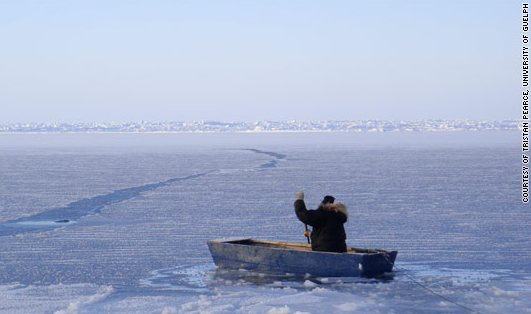
    Inuit sailing in arctic waters

    Climate change is altering people’s diet, according to Professor Barry Smit at the University Of Guelph, Canada. Professor Smit has conducted a research for the past five years on how melting ice and change in climate is affecting northern communities in Canada.

    One of his findings is a change in those communities diet. Loss of hunting grounds and changes in ice patterns are affecting the people in such way that they need to find a substitute nourishment for their diet, which usually consists of high carbon, easily transportable and storable food. Inevitable, this change in their diet has lead to some health problems, where high carbon food is not on their usual menu. A loss of identity is also mentioned as a concern where younger generations do not participate in traditional hunts. This is reported at the CNN website as an Earths Frontiers feature that was published on December 30th 2011

    Unfortunately, this problem has been known for some time where loss of traditional hunting grounds are affecting northern communities, where loss of identify and traditional nutrition is changing theirs way of life. Pollutants have also been identified as a major problem since traditional food becomes inedible due to persistent toxics in the Arctic, which has lead to change in traditional diet in northerners lives. This has for example been identified in the Arctic Human Development report, which was published in 2004.

    However there is no doubt that the Arctic is facing a major transformation, where people and animals need to adapt. Some of those changes are socio-economically positive, whilst other is not. Therefore there is a need to further identify those changes and measures need to be adopted in order to reduce the negative impact of changing climate.