Category: News & Press Releases

Arctic Portal News Portlet

  • Largest Iceberg to Break of the Greenland Glacier in 50 years

    Largest Iceberg to Break of the Greenland Glacier in 50 years

    Nares overview

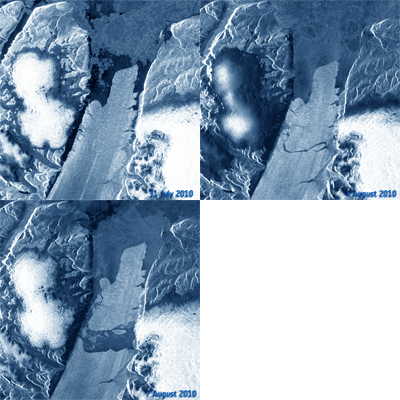
    The largest Iceberg since 1962 has broken of the Greenlandic Ice sheet. The Iceberg comes from the Petermann glacier in North-West Greenland which is one of the largest glaciers connecting the Greenland Inland ice sheet with the Arctic Ocean.

    As the glacier reaches out into the ocean a tongue of ice is formed, which moves annually about one km. The Ice tongue of the Peterman glacier was the largest one in Greenland, with an extension of about 70km into the sea until now when this massive Iceberg has broken free.
    Petermann glacier

    The ice island has a surface area of about 161 square kilometers or 100 square miles and a thickness of about a 190 meters high. These astonishing numbers can be put in perspective by saying that it’s four times larger than Manhattan and it’s height approximately half of the empire state building- the freshwater stored in the ice island could keep all U.S. public tap water flowing for 120 days.

    it can be estimated that this event was hastened by rising sea and air temperatures in the Arctic but perhaps not a direct consequence of the warming. In 1962 a 370 square kilometer iceberg broke of from the nearby Ward Hunt Ice Shelf.

    There is some fear that the Ice island may travel down into the Baffin bay area, where there is a lot it could crash against. Further more it could over a number of years reach as far as into the North Atlantic either as still rather large ice island or it could brake up into smaller parts which in both event could pose a threat to infrastructure and shipping lanes.

    [http://www.youtube.com/watch?v=5G7L6T_rYcY]

  • Gwichin ethnobotany database

    Gwichin ethnobotany database

    Gwichin Ethnobotany, plants

    The Arctic Portal has just come across a plant portal launched by the Gwichin Social and Cultural institute. In 1997 the Gwich’in Social and Cultural Institute partnered up with the Aurora Researc Institute (ARI) and commenced work with Gwich’in elders on an ethnobotany project.

    The outcome of this cooperation include the book titled Gwich’in Ethnobotany: Plants Used by the Gwich’in for Food, Medicine, Shelter and Tools” by Alestine Andre and Alan Fehr (2002) as well as a masters thesis titled Master’s thesis by Alestine Andre (2006) called, Nan t’aihnakwits’inahtsìh (The Land Gives Us Strength). Combined these two bodies of work form the basis for the Gwich’in ethnobotany database.

    The plants in the database are divided into two categories which are by their use and by their type and guidlines or recomended on how to treat the land that offers these plants which can be seen below.

    Respect for the land:

    Important message from our Gwich’in Elders teachings

    • Harvest all medicine plants away from roads and communities.
    • Take only what you need. It is important to collect only the plant parts you need, pick selectively from different areas and take care not to over harvest from one area.
    • Leave an offering for gathering special medicine plants like tamarack, juniper and white moss (reindeer lichen). You may also leave offerings for other plants as a sign of respect. Place an offering like tobacco, wooden matches, or say prayers before and while collecting plant parts. Please note to always place an offering before collecting ochre.
    • Share harvested resources such as medicine plants, meat, fish, berries with those not able to obtain these resources for themselves.
    • Harvest resources with care, love and respect.

    Gwich’in Ethnobotany: Plants Used by the Gwich’in for Food, Medicine, Shelter and Tools” by Alestine Andre and Alan Fehr (2002)

  • State of the Arctic Coast 2010 Report

    State of the Arctic Coast 2010 Report

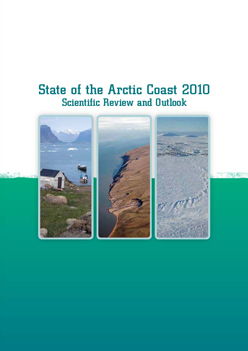
    State of the Arctic Coast cover

    The Arctic coastal interface is a sensitive and important zone of interaction between land and sea, a region that provides essential ecosystem services and supports indigenous human lifestyles; a zone of expanding infrastructure investment and growing security concerns; and an area in which climate warming is expected to trigger landscape instability, rapid responses to change, and increased hazard exposure.

    Starting with a collaborative workshop hosted by the Norwegian Institute for Air Research in October 2007, the International Arctic Science Committee (IASC), the Land-Ocean Interactions in the Coastal Zone (LOICZ) Project and the International Permafrost Association (IPA) decided to jointly initiate an assessment of the state of the Arctic coast. The goal of this report is to draw on initial findings regarding climate change and human dimensions for the Arctic as a whole provided by the ACIA and AHDR reports to develop a comprehensive picture of the status and current and anticipated changes in the most sensitive Arctic coastal areas. Adopting a social ecological system perspective the report considers the implications of change for the interaction of humans with natural coastal systems. The report is intended as a first step towards a continuously updated coastal assessment and aims to identify key issues requiring future scientific attention in an international Earth system research agenda.

    State of the Arctic Coast 2010

    The draft report is the outcome of this collaborative effort and starts with a thematic review of the state of physical and ecological systems and human communities and activities on the Arctic coast as of 2010. It than moves to a more holistic and coupled-system perspective to identify
    knowledge gaps and future research needs. Current knowledge presented and synthesized is based on published literature and other sources.

    The document was prepared by an international writing team, including 15 Lead Authors and 27 Contributing Authors. The draft report was released during the IPY Oslo Conference, 8-12 June 2010. The whole report will soon be available for a 2-month public review during August-September with the objective to publish the final version early in 2011. Instructions for submitting review comments will be posted along with the full draft report by the end of July.

    General Editor: Donald L. Forbes (dforbes@nrcan.gc.ca)

    Editorial Board: Hugues Lantuit (hugues.lantuit@awi.de) Volker Rachold (volker.rachold@iasc.info) Hartwig Kremer (hartwig.kremer@loicz.org)

    For more information and to access the report, see: http://arcticcoasts.org

    To submit comments and questions, please email: info@arcticcoasts.org

    For more information and to access the draft report, see: http://arcticcoasts.org

  • Inuit Leaders Meet in Nuuk, Greenland

    Inuit Leaders Meet in Nuuk, Greenland

    Inuit leaders from Canada, Russia, USA and Greenland

    During the 28. June to July 2. The ICC holds it’s general assembly in Nuuk, Greenland.

    Inuit Leaders from Canada, Russia, USA & Greenland come together every four years to discuss the development in the arctic and their common concerns- and the meeting now is especially focused on during the meeting:

    • Environment, including Climate Change
    • Political and economic development
    • Health and Well-being
    • Hunting and Food Security
    • Governance
    • Inuit Arctic Policy

    Climate change and many other issues that are effecting the arctic, and thereby the Inuit, need to be discussed and a common policy or guidelines formulated.

    Further information can be found on Http://www.inuit.org

    Source: Arctic Council news

  • IASSA Website moves to the Arctic Portal

    IASSA Website moves to the Arctic Portal

    Arctic Portal news

    The Arctic Portal is proud to velcome International Arctic Social Science Association (IASSA) into the Arctic portal community, as the IASSA website is now hosted and designed by the Arctic Portal.

    The website has been up and running for a while and more content will continue to be added.

    For those interested in taking a look please go to http://iassa.org/

  • Exploring Polar Science Strengthening future generations of polar researchers

    Exploring Polar Science Strengthening future generations of polar researchers

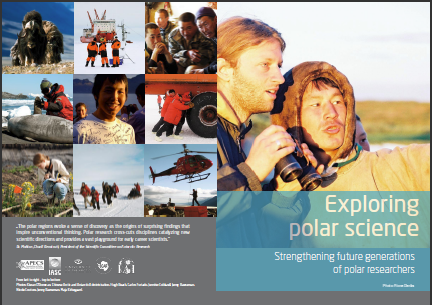
    Exploring Polar Science poster

    The Arctic Portal would like to draw your attention to the following publication, which is a cooperation between APECS, UArctic, SCAR, IAI and IASC. The cooperation is intended to assist early carrier scientists in planningthe path to the richly diverse and challenging world of polar research, and informative for all interested in the polar regions.

    An information flyer to ‘explore’ polar science is now available for students and early career scientists. The flyer is a shared initiative of the Association of Polar Early Career Scientists (APECS), the University of the Arctic (UArctic), the Scientific Committee on Antarctic Research (SCAR), the International Antarctic Institute (IAI) and IASC.

    With a simple overview it aims to inform about international opportunities to study the richly diverse and challenging world of the polar regions. It contains information on, and links to international organizations that inform and advise early career scientists on: career development, networking, funding opportunities and communication and outreach.

    The flyer offers a first step in the advancement and support of a strong future of polar researchers and can be downloaded for print here:

    Exploring Polar Science Flyer – small file size

    Exploring Polar Science Flyer – large file size

  • Scientists confirm Polar bear Hybrid

    Scientists confirm Polar bear Hybrid

    Arctic Portal news

    Scientists in the Northwest Territories have come across a polar bear and grizzly hybrid in the Arctic. The animal that was killed on April 8 in the proximity of the Holman community by inuvialuit hunter David Kuptana.

    The animal is believed to be a second generation hybrid, meaning that it’s mother was a mixture of polar bear and grizzly bear, while it’s father was a regular polar bear. Scientists state that this may be the first second- generation polar-grizzly bear hybrid to be found in the wild.

    It is estimated that these hybrids will becoming increasingly apparent due to climate-change as polar bears are more likely to come into contact with grizzly bears due to declining summer sea ice, leaving them stranded on land.

  • IPY International Early Career Researcher Symposium Report Summary

    IPY International Early Career Researcher Symposium Report Summary

    IPY International: Early Career Researcher Symposium

    A report summary from the IPY International Early Career Researcher Symposium is now available at the APECS website.

    There are many skills required of early career polar researchers that are not typically taught in graduate school or post doctoral environments, but are essential for the basis of a strong career. To help address this, the Association of Polar Early Career Scientists (APECS), together with the ArcticNet Student Association, and the Northern Research Forum held the IPY International Early Career Researcher Symposium, in Victoria, B.C, Canada from December 4-8, which was sponsored mainly by the IPY Canadian Federal Programme and the Canadian Polar Research Commission.

    The summary of the meeting includes an overview of all seven sessions and the evaluations that were made. The career development workshop was attended by 71 participants and 20 mentors from 14 different countries, and brought together early career polar researchers from a range of disciplines for a series of training sessions to develop professional skills, work with senior mentors, and develop international and interdisciplinary collaborations. The Symposium had seven themed sessions, all of which included a plenary talk attended by all symposium participants, and a hands-on training session. All plenary talks and breakout sessions were recorded, and recordings will be available on the APECS website by June.

  • Polar Law Master’s program in Akureyri Iceland

    Polar Law Master’s program in Akureyri Iceland

    Akureyri, Iceland

    The unique Polar law Master’s program at the University of Akureyri, Iceland is open for application. The deadline for the submission of applications for admission and scholarships is April 1st. for International applicants and June 5, 2010 for EU/EETA applicants.

    The Master’s program is designed both for lawyers (leading to the LL.M. degree -90 ECTS) and non-lawyers (leading to the M.A. degree -120 ECTS). There is also an option of a Diploma in Polar Law Studies at the undergraduate level (60 ECTS).

    Polar law describes the legal regimes applicable to the Arctic and Antarctica. Emphasis is placed on areas of international and domestic law concerning the Polar Regions. Issues of human rights law, environmental law, the law of the sea, the law of sustainable development and natural resources are addressed, including questions of sovereignty and boundary disputes on land and sea; the rights of Arctic Indigenous peoples; self-government and good governance; security; climate change; economies and business development; resource claims and biodiversity in the Polar Regions.

    Graduates will be able to seek work in the public and private sectors; with different levels of government (nationally and globally), with international and regional organizations; with academic institutions and non-governmental organizations; and with national and transnational corporations to promote the interests of the Polar Regions and their inhabitants. Intensive courses are taught in English by the leading international academic experts and practitioners in the field of Polar Law. There is no tuition fee.

    The University of Akureyri is located in Northern Iceland in attractive natural surroundings.

    For further information regarding the application process and courses, please visit the Polar Law website or contact Dr. Markus Meckl, Polar Law Coordinator, tel.: +354 460 8655

  • Interesting discoveries in Greenlandic gene map

    Interesting discoveries in Greenlandic gene map

    Inuit drawing

    The connection between the native Americans and North American Inuit to the Inuit living in Greenland has long puzzled the minds of researchers. Also, the migration patterns of people over the northern hemisphere have for a long time interested people.

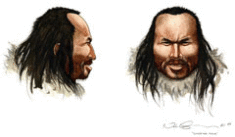
    Now it has been found out by the research team of Professor Eske Willerslev and his PhD student Morten Rasmussen, from Centre of Excellence in GeoGenetics at the Natural History Museum, University of Copenhagen, Denmark, that people preceding the Inuit living in Greenland today crossed into the New World from north-eastern Siberia between 4,400 and 6,400 years ago in a migration wave that was independent of those of Native Americans and Inuit ancestors. The discovery was made by analysing a tuft of hair that belonged to a man from the Saqqaq culture from north-western Greenland 4,000 years ago. This discovery is an achievement both in gene technology as wel as in archaelogy and can be of significant help to scientists as they seek to determine what happened to people from extinct cultures.

    For more information, please visit the news section of the University of Copenhagen