Category: News & Press Releases

Arctic Portal News Portlet

  • First ever Ph.D. dissertation in the University of Greenland

    First ever Ph.D. dissertation in the University of Greenland

    Arctic Portal news

    The first ever doctoral dissertation will take place in the University of Greenland, Ilisimatusarfik, on friday.

    Katrine Kjærdgaards’ thesis discusses biblical and religious images in Greenland since 1721 and the influence of the images on the identity and mentality of the greenlandic people.

  • Arctic COP15 Participants

    Arctic COP15 Participants

    COP15

    Already 65 world leaders have confirmed their attendance to the COP15 in Copenhagen in two weeks. What is, however, still unclear is whether the heads of states of the world’s top three carbon polluters – USA, China and India – will attend.

    The Arctic countries are well represented in the climate change conference, since in addition of being hosted by Denmark, the conference will attract JIm Prentice, the Minister of the Environment and Michael Martin, Chief Negotiator and Ambassador for Cliamte Change from Canada and Jóhanna Sigurðardóttir, Prime Minister and Svandís Svavarsdóttir, the Miniter of the Environment from Iceland. In addittion, Finland will send both the Prime Minister Matti Vanhanen and the President Tarja Halonen in association with Paula Lehtomaki, the Minister of the Environment and Jan Vapaavuori, the Minister for Housing and Nordic Cooperation.

    Sweden and Norway are yet to announce their delegation, but they are as well expected to send a high-profle delegation.

  • President Obama in COP15

    President Obama in COP15

    cop15

    en.cop15.dk – The official homepage of the COP15 announces that the President of the USA Mr. Barack Obama will visit the Conference briefly on December 9, on his way to Oslo to receive the Nobel Peace Prize.

    The announcement has been taken with conflicting feelings, some environmental organizations claimin President Obama undermining this way the very important agenda of the Conference. Others say, on the other hand, that his visit, though brief, demonstrates a shift in US climate policy and gives hope that a new binding solution for future emission reduction can be reached in Copenhagen.

  • EU in the Arctic

    EU in the Arctic

    EFS - Ericon Aurora Borealis

    Arctic has for a long time interested expeditioners and many journeys have been initiated throughout the past one and a half century. For a long time, very few expeditioners made it through the harsh conditions, but due to the climate change it has started to look like that trans-Arctic shipping is becoming a possibility both for researchers and transportation.

    Since the end of the cold war, there has been done immense amount of research in the Arctic and the Arctic Council has been created arounf the environmental sphere of the area. In recent years, the political situation also has again become an issue and quite a few new Arctic policies have been initiated both by Arctic and non-Arctic states.

    The European Union physical connection to the Arctic is through northern Finland and Northern Sweden, but politically it cooperates with various Arctic countries through the EEA or as a neighbour and business associate.

    Both the EU Commission and the Parliament have recently initiated an Arctic communication, where they aim at preventing and mitigating the negative impacts of climate change as well as supporting adaptation to inevitable changes. Further the commision will commit to implement already existing obligations, rather than propose new legal instruments for the area.

    Here following, the EU‘s role and activities in the Arctic will be discussed and links provided to the relevant sections in the EU web portal.

    Historical perspective to the European Union in the Arctic

    Northern Dimension

    The first real EU policy initiative in the peripheral north was the Northern Dimension, which is a cooperation program of European Union, the Russian Federation, Norway and Iceland to support sustainable development, stability, welfare and security in the northern parts of Europe. It was initiated in 1999 and covers various subjects, such as energy, transportation, the environment, nuclear safety, justice and home affairs, the fight against organised crime, health care, the promotion of trade and investment, cross-border cooperation, information technology and research. In addition to the EU and state partners the Council of the Baltic Sea States (CBSS), the Barents Euro-Arctic Council (BEAC), the Arctic Council (AC), the Nordic Council of Ministers (NCM) and various international financial institutions, such as the European Bank for Reconstruction and Development (EBRD), the European Investment Bank (EIB) and the Nordic Investment Bank (NIB) and NGOs, trade unions etc. participate as observers.

    The Northern Dimension ran from 1999 til 2006 until a new Northern Dimension policy was launched jointly by the leaders of the EU, Russia, Norway and Iceland at a meeting in Helsinki in November 2006. The new Northern Dimension provides a joint framework for addressing the challenges of Northern Europe, especially its fragile environment and the socio-economic problems facing its inhabitants. It will further reflect the EU/Russia Common Spaces as relevant for this region.

    ERICON AURORA BOREALIS (European Research Ice Breaker Consortium)

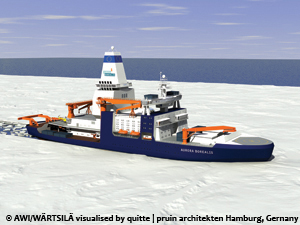
    Another EU initiative in the polar regions is the ERICON AURORA BOREALIS ice breaker initiative, which is a hypermodern research vessel designed to handle the cool summers and freezing winters of the polar oceans and to drill deep into the sea floor.

    The AURORA BOREALIS will be the most advanced research vessel in the world; a platform with state-of-the-art technology for polar science. With its all-season capability it will provide a tool for tackling major scientific challenges, which has not been possible before. It will be a real floating European university in polar sciences.

    The project was initiated in Alfred Wegener Institute for Marine and Polar Research (AWI) in the Helmholtz Association, Germany in 2004. Funded by the German government, it detailed the engineering work for the vessel’s construction and resulted in a complete technical design in mid-2009.

    The project started a new phase in March 2008s, when the ship’s development generating the strategic, legal, financial and organisational frameworks for the construction and running of AURORA BOREALIS was initiated. Apart from the necessary administrative structures for joint European ownership and operations of the vessel, a common scientific managing body has to be set up to handle large-scale, multi-year, mission specific research programmes. The final aim of the project is to reach an agreement with European countries and European Commission committing to the construction and operation of the vessel.


    Contemporary Developments

    Policy Issues in Arctic relevant sectors


    Scientific Issues
    European Science Foundation


    European Polar Board


    • EPB – news
    • European Polar Summit
    • Polar Alert
    • EuroPICS
    • EuroANDRILL
    • EPB Publications
  • Northeast Passage Open for a Cargo Ships

    Northeast Passage Open for a Cargo Ships

    German Vessel Beluga Fraternity

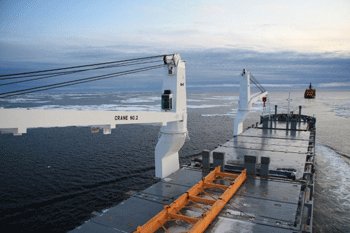
    Two German multipurpose heavy-lift vessels, Beluga Fraternity and Beluga Foresight, has managed to complete the first transit of the Northeast Passage by non-Russian commercial vessels.

    The carco vessels were assested by a nuclear-powered Russian Atomflot ice breaker “50 let Pobedy” through the East Siberian Sea and the Sannikov Strait into the Laptev Sea from were the vessels reached their Siberian destination of Novyy Port on Monday.

    The Northeast passage is ice-free only few weeks each summer and thus still unlikely that regular commercial shippin can take place in near future. The possibility of future shipping is, however, worth noticing since the Arctic Northeast passage will shorten the route between Asia and Europe approximately 5000km.

  • International Arctic Security Conference

    International Arctic Security Conference

    Military ships

    According to the AFP News, an International Arctic Security Conference is been held in Anadyr, Chukotka, Russia. The main focus of the conference is on emergency situation management and prevention, nuclear accidents and rescue operations in the Arctic region.

    Six out of the eight Arctic countries take part in the conference, including the US and Canada.

    In the past year, military activities in the Arctic have been increasing again for the first time after the cold war and for example has Canada alone conducted its largest ever military exercises in the region this year.

    The unsolved sovereignty over the Arctic continental shelf can be considered one of the main reasons for the military presence in the area. It is estimated that within the Arctic continental shelf can be found an extensive amount of oil ang gas and as long as the UN Continental Shelf Committee has not given its final decision on the national limits of the continental shelf, the military presence can be expected to continue.

    According to the Illulissat declaration from May 2008, the Arctic countries – apart from Finland, Iceland and Sweden – decided to solve any upcoming conflict in the Arctic in peaceful manner. The Anadyr Arctic Security Conference can thus be considered as a part of a joint governance effort over the Arctic region.

  • Finnish Forestry Administration and Nellim Sámi Reindeer Herders settle herding land disagreement

    Finnish Forestry Administration and Nellim Sámi Reindeer Herders settle herding land disagreement

    Stora Enso

    Metsähallitus (state-owned Forest Administration enterprise) and three Sámi reindeer herders from Nellim in Finnish Lapland have settled their disagreement, formerly under review of  Lappi District Court and Rovaniemi Court of Appeal as well as the United Nations Human Rights Committee.

    The newly initiated agreement ends Metsähallitus’s forestry operations for the next 20 years in specified state-owned lands and terminates all lawsuits between the parties.

    The agreement applies to standard forestry operations. Metsähallitus refrains from logging in forests where no previous forestry operations have been carried out. Cutting of timber and land use referred to in the Skolt Sámi Act is not restricted, nor activities such as fishing, hunting or off-road traffic.

    According to the Matsähallitus homepage both parties are very pleased with the agreement. It will preserve significant areas in Nellim for herding only, but guarantees for Metsähallitus continued forestry operations in other areas clearly specified in the agreement.

  • New IPY website

    New IPY website

    International Polar Year - IPY

    International Polar Year (IPY) has launched a new website in association with the Arctic Portal. The IPY is a huge exciting scientific campaign focusing on the Polar Regions. It is also an unprecedented opportunity to demonstrate, follow, and get involved with, cutting edge science in real-time.

    The IPY is a collaborative, international effort researching the Polar Regions. The polar areas have many unique phenomena. Circulatory systems for air and water reach the surface, as do the majority of the Earth’s magnetic field lines. Thick glaciers have trapped air and water from ancient times. It is easiest to observe these phenomena near the poles.

    Unfortunately, the poles are expensive places to visit, because they are distant, cold and deserted; infrastructure is sparse and the terrain is rough in polar regions (often consisting of ice blocks with crevasses between them). International cooperative programs share the costs and maximize the number of coordinated scientific observations. The IPY is the most famous example of such a cooperative program.

    On the IPY website it is possible to follow various IPY projects through blogs from the projects. In the news section it is also possible to read news from various projects within the IPY. There is also a comprehensive list of links and other resources regarding IPY issues.

    Visit the IPY website

  • Arctic Council Indigenous Peoples Secretariat  – International Work Opportunity

    Arctic Council Indigenous Peoples Secretariat – International Work Opportunity

    Arctic Portal news

    International Work Opportunity, Copenhagen, Denmark

    The Arctic Council Indigenous Peoples Secretariat is looking for an Executive Secretary. The position requires an understanding of issues concerning Arctic Indigenous Peoples, the Environment, and Sustainable Development.

    Read more about the job at: www.arcticpeoples.org

    About the Arctic Council Indigenous Peoples’ Secretariat

    The Arctic Council Indigenous Peoples’ Secretariat is a support Secretariat for the International Indigenous Peoples’ Organisations that are Permanent Participants to the Arctic Council .

    IPS does not speak for the Permanent Participants. Instead, it creates opportunities for the Indigenous Peoples’ Organisations to speak for themselves, and helps provide them with necessary information and materials.

    IPS work includes:

    • Ensuring that Permanent Participants are sent documents and reports connected to the work of the Arctic Council and its working groups.
    • Helping Permanent Participants to present their views to the Arctic Council and its Working Groups.
    • Collecting and communicating information about the Arctic Council and its results to the Indigenous Peoples in the various parts of the Arctic.
    • Providing co-ordination for the Indigenous Peoples’ Organisations to meet with each other, and to participate in the Arctic Council Working Groups.
  • New CliC Newsletter – Ice and Climate News

    New CliC Newsletter – Ice and Climate News

    Climate and Cryosphere - CliC

    The new edition of the the Climate and Cryosphere (CliC) Newsletter is available for download here. This June issue consists of contributions on the Carbon and Permafrost (CAPER) Initiative, integration across cryospheric disciplines, workshop reports and project updates.

    CliC was initiated by the World Climate Research Programme ( WCRP ) in 2000. Its goal is to stimulate, support, and coordinate research that focuses on processes by which the cryosphere interacts with the rest of the climate system.

    The contents of the CliC newsletter are

    • Integration across cryosphere disciplines
    • New CliC SSG members
    • Norway/China collaborations
    • Brazil update
    • Water resources and cryosphere in mountains and N. Canada
    • CliC-related IPY activities in Russia
    • Progress in Chinese cryospheric research
    • The carbon permafrost initiative
    • Asia-CliC data workshop
    • Arctic surface-based sea-ice observations
    • IGOS partnership cryosphere theme: where are we now?
    • International NRB symposium and workshop
    • Early career scientists on polar marine research
    • SWIPA update: lake and river ice

    The CliC Newsletter – Ice and Climate News