Category: News & Press Releases

Arctic Portal News Portlet

  • PAGE21 field season continues

    PAGE21 field season continues

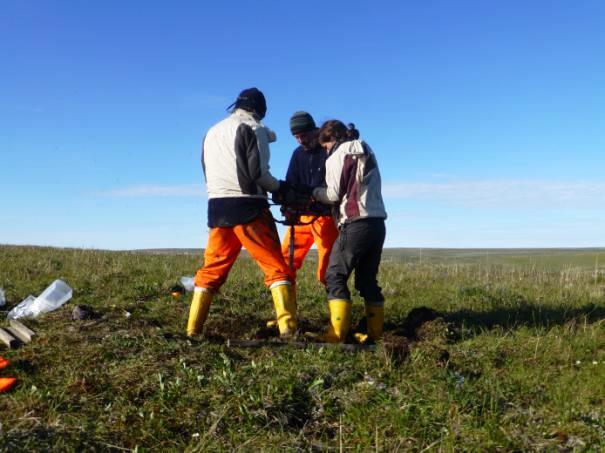
    The coring team working to get the core barrel out of the ground in Herschel Island

    PAGE21 young researchers have continued their season of permafrost investigation in remote areas, located in the northern hemisphere.

    Teams of scientists took off to Kytalyk and Herschel Island in the end of June. Researchers will come back to their home institutions at the beginning of September.

    While collecting data on permafrost temperature, CO2 and CH4 fluxes, delegates from all the research stations, explain the particularity of the research done at each site. What is more they describe adventures, dangers and exciting daily life in remote tundra locations.

    PAGE21 Blogs are available for the public and can be accessed here.

    PAGE21 project aims to understand and quantify the vulnerability of permafrost environments to a changing global climate, and to investigate the feedback mechanisms associated with increasing greenhouse gas emissions from permafrost zones.

    This research will make use of a unique set of Arctic permafrost investigations performed at stations that span the full range of Arctic bioclimatic zones.

    The project will bring together the best European permafrost researchers and eminent scientists from Canada, Russia, the USA, and Japan.

    Page21 on Facebook

    Page21 on Twitter

    Sources

    PAGE21

    PAGE21 Blogs

  • Internet for the Arctic might be available

    Internet for the Arctic might be available

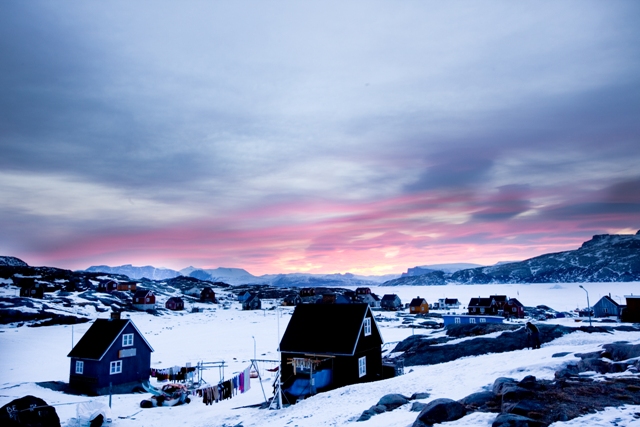
    Uummannaq-village in Greenland

    Norwegian Space Center stated last week that there might be a possibility to provide the high speed internet to the one of last places on Earth where it is still not available: the Arctic.

    Norwegian Space Center has teamed up with Telenor Satellite Broadcasting to assess the feasibility of a new satellite system covering northern areas outside the reach of current geostationary communications satellites.

    The appointed team was measuring the feasibility and cost of establishing broadband internet cover in the Arctic.

    The research shows that the cost of the activity might reach 4 billion NOK.

    The Arctic is one of the last places on Earth remaining without the high – speed internet. The reason for that is the location of satellites. Because they are set up close to equator, the signal does not have a chance to reach further than 70°N.

    Although the demand is not big it will grow, together with melting ice and growing potential for commerce and scientific research.

    Source

    NewsInEnglish.no

  • Elections for APECS Executive Committee

    Elections for APECS Executive Committee

    APECS

    Association of Early Career Scientists (APECS) encourages their members to apply for next elections to APECS Executive Committee that will be held in September 2013.

    APECS is now an internationally respected association and is recognized as one of the major legacies of the 4th International Polar Year.

    APECS members, particularly those of our past APECS Executive Committees and Councils have largely contributed to this through their excellent and hard work. To maintain this high level of success, and bring new vision and ideas to APECS, it is truly important for potential participants to be active in this election.

    To read more about the function of APECS Executive Committee, please access the organization´s website.

    Application deadline is 8th of September. All applications should be sent directly to Allan Pope allen.pope@nsidc.org

    For more information on how to apply, please visit APECS website.

    Source

    IceNews

  • Greenland´s ice cap melt rapid spread

    Greenland´s ice cap melt rapid spread

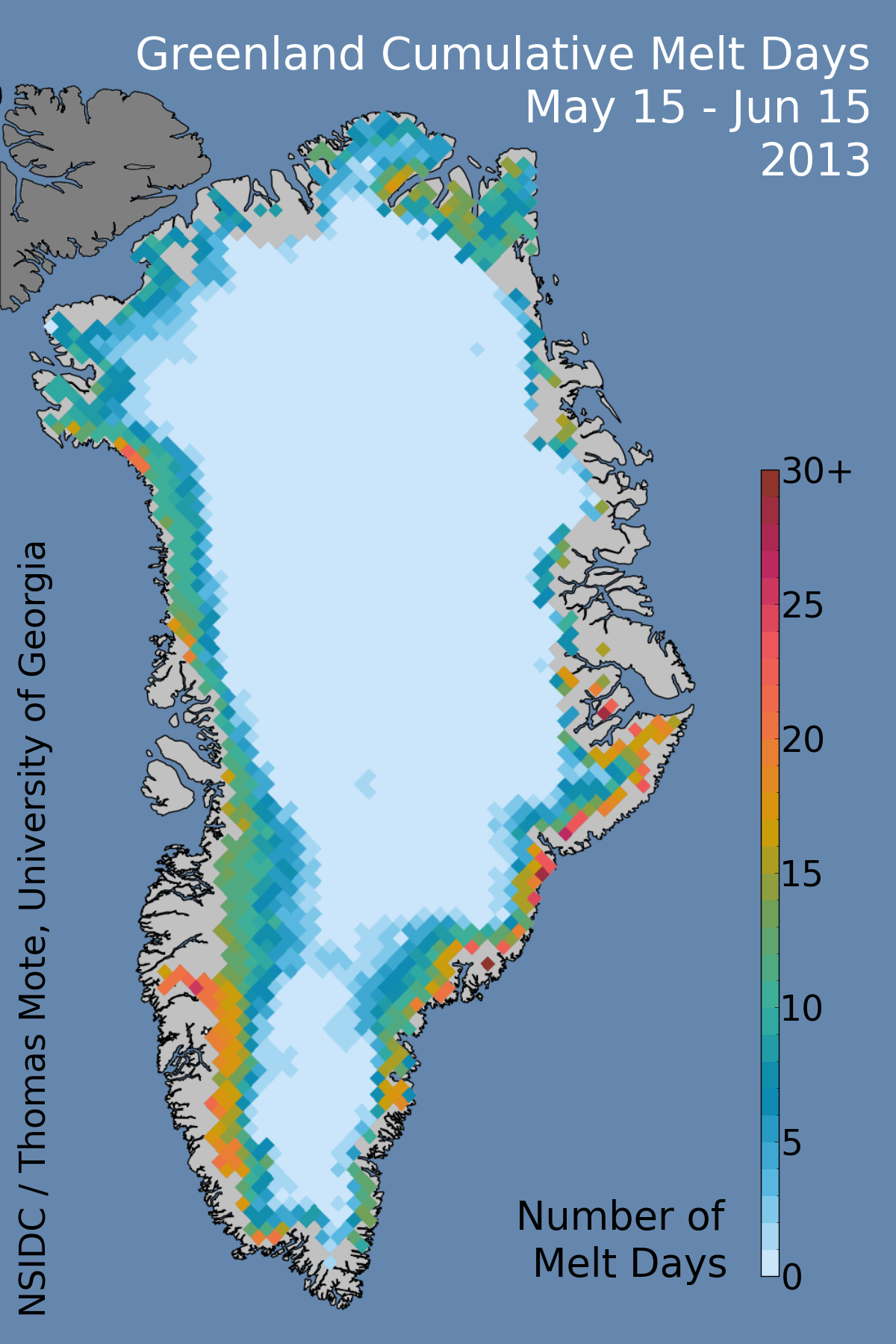
    Cumulative surface melt days for mid-May to mid-June in Greenland.

    Summer melt on Greenland ice sheet had slightly late start this summer but the surface has been now melting very quickly.

    In the last three months the melt has been spreading rapidly over the significant area, extending over more than 20% of the ice sheet in early June and reaching above 2000 meters elevation in some areas.

    The satellite used for the research reported small lakes that started to form on the ice sheet.

    After the annual re-calibration of the melt algorithm in mid March, very little melt was detected until May.

    A few southern coastal areas began melting in mid-May, followed by inland higher-elevation ice and all remaining coastal areas about June 3, when warmer conditions arrived.

    Surface melting reached the “Saddle” region of the ice sheet on June 11 and 13. Only the central eastern coast remains relatively melt free.

    Cool conditions in April and May shifted to warmer-than-average weather along both coasts in early June, which initiated more widespread melt on the ice sheet.

    The sea ice on both sides of Greenland remained at near-normal extent through the period.

    More information about this year´s melt of Greenlandic ice sheet is available at National Snow and Ice Data Center, University of Georgia.

    Source

    National Snow and Ice Data Center

  • New Secretary General for Norden

    New Secretary General for Norden

    Britt Bohlin, new Secretary General of the Nordic Council.

    Britt Bohlin, Governor of Jämtland, Sweden, will be the new Secretary General of the Nordic Council from the beginning of the new year. She will thus become the Council´s highest ranking official, working at the Secretariat in Copenhagen.

    As Secretary General of the Nordic Council, Britt Bohlin will help to put current and future issues on the Nordic parliamentary agenda. She will be the head of the staff at the Secretariat in Copenhagen and the expectation from the Nordic Council’s current President, Marit Nybakk, is that she will be very effective in her relationship with the Nordic governments’ co-operation in the Nordic Council of Ministers.

    “I expect that Britt Bohlin will lead the Nordic Council into a new era”, says Marit Nybakk and adds that she is confident that Britt Bohlin is the right person for the job.

    Before being appointed Governor of Jämtland County in 2008, Britt Bohlin was a Social Democrat MP for 20 years, first as defense and security politician, and then as the Social Democrat parliamentary group spokesperson for eight years. With a background in health care, she also has many years’ experience as a trade union leader in the Municipal Workers’ Union.

    “Britt Bohlin has a solid political background and has shown leadership with impressive results”, says Marit Nybakk, who was the one who banged the gavel on the table when the Nordic Council Presidium’s took the decision on the new Secretary General at the end of its recent meeting.

    As Governor in Jämtland Britt Bohlin has been deeply involved in the border issues between Norway and Sweden, and she claims to have experienced co-operation between the two countries as good and intense.

    “So I will now have the awe-inspiring and exciting opportunity to work with all the Nordic countries and with the parliaments who have been developing and strengthening our part of the world. I am honored, happy and humbled by the task”, says Britt Bohlin.

    Source

    NORDEN

  • Fascinating book now in English

    Fascinating book now in English

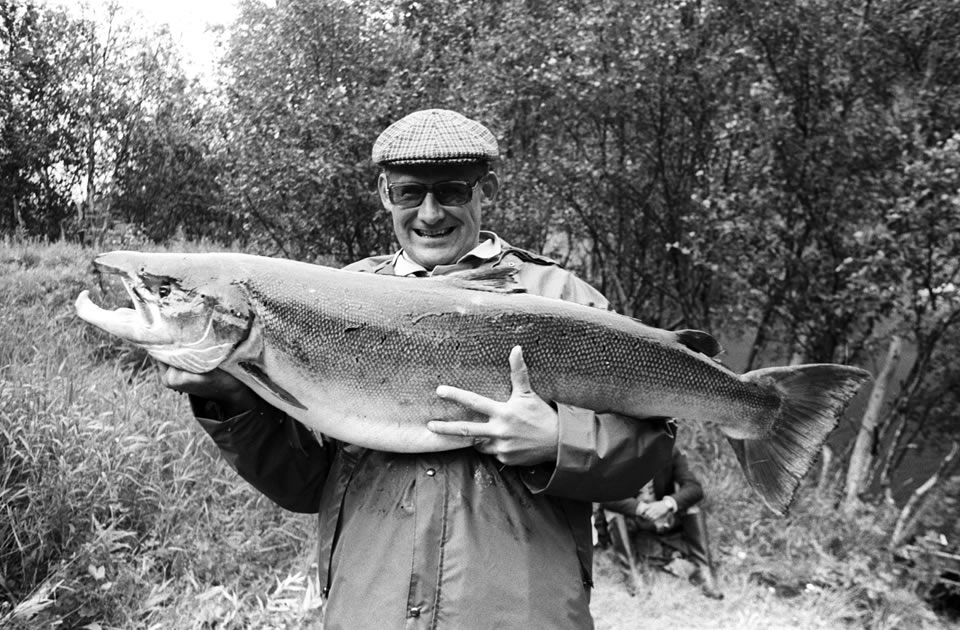
    Jan Ekman in Alta

    “Few of us anglers will ever get to fish the storied Alta, but this charming report helps fill that void. Seven Nights on the Alta is truly a story of love – of man and rivers, of the noble Atlantic salmon, and ultimately of untrammeled nature. I promise, once you begin you will read it through, and think again about saving the salmon, and all those other rivers that enhance our lives.”

    Paul Volcker

    There are many classic Atlantic salmon rivers each with its own unique history, but there is only one that can said to be ‘first among equals’ — the Alta River in northern Norway.

    The Alta’s primeval gorge setting, legendary monster salmon and exclusive status have given it has an almost mythical reputation around the world.

    Fishing the Alta is the stuff of dreams.This dream certainly came true for Jan Ekman in 1983 as described in his wonderful fishing diary book called Seven Nights on the Alta. Written in Swedish however, this book — like the Alta — has been out of the reach of most anglers — until now! At last an English version has been published.

    Jan was prompted to write the book due to what he believed was the imminent destruction of the river as a result of a hydro power project. It is based around a diary of seven nights of fishing the river in July 1983.

    This new English edition is richly illustrated by Jan’s own photographs and the book has a wonderful feel of ‘time gone past’. That said, many of the issues are still being debated, or have been replaced by even more pressing ones.

    Thankfully the doomsday prophesies in the book have been averted; as a matter of fact, the Alta has had some of its best years ever recently. That’s not to say that we can relax.

    It is only over the past few years that we have seen any form of improvement in stocks and the survival of the Atlantic salmon as a species is far from guaranteed. There is a lot of work still to be done, and for that reason I’m delighted and grateful that 100% of the proceeds from the sale of the book will go towards supporting NASF’s work throughout the North Atlantic.

    For more information on how to order a book, please read the publisher´s brochure.

    Source

    Seven Night on the Alta

  • Sámi Customary Rights conference

    Sámi Customary Rights conference

    Polar bear in the Arctic

    The conference Sámi Customary Rights in Modern Landscapes – Indigenous People and Nature Conservation will be held in Luleå, Sweden, 28-29 August 2013, with an optional excursion and workshop in Jokkmokk on the 30th of August.

    The conference aims to explore how culturally defined values, ideologies and policies have formed, and continue to form, the basis of Indigenous rights and management models of nature conservation areas in Sápmi.

    Comparisons with, or cases of, the situations of other Indigenous Peoples are welcome. The conference seeks to bring together different disciplines such as history, political science, law, cultural geography, sociology and anthropology.The purpose is to combine different scientific disciplines such a history, political sciences and law. Some specific issues include:

    • How the cultural imagination of nature and landscape among different Indigenous groups has influenced the establishment of nature conservation areas and the design of governance models for natural resources.
    • How the contemporary governance of protected areas has been influenced by the principles of equality and positive discrimination, affecting the possibilities to establish adaptive co-management arrangements of specific areas.
    • How the legal situation of the Sámi and other Indigenous Peoples has been recognized, especially concerning longstanding customary territorial rights.

    For more information see the conference website.

    Source

    Sámi Customary Rights in Modern Landscape

  • Polar Code seen in place by 2016

    Polar Code seen in place by 2016

    sailing in arctic waters

    International Maritime Organization announced that the Arctic shipping code will be released and in use before 2016.

    Arctic shipping code, regulating navigation in the high Arctic, where maritime traffic is expected to increase as the ice cap recedes, is due to be implemented in 2016 as confirmed by International Maritime Organization (IMO).

    Shipping along the Arctic northern sea route is set to grow more than 30 – fold over the next eight years and could account for a quarter of the cargo traffic between Europe and Asia by 2030.

    It is predicted for the code to be operational in 2015 and to be fully implemented in 2016. The code aims to ensure safe navigation in fragile ecological environment, where infrastructure is few and help in case of an accident is far away.

    The new code will govern all technical requirements covering design and operations. It will ensure the competence of seafarers.

    By implementing the international polar code, IMO makes sure that vessels will not be allowed to navigate in the Arctic waters unless seafarers on board are well trained.

    Opening of the Arctic waters caused by the global warming will increase the usage of high northern passages. Read more about the future of the Arctic shipping on Shipping Portlet – comprehensive gateway to Arctic shipping information on the internet.

    Source

    International Maritime Organization

  • Protecting the sacred in the Arctic

    Protecting the sacred in the Arctic

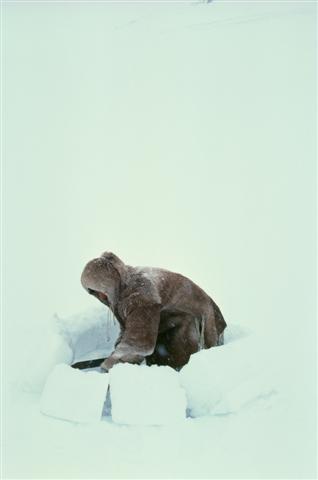
    Indigenous lifestyle

    Conference recognition of Sacred Sites of Indigenous Peoples for Sustaining Nature and Culture in Northern and Arctic Regions, will take place 11 – 13 September 2013 in Rovaniemi and Pyhä, Finland.

    The conference brings together scientists, sacred natural sites custodians, Indigenous Peoples’ Organizations, policy makers, conservation and civil society leaders, to evaluate options for international and national law, policy and practice in order to better recognize, safeguard, conserve and manage Sacred Natural Sites (SNS) of Indigenous Peoples in Northern and Arctic regions.

    SNS are being increasingly recognized as an important means for the conservation of biological and cultural diversity, and the transmission of culture and identity.

    Yet, legal protection of SNS and related policies are still often insufficient or absent. It becomes increasingly difficult for custodians in the North to protect these ancient sites, due to economic developments (tourism, mining, forestry) and infrastructural development (roads, dams, mega projects).

    At the same time the need for protection may be challenged by some protection measures (identifying of location, mapping) and may raise the question of keeping intimacy and sensitivity of these places.

    At international level, SNS have been receiving increasing legal attention; they are now mentioned in several international legal instruments (e.g., CBD, UNDRIP). Yet, effective and culturally appropriate implementation is often still lacking.

    The Conference is co-organized by the Arctic Centre (University of Lapland), University of Montreal and the University of the Arctic Thematic Network on Arctic Law.

    In order to attend the conference, please complete and submit the registration form by 8th of August. Click here for more information about the event.

    Source

    Arctic Centre

  • New laws for the Russian Arctic

    New laws for the Russian Arctic

    Arctic Territory, including Russian Arctic - Map Arctic Portal

    A new Russian law is about to deprive significant areas in the northern part of the country their Arctic status. New rules of demarcation are being introduced for the region.

    The Russian Law on Arctic Territories is expected to considerably shrink the extension of Russian Arctic land territories and lay down new rules both for the ones living and working in the area.

    According to a draft version of the legislative document, the Komi Republic will be among the areas, which are to be redefined, Rossiiskaya Gazeta reports.

    Also parts of Murmansk and Arkhangelsk Oblasts might be affected. According to Murmansk Senator Igor Chernishenko, only the areas which have direct access to the Arctic coast will be defined as Arctic in the new legislation.

    The draft legislation proposes number of rules for infrastructure development in the region that will be defined as Russian Arctic. Development will include aviation transportation infrastructure that will become state´s priority. Privatization of aviation sector that serves the Russian Arctic will be forbidden by new law.

    The adoption of the new Arctic Law will subsequently be followed up with the elaboration of an Arctic Development Programme, which is to outline priorities as well as propose the necessary financial instruments.

    The Russian government has earlier confirmed that the new law will be adopted in the course of 2013. The Ministry of Regional Development is leading the process.

    As previously reported, the ministry in a tender announcement last year offered bidding consultancy companies five million RUB for the first drafting of the legislative document.

    Source: Barents Observer