Category: YAR & Features

Young Arctic Researchers & Features

  • Stefansson Arctic Institute
    Stefansson Arctic Institute

    Stefansson Arctic Institute

    Stefansson Arctic Institute logo

    The Stefansson Arctic Institute (SAI) was established in 1998 and operates under the auspices of the Icelandic Ministry for the Environment. Recently, the Institute celebrated its ten year anniversary. Among guests and speakers at the celebration were Ms. Þórunn Sveinbjarnardóttir, Minister for the Environment and Ms. Sigrún Björk Jakobsdóttir, Mayor of Akureyri.

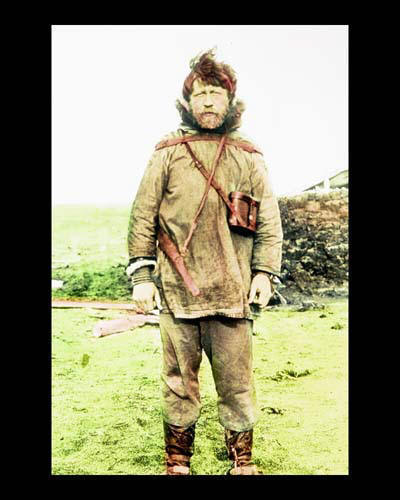
    The Institute bears the name of explorer and anthropologist Vilhjálmur Stefansson (1879-1962). He was born in Canada and both his parents were Icelandic immigrants. Vilhjálmur studied anthropology at Harvard and then explored the Arctic from 1906 to 1918. When he returned he lived in the USA, giving lectures, writing and teaching.

    Vilhjálmur Stefánsson
    Vilhjálmur Stefánsson

    Stefansson undertook his first expeditions when he was a student of anthropology at Harvard University. These were journeys to Iceland in 1904 and 1905 for the purpose of obtaining human bones for research in anthropological anatomy. Vilhjálmur Stefansson was best known, however, for his extensive scientific expeditions into the unexplored regions of northern Canada.

    Stefansson’s expeditions constitute impressive achievements, in the fields of both exploration and research, and include numerous elements of the societies and natural environment of the North. Vilhjálmur spent a total of ten winters and seven summers travelling through the northern regions. With his companions, he travelled on foot and by dog sledge, covering a distance of approximately 32,000 kilometers, often in extreme conditions.

    Stefansson wrote over 20 books as well as nearly 400 articles and essays on most subjects in the sphere of Arctic studies. One of Vilhjálmur Stefansson’s best-known books is The Friendly Arctic, and he foresaw that the book’s title presented a challenge to many of his contemporaries who did not share his positive approach to Arctic regions and their inhabitants. Stefansson undertook three arctic expeditions, which included discoveries of new land and the edge of the continental shelf. His journeys and successes are among the marvels of polar exploration.

    Expeditions:

    1906-1907 Anglo-American Expedition explored Mackenzie Delta area of Arctic Canada
    1908-1912 Stefansson-Anderson Arctic Expedition: explored Arctic Canada
    1913-1918 Canadian Arctic Expedition: explored Arctic Canada and discovered Brock, Borden, Meighen and Lougheed Islands

    The legacy of the explorer and anthropologist Vilhjálmur Stefansson is closely connected with human-environmental relations, the sustainable use of natural resources, and the survival and viability of northern communities. Perhaps his legacy is of primary importance because he has, more than anyone else, contributed to a change in the image of the North, from a barren eternally frozen wasteland into a rich region of diverse character that deserves the attention of the international community. We live in changing times and the current focus of awareness has certainly been shifted north. This has been a rapid development, transferring the Arctic regions to a central position with regard to the issues of environmental and climate change, international co-operation and resource governance and use.


    Stefansson Arctic Institute

    The Stefansson Arctic Institute is located in Akureyri in Northern Iceland. The staff at the Stefansson Arctic Institute includes scientists with broad interdisciplinary research background and experience. SAI has enjoyed and further welcomes visits by scholars, to work on and present their research. The role of the Institute is to:

    • promote sustainable development in the circumpolar north and strengthen Icelandic participation in this endeavor,
    • facilitate and co-ordinate arctic research in Iceland,
    • be a forum of co-operation with regards to multidisciplinary research and international events and projects,
    • collect and disseminate research material and information on circumpolar issues,
    • provide facilities for scholars pursuing research relevant to SAI’s agenda,
    • advise the government on northern issues.

    Stefansson Arctic Institute Current Projects

    Arctic Human Development Report

    The Arctic Human Development Report was published in November 2004. The report was prepared under the auspices of the Arctic Council and is an overview and assessment of human conditions in the circumpolar region. The secretariat of the project was at the Stefansson Arctic Institute.

    The Friendly Arctic: A Travelling Exhibition

    The exhibition focuses on Vilhjálmur Stefansson’s life, legacy and vision for the Arctic, featuring a selection of his photographs, recordings, publications, diaries, maps and other items. The exhibit opened in Akureyri Art Museum in November 2000 and has after that visited Reykjavík, Gimli, Winnipeg, Iqaluit in Nunavut, Norwich in Vermont, New York and in Bryggen, Copenhagen. To view a web version of the exhibition, please click here.

    Human Dimensions of Arctic Environments

    This web-based information project is concerned with arctic cultures and environments, with a broad comparative focus on critical issues, problems and opportunities which face the peoples of the Circumpolar North today. Launched by SAI in 2000 with funding from the European Commission, the project involves co-operation with the Arctic Centre in Rovaniemi, Scott Polar Research Institute in Cambridge, the Institute for Arctic Studies at Dartmouth College, University of Iceland Institute of Anthropology and University of Akureyri. The name of the project is The Arctic Is. To view the projects website, please click here.


    International Collaboration

    University of the Arctic

    Designed to meet the needs of northern peoples as they face the challenges of a rapidly globalizing world, the University of the Arctic has begun to make important contributions to higher educational in the emerging circumpolar region. The Stefansson Arctic Institute has a representative in the Council of the University of the Arctic, participates in developing the University’s Bachelor of Circumpolar Studies Program, and contributes to the delivery of UArctic courses at the University of Akureyri. The UArctic webpage.

    Northern Research Forum (NRF)

    The NRF provides a platform for effective, policy-relevant discussion and the sharing of research on northern issues. Open meetings are held biennially with the participation of a wide variety of scientists, policy makers and representatives of other stake-holders. The first NRF was held in Akureyri in November 2000, the second in Veliky Novgorod, NW Russia in 2002, and the third in Yellowknife and Rae Edzo, the Northwest Territories, Canada in 2004. The fourth Open Meeting was held in Oulu, Tornio, Haparanda and Luleå in Sweden and Finland in 2006. The 5th NRF was held in Anchorage, Alaska, in September 2008. The secretariat for the NRF is operated jointly by the Stefansson Arctic Institute and the University of Akureyri. Northern Research Forum Website.

    North Atlantic Biocultural Organization (NABO)

    SAI is the one of NABO’s coordination offices. NABO is a non-governmental regional research co-operative with over 450 members in 14 countries. NABO includes 28 major northern research centers in North America, and northern Europe. NABO webpage.

    The International Arctic Social Sciences Association (IASSA)

    IASSA is governed by an elected eight-member Council and a General Assembly consisting of all members having paid their membership. There is a General Assembly every three years held during the International Congress of Arctic Social Sciences (ICASS) organized by IASSA. Between the General Assemblies IASSA is run by a Secretariat. The Secretariat is located at the Stefansson Arctic Institute.

    Other international initiatives and circumpolar networks in which SAI participates include the International Arctic Science Committee Regional Board, the Nordic Polar Group, and International Conference on Arctic Research Planning.


    Location of the Stefansson Arctic Institute

    The Stefansson Arctic Institute is located in Akureyri, Iceland’s Capital of the North, which is a growing centre of arctic activities and events. Two of Arctic Council’s secretariats are located in Akureyri – CAFF (Conservation of Arctic Flora and Fauna) and PAME (Protection of the Arctic Marine Environments). The Northern Research Forum secretariat is located in Akureyri and the International Arctic Social Sciences Association (IASSA) was recently moved to Akureyri. In addition, Studies in Polar Law for M.A. and LL.M. were launched in the autumn of 2008 at the University of Akureyri. The town of Akureyri, of 17000 people, is gaining reputation for hosting arctic related workshops, conferences and other events. The Arctic Portal Project is also based in Akureyri.

  • Conference organized jointly by the French presidency of the council of the European union and the principality of Monaco, 9-10 November 2008

    The conference will take place in two phases: One session devoted to discussions between experts which will itself be broken down into two parts: an inventory of environmental research in the Arctic; a focus on existing research tools and current thoughts/discussions on the creation of a network of observation stations in the Arctic; A ministerial session organized around two round tables in which ministers will participate and where recommendations by experts will be debated.

    Background

    The Arctic is the area in the world where the effects of climate change on the environment are most evident, should they deal with the physical environment, the populations or biodiversity. The Arctic basin also houses part of the different types of pollution emitted into the northern hemisphere. It is therefore a privileged field for observing the evolution of pollution with time as well as their effects on polar environment. Monitoring the effects of climate change upon our environment in the long run requires the pursuit of the significant effort made by countries active in scientific research in the Arctic, and their operators. The European Union has undertaken various ambitious programmes in the Arctic (including the DAMOCLES programme). The International Polar Year (2007- 2009) provides an opportunity to increase research efforts: over two thousand projects bringing together thousands of scientists from around 60 countries have been launched. Such efforts are based on observatories which, however, present some weaknesses (heterogeneity, very variable meshing according to the different regions and heterogenic standards). In order to lessen these weaknesses, it is highly desirable to strengthen cooperation between the scientific teams involved and better ensure the quality of measures and the circulation of data. An impulse has already been given to the creation of a network of stations to observe the Arctic, both within the framework of the Arctic Council ?(the SAON group, Sustaining Arctic Observation Networks, which will present its conclusions in April 2009) and within the European framework by way of the European Polar Board. In order for this dynamic to continue beyond the International Polar Year, France, whose polar institute (IPE V) coordinates around 20 research programmes in the Arctic, decided to organize an international conference on the Arctic in the framework of its presidency of the Council of the EU and following the conclusions of the Grenelle environment forum. The Principality of Monaco, which has long had an interest in polar issues, inspired a decision adopted by the Board of Directors of UNEP (United Nations Environment Programme), held in Monaco in February 2008, calling on States ‘to support and strengthen networks to observe the Arctic over coming years’. The Principality offered to organize jointly with France this international conference which will take place in Monaco on 9 and 10 November this year.

    Format of the Conference

    The conference will take the form of a ministerial meeting. Over one and a half days, on 9 and 10 November 2008, it will bring together experts belonging to the international scientific community and governments interested and secondly the ministers involved in Arctic issues. The Conference will bring together around 230 people and is directed at: Representatives of the governments of the 27 EU member states, Norway, Iceland, Principality of Monaco and the home rule authorities of Greenland; Representatives of member States of the Arctic Council or with scientific activities in the Arctic (including China, India, Japan and Republic of Korea); The European Institutions (European Commission, European Parliament, European Environment Agency) ; Representatives of regional and international organizations; Experts belonging to the international scientific community; Representatives of indigenous people; Representatives of civil society; Personalities with knowledge on this issue.

    Expected results

    A political support to the pursuit of scientific research beyond the International Polar Year as well as to intensify the work underway within the SAON group on the network of observation stations in the Arctic in order to provide elements for decision making on the prevention of environment deterioration. The launch of the process necessary to enable the creation of a network of European observatories in the Arctic which would be based on the work of the European Polar Board and the European Polar Consortium, and considered to be a contribution to the ongoing process within the SAON group.

    Conference objectives

    To increase public awareness on the urgent need for action to protect the Arctic from damage caused by degradation of the global environment; To provide a focus on scientific studies carried out in the Arctic within the context of the International Polar Year, broadening them into wider subjects around a central theme: the Arctic as a privileged observatory of global environmental changes, and especially the effects of climate change; To launch a political appeal to pursue scientific research beyond the International Polar Year and to create a network of Arctic observation stations for the protection of the environment.

  • Arctic Indigenous Languages Symposium

    The Arctic Indigenous Languages Symposium will be held in Tromsø, Norway on 19-21 October 2008.

    On the Arctic Indigenous Languages website are published the goals of the symposium and the their vision statement. The vision statement and the goals are:

    The symposium is an exciting initiative that will bring together indigenous peoples from throughout the circumpolar region to build on each other’s knowledge and experience in protecting and revitalizing our indigenous languages.

    The symposium aims to be a forum where Arctic indigenous peoples can learn from one another and develop practical ways to revitalize our languages so they remain strong for generations to come.

    The languages symposium was mandated by the Salekhard Declaration, 2006, which stated that “Ministers representing the eight Arctic States, convening in Salekhard, Russia, for the Fifth Ministerial meeting of the Arctic Council, … Recognizing the cultural diversity in the Arctic represented by more than 40 distinct peoples, cultures and languages … Hereby:”

    Please check back to the Arctic Indigenous Languages website for the latest details on the symposium and many insightful background articles as well as video clips showing individuals from several Arctic peoples speaking their indigenous languages.

    To view Live Webcast from the symposium, please click here, on the Arctic Portal Webcast area. It is also possible to view the recordings of the symposium at the Arctic Portal Webcast Archive.

    “To enhance and promote Arctic Indigenous languages and all the Arctic knowledge contained therein”.

    Their objectives are:

    1. To share best practices from across the Arctic and elsewhere on enhancing and promoting Arctic Indigenous languages.
    2. To engage policy-makers and indigenous experts in discussion of the state of the languages and on revitalization strategies.
    3. To explore the role of language in understanding, maintaining, and increasing Arctic-specific knowledge.
    4. To investigate the many ways language is transmitted through cultural expressions, stories, and literature across the Arctic.
    5. To provide guidance and recommendations on circumpolar-wide language issues to the Arctic Council and indigenous peoples, as well as other bodies such as:

    Arctic states
    UNESCO
    UNPFII
    Other legislative jurisdictions responsible for Arctic Indigenous language policy
    Other interested groups, such as universities and research institutes.

  • Plenary themes and sub-themes of the 5th NRF Open Assembly

    The future of Northern co-operation

    • New Northern policies of the Arctic States
    • The Arctic Council and multilateral co-operation
    • Bilateral relationship

    The new Geography of a warming North

    • Climate change: Facts – Scenarios
    • Threats to manmade environment
    • Human security e.g. health and wellbeing – education
    • Threats to sovereignty and local autonomy
    • Human – environment relationship

    The accessible Arctic in the global Economy

    • Oil, gas and coal
    • Renewable energy
    • Energy Security of the Arctic and the world
    • New Sea Routes – Revolution in Global Shipping and Trade

    Leadership in the age of uncertainty

    • Impacts of climate change
    • Climate change: “awakening” and Good governance
    • Citizenship and climate change: Adaptation – implementation
  • The Location of the 5th NRF Open Assembly

    Nestled between the Chugach Mountains to the east and the shoreline of Cook Inlet to the west, Anchorage is a unique combination of a wilderness and modern city life. Within just a few minutes from downtown, you can be alone in a forest or hiking in the mountains. Anchorage has many parks and bike trails and it is quite common to spot the moose and other wildlife that make their home in the city.

    Anchorage residents value their access to the wilderness and the abundance of outdoor activities including two spectacular marine environments: Prince William Sound and Kenai Fjords National Park. Both offer spectacular scenery and wildlife viewing as well as opportunities for fishing and other outdoor excursions.

    Anchorage is Alaska’s largest city, with nearly half of the entire state population residing here! Though it is a young city by most standards – it was founded in 1915 – Anchorage has a rich and fascinating history that extends back to the original indigenous population. What you see today began as a tent city to house Alaska Railroad workers and has grown to encompass a vibrant and diverse population. The city is known for being the crossroads for air transportation, home of Alaska’s largest university, the University of Alaska Anchorage, as well as enjoying rich cultural diversity from the indigenous Alaska Natives to the immigrant populations who choose to make Anchorage their home.

    This mingling of cultures and traditions makes Anchorage known for great restaurants, world class museums and art, friendly people and stunning natural beauty.

  • The Fifth Open Assembly of the Northern Research Forum

    Anchorage, Alaska, 24 – 27 September 2008

    The 5th Open Assembly of the Northern Research Forum, Seeking Balance in a Changing North, will take place in Anchorage, Alaska, USA on September 24th – 27th 2008. The event is being organized by the Northern Research Forum, together with the 5th NRF Host Organizing Committee representing the Office of the Governor of Alaska, Office of the Mayor of Anchorage, US Arctic Research Commission, Inuit Circumpolar Council, Institute of the North, University of Alaska Anchorage, Alaska Native Science Commission, The Northern Forum, Chickaloon Village Traditional Council, Anchorage Museum of History and Art, Cinza Research, and Anchorage Convention & Visitors Bureau.

    The purpose of the Northern Research Forum is to promote intensive dialogue among members of the research community and a wide range of other northern stakeholders. This dialogue addresses the critical issues, problems and opportunities facing circumpolar peoples in the context of social and environmental changes and economic globalization. The Forum provides an open meeting for policy-relevant discussion on the role of research in addressing issues of sustainable development, community viability, peace and security, social and environmental policy, and the impacts of global change.

    The purpose of the Northern Research Forum is to promote intensive dialogue among members of the research community and a wide range of other northern stakeholders. This dialogue addresses the critical issues, problems and opportunities facing circumpolar peoples in the context of social and environmental changes and economic globalization. The Forum provides an open meeting for policy-relevant discussion on the role of research in addressing issues of sustainable development, community viability, peace and security, social and environmental policy, and the impacts of global change.