Through the times, the island today called Greenland has hosted many different peoples over varying periods. It has been estimated that first peoples came to the remote North-Atlantic island around 2500 BC and that the ancestors of the contemporary Inuit populations came from Alaska, Siberia and Canada, the Arctic thus having one Inuit population over a vast area of northern hemisphere.
First Norse settlers came to Greenland around the same time as Iceland was settled or around 1000 AD. These peoples vanished 400 -500 years later and it was not before early 18th century that the Norse settlers came again. This time the Danish established a colonial relationship with the island. This relationship has in part remained to this date.
The Danish era

Despite the colonial relationship with Denmark from the early 18th century, Greenland remained somewhat isolated until the beginning of the World War II. The Germans occupied Denmark in 1940 making new arraignments concerning Greenland possible. In 1941, an agreement with the US was signed placing Greenland under the protection of the US troops. Following this agreement, the US Air Force established an air base in Thule in 1951 and has remained there since.
During the decolonization period following the World War II Greenland’s colonial status was abolished and the island was integrated into the Danish Kingdom in 1953.
In 1 May 1979 following a referendum in Greenland, a Greenlandic Home Rule, an autonomous entity, was created granting Greenlanders own parliamentary organ as well as government. The Home Rule government gained jurisdiction in a series of important fields, such as internal administration, taxes, religious matters, fishing, hunting and agricultural affairs. Also social welfare, labour market affairs, education and cultural affairs, health service, housing and area protection were moved under internal administration of Greenlanders.
Greenland had joined the ECC (today EU) originally as a part of Denmark in 1973, but opted out from the agreement in 1985 obtaining thus a status as an Oversees country and territory (OCT) with special arraignments regarding its unique circumstances within the ECC. The new agreement with the ECC included among other things fisheries agreement allowing ECC quota in Greenlandic waters in turn of compensation. Greenland gained also territorial allocation from the European Development Fund instead of getting support from the ECC budget.
In 2005, Danish Parliament issued an Authorization Act, which granted Greenland a right to enter into international agreements in the areas that were under the jurisdiction of the Greenlandic Home Rule. This Act was a first step of what will become Self-Government on Sunday, 21 June 2009.
The Greenlandic Self-Government
In 2004 a Danish-Greenlandic Commission was established to evaluate whether the Greenlandic authorities could assume further powers and to make proposals how it could be done. The Commission concluded its work in April 2008 and a non-binding referendum on Greenland’s autonomy was held on 25 November 2008. 75% of the Greenlandic people voted in favor of further autonomy and it was decide that a Greenlandic Self-Government would be established in June 21, 2009.

The Greenland Self-Government Agreement reaffirms in most parts the practice that has been established and evolved during the years of the Home Rule. Some new areas of administration are however established in the new agreement.
Greenlandic will be the only official language in Greenland after June 21. To date, both Danish and Greenlandic have had an equal status in both education and administration.
Further, when Danish Government bills cover matters that affect also Greenland, the Self-Government must be consulted before the bill is presented to the Danish Folketing. During the Home Rule, the law provided such an opportunity, but the consultation was not obligatory, as it will be under the Self-Government.
Economies of Denmark and Greenland will be increasingly separated. As Greenland will become more independent economically, the government subsidies will be decreased. Moreover, new system of sharing revenue from mineral resource activities will be introduced.
Under the Self-Government, Greenland will become a subject under international law in matters that are within its jurisdiction. This means that Greenland can enter into agreements and establish bilateral and multilateral relationships with other states. In addition, Greenlandic government, Landsstyre, will be taken increasingly into consideration in foreign policy matters under the central authorities of the Danish Realm.
Other fields of responsibility are also moved under the authority of the Self-Government. Different areas of law and justice administration will become an internal matter of Greenland as well as security at sea, ship registration and maritime affairs. Weapon registration and licenses, upper secondary education and food and veterinary matters will also be covered by the Self-Government after June 21.
Conclusion
With the new Self-Government agreement, Greenland will take very important step towards becoming an independent state. However, the agreement allows Greenlandic people to decide themselves whether they will seek independency and when it should be done if ever. The agreement assures that the contemporary foundation of the society, built with Danish funding and assistance, will not be jeopardized, but Greenland will be given an opportunity to slowly mature and become the kind of society that Greenlanders themselves aspire.
Main sources
The Greenlandic-Danish Self-Government Commission’s Report on Self-Government in Greenland. April 2008.http://uk.nanoq.gl/sitecore/content/Websites/uk,-d-,nanoq/Emner/Government/~/media/46185A4413C54A3D89D3D16F1D38F0D3.ashx
Draft Act on Self-Government. http://www.amblissabon.um.dk/NR/rdonlyres/EDC5978E-71C2-467E-974A-598A01EEA562/0/DraftActonGreenlandSelfGovernment.pdf
Loukacheva, Natalia. The Arctic promise – Legal and Political Autonomy of Greenland and Nunavut. 2007. University of Toronto Press Incorporated. Toronto
Lectures in Polar Law, University of Akureyri, Iceland. Academic year 2008-2009. see: http://english.unak.is/?d=5&m=page&f=viewPage&id=246


 IA will be the first party to govern in Greenland under the newly expanded home-rule agreement, which was approved by popular vote in November 2008. The newly approved home-rule agreement will give the Greenlandic government increased control over their natural resources and allow it to take greater charge of justice and legal affairs and will make the political development of Greenland all the more interesting.
 With the creation of the CAFF Flora Group (CFG) within the Conservation of Arctic Flora and Fauna (CAFF) of the Arctic Council, it is ensured that scientists, conservationists, and managers interested in arctic flora and vegetation have a forum to promote, facilitate, and coordinate conservation, management, and research activities of mutual concern. Conservation of rare and endemic arctic plants is one of the roles of Caff Flora Group. Adequate knowledge of all plants present in the Arctic and their distribution within the Arctic is a prerequisite for satisfactory preservation of arctic diversity.




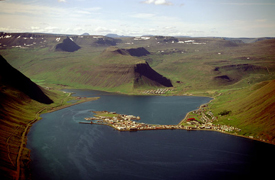 The University Centre acts as a contact between Westfjords residents and institutions of higher education. The most important aspect of this work is the University Centre’s function as the West Fjord’s distance-learning institute. Seven universities in Iceland offer distance learning courses and distance learning instruction takes place at the Centre, variously through the Internet or with the help of remote conference technology.
 The University Centre of the Westfjords offers exciting continuing education opportunities in the field of environmental and resource management, in connection with its cross-disciplinary program in Coastal and Marine Management.

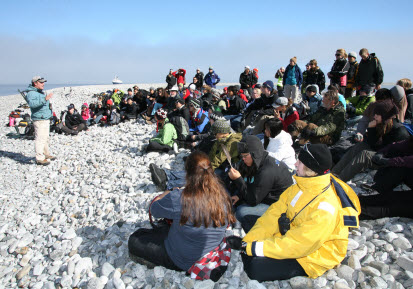 SOI was founded by adventurer, environmentalist and educator, Geoff Green – a veteran expedition leader of 74 Antarctic expeditions and 31 Arctic expeditions. In 2004, Outpost Magazine chose Geoff as one of the “Top 5 Explorers to Watch”. Over the past fifteen years, Geoff and SOI have worked directly with many IAATO Members, including Quark Expeditions, Polar Star Expeditions, Peregrine Expeditions, Hapag Lloyd, ResidenSea, and Antarpply Expeditions.
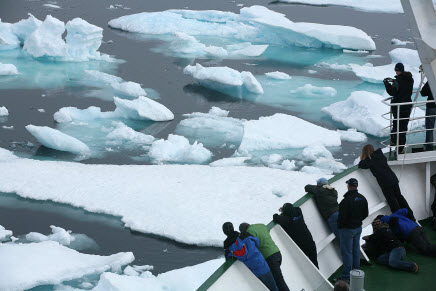 The aim of Students on Ice is not to simply provide students with a “trip” to a unique destination but rather to give students an opportunity to have an aesthetic experience in some of the most wild and awe-inspiring ecosystems in the world. The objective is not to let students to just pass through a place with camera in hand, but rather to listen to the land; to ‘feel’ these natural places and in turn, explore how humans feel when immersed in such places. The goal of SOI is that students experience a transformative connection with Nature – a connection that changes the way they understand and act in this world.
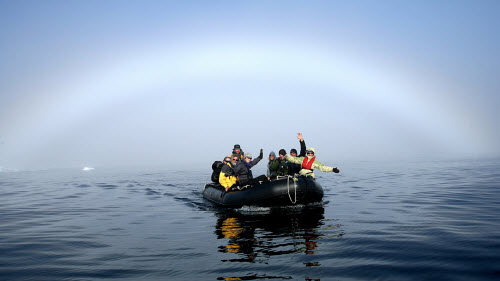 Students on Ice program, has received numerous awards and citations for its work with young people, education, the environment and polar conservation. Recently, it received the prestigious 2007 Citation of Merit Award from the Explorers Club in New York City. It has also received the Michael Smith Award for Science Promotion in Canada, as well as a special Citation of Merit from the United States Congress.