Blog

  • Sea levels rise to cost trillions?

    Melting of sea ice

    The rise of sea levels due to melting sea ice, as a result of climate change, could cost around $2 trillion US dollars. This is the result of a study by the Stockholm Environment Institute in Sweden.

    By the end of the century the cost could skyrocket. The scenario made by the SEI is that the Earth´s temperature will rise by 4° by 2100. The report is part of a book, Valuing the Ocean, which is being compiled by the SEI for the UN’s Rio+20 Conference on Sustainable Development in Rio de Janeiro, Brazil, in June.

    The rise of the Earth´s temperature will have several economic impacts, for example on fisheries, tourism, as well as those associated with the oceans’ ability to absorb atmospheric carbon. If the temperature rise holds at 2 °C it could save as much as $1.4 trillion.

    Report co-editor Kevin Noone of Stockholm University emphasizes that the $2 trillion figure is not a worst-case scenario. It doesn’t count the cost of factors that aren’t easily quantifiable, such as the value of species which will go extinct when their habitats are lost.

    The value of the oceans should not be underestimated. “Every second breath [of oxygen] we take comes from marine organisms,” Noone says.

    Sources

    New Scientist

  • Stronger global governance needed

    Climate measuring tools

    Stronger global governance is needed to mitigate human impact on the earth’s climate and to ensure sustainable development. This is the statement of 32 scientists who published a paper in the journal Science.

    The article criticizes institutions around the world, including the United Nations, as inadequate for facing the issue.

    Lead author Frank Biermann, an environmental policy specialist from VU University in Amsterdam, cites climate change as the most prominent example of the failure of global governance to meet the needs of global society.

    “It just takes a long time normally to get new agreements in place,” Biermann says. “One example is climate change where the first Framework Convention has been negotiated in 1992. And since then, there is no change in the emissions trends of major countries.”

    “I mean the current state of global climate governance is surely not effective in dealing with the challenge of global warming that we see today.”

    The scientists recommend changes both within and outside of the United Nations, including:

    • A shift in the UN from consensus decision making, which requires all nations to agree to a new treaty, to qualified majority voting: “Not necessarily majority voting on the one country-one vote principle, but a system of voting where also larger countries can protect their own interest in a more meaningful way.”
    • Creation of a new council within the UN, the Council on Sustainable Development, that would consolidate the many agencies and more than 900 environmental treaties currently in effect. The call for environmental policy to be administered on the model of global economic governance—the World Bank, the International Monetary Fund. “We also argue for the upgrading of the existing U.N. environment program toward full-fledged specialized U.N. agencies, which would give this agency better possibilities, better mandate to influence norm setting processes, a better source of funding, and a higher influence in the international governance.”
    • A stronger role for civil society—for non-governmental organizations—in international decision making. This is necessary, Biermann says, in part to ensure accountability: ”The key question that we also have to ask ourselves is, ‘How can we hold these global systems of governance accountable to citizens? I mean, how can we invent in a way democracy, accountability, legitimacy at the global level?’ Civil society organizations should gain more rights in getting information and assessing information and also a stronger right to be heard in international norm setting procedures.”

    The authors are primarily public policy experts affiliated with universities including Yale, Oxford, the University of California, the University of Oregon, the University of Massachusetts, the University of Arizona, Arizona State University, Colorado State University, among others.

    Sources

    Forbes

  • Green economy in forefront at Rio+20

    Solar Energy Farm

    Green economy is the focal point of the summer. Rio+20, United Nations Conference on Sustainable Development, will be held in Rio de Janeiro, Brazil, on June 20-22, 2012.

    It will be the 20th anniversary of the 1992 United Nations Conference on Environment and Development (UNCED), in Rio de Janeiro, and the 10th anniversary of the 2002 World Summit on Sustainable Development (WSSD) in Johannesburg.

    It is envisaged as a Conference at the highest possible level, including Heads of State and Government or other representatives. The Conference will result in a focused political document.

    The objective of the Conference is to “secure renewed political commitment for sustainable development, assess the progress to date and the remaining gaps in the implementation of the outcomes of the major summits on sustainable development, and address new and emerging challenges.”

    In the latest edition of Our Planet, magazine of the xxx, the green economy is in forefront. MR. Adnan Amin, director general of the International Renewable Energy Agency states in the magazine that “by developing renewable energies we can place the world on a path to sustainable clean energy, cut emissions of greenhouse gases and benefit the environment.”

    “In the developing world, renewable energies not only help lift isolated rural communities out of poverty, creating opportunities and jobs, but can have a fundamental role in addressing energy security and climate change.”

    “Many economists say a move to renewable energies could be the turning point that is needed to drag western economies from the brink of a long-term recession. Renewable energies are a source of diversified economic growth and job creation: more than 3.5 million people are already employed in renewable energy industries.”

    The Rio+20 will be an exciting event and is specially highlighted by many because of the 20th anniversary. What comes out of the meeting is another issue, but many are optimistic that it could lead to an important document regarding renewable energy.

    Source: Our Planet

  • Aquaculture in the Arctic

    Aquaculture in the Arctic

    Aquaculture is an important part of the food sector in the world. Aquaculture involves cultivating freshwater and saltwater populations under controlled conditions, and can be contrasted with commercial fishing, which is the harvesting of wild fish.

    Aquaculture is predominantly for human consumption. Aquaculture accounted for 45,7% of fish consumption in the world in 2008. It has grown rapidly over the last 50-60 years, the annual production in 1950 was around 1 million tons compared to 52.500 thousand tons in 2008.

    Some nations have a long history of aquaculture but Asia dominates the world production, around 88,8% of the world aquaculture production comes from Asia. China alone is responsible for 62,3% of that.

    China produced around 32.736 thousand tons in 2008. India is next (3479 t), Vietnam (2462 t) and then Indonesia, Thailand and Bangladesh all between 1000 and 2000 thousand tons.

    Norway is next with 844.000 tons, the largest of the Arctic states, and USA has 500.000 million. Russia was under 100.000 tons, Canada 15.360 tons and Iceland only around 5000 tons.

    The Arctic states produce enormous amounts of fish product s with aquaculture. The industry is a complicated process, if properly regulated; aquaculture can provide good opportunities for local development without large impacts on the ecosystem. Poorly managed and poorly regulated aquaculture, however, can have severe negative impacts through the release of excessive nutrients and chemicals, as well as escapes of farmed fish and the risk of disease transfer.

    More stable and predictable production volumes, as well as large markets in the EU and the US, are among the advantages of aquaculture, the farming of marine organisms, seen from a business perspective. Salmon and trout are common industries both in Norway and USA to a large scale. Other countries participate as well.

    The expansion of the aquaculture industry gives rise to two overriding concerns: the intrusion of fish farms into vulnerable marine and coastal areas, and the overall sustainability of an industry that depends on large catches of wild fish to feed farmed fish.
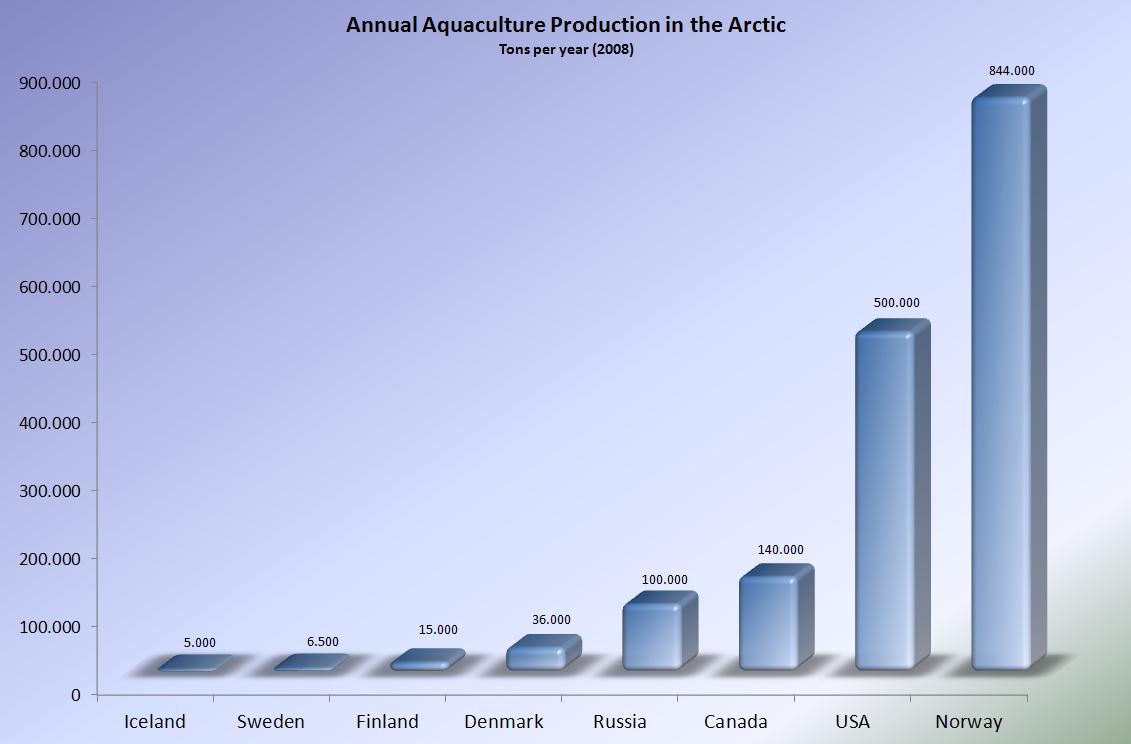
    Annual aquaculture production in the ArcticBelow is an overview of agriculture in the eight Arctic states.

    Norway (844.000 tones): Intensive farming of Atlantic salmon is by far the most important activity, accounting for more than 80 percent of the total Norwegian aquaculture production. Rainbow trout is also important and several marine finfish (cod, halibut) and shellfish species (blue mussel, oysters) are in the process of becoming commercialized. Ninety-five percent of Norwegian production is exported with the EU being the main market.

    USA (500.000 tones): The aquaculture industry in the United States of America has become well established over the last 35 years but faces significant challenges to maintain continued growth. The mainstay of the industry is the production of channel catfish which occurs largely in earthen ponds in the southeastern States of Mississippi, Louisiana, Arkansas, and Alabama. Catfish represent 81 percent of the 287.132 tons of finfish produced in 2008. There is a steady incline of total production from 1950 when it was around 50.000 tons. The peak was in 2003 when it went over 600.000 tons. But generally since then the number is around 500.000 tons. By law, aquaculture is federally defined as agriculture in the USA.

    Canada (140.000 tones): The aquaculture industry in Canada is a dynamic sector which has experienced significant growth since 2000 primarily as a result of increases in production of Atlantic salmon in marine net pens. The salmon farms are located in sheltered waters of the Pacific Ocean off of British Columbia, and in the Atlantic Maritime provinces of Nova Scotia and New Brunswick. Atlantic salmon sales generated 88 percent of the aquaculture industry’s total value in 2010 and 70 percent of tonnage.

    Russia (100.000 tones): There are four types of aquaculture activity in the Russian Federation: pasturable, ponds, industrial and recreational. There are 295 freshwater fish species in the water bodies of the Russian Federation. 63 fish species, crustacean species and mollusks are reared artificially. 27 fish breeds, crossbreeds as well as 9 domesticated forms of carp, salmon, sturgeon, coregonid and cichlid fish are now cultivated. In this century the production is around 100.000 tons annually.

    Denmark (36.000 tones): Ranking sixth in the world’s leading exporters of fish products, Denmark has a strong position in fish production and aquaculture has a long and well established tradition in the country. The main product produced is rainbow trout from freshwater ponds and mariculture units, the latter also producing roe as an important by-product. Eel is farmed in recirculated freshwater tank systems; mussels and oysters are produced in minor quantities and turbot fry is exported for further on growing. A variety of other species are raised primarily for restocking which represents an increasing share of total turnover.

    Finland (15.000 tones): With decreasing catches of wild salmon in the Baltic Sea, aquaculture became a commercial activity in the 1970s and intensified in the 1980s. Most of the aquaculture installations are located in coastal areas and mariculture is particularly important in the Archipelago Sea and along the west coast of Finland. The most important species in aquaculture is rainbow trout raised in sea cages, representing around 80 per cent of the total production from aquaculture. The rest consists of rainbow trout raised in freshwater ponds and a few other finfish. There is also farming of crayfish and production of fry and salmon for restocking purposes in the Baltic Sea.

    Sweden (6500 tones): Rainbow is the dominant specie in Swedish aquaculture. Total production in 2003 was just over 6500 tons. Sea trout, arctic char and salmon are amongst other species. Aquaculture is not a big part of the fishing industry in Sweden. It has had a steady production of around 5000-7000 tons for the last 20 years.

    Iceland (5000 tones): Aquaculture began in Iceland just before the year 1900 with the first attempts to fertilize and hatch salmonid ova and to release the emerging fry into rivers. During the period 1985-90 a large-scale build up of salmonid farms took place. Most of these farms became bankrupt, however, and the nineties were characterized by stagnation in production. In the nineties, Icelandic scientist and farmers worked on developing aquaculture of species such as Atlantic halibut, turbot, abalone and Atlantic cod. From 2000 onwards, the main increase has occurred in the production of Atlantic salmon, Arctic char and Atlantic cod. Since 2004 Iceland has produces around 5000 tons annually with aquaculture.

    Sources: Food and Agriculture Organization of the United Nations , Grida , Fisheries.is , ACIA Report
  • Greenlandic ice sheet to melt completely?

    Satellite image of Greenland

    The Greenlandic ice sheet may completely melt in 2000 years as it is more vulnerable to global warming than previously thought. This is the results of a study released this week.

    The conductors were scientist from the Potsdam Institute for Climate Impact Research (PIK) and the Universidad Complutense de Madrid.

    The temperature threshold for melting the ice sheet completely is in the range of 0.8 to 3.2 degrees Celsius of global warming, with a best estimate of 1.6 degrees above pre-industrial levels. Today, already 0.8 degrees global warming has been observed. The time it takes before most of the ice in Greenland is lost strongly depends on the level of warming.

    “The more we exceed the threshold, the faster it melts,” says Alexander Robinson, lead-author of the study now published in Nature Climate Change.

    In a business-as-usual scenario of greenhouse-gas emissions, in the long run humanity might be aiming at 8 degrees Celsius of global warming. This would result in one fifth of the ice sheet melting within 500 years and a complete loss in 2000 years, according to the study.

    “This is not what one would call a rapid collapse,” says Robinson. “However, compared to what has happened in our planet’s history, it is fast. And we might already be approaching the critical threshold.”

    In contrast, if global warming would be limited to 2 degrees Celsius, complete melting would happen on a timescale of 50.000 years. Still, even within this temperature range often considered a global guardrail, the Greenland ice sheet is not secure.

    Previous research suggested a threshold in global temperature increase for melting the Greenland ice sheet of a best estimate of 3.1 degrees, with a range of 1.9 to 5.1 degrees. The new study’s best estimate indicates about half as much.

    “Our study shows that under certain conditions the melting of the Greenland ice sheet becomes irreversible. This supports the notion that the ice sheet is a tipping element in the Earth system,” says team-leader Andrey Ganopolski of PIK.

    “If the global temperature significantly overshoots the threshold for a long time, the ice will continue melting and not regrow – even if the climate would, after many thousand years, return to its preindustrial state.”

    Sources

    PIK Potsdam

  • Excitement about EU Arctic Information Centre

    Excitement about EU Arctic Information Centre

    Director of the Arctic Centre Paula Kankaanpää, Lady Catherine Ashton, Minister for Foreign Affairs Erkki Tuomioja and Ambassador Hannu Halinen.

    The EU Arctic Information Centre will bring the Arctic closer to the European Union, and vice versa. Catherine Ashton, High Representative of the Union for Foreign Affairs and Security Policy and Vice President of the Commission, visited Rovaniemi and the Arctic Centre of the University of Lapland in Finland last week.

    She travelled together with Erkki Tuomioja, Finnish Minister for Foreign Affairs. They attended an invitation seminar at the Arctic Centre discussing the plan to establish the EU Arctic Information Centre as a network of institutions, with a hub in Rovaniemi.

    The EU Arctic Information Centre has been proposed by a group of leading Arctic research institutions. It will be a network model with nodes by expert institutions in Europe and a hub in the Arctic region of EU.

    The idea in this proposal is to organize European cooperation to inform and communicate about the Arctic, its environment, communities, cultures and peoples through the Information Centre. The new Centre will also offer requested information material to the experts, decision makers and the general public on arctic issues.

    The proposal follows the Arctic statements of the European Union (Commission 2008 and the Council 2009) that have high importance for sustainable development of the Arctic regions.

    Ms. Ashton and Mr. Tuomioja were very positive in the meeting. Ashton noted that “this is a very important place because it’s also the birth place of both the Northern dimension and the Arctic Council. And I will be completely upfront in saying I can think of nowhere better for the Arctic Information Centre to be but here.”

    The proposed Centre would have numerous positive effects and Ashton was positive it could be established in the near future. And minister Tuomioja noted that it just needed a final decision.

    “EU is preparing to establish an Arctic Information Centre in Rovaniemi. To reach that a decision prepared according to the Commission rules is still required. In Rovaniemi there was a confident mood that the decision will be ready soon and the comments given by Ashton did not weaken this confidence, to say the least”, wrote minister Tuomioja in his blog after the visit.

    Ashton also talked with the leaders of Sami parliaments of Finland, Norway and Sweden. She continued her Arctic trip to Kiruna (Sweden), Tromsö (Norway) and Svalbard.

    Sources

    Tha Arctic Centre

  • Nordic Council of Ministers

    Nordic Council of Ministers

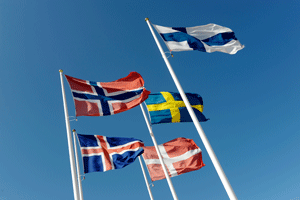
    Flags of Scandinavian countries

    The cornerstone of Nordic cooperation is the Nordic Council, which represents Denmark, Finland, Iceland, Norway, Sweden, the Faroe Islands, Greenland and Åland.

    The “Norden” consists of two separate but interoperable entities, The Nordic Council, an official inter-parliamentary body, and the Nordic Council of Ministers, a forum for Nordic inter-governmental cooperation. In addition to the Council and the Council of Ministers, there are more than 20 official Nordic institutions – and about the same number of unofficial ones. The Nordic Innovation Centre (NICe), NordForsk, Nordic Culture Point, Nordic Project Fund (NOPEF), the Nordic Centre for Welfare and Social Issues and the Nordic School of Public Health (NHV) are full Nordic institutions, as are the Nordic houses in Iceland and the Faroe Islands. One of the main institutions in the second category is the Nordic Investment Bank (NIB), which has been jointly owned by the five Nordic and three Baltic states since 2005. Another key organisation is the Nordic Cultural Fund, which supports culture in the Region as well as Nordic projects elsewhere in the world.

    Norden

    The Nordic Council is the official inter-parliamentary body. Formed in 1952, it has 87 elected members from Denmark, Finland, Iceland, Norway and Sweden, as well as the three autonomous territories (Greenland, the Faroe Islands and Åland). The members are all national MPs nominated by the party groups in their home parliaments. There are no direct elections to the Council. It is run by a Presidium and convenes for an annual autumn meeting called the Session, which passes recommendations to the national governments. The main priorities in the work of the Nordic Council are: climate, environment and energy; education and research; and welfare and culture.

    The cornerstone of the cooperation is The Helsinki Treaty, which regulates official cooperation between Denmark, Finland, Iceland, Norway and Sweden. It was signed on 23 March 1962 and came into force on 1 July 1962. The main objective of the treaty is to maintain and develop further co-operation between the Nordic countries in the legal, cultural, social and economic fields, as well as in those of transport and communications and environmental protection. In addition, the treaty establishes a foundation for joint positioning in matters of common interest which are dealt with by European and other international organisations and conferences.

    The Council of Ministers is the official inter-governmental body. The prime ministers have overall responsibility for its work. In practice, this responsibility is delegated to the ministers for Nordic cooperation and the Nordic Co-operation Committee, which co-ordinates the day-to-day work. Despite its name, the Council of Ministers, which was founded in 1971, consists of several councils. These councils meet a couple of times a year. At present, there are 11 of them.

    On of the areas of Nordic cooperation is the Arctic. The Nordic countries cooperate to improve the quality of life for the indigenous peoples in the northern areas and to promote social and cultural development for the Arctic people. Nordic cooperation also strives to protect the sensitive and characteristic Arctic nature, and to ensure sustainable use of the region’s resources, and protection of its biological diversity.

    An Advisory Expert Committee was established in conjunction with the adoption of the new Arctic Co-operation Programme in 2002. The Arctic Expert Committee is made up of Nordic members of the Arctic Council and representatives from the autonomous territories. In Nordic Council terms the Arctic Expert Committee will offer advice to the Ministers for Co-operation and the Nordic Co-operation Committee on matters relating to the Arctic.

    Following the increasing importance of the Arctic region in international politics, the Nordic Council will discuss the controversial question of a Nordic strategy for the Arctic Region in its meeting in Reykjavik, 21-23 March, 2012 . The meeting will also discuss oil extraction in the Arctic and recommendations for allocating responsibilities in the event of environmental incidents. A plenary session will be in the Icelandic parliament on Friday 23 March, 08:30-11:45 local time.

    Sources: Norden.org, Nordic Co-operation

  • France and Iceland agree Arctic cooperation

    France and Iceland agree Arctic cooperation

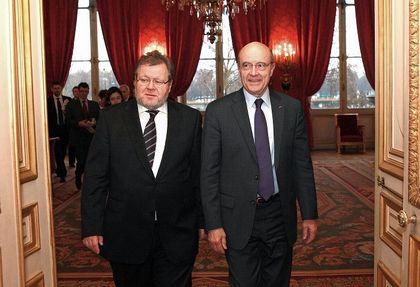
    Össur Skarphéðinsson

    France has agreed to cooperation with Iceland regarding the Arctic. The foreign ministers of the two countries met this week to finalize the agreement.

    Mr. Össur Skarphéðinsson of Iceland and Mr. Alain Juppé of France met and discussed several matters.

    “We agreed to a cooperation regarding the Arctic. This is in line with our policy of engaging cooperation related to relative projects with as many nations as possible,” Össur said to Fréttablaðið.

    France will invite Icelandic researchers to their stations, both in Ny Alesund in Svalbard and to Antarctica. Iceland will invite French specialist to Akureyri for research there.

    Close cooperation between the University of Akureyri and the established University Pierre and Marie Curie will be engaged.

    Iceland will also participate in a big project related to economic and social impacts of climate change in the Arctic.

    Sources

    Fréttablaðið

  • Joint Canadian-Russian council?

    Joint Canadian-Russian council?

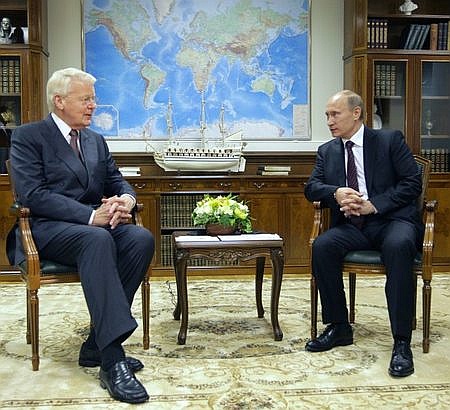
    Vladimir Putin and Ólafur Ragnar Grímsson

    The relationship between Canada and Russia is set to strengthen with an establishment of a joint research council. The countries relationship is thought to be stiff.

    “We have normal relations,” said newly elected president Vladimir Putin said, adding that he would like to meet with Stephen Harper, prime minister of Canada, at coming G8 and G20 summits. “The volume of trade is very low. Perhaps that is part of the problem.”

    Putin spoke to a group of six newspaper editors invited to his residence outside Moscow. In response to questions about Canadian relations, he said he would push for a joint scientific team, and pointed to a successful Russia-Norway approach to Arctic sovereignty.

    “The border of the continental shelf needs to be determined by scientists,” he said. He also tried to calm concerns over Russian exploration. “You needn’t suspect us of some kind of unilateral action. Yes, we have been exploring the shelf. What’s wrong with that?”

    The words from Putin are encouraging as Canada and Russia share boarders in the middle of the Arctic Ocean where land claims are being disputed. A joint research council could help the relationship between the two Arctic giants across the Arctic Ocean in the search for resources in the north.

    Source: The Globe and Mail

  • Life found in the Little Ice Age

    Life found in the Little Ice Age

    Arctic trees are older than many thought

    Many established scientist thought that trees were wiped off in the north in the Little Ice Age, which started some 115.000 years ago. That is not the case according to Danish scientist.

    Their newly published study claims that that conifer grew in northern Scandinavia in the glacial period despite several kilometer thick ice sheets.

    A huge ice sheet covered the Northern region of the world, melting some 9000 years ago. But the research show that the conifers protruded from the enormous ice sheet, on islands and in coastal areas.

    “This means that we need to rethink how life reacts to global climate changes and that life on Earth is a lot more robust than we think,” says Professor Eske Willerslev, of the Centre for Geogenetics at the University of Copenhagen, who headed the research.

    The scientist used DNA technology to determine that the trees did not have to completely emerge from the south around 9000 years ago, some actually survived.

    The Swedish professor of physical geography at Umeå University, Leif Kullman, caused a heated debate among scientist when he claimed that he found remains of trees throughout Scandinavia that dated back before the time the ice melted away. That suggested that ice free areas did exist, causing a stir in the scientific community. Now the new proof supports Kullmans theory.

    After researching over 100 European spruces the researchers found two gneric types, one of which is only found in Scandinavia. The other specie migrated from the south.

    Sediments at the bottom of a lake in Trøndelag in central Norway revealed samples of 10,300 year-old DNA, which indicate that the indigenous Scandinavian spruce type was located in central Norway, while the country was supposed to have been covered by a thick layer of ice.

    From samples dating back some 20,000 years, they also managed to identify DNA from both pine and spruce on the island of Andøya in northwestern Norway. “This means that Kullman, who everyone though was mad, was probably right,” says Willerslev.

    Sources

    Science Nordic

    BBC