Blog

  • Melting the Vitruvian Man

    Melting the Vitruvian Man

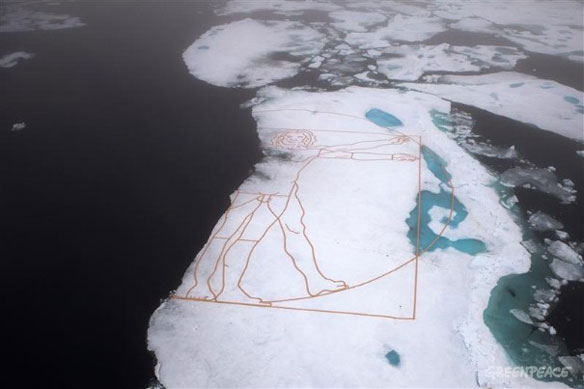
    Vitruvian man greenpeace

    “Climate change is literally eating into the body of our civilisation,” artist and activist John Quigley explained his newest art piece. It is no ordinary drawing; it is a remake of Leonardo Da Vinci’s famous drawing, Vitruvian Man, at the size of four Olympic-sized swimming pools.

    The Vitruvian Man is based on the correlations of ideal human proportions with geometry described by the ancient Roman architect Vitruvius.

    The art piece is melting, it is located 800 kilometers from the North Pole, as a call for urgent action on climate change.

    Quigley used copper strips normally used to create solar panels to construct the giant copy of da Vinci’s 500 year-old drawing. All
    materials were removed after construction
    and the copper will be reused.

    “When he did this sketch it was the Enlightenment, the Renaissance, the dawn of this innovative age that continues to this day, but our use of fossil fuels is threatening that,” Quigley said.
  • Boiling water to shrink icebergs?

    Boiling water to shrink icebergs?

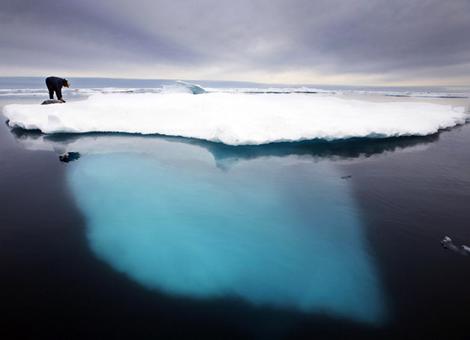
    Polar bear walking on iceberg

    Icebergs are a huge problem in the Arctic. In short, they can be in the way! Vessels are scared of these sometimes huge and unpredictable blocks of ice.

    Add that only 1/10th of the icebergs are visible above water, they can be a huge hazard in Arctic Sailing.

    Oil giant Gazprom has now developed a way to use boiled water to melt the icebergs. They would melt anyway but to speed up the process might help, especially ships that are not strengthened for sailing in ice.

    The method includes the use of helicopters to cover an approaching iceberg with a water-proof coat and the subsequent injection of hot water.

    Gazprom knows the problem well so there is no wonder the company researched ways to help their vessels in ice layed waters.

  • The 6th NRF Open Assembly

    The 6th NRF Open Assembly

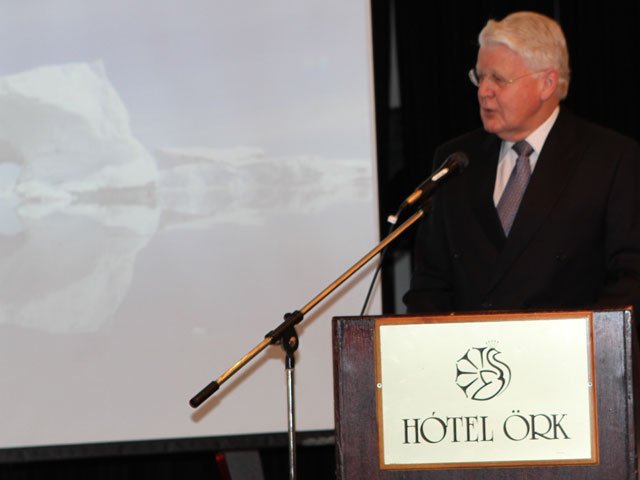
    Ólafur Ragnar Grímsson

    Arctic Portal broadcasted the 6th NRF Open Assembly this weekend. Shortly the presentations and discussion will be available here on the Arctic Portal website. Pictures and videos will also be uploaded shortly.

    ————————————————————

    On Sunday the 4th of September and Monday the 5th the Assembly will be held.

    It´s title is Our Ice Dependent World.

    A host of excellent hosts will hold sessions, beginning with opening words from amongst others the president of Iceland, Mr. Ólafur Ragnar Grímsson and Kupik Kleist, the Premier of Greenland.

    Professor Lonnie Thompson from the School of Earth Science will present in the session about Implications of the Ice Melt.

    Open discussions will be held after each session.

    The Assemblies program schedule can be found here.

  • UArctic reaches further north

    UArctic reaches further north

    Arkhangelsk on a map

    The University of the Arctic has opened a research center in Russian city Arkhangelsk.

    The Northern Arctic Federal University (NArFU) is seen as a critical step in creating a collective capacity for UArctic members to coordinate northern research, says UArctic president Lars Kullerud.

    The office will strengthen both the University and Russia. Kullerud notes that many UArctic members in the North are perceived as smaller actors, and risk being marginalized by larger institutions from outside the region when it comes to high level research projects.

    The new office will help to promote the collective capacity of these members and strengthen the role of northern institutions in Arctic research.

    The Research Office will be officially opened during the Arctic Forum in Arkhangelsk organized by the Russian Geographical Society The Research Office will first host a small seminar the previous day with UArctic and key external partners to discuss
    potential opportunities.

    UArctic

  • NRF and Our Ice Dependent World

    Northern Research Forum

    The 6th NRF Open Assembly will be held in Hveragerði, Iceland in the beginning of September. From 3rd – 6th of September the theme “Our Ice Dependent World” will be addressed.

    Representatives from Canada, USA, Russia, China, India and Nepal are amongst others joining forces to discuss this issue. It regards not only the Arctic and Antarctica, but also the Himalayas.

    Arctic Portal will record the Assembly and webcast it.

    The overall objective is to address the impact of dwindling ice – terrestrial as well as ocean bound – on the complex interface of nature and society in all climatic zones of the world. In light of the man-made part of climate change, particularly meaning global warming, and the natural phenomena of ice is gradually becoming a concept of global politics – a common heritage of humankind- affecting societal life in quite dramatic ways on a global scale.

    This turn in the interrelationship and working of the society/nature interface is the focus of the Assembly requiring two intertwined questions to be addressed:

    • First, what will the economic, industrial, cultural and political consequences of the accelerating global ice melt be in different time spans, i.e. in the short (5-10 years), medium (10-20 years) and long term (20- years)?
    • Second, what economic, industrial, cultural and political possibilities and challenges are facing human kind in light of global ice reductions?

    There are also more subthemes which can be seen at the Assemblies website along with more information about the Assembly.

  • Four horse race?

    Four horse race?

    Map of the North Pole

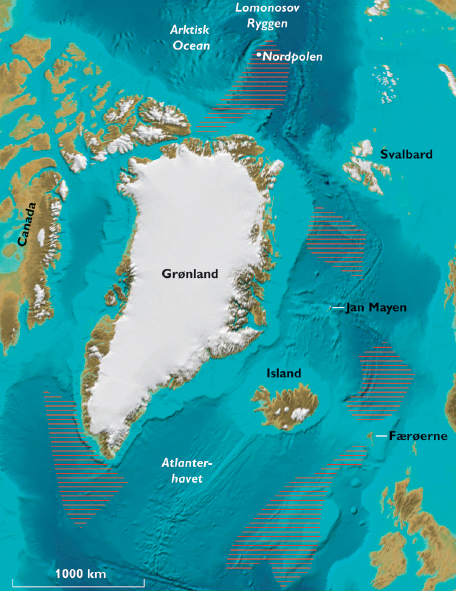
    Denmark has confirmed it will make a claim for the North Pole. Four out of five states around the pole have the right to make these claims and Denmark is the last one in line to do so.

    The Commission on the Limits of the Continental Shelf (CLCS) oversees territorial claims in the Arctic.

    “The Kingdom has submitted documentation to the CLCS for claims relating to two areas near the Faroe Islands and by 2014 plans to submit documentation on three areas near Greenland, including an area north of Greenland which, among others, covers the North Pole,” read the Danish Arctic Policy, released last week.

    Upon ratification of the United Nations Convention on the Law of the Sea (UNCLOS), the countries have ten years to make their claims to an extended continental shelf. If these claims are confirmed by CLCS, the country will receive exclusive rights to resources on or below the seabed of that extended shelf area.

    That means alot can be at stake. Due to this, Norway (1996 ratification), Russia (1997), Canada (2003) and Denmark (2004) launched projects to provide a basis for seabed claims on extended continental shelves beyond their exclusive economic zones.

    Canada has not sent its claims, but Denmarks has or will research these areas to claim the North Pole (from 176.dk). has time until 2013 to do so.

    USA has signed but not ratified the contract. That means they cannot make any territorial claims unless they do so. All four states have now confirmed that claims will be sent (or will be in time), so the over used cliché about the Race to the North Pole is between four countries. That is unless USA ratifies UNCLOS, which it has hinted will happen with Hillarys Clinton words about making that her “priority”.

    Look at the Interactive Arctic Portal map to see the Exclusive Economic Zones in the Arctic. Light blue is a territory nobody can claim. Yet.

  • Gas pipeline to the Barents Sea?

    Gas pipeline to the Barents Sea?

    Snohvit gas fields

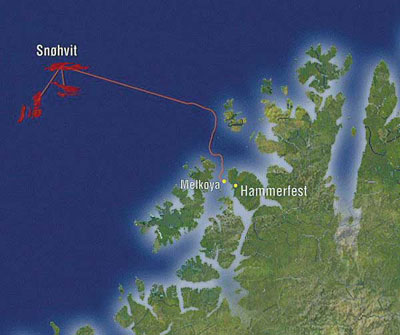
    The only gas field in the Barents Sea could soon be connected to the mainland. Snøhvit gas field is so promising; Norway could extend its current pipeline system to get the gas on shore, but only if other areas for gas production can be found.

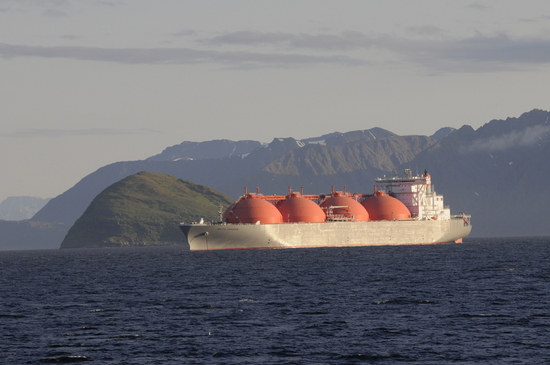
    Huge LNG tankers are used to transport the gas to the markets in Europe and USA, but a new pipeline would be a revolution.

    Norway’s Foreign Minister Jonas Gahr Støre says that this is a possibility, but underlines that the need for more areas to be found are crucial.

    With Russia also planning to extend its pipeline system, some kind of cooperation between the countries has also been discussed.

    Research in the Barents Sea aimed to find gas have been promising in recent years. The cost and time for transport will encourage both Russia and Norway to react
    and the pipelines might be a necessity in a few years time.


    LNG tanker, used for gas transport (From BO news)

  • New current found near Iceland

    New current found near Iceland

    Ocean currents around Iceland

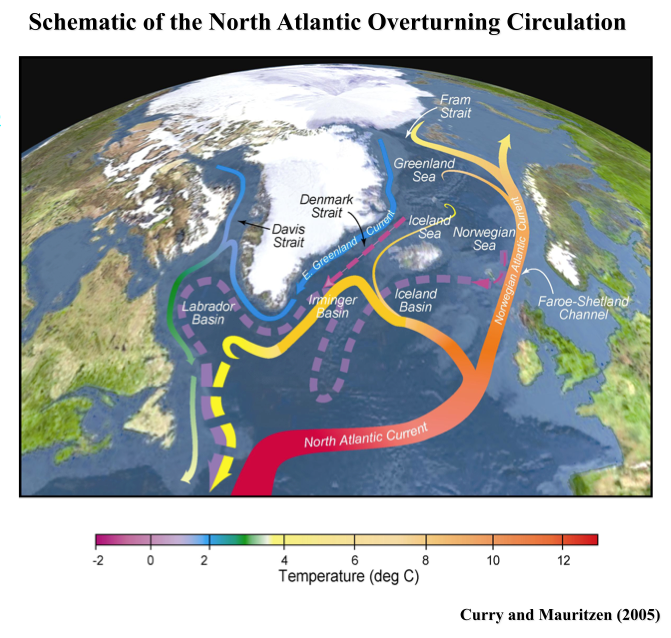
    A hidden ocean current, discovered far below the sea’s surface near Iceland, could be a major player in the ocean’s response to climate change. Deep water currents have its say in the matter and this new player could play its role.

    Icelandic Scientists Steingrímur Jóhannesson from the University of Akureyri and Héðinn Valdimarsson found the current in the Denmark Strait. Located between Iceland and Greenland, The Denmark Strait is one of the most important stretches of water in the entire world-ocean circulation, according to the scientists.

    The 600 mile wide Denmark Strait is the main portal for southbound water. Every second of every day millions of cubic meters of warm water flow north along the British Isles and up the coast of Norway aboard an arm of the Gulf Stream System, treating Western Europe to a far more moderate climate than their latitude deserves.

    However, if all that warm water flows north, an equal quantity of cold water must flow south to maintain the circulation—the stability of our climate depends on it.

    The new current has changed the accepted theory that said a current flowing down the East Greenland coast delivered most of the water to the strait. Yet the area was, according to the Icelanders, under-measured.

    In 2004 they found the current, named it the North Icelandic Jet and in 2008 the current was confirmed by WHOI oceanographer Bob Pickart with extended measurements.

    The new theory is that the current supplies fully half the water that exits the strait to form the return-flow current.

    The expedition witch set sail from Reykjavík three days ago is looking to confirm this, and continuing to research the possibly vastly important current.

    HERE is the webpage of the expedition.

    Schematic of the North Atlantic Overturning Circulation

  • Research grant application extended

    Research grant application extended

    INTER-ACT

    The call for INTERACT Transnational Access has been extended until 7th of September. The exciting venue offers the opportunity to visit research sites and gain access to information and equipment on site.

    The call covers the winter season from October 2011 to April 2012 (with some variation on different sites), and summer season May to September 2012 for stations located in Russian Federation.

    This project has a main objective to build capacity for identifying, understanding, predicting and responding to diverse environmental changes throughout the wide environmental and land-use envelopes of the Arctic.

    Examples of potential research fields include animal sciences and botany, climate change research and environmental monitoring, ecology, ecosystems and biodiversity, contaminants, geography, geology and related fields, glaciology , limnology, paleolimnology and hydrology and social sciences and humanities.

    More information can be found here, and the online application form.

  • Denmark releases Arctic strategy

    Denmark releases Arctic strategy

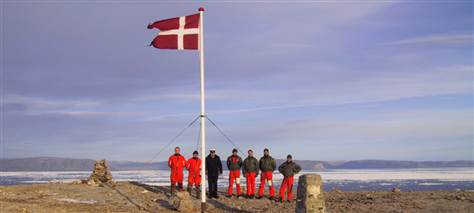
    Researchers standing with the Danish flag

    Denmark has released its Arctic Strategy up to the year 2020. Denmark reins both in Greenland and the Faroe Islands and their interest are numerous in the Arctic.

    The Arctic strategy will make it possible for the three parts of the Kingdom to address the challenges in a coordinated way, the strategy report states.

    “The purpose of this strategy is to focus attention on the Kingdom’s strategic priorities for future development in the Arctic towards 2020. The aim is to strengthen the Kingdom’s status as global player in the Arctic.”

    Denmark aims to strengthen its position in Arctic matters, but underlines close cooperation with its neighbors and partners in the area.