Blog

  • Icelandic Arctic Policy under development

    Icelandic Arctic Policy under development

    Össur SkarphéðinssonAlthing, the Icelandic parliament is now developing an Arctic policy for the Icelandic government. The work is being conducted under the management of the Icelandic foreign minister Össur Skarphéðinsson. Icelandic authorities are becoming aware of the state’s significant status within the Arctic and regional cooperation and have thus decided that a declared policy is needed for the Icelandic state to have impact on future developments in the area. The main aim of the policy is to secure Icelandic interests within the region and strengthen relations with other Arctic states and various stakeholders.

    One significant political aspect can be found in the proposed policy, namely to make sure Iceland is considered to be an Arctic coastal state. This is thought to be important in order to reverse the recent development of the Arctic five meetings. Icelandic authorities do not welcome any deliberate undermining of the Arctic Council as the forum for regional cooperation on Arctic matters and would rather want the Council to be strengthened. In addition to this political view, the Icelandic government wants international obligations and agreements to be observed in decision-making and settlements of disputes.

    In discussions on the proposed Arctic policy in the Althing, some concerns have been raised regarding the Arctic five meetings and there does seem to be a general view within the parliament that this development should be obstructed as possible. However, the clear will of the Icelandic government to secure the state’s spot as an Arctic coastal state seems to imply that such “Arctic six” meetings could be more welcomed with Iceland on board. In reality, this deliberation is rather improbable as the Icelandic government is keen on prevent the exile of small state actors such as the Faroe Islands and the non-Arctic coastal states within the Arctic Council, Finland and Sweden.
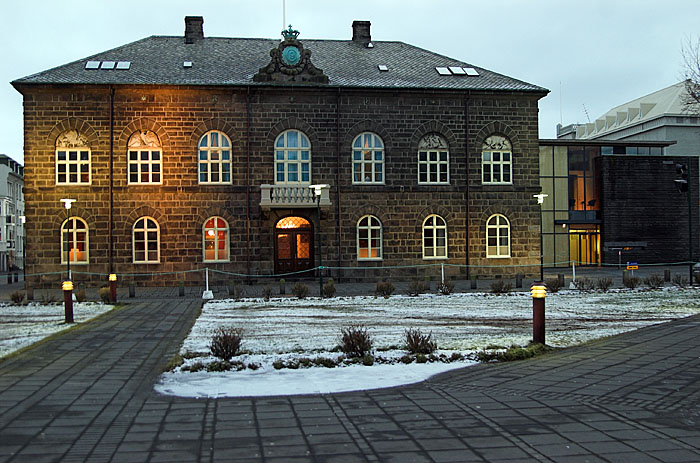
    AlthingishusidAnother significant aspect of the proposed Icelandic Arctic policy is react against armament in the Arctic region has been raised in the parliament. This point has been discussed to a certain degree in the Althing, where the foreign minister has tried to water down the concerns of direct military confrontation or severe armament. The third significant political aspect of the discussions in the Althing about the policy is the EU negotiation phase and the outcome in Arctic matters for the European Union. Some concerns have been raised that the argument for Iceland as an Arctic coastal state is meant to secure the interests of the EU instead those of Iceland specifically. Even though this concern might be a bit farfetched, it was officially declared by the EU that Arctic matters were the primary gain for the EU with the membership of Iceland.

    The Icelandic Arctic policy will consist of eleven general elements that together represent the main concerns of Icelandic authorities, in addition to interests that will be pursued. There are no big surprises in the proposed policy, with the development of Iceland’s status as an Arctic costal state as the exception. The focus of Icelandic government on the rights of indigenous peoples and other inhabitants of the Arctic is, however, also a significant attribute that could be seen as unusual.

    The eleven elements of the proposed Arctic policy of the Icelandic government are as follows:

    1. Secure the status of Iceland as an Arctic coastal state regarding decisions on Arctic issues. This will be based on the geographical, economic and ecological reasons.
    2. Increase global understanding on that the Arctic region is not restricted to the area north of the Arctic Circle, but other areas based on various ecological, economic and geopolitical reasons.
    3. Strengthen the Arctic Council as the main cooperative body on Arctic issues and press for decisions to be made within the Council.
    4. Build on the United Nations Convention on the Law of the Sea which sets out the universal principles of marine governance.
    5. Strengthen and increase cooperation with the Faroe Islands and Greenland with the aim of increasing the economic and political status of the three states.
    6. Secure and support the rights of indigenous peoples in the Arctic and secure their involvement in decision making.
    7. Build on international agreements and encourage cooperation with other states and stakeholders on Arctic issues regarding Icelandic interests in the Arctic.
    8. Safeguard civil security interest in the Arctic and react against armament in the area. Increase cooperation with other states on preservation of wildlife, research, and preparedness in surveillance, search and rescue and pollution prevention in order to secure environmental, communal and sustainable development interests.
    9. Develop commercial cooperation between Arctic states and secure Icelandic opportunities in economic development within the region.
    10. Increase national knowledge on Arctic issues and introduce Iceland as a forum for conferences, meetings and discussions on Arctic issues. Effort shall be made to establish centers, research institutes and educational institutions on Arctic affairs in cooperation with other states and international institutions.
    11. Increase national consultation and cooperation on Arctic issues to secure increased knowledge on the status of the Arctic, democratic dialogue and solidarity on the implementation of the official Arctic policy. The foreign minister shall develop and implement the Arctic policy in consultation with the Althing’s committees on foreign affairs and environment.

    No major changes are expected to be made on the eleven elements mentioned above. A few might, however, become more precise in order to make implementation easier. The implementation of the policy and the making of an Arctic strategy will be initiated after the proposed Arctic Policy has been developed. The proposed Arctic strategy will most likely be finalized in early summer of 2011.
  • Arctic Report Card

    Arctic Report Card

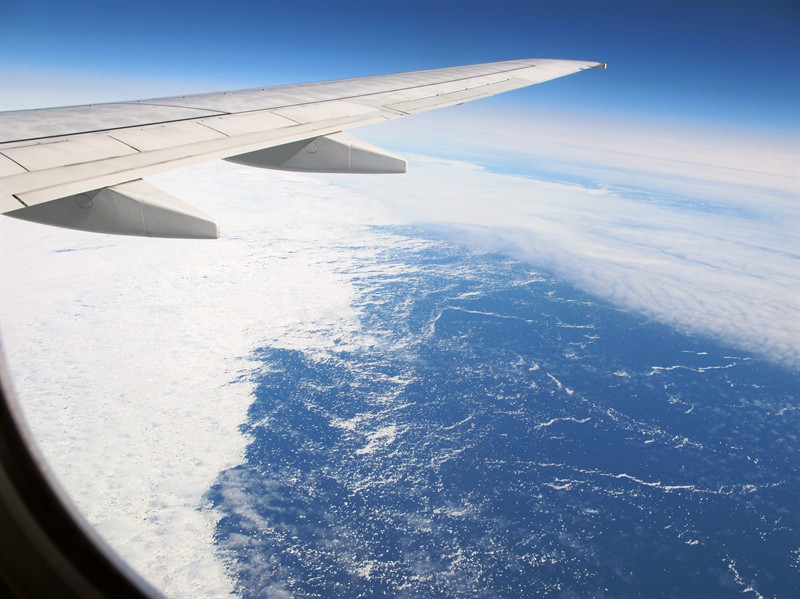
    Dissolving Sea Ice, South of Svalbard

    Issued annually, the Arctic Report Card is a timely source for clear, reliable and concise environmental information on the state of the Arctic, relative to historical time series records.

    Material presented in the Report Card is prepared by an international team of scientists. The Arctic Report Card is collaboratively supported by the international Arctic Council.

    The Conservation of Arctic Flora and Fauna (CAFF) Circumpolar Biodiversity Monitoring Program (CBMP) provides collaborative support through the delivery and editing of the biological elements of the Report Card.

    The 2011 Arctic Report Card has been published. Amongst the results are significant changes in the atmosphere and the sea ice and the ocean.

    The NOAA (National Oceanic and Atmospheric Administration) issues the Arctic Report Card annually The Arctic Report Card is a timely source for clear, reliable and concise environmental information on the state of the Arctic, relative to historical time series records.

    Among the 2011 highlights are:

    Atmosphere: In 2011, the average annual near-surface air temperatures over much of the Arctic Ocean were approximately 2.5° F (1.5° C) greater than the 1981-2010 baseline period.

    Sea ice: Minimum Arctic sea ice area in September 2011 was the second lowest recorded by satellite since 1979.

    Ocean: Arctic Ocean temperature and salinity may be stabilizing after a period of warming and freshening. Acidification of sea water (“ocean acidification”) as a result of carbon dioxide absorption has also been documented in the Beaufort and Chukchi seas.

    Land: Arctic tundra vegetation continues to increase and is associated with higher air temperatures over most of the Arctic land mass.


    Here is a video from NOAA about the report.


    2010 Report card:

    ice glacier from above

    Highlights of the 2010 report card is:

    • Four years of record minimum sea ice extents
    • Record temperatures and ice loss in Greenland
    • Strong links between the Arctic and mid-latitude weather in winter 2009-2010

    Below is a video about the 2010 report card.

    [http://www.youtube.com/watch?v=NjmHMSv2Amk]

  • Environmental Protection

    Environmental Protection

    Arctic Portal news

    Offshore Oil and Gas Development in Northwest Russia: Consequences and Implications – Bellona Foundation

    • Introduction
    • Ch.1: Oil and Gas Resources on the Arctic Continental Shelf in Russia
    • Ch.2: Transporting oil and gas in Northwest Russia
    • Ch.3: Environmental Risks when extracting and exporting oil and gas
    • Ch.4: Oil and gas accidents – prevention and liquidation
    • Ch.5: Environmental Impact of oil and gas activity in the Arctic
    • Conclusion


  • Political overview

    Political overview

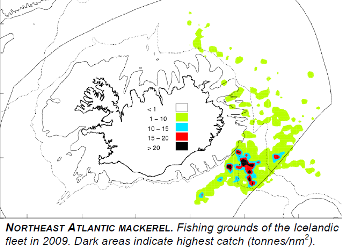
    Northeast Atlantic Mackerel fishing grounds

    “Counting fish is somewhat just like counting trees, except you can’t see the fish and it moves” This joke explains the nature of fish and its ability to move. Living resources like fish and other marine animals change their distribution patterns in relation to their habitual conditions, regardless of Exclusive Economic Zones and other jurisdictional waters.

    This fact can and has caused some political disputes, even though the Legal issues in connection with maritime boundaries and rights to fisheries both in countries’ economic zones as well as international waters have mostly been settled under the United Nation Convention for the Law of the Sea (UNCLOS).

    The distribution patterns of some species are changing faster than international agreements and conventions, causing disagreement of utilization of those species. The most recent case is the Mackerel dispute of Iceland and the European Union and other contracting parties (coastal states) of the North East Atlantic Fisheries Commission (NEAFC).

    During the recent years, Atlantic Mackerel has entered Icelandic waters due to warming waters and is in search for nutrition. The Mackerel extracts biomass from Icelandic waters and migrates again into coastal states waters, causing a huge biomass transfer. The composition of the biomass that the Mackerel transfers is thought to be spawns and fingerlings of economically valuable species and nutrition for those economically valuable species, such as small capelin and herring. In spite of that, Iceland has not been issued any quota from the overall maximum allowable catch issued by NEAFC, based on recommendations from the International Council for the Exploration of the Sea (ICES).

    Halibut on drying racks

    In the beginning the EU and the other coastal states did not want to recognize the fact that Mackerel was in Icelandic waters, however the catch over the recent years in Icelandic waters can’t be ignored. The Mackerel started as a by catch with herring fisheries in Iceland but is now in great abundance that direct harvest of Mackerel has started. Therefore Icelandic officials issued a unilateral quota, since it was not allowed any from the overall maximum allowable catch issued by NEAFC, based on recommendations from ICES.

    Still, there is no agreement and currently Iceland has issued quota in Icelandic waters for 130.000 tons. That is addition to the total recommended catch from ICES, since the other states refuse to give share and accept Iceland as a coastal state with Mackerel. This economical and political approach by the states might therefore threaten the Mackerel stock since no agreement is available of total catch.

    Disputes like those might become more common in the future since changes are occurring and economical valuable species will move to find their ideal habitat and they do not care about man made Exclusive Economic Zones. Economical and political approach of controlling maximum allowable catch of species is not in favor of the environment. An ecosystem approach has to be established in order to be able to utilize marine resources in a sustainable way. In order to do that a collective responsibility has to be established within stakeholders of this abundant resource that has supported Arctic peoples and others over the centuries.

  • Economical opportunities

    Economical opportunities

    Arctic Portal news

    Northward shift of species might also have great economical opportunities for those countries and areas that are dependable on fisheries.

    A northward shift of species might bring in more economically valuable species into the area from the south and therefore benefit the local fisheries.

    Some shift in fisheries technologies will be needed, but that poses not a great threat, for human adaption is very flexible.

    A southern ward specie such as the Atlantic Mackerel has been shifting northwards due to warming waters.

    This has caused economical opportunities for countries such as Iceland and the Faroe Islands.

    The Atlantic Mackerel is valuable specie and could come as economical substitute specie for capelin, however the role of the Mackerel in the food web of the Arctic and the Sub Arctic is not known.

    Due to its size, it is not dependable food source for other species such as the Cod or the Pollock. Also, signs lead to that the Mackerel eats spawns, fingerlings and other small fishes, such as small herring and capelin.

    Therefore the Mackerel might be in direct competition with currents species for nutrition.

    It is however unknown if climate change will support growth of other smaller species that might come in substitution for current nutrition for higher species like Cod or Pollock

  • The Northward Shift

    fishing hole in the ice

    Climate change poses both threats and opportunities for Arctic fisheries. Those concerns include indicators of a major ecosystem northward shift, meaning that species will shift northwards in order to find ideal habitat conditions.

    Such shift has ambiguous effects, especially in economical terms, meaning that traditional species that are harvested might leave traditional waters, moving from one Exclusive Economic Zone to another and or into unfishable waters

    Some will lose their ideal habitat, since a northward shift is not infinite and species that are weaker to adjustment will lose in the competition for their ideal habitat. That poses a threat to the traditional commercial fisheries for countries and areas that are economical dependable of traditional fisheries of such species.

    Marine Food Web

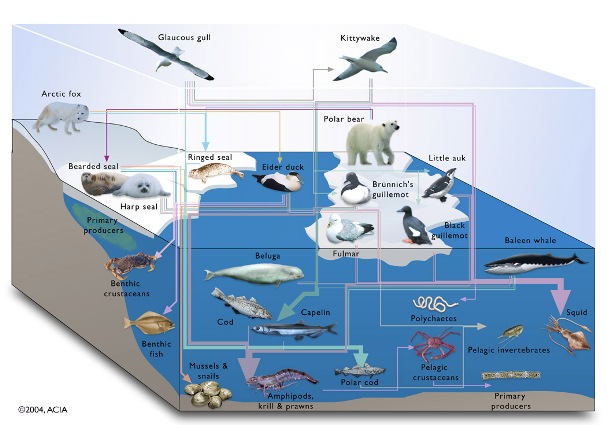
    As an example, a northward shift of coldwater specie like capelin might have enormous affect to the biodiversity in the Arctic. Capelin feeds mainly from zoo plankton and is an important food source for many valuable benthic and pelagic species, such as Atlantic cod and Pollock.

    A northward shift of the capelin, due to warmer waters, might therefore affect other stocks significantly, even though warmer waters do not affect those species directly. The basis for growth of the Atlantic cod is capelin and without such important food source the cod needs to find substitute specie, like shrimp (which is also coldwater specie that is moving further north), herring, spawns, fingerlings or other smaller species.

    Species in the higher levels of the Arctic food web need to adapt by finding other food sources or simply move along with the current food source. One direct effect of climate change to one specie might
    therefore affect indirectly too many other species that depend on that species.

  • International Monitoring Plan for Polar Bears

    International Monitoring Plan for Polar Bears

    Polar Bear

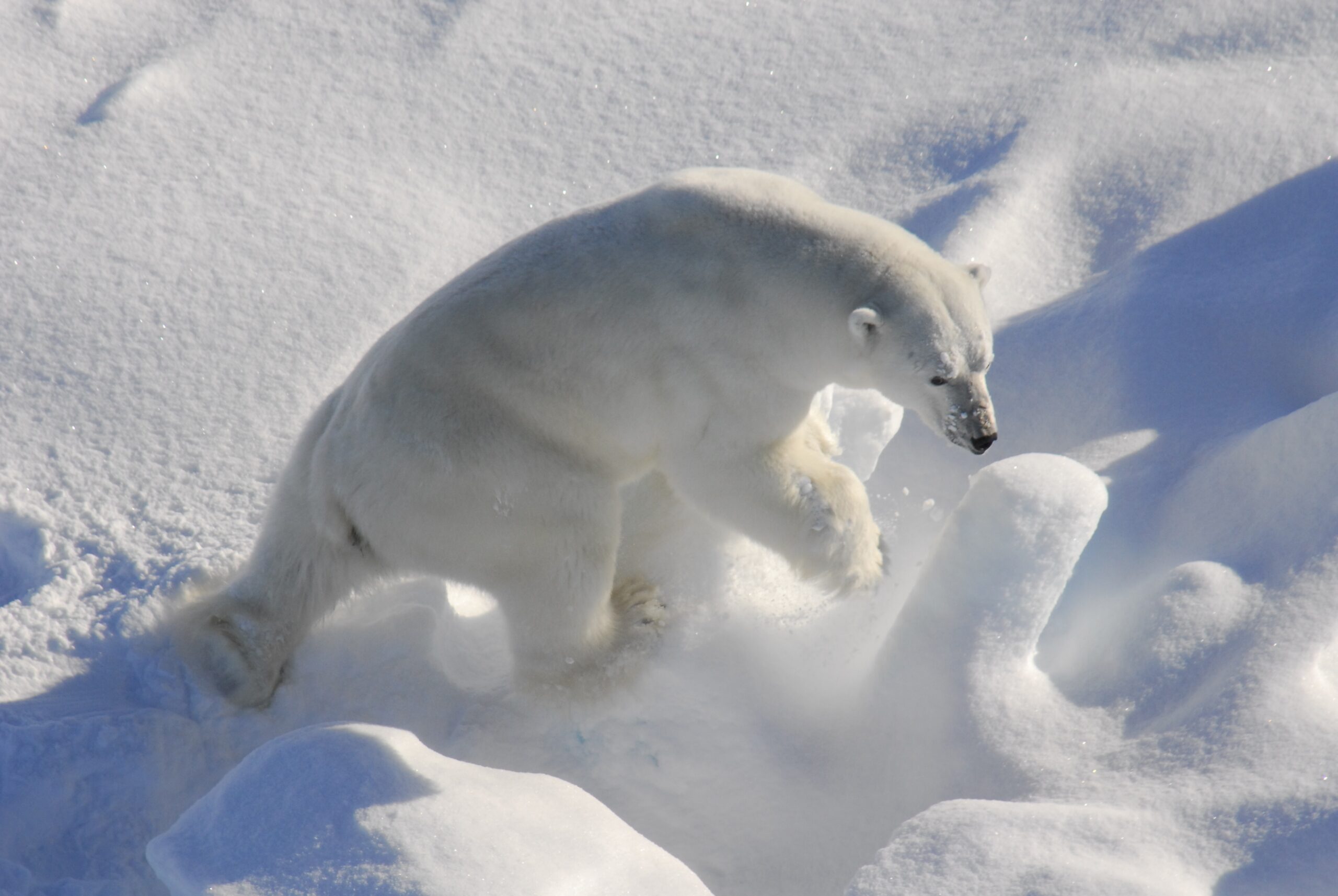
    Specialists Meet to Develop an International Monitoring Plan for Polar Bears

    Twenty-two scientists, managers and community experts from Russia, Norway, Canada, Greenland and the United States met in Edmonton, Canada

    on February 19th to 21st, 2011 to develop a Pan-Arctic Monitoring Plan for Polar Bears. The U.S. Marine Mammal Commission sponsored the workshop and the Conservation of Arctic Flora and Fauna (CAFF – www.caff.is) Working Group of the Arctic Council managed it. CAFF invited participants based on their expertise on polar bears and/or monitoring. Please download press package here

    The workshop focused on developing a coordinated and efficient pan-Arctic monitoring approach that would:

    • detect changes in polar bear populations across the Arctic,
    • implement standard assessment measures using community-based and scientific monitoring,
    • identify which subpopulations to monitor and the necessary frequency of monitoring,
    • use a suite of indicators to assess subpopulation status and trends,
    • identify the factors driving population changes, and
    • report the results to decision-makers from local communities to national government and regional bodies.

    Arctic ecosystems are changing rapidly and will continue to do so. Monitoring polar bears is a considerable challenge that will require substantial resources. To be successful, we must focus and prioritize circumpolar monitoring efforts and work together across national boundaries. Doing so is essential to better coordinate our assessment efforts, further our understanding, and convey the information needed to conserve and manage this remarkable species” said workshop organizer Dag Vongraven from the Norwegian Polar Institute.

    The results of the workshop will be used to develop a Pan-Arctic Polar Bear Monitoring Plan over the coming months (expected release September 2011). The draft plan will undergo comprehensive review prior to adoption.

  • A Shift to Arctic Oil

    A Shift to Arctic Oil

    offshore oil platform

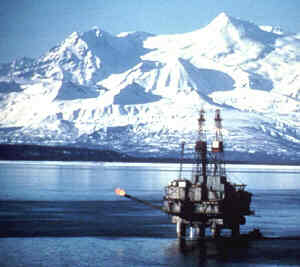
    Unrest in the Middle East means the potential oil riches in Arctic areas like Greenland are more important than ever, the island’s premier said on Wednesday, criticizing environmental groups that want to hamper exploration.

    Greenlan enjoys self-rule as part of the Kingdom of Denmark, has issued 20 licenses for oil and gas exploration in Baffin Bay on its West coast. Some estimates put Greenland’s offshore oil reserves at 20 billion barrels.

    Kuupik Kleist said that there is a strong focus on the Arctic, especially because of the richness of natural resources. The very last days’ developments in the Middle East have put more (emphasis) on this focus.

    We are of course influenced and also highly affected by what’s happening on world markets,” Mr. Kleist said at an Ottawa conference on the Arctic.

    Speaking separately, Greenland’s industry and mineral resources minister, Ove Karl Berthelsen, said exploration licenses for blocks in the Greenland Sea to the east would be auctioned in 2012 and 2013. Firms with licenses include U.S.-based ConocoPhillips and Exxon, Canada’s Encana, Norway’s Statoil, France’s GDF Suez, Britain’s Cairn Energy, Royal Dutch Shell Plc, Denmark’s Maersk and DONG Energy, and Greenland’s national oil company Nunaoil.

    Kuupik Kleist

    Although environmental groups say the Baffin Bay exploration blocks are particularly vulnerable to oil spills and should be kept off limits, Kuupik Kleist made it clear there is no turning back where he said that if Greenland should stay away from exploiting its mineral resources, some other place on Earth will do it.

    Greenland, dependent on the fishing industry and funding from Denmark, says it needs the money to cope with pressing social needs. Mr. Kleist stated that the status quo is not an option, since Greenland is faced with big huge challenges in all areas, social, educational, health and infrastructure.

    The Greenland government says while there are risks to offshore drilling, modern technologies mean the dangers are much lower than in the past. Last year, Greenpeace protesters boarded a drilling rig operated by Cairn Energy to highlight what they said were the dangers of a spill in one of the world’s most remote regions.

    You see environmental groups coming now to the Arctic area and trying to hinder activities conducted by indigenous governments… Why didn’t they do that like 100 years ago, 50 years ago or even just 15 years ago?” said Kleist. “I think Greenpeace has a lot of work to do in other places in the world. Greenland is not the most dangerous place.

    Source: Reuters

  • The Shared Future: A Report of the Aspen Institute Commission on Arctic Climate Change.”

    The Shared Future: A Report of the Aspen Institute Commission on Arctic Climate Change.”

    The Aspen InstituteRecognizing that the circumpolar Arctic region is experiencing significant ecological change due to global climate change, the Aspen Institute convened a civil society Dialogue and Commission to consider the implications of this impending transformation for the region’s inhabitants and resources. The Aspen Institute released a final report and recommendations of Commission, entitled “The Shared Future: A Report of the Aspen Institute Commission on Arctic Climate Change.”

    The report features a very special foreword by President Jimmy Carter and presents the Commission’s recommendations, foremost of which is that governance in the Arctic marine environment should be sustained and strengthened by a new conservation and sustainable development plan based on using an ecosystem-based management approach.

    The Commission believes marine spatial planning provides a workable method to begin implementation of ecosystem-based management. Governance of the Arctic can and should be strengthened through an inclusive and cooperative international approach that allows greater participation in information gathering and sharing, and decision-making, leading to better information policy choices and outcomes.
    The report is issued under the auspices of the Aspen Institute and the members of the Aspen Institute Commission on Arctic Climate Change, with support from the Prince Albert II of Monaco Foundation.

    Aspen Climate Change Report

    Aspen Climate Change Report – Handout

    Arctic OceanThe report presents the Commission’s recommendations, foremost of which is that governance in the Arctic marine environment, which is determined by domestic and international laws and agreements, including the Law of the Sea, should be sustained and strengthen by a new conservation and sustainable development plan using an ecosystem-based management approach. The Commission believes marine spatial planning provides a workable method or approach to begin implementation of ecosystem-based management. According to the Commission, Arctic governance can and should be strengthened through an inclusive and cooperative international approach that allows greater participation in information gathering and sharing, and decision-making, leading to better informed policy choices and outcomes.

    gullThe Commission recognizes that this Aspen Dialogue has been a preliminary step toward a fuller discussion on the future of the Arctic marine environment. Its major discovery is that a more modern, holistic and integrating international plan is needed to sustainably steward and govern the Arctic marine environment. The Commission has made significant progress in understanding the needs and requirements for action to sustain the Arctic and realizes that in order to implement its recommendations the entire Arctic community must be engaged.
    The Aspen Commission on Arctic Climate Change has identified the following initial Principles of Arctic Governance as forming the guiding foundation of its recommendations and the standards by which future governance and sustainable management of human activities in the Arctic marine environment should be measured. Specifically, governance and sustainable management of human activities in the Arctic marine environment should seek to:

    1. Optimize ecosystem resilience, integrity and productivity by maintaining food-web (trophic) structure and protecting and restoring biodiversity and available habitat.
    2. Maintain the full suite of Arctic ecosystem services to support human well-being on a continuing basis.
    3. Promote investment in scientific research and related infrastructure necessary to ensure sustainable development and environmental protection.
    4. Avoid exacerbating changes that may be difficult or impossible to reverse in temperature, sea-ice extent, pH, and other key physical, chemical and biological ecosystem parameters.
    5. Assess, monitor and manage multiple human activities using an integrated, adaptive, ecosystem-based management system that takes into account risks and cumulative and interacting effects.
    6. Apply ecosystem-based management processes based on science and traditional knowledge, particularly to new and expanded human activities which are subject to prior evaluation and analysis. Prudent measures to reduce or eliminate impacts are to be taken when there are reasonable grounds for concern that such activities, directly or indirectly, will bring about hazards to human health, harm living resources and ecosystems, damage amenities or interfere with other legitimate uses.
    7. Fully respect the rights, including human rights, of Arctic residents and Arctic indigenous peoples, and maximize participation in and transparency of decision-making for all interested stakeholders.
    8. Link global policy discussions to the need to conserve and manage Arctic ecosystems and dependent communities.
    9. Promote cooperation among Arctic states to arrive at appropriate standards for managing activities in the Arctic to meet the special conditions of the Arctic region, while promoting sustainable development.
    10. Inform, in a timely manner, national and international decision-makers as well as the public of the consequences of climate change impacts in the Arctic, and needed actions required to meet the above noted principles.

    shippingThe Aspen Institute Commission on Arctic Climate Change believes that existing frameworks can be enhanced and new frameworks can be established to improve governance and strengthen resilience in the Arctic marine environment in response to climate change impacts and the need for adaptation readiness. The Commission developed its recommendations against the backdrop of at least three observable strategies currently discussed internationally to strengthen the Arctic Council; expand and strengthen the existing system of bilateral and multilateral agreements; and/or establish a new Framework Convention for Arctic governance.
    Aspen Commission Recommendations

    1. Arctic governments should take immediate steps to begin developing an Arctic Marine Conservation and Sustainable Development Plan by 2012, in collaboration with civil society and other interested parties.
    2. Arctic governments, independently and collectively, should implement an integrated ecosystem-based management approach in the Arctic marine environment utilizing appropriate marine spatial planning, as well as regulatory rules and standards that address the special conditions of the Arctic region.
    3. In addition to an Arctic marine conservation and sustainable development plan, a number of specific actions should be initiated through the development of agreements or standards that foster consistent implementation among and across Arctic governments.
    4. An open-source Arctic network, focused on ecosystem-based management, should be developed through the Arctic Council and used to complement the existing system of national and international governance mechanisms in the Arctic.
    5. Arctic governments should call for a special diplomatic conference in 2012, which includes participation by Indigenous Peoples and the eight Arctic nations, to establish a timetable for designing and implementing the preceding recommendations.
    6. All Arctic residents, including Indigenous Peoples, should play a pivotal role in planning the future of the Arctic and should share in the benefits of its resources as well as responsibility for its sustainable future.
    7. An Arctic science program should be implemented and integrated as part of the Arctic Marine Conservation and Sustainable Development Plan using an open-source information network.
    8. The Commission urges that the Arctic Council be reinforced as an effective, multilateral organization for the region and that it be given the resources and a revised architecture to ensure that the planning, participation, management and accountability recommendations put forward in this report are implemented.

    About the Aspen Institute

    The Aspen Institute mission is twofold: to foster values-based leadership, encouraging individuals to reflect on the ideals and ideas that define a good society, and to provide a neutral and balanced venue for discussing and acting on critical issues.

    The Institute is based in Washington, DC, Aspen, Colorado, and on the Wye River on Maryland’s Eastern Shore and has an international network of partners. Further information.

  • Sweden welcomes four legged Finnish – Russian immigrant

    Sweden welcomes four legged Finnish – Russian immigrant

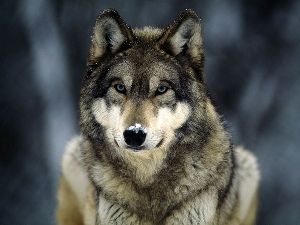
    grey wolf

    For the first time in years, a Finnish-Russian wolf is about to migrate into Swedish wolf territories. That could positively contribute to Swedish and Norwegian wolf genes, researchers say.

    The lone traveler has moved into Sweden’s northernmost county of Norrbotten and is wandering further towards Swedish wolf territories. In the last decade, only two other wolf individuals have made the long journey. This is reported in the Swedish public radio.

    Last time the wolf was traced, he was about one and a half mile from a previously known wolf territories where there is a lone female.
    The wolf which is believed to be a male, can bring new fresh genetic materials to the Swedish-Norwegian wolf stock, Swedish authorities say. Faeces samples revealed that the lone wolf came from the Finnish-Russian population, which could strengthen the heavily inbred Swedish-Norwegian wolf population.

    Authorities are now trying to trace the new immigrant and hope that it naturally enters and establishes itself in the Swedish population.

    Further information about wolves

    Sources:
    Barents Observer
    Swedish Radio
    National Geographic (Photo)