Introduction
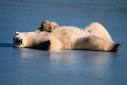 The Arctic has a unique climate within the earth’s ecosystem. Fearly little of low angle sunlight reaches the Arctic and more energy is radiated from the polar regions than is received. This makes the Arctic climate very harsh and difficult for growth and survival. Great variation in temperature and the contrast between the long and dark winter and the brief and light summer require extreme adaptability of plants and animals. The Arctic contains many species not found elsewhere, and many habitats and ecological processes and adaptations that are unique.
To survive the Arctic conditions, animals have developed many behavioral and morphological adaptations. They use snow as shelter throughout the winter, accumulate large fat deposits when food is available and change the color and texture of their fur or plumage in winter to insulate their bodies and retain their cryptic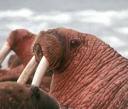 coloration year round.
Several mammalian species spend the winter in torpor to escape the coldest period of the year and species such as bear and badger spend their winter sleeping under the snow.
One of the characteristics of almost all Arctic animals is their ability and willingness to migrate even very long distances in search for food and easier environment.
Some Arctic species
The Arctic Char
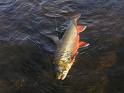 The Arctic Char (Salvelinus alpinus (L.)) is the most northern distributed freshwater fish, and part of the small group of salmonid fishes (i.e., salmons, trouts, whitefishes). Chars are a significant component of aquatic and near shore marine ecosystems in the Arctic. Often the only freshwater fish available, they play a major role for the subsistence of local people who fish returning upstream migrants of sea-run char in late summer and early autumn. Arctic Chars are threatened by a wide range of impacts ranging from local exploitation and habitat fragmentation and degradation mostly through oil and gas development, to widespread and pervasive impacts such as climate change and atmospheric contaminant deposition. Moreover, pervasive threats such as climate change affect Arctic aquatic ecosystems in a dramatic way, clearly having a huge impact on its most sensitive ecosystem components. Yet, many aspects of ecological roles of chars are still unknown at present for most northern ecosystems. Clearly, the integrity and continued health and viability of northern aquatic ecosystems are intimately connected to the biodiversity of chars present in those systems.
Reindeer and Caribou
Reindeer and Caribou (Rangifer tarandus) are distributed circumpolar in every Arctic country. Caribou represent the most dominant large mammal species in 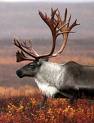 Arctic habitats and are an extremely valuable component of Arctic biodiversity and cultural identity of many northern peoples. Caribous are the only member of the deer family where both males and females grow antlers. Pregnant females will retain their antlers until after calving, allowing them to dominate the social hierarchy in late winter. During deep snow years, caribou will move in search of more favorable snow conditions, as more energy is expended digging to the lichens than is derived from feeding. Reindeer and Caribou are a vulnerable yet crucial source of income from Arctic terrestrial ecosystems for northern peoples. Close monitoring of these wild and domestic Rangifer populations is vital in assessing the impact of climate change.
Gray Wolf
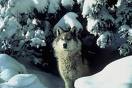 Gray wolves (Canis lupus arctos) currently number about 150,000 worldwide. Some 80% live in the circumpolar countries, although the number actually living in the Arctic is unknown. Canada has the most wolves of any arctic country, with some 50,000 to 63,000 animals inhabiting about 86% of their historical range. About 16,000 of the wolves live north of 60°N. Most of these Arctic populations are considered stable and not at risk. While wolves are abundant in Alaska, northern Canada, and Russia, local overharvests may occur. Habitat loss continues to be a concern for wolf conservation, especially in areas with recovering wolf populations. Wolves are regarded by many as a nuisance species, hampering thus management and recovery plans. The challenge continues to be the development and public acceptance of a flexible conservation plan that accommodates wolves in wilderness, but allows for local conflict management.
Ivory Gull
The Ivory Gull (Pagophila eburnean) is a high Arctic seabird breeding at high latitudes in the Atlantic sector of the Arctic and often associated with sea ice throughout the year. In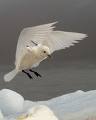 spite of an early discovery the Ivory Gull still remains one of the most poorly known seabird species in the world. There is growing concern in the circumpolar Arctic that the Ivory Gull may be in decline. The most recent information on population trend of Ivory Gulls exists for Canada, Svalbard and Russia. In Canada, the Ivory Gull has a highly restricted range, breeding exclusively in Nunavut Territory. Recent surveys in Svalbard suggest that only a few of the known colonies are still being used there and that the total population is smaller than previously estimated. Information obtained currently on Russian breeding grounds indicate stable populations breeding at some key colonies, although considerable annual fluctuations in numbers of breeding birds occurs. The Ivory Gull has been protected in West Greenland since 1977 under the Greenland Home Rule Order of 5 May 1988 concerning the protection of birds in Greenland. In Svalbard, it has been protected since 1978, under the Svalbard Environmental Protection Act. In Russia, it was listed in the Red Data Book of the USSR (1984) and now is registered as a Category 3 (Rare) species in the Red Data Book of the Russian Federation.
Climate change
Climate change is perhaps the greatest threat to the Arctic environment as it exists today. Observed changes in species abundance and distribution, and to permafrost and sea ice, are evidence that climate change is already having an impact. Although the predictions cannot tell what will happen, they do indicate the types of ecological impacts that may occur.
The impacts are likely to include melting of discontinuous permafrost, changes in distribution of moisture and the northward expansion of the forest. The climate change is further likely to affect the distribution of most plants and animals of the tundra and polar desert and affect the fish and shellfish distribution in the Arctic waters. Loss of permanent sea ice altogether would clearly have tremendous impacts on algae, plankton, fish, and marine mammals that use sea ice.
Monitoring to detect the impacts of climate change and ultraviolet radiation on Arctic ecosystems is vital, as is further research to understand the dynamics of the systems that will be affected.
Reference:
All the information presented above is gathered from the Arctic Council’s Conservation of Arctic Flora and Fauna (CAFF) Working Group’s homepage
and from the Arctic Flora and Fauna: Status and Conservation report.
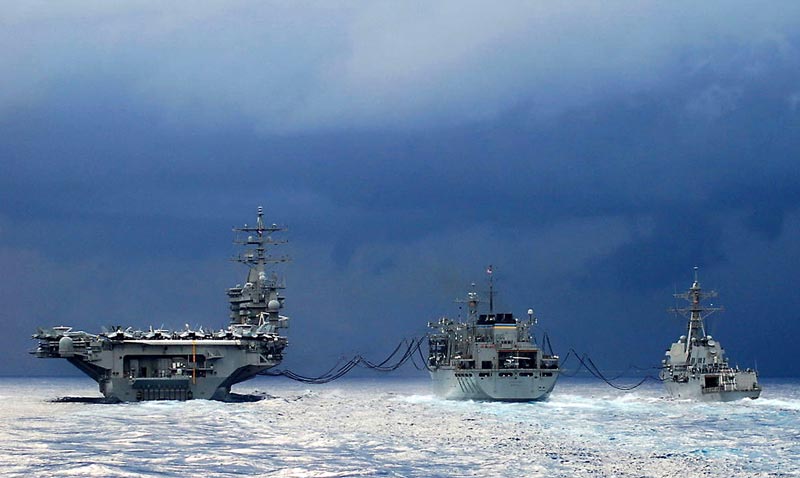
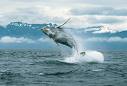
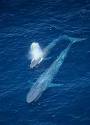 The travelling pattern of the Blue Whale is characterized by rapid sprints, while it can dwell in restricted areas for several days, most likely for food gathering.

 Expedition of 1872-74. Weyprecht realised that a comprehensive polar research could not be a task of one nation only, but should involve a coordinated international effort. He recognized that a time of mere geographical discovery had past and a series of coordinated expeditions dedicated to scientific research should be undertaken to further peoples understanding on fundamentals of meteorology and geophysics. Unfortunately, he died before the international research became a reality, but his inspiration led to an establishment of the largest coordinated series of scientific expeditions ever undertaken in the Arctic during the 19th century, or to what is now known as the First International Polar Year.
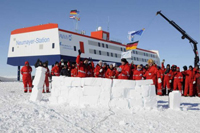 The latest International Polar Year, organized through the International Council for Science (ICSU) and the World Meteorological Organization (WMO), took place in 2007-2008. It was gigantic international multidisciplinary collaborative with around 10 000 scientists and 50 000 other participants from over 60 countries. Main objectives of this megaproject were to significantly increase the scientific knowledge and understanding of the polar areas, especially the wide-ranging and significant impacts of climate warming in the Arctic and Antarctic, and to conduct research projects beyond the resources of individual countries. In addition, the Polar Year aimed at educating a new generation of polar scientists and engineers and raise awareness of the public and policymakers of the importance of the polar areas for the entire planet. The disciplinary breadth of the third IPY far exceeded the previous Polar Years of 1882, 1932 and the 1957 IGY providing more comprehensive picture of the polar areas.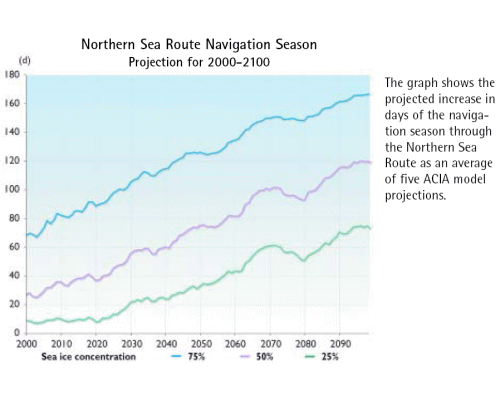
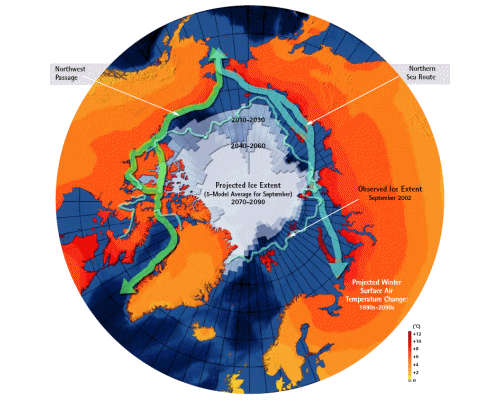 Currently there seems to be a consensus that all of these activities will increase further and that trans arctic shipping will become a reality, that it is just a matter of time. There are nonetheless significant challenges, and issues that need to be analyzed and dealt with to prevent environmental disasters and ensure the safety of seafarers. It is clear that the benefits of these activities can be significant, but the environmental hazards are numerous as well. Infrastructure and safety measures are lacking and need to be addressed. There is an ongoing debate if there is a need for mandatory regulations by the IMO. The jurisdiction over the waterway is also disputed most prominently between the U.S and Canada.