Blog

  • The dire situation of the world’s fisheries in the Arctic and beyond

    The dire situation of the world’s fisheries in the Arctic and beyond

    Fishing ship

    Fishing within the North East Atlantic has been a significant economic resource as well as a practice that has become rooted in the culture of fishing nations utilizing the resource. In the Icelandic sagas, the fish was considered to be a gift from the gods and free for all who sought it (Jón Þ. Þór, 2006). This has however changed in Iceland as well as the world in whole.

    Technological advancements have multiplied the possible catch of each vessel and the world’s population growth has increased the demand for fish significantly. Legal issues in connection with maritime boundaries and rights to fisheries both in countries’ economic zones as well as international waters have mostly been settled under the UNCLOS. The realisation that stocks would have to be managed to yield a maximum return has lead to the establishment of fisheries management schemes the world over, both within countries’ Exclusive Economic Zones (EEZ) and multilateral cooperation’s in connection to the high seas and migratory stocks.

    Despite measures taken, the somewhat dire situation of the world’s fisheries has become increasingly apparent, which can mostly be contributed to overfishing and the effect global warming has on the worlds fish stocks (FAO 2009). These findings, call for evaluation and further examinations of both the regulatory framework in place as well as the existing management schemes and cooperation’s.

    Climate change and predicted fluctuations in fish stocks have been a constant through the earths history, the rapid change now and in the foreseeable future is however unprecedented (UNDP 2007). Climate change is increasing the world’s temperature and one of the consequences is the migration of fish stocks towards the two poles to cooler water’s. For stocks already residing in cooler waters this may have a severe affect and recent studies indicate that the Atlantic cod stock may be significantly challenged. The warming will lead to a loss of habitat by the Cod in its more southern range and reduce survival during early life and offset growth. This is estimated to result in a decline of the Atlantic Cod stock by as much as 50% by 2050, and cause it to migrate further North (Cheung et al 2009).
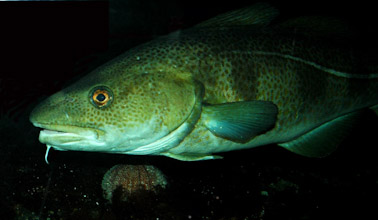
    Cod up close

    Fish and fisheries are extremely important to the Arctic region as its waters are often considered to be one of the richest fishing grounds in the world. Despite the drastic effects the significant fluctuations or collapse of the stock would have on the northern hemisphere its counterparts in the south would be considerably more vulnerable. Nations within Africa, who many of them are among the least developed nations in the world, generally have a less diversified economy and fewer means to deal with such change. In a global context fisheries are a significant part of the worlds nutritional intake, with at least 20% of the worlds annual consumption of dietary protein (Fao, 2007 (Allison et al 2009).

    Due to negative reports of the state of the fisheries globally, international and regional bodies are starting to react. One of the most commonly criticized fishery policies or organization is the European Union, which has recently addressed the issue of over fishing within its chambers. At the end of May 2009 European fisheries ministers concluded in a meeting to effectively scrap current rules that decide fishing quotas. Given this conclusion the European Union has decided to draw up a new common fisheries policy before 2012.

    It will be interesting to see if the new fishing policy will be adequate to deal with E.U problems in connection to fishing as 80% of E.U fishing grounds are estimated to be overfished (BBC News, 2009). Similarly it will be interesting to sea how regional bodies like the North East Atlantic Fisheries Committee (NEAFC) will be able to manage changes in migratory patterns of stocks.
    The position as it is portrayed by many of the leading specialist’s and organizations on a global scale will demand for close cooperation and some difficult decisions so world fishing can become sustainable within the changing environment at hand.

    Illegal and unregulated fishing also continues to be an important issue. It’s value has been estimated being between $4bn and $9bn. It also presents a further danger to species, which are already under threat of being overfished. Some interesting videos on the matter can be seen by following the links bellow:

    Sources

    • Allison, Edward H. Conway, Ashley S. Halls, Graham M. Pilling, John D. Reynolds, Neil L. Andrew & Nicholas K. Dulvy. (2009) Vulnerability of national economies to the impacts of climate change on Fisheries. Fish and Fisheries magazine
    • Cheung, William W.L. Lam, Vicky W.Y. Sarmiento, Jorge L. Kearney, Reg Watson & Pauly, Daniel (2009). Projecting global marine biodiversity impacts under climate change scenarios. Fish and Fisheries magazine
    • FAO (2007) The State of World Fisheries and Aquaculture
      2006. Food and Agriculture Organisation of the United
      Nations, Rome. Retrieved 18.02.09 from: http://www.fao.org/docrep/009/a0699e/A0699E00.HTM
    • FAO (2009) THE STATE OF WORLD FISHERIES AND AQUACULTURE
      2008. http://www.fao.org/docrep/009/a0699e/A0699E00.HTM
    • Jón Þ. Þór (2002) Sjósókn og Sjávarfang. Saga Sjávarútvegs á Íslandi. 1. Bindi Árbáta og skútuöld. Bókaútgáfan Hólar á Akureyri.
      UNDP (2007). Climate change threatens unprecedented human development reversals. http://content.undp.org/go/newsroom/2007/november/hdr-climatechange-20071127.en

  • Turmoil in Greenlandic politics

    Turmoil in Greenlandic politics

    Kuupik KleistThe left- wing party Inuit Ataqatigiit (Community of the people, IA) has won the Greenlands parliamentary elections with the support of 43.7% of voters. The ruling party for the last 30 years, the Social Democratic party (Siumut), received 26.5 % of the total vote. The democratic party(demokraatit) received 12.7% of the popular vote and the feeling of community(Atassut) came in fourth with 10.9%

    IA will hold 14 of 31 seats within the newly elected parliament and will still need the support within some of the smaller parties to form a coalition government and receive majority support within the parliament.

    IA leader Kuupik Kleist told supporters that “Greenland deserved this, we can lead this country forward, into a new era” in a celebration ceremony in Nuuk when the outcome of the election became apparent

    Political observers in Greenland believe that this shift can traced to a series of financial scandals involving leading members of the governing Social Democratic Siumut Party. The outcomes of the elections can be said to reveal that the people of Greenland say “no” to these practices and have lost faith in the Siumut party to lead the nation forward in these interesting times. Following the outcome of the elections out-going premier Hans Enoksen, party leader for the past eight years, has resigned as the leader of Siumut and will be replaced by Alega Hammond.

    Aleqa HammondIA will be the first party to govern in Greenland under the newly expanded home-rule agreement, which was approved by popular vote in November 2008. The newly approved home-rule agreement will give the Greenlandic government increased control over their natural resources and allow it to take greater charge of justice and legal affairs and will make the political development of Greenland all the more interesting.
    11.06 News update: Agreement reached for new coalition agreement.

    The new IA coalition partners are Demokraatit and KP, giving the IA coalition a majority of 19 seats in parliament, against the 12 opposition members made up of Siumut and Atassut MPs.

  • Arctic Marine Shipping Assessment Report 2009

    Arctic Marine Shipping Assessment Report 2009

    AMSA 2009 report

    The Protection of the Arctic Marine Environment working group of the Arctic Council has released a new Arctic Marine Shipping Assessment report for the year 2009.

    The AMSA working group, led by Canada, Finland and the United States has produced a extensive and well-illustrated document that represents a four-year effort to consider and review all aspects of Arctic shipping. It includes documentation of shipping activities from a baseline year (2004) and future projections in key areas such as environmental protection, marine infrastructure, human dimensions, and governance. The report also contains series of very useful maps and charts.

    Main topics of the report are:

    • Arctic Marine Geography, Climate and Sea Ice
    • History of Arctic Marine Transport
    • Governance of Arctic Shipping
    • Current Marine Use and the AMSA Shipping Database
    • Scenarios, Futures and Regional Futures to 2020
    • Human Dimensions
    • Environmental Considerations and Impacts
    • Arctic Marine Infrastructure

    The Arctic is undergoing extraordinary transformations early in the 21st century. Natural resource development, governance challenges, climate change and marine infrastructure issues are influencing current and future marine uses of the Arctic. The Arctic Council, recognizing these critical changes and issues, at the November 2004 Ministerial meeting in Reykjavik, Iceland, called for the Council’s Protection of the Arctic Marine Environment (PAME) working group to “conduct a comprehensive Arctic marine shipping assessment as outlined under the Arctic Marine Strategic Plan (AMSP) under the guidance of Canada, Finland and the United States as lead countries and in collaboration with the Emergency Prevention, Preparedness and Response (EPPR) working group and the Permanent Participants as relevant.” The Arctic Marine Shipping Assessment, or The AMSA 2009 Report, is the product of that Arctic Ministerial decision in Reykjavik and was approved at the 2009 Arctic Council´s Ministerial meeting in Tromsø.

    The AMSA 2009 Report

  • Circumpolar Young Leaders Program

    Circumpolar Young Leaders Program

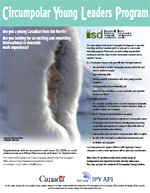
    Circumpolar Young Leaders Program flyer

    The International Institute for Sustainable Development is currently recruiting northern Canadian youth to take part in a six-month internship program “Circumpolar Young Leaders Program”. Placements are with leading organizations working on northern issues in other circumpolar countries and in southern Canada.

    The Circumpolar Young Leaders Program is now offering 5 internships for young people between the ages of 20-30 living in or originally from Nunavut, NWT, Yukon, Northern Quebec and or, Labrador. It is anticipated that training will take place in September and the 6 month placements starting immediately following the training.

    Applications will be accepted until June 22, 2009, or until placements are filled. Placements will start in September.

    For more information on how to apply, contact at intern-info@iisd.ca

  • CAFF Flora Group and Arctic Lichen Distribution Map

    CAFF Flora Group and Arctic Lichen Distribution Map

    CAFF – Flora group

    arctic flowerTraditionally, conservation and research activities for arctic plants have not been well coordinated in terms of common direction, concerns, reporting, and information exchange. Governmental and non-governmental groups have been organized bilaterally. Therefore, plant conservation and research activities have not had a fully circumpolar perspective.

    During the next few decades the Arctic will be strongly affected by forces within and from outside the region, including the impacts of global climate change, resource development, changes in numbers of wildlife species, increases in permanent residents, and burgeoning tourism.

    The relatively simple and often fragile arctic ecosystems are dramatically altered through changes to the species composition of the vegetation, destruction of wetlands, and thawing of ice-rich permafrost, as well as through feedbacks of these effects to global hydrologic and atmospheric systems. To preserve plant diversity, conservation programs must be guided by the biological requirements of species and ecosystem components as biological diversity ensures a healthy biosphere.

    Traditionally, conservation and research activities for arctic plants have not been well coordinated in terms of common direction, concerns, reporting, and information exchange. Except for two CAFF action items, Panarctic Flora Project (PAF) and Circumpolar Arctic Vegetation Mapping Project (CAVM), governmental and non-governmental groups are often organized bilaterally. Therefore, plant conservation and research activities have not had a fully circumpolar perspective.

    Arctic Lichen Data Map

    Arctic LichenWith the creation of the CAFF Flora Group (CFG) within the Conservation of Arctic Flora and Fauna (CAFF) of the Arctic Council, it is ensured that scientists, conservationists, and managers interested in arctic flora and vegetation have a forum to promote, facilitate, and coordinate conservation, management, and research activities of mutual concern. Conservation of rare and endemic arctic plants is one of the roles of Caff Flora Group. Adequate knowledge of all plants present in the Arctic and their distribution within the Arctic is a prerequisite for satisfactory preservation of arctic diversity.

    As part of this task, a list of all lichens (1610) and lichenicolous fungi (250) recorded in the Arctic is presented in the Arctic Lichen Distribution Map on the Arctic Portal. For this purpose the Arctic has been divided into 28 regions with separate lists for every region. The highest lichen diversity is found in West Greenland, 851 species. Well investigated arctic regions of considerable size generally contain about 5-600 species of lichens. 133 species of lichens appear endemic to the Arctic according to present knowledge. That means they are not found anywhere outside the Arctic. 15 species of lichens have been recorded in all of the 28 arctic regions.

    To view the Arctic Lichen Distribution Map, please click here.

  • The Story of Stuff

    The Story of Stuff

    The Story of Stuff

    The documentary “The Story of Stuff” is short documentary video which is a description of modern day consumption, with a special emphasis on the US. The video is 20 minutes long and goes over the Story of Stuff, from resource extraction, production, distribution, consumption and disposal. Consumption and waste is a major topic in the video, which raises concern about our consumption driven economy.

    The video has been a big hit in and about 6 million peoples have watched the documentary on it´s webpage and about a million more on YouTube. In the US around 7000 schools and congregations have ordered the video on DVD and hundreds of teachers have contacted the author, Annie Leonard. Since The Story of Stuff was launched online on December 4, 2007, the site has been visited by people in over 224 countries and territories around the world, and the website has received thousands of requests for the film to be translated. An international site has been launched been, which includes translated versions of the films with subtitles, as well as the contact information for the organizations around the world that did the translations.

    Annie Leonard is a former Greenpeace worker and criticisms have been made about the video, claiming it to be one-sided feature and anti-capitalistic. On the whole, the video has started some debates about environmental issues of all sorts of nature. Open Discussions about environmental issues from both sides always promotes healty dialouge, which should be welcomed by everyone.

    To view the webpage go to The Story of Stuff

  • New APECS Website

    New APECS Website

    Association of Polar Early Career Scientists

    Recently the Association of Early Career Polar Scientists launched a new website.The outlook of the website has been changed and some new features have been added. The new site features a fully searchable membership directory to find colleagues and for prospective employers to search for new hires. There is also a new and improved discussion board that is refered to as the APECS Student Lounge.

    APECS is an international and interdisciplinary organization for undergraduate and graduate students, postdoctoral researchers, early faculty members, educators and others with interests in Polar Regions and the wider cryosphere. Our aims are to stimulate interdisciplinary and international research collaborations, and develop effective future leaders in polar research, education and outreach.

    APECS’ goals include creating opportunities for the development of innovative, international, and interdisciplinary collaborations among current early career polar researchers as well as recruiting, retaining and promoting the next generation of polar enthusiasts.

    To learn more about APECS, please visit their website www.apecs.is

  • Arctic Council Ministerial Meeting in Tromsø

    Arctic Council Ministerial Meeting in Tromsø

    Arctic Council

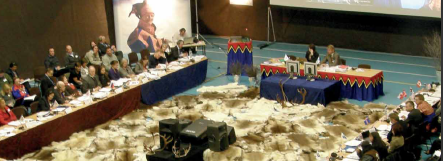
    During this week 27th of April – 1st of May, Tromsø in Northern Norway will be the capital of the Arctic as the city is the venue for The Arctic Councils biennial Ministerial Meeting. Besides this event the Norwegian minister of Foreign Affairs, Mr. Jonas Gahr Støre, together with former US Vice-president, Mr. Al Gore, have called several of the worlds foreign ministers to a conference about the global warming. The conference entitled “Melting Ice: Regional Dramas, Global Wake-Up Call” takes place.

    The two meetings will gather around 400 of the worlds leading experts and politicians on Arctic matters. In addition round 80 journalists and photographers have announced their participation.

    At the end of the ministerial meeting the Chairmanship will be handed over to the Danish delegation. The new chair of the Arctic Council will be MFA Per Stig Møller

    Parts of the “Melting Ice” Conference are broadcasted live at the Arctic Portal Webcast, along with parts of the Arctic Council´s Ministerial Meeting. All videos presented will be archived at the Webcast Archive.

    About the Arctic Council

    Starting in the late 1980s, international cooperation in the Arctic has increased to the extent that a new regional identity is emerging, with numerous political initiatives and new fora.
    The so-called Murmansk Speech by President Mikhail Gorbachev of the Soviet Union is often regarded as the initiating event for current regional cooperation in the Arctic. It had still the Soviet rhetoric on peace but reflected more the processes of glasnost and perestroika in the Soviet Union through its six proposals. The first two were about establishing a nuclear-weapon-free zone in northern Europe and reducing military activities. The others discussed confidence-building measures in northern seas, civilian cooperation in developing natural resources, coordination of scientific research, cooperation in environmental protection, and opening the Northern Sea Route to foreign ships.

    SAO meeting in Kautokeino

    SAO Meeting, Kautokeino, Norway, November 19. – 20. 2008

    Intergovernmental Arctic cooperation officially started in 1989 with the Rovaniemi process in the wake of Mikhail Gorbachev’s Murmansk speech. At the first ministerial meeting in Rovaniemi, Finland, of the eight Arctic states, which also included three northern indigenous peoples organizations, the Arctic Environmental Protection Strategy (AEPS) was signed in June 1991. The initial focus on environmental protection gradually expanded to related fields, notably sustainable development. In 1996, the Arctic states replaced the AEPS with the Arctic Council as a high-level intergovernmental forum for Arctic international cooperation that would include as Permanent Participants a certain number of transnational northern indigenous peoples organisations. Therefore the Arctic Council was established as a high level intergovernmental forum to provide a means for promoting cooperation, coordination and interaction among the Arctic States. The Arctic Council deals with common Arctic issues, with the involvement of the Arctic Indigenous communities and other Arctic inhabitants. These issues are, in particular, sustainable development and environmental protection in the Arctic.

    For further information, please visit the Arctic Council homepage and Melting Ice: Regional Dramas, Global Wake-Up Call Conference homepage.

    Reference

    Arctic Human Development Report
    The Arctic Council

  • The ACUNS-APECS: Communities of Change – Building an IPY Legacy, Call for abstracts

    The ACUNS-APECS: Communities of Change – Building an IPY Legacy, Call for abstracts

    Communities of Change

    The ACUNS-APECS: Communities of Change – Building an IPY Legacy

    9th Annual ACUNS International Student Conference on Northern Studies
    October 2 to 5, 2009,Yukon College – Whitehorse, Yukon, Canada

    Call for Abstracts

    ACUNS and APECS, in partnership with Yukon College, are soliciting Abstracts that encompass the following areas:

    • The impact of sustainable development, economic activity and polar law on communities, governance and natural habitats.
    • The use of natural, physical and social sciences to help understand the causes and effects of the changing polar climate.
    • Changes to polar marine and terrestrial communities over the short and long term.
    • Changes in research communities and how research is undertaken in the Polar Regions.

    The ACUNS-APECS: Communities of Change – Building an IPY Legacy Conference will highlight research occurring at both poles, including interactions between the cryosphere, hydrosphere, biosphere, atmosphere and society. Inter-disciplinary sessions will be arranged based on the number and breadth of Abstracts submitted.

    Submission Deadline: April 15, 2009

  • Online Whale Watching: Valuable information for fishermen

    Online Whale Watching: Valuable information for fishermen

    Last autumn the Marine Research Institute of Iceland started an experimentation of marking whales with satellite senders that send signals of their route around Iceland. The aim of the experiment is to map their migration route around the island and map their departing points of Icelandic waters.

    From 4th to 7th of November, four of those satellite senders were pinned to two humpback whales and two minke whales just north of Iceland. To mark the whales, a special air gun was used and a small research boat. Usable signals were received from both of the humpback whales, but none from the minke whales.

    Below you can see a map with the migration of one of the humpback whales. Its journey starts in the North of Iceland and the last signals received by the whale were at the south coast of Iceland, a trip that the whale made in a week or so.

    Humpback whale migration pattern around Iceland - map

    The interesting thing is that the whale stayed for a while in a location south-west of Iceland. Therefore some speculations were made that the whale had found some kind of feed. Based on those speculations, some herring fishing vessels went to the same location as the whale and gave the area a try. After some few tosses of the fishing equipment they found considerable amount of herring. So by observing the behavior of the whale, the fishing vessels were able to locate their catch.

    satellite sender device

    In a capelin research expedition by the Marine Research Institute of Iceland that is now going on, two humpback whales were pinned with two satellites senders at the east coast of Iceland. Already some signals have been received by one of those humpback whales that were marked 1st of February this year. It is possible to follow the migration of one of the humpback whale at the Marine Research Institute of Iceland website, to see the whale´s migration pattern

    whale

    Who knows if those two humpback whales that were marked in the capelin research expedition will lead the way to large shoal of capelin for Icelandic fishermen to catch?

    All information and photos are from the the Marine Research Institute of Iceland website, www.hafro.is