Blog

  • Call for Contributions: “Northern Notes,” IASSA Newsletter

    Call for Contributions: “Northern Notes,” IASSA Newsletter

    IASSA

    The International Arctic Social Sciences Association (IASSA) invites contributions for the next issue of the Northern Notes newsletter.

    Contributions are invited from both members and non-members of the Association on issues of interest to Arctic social scientists. Articles, reports, announcements, reviews (books, films, etc.), and conference or meeting announcements should be submitted by 2 February 2009 to IASSA secretary, Lára Ólafsdóttir, at iassa@svs.is.

    Northern Notes is published on the web by the IASSA secretariat twice a year with a Spring/Summer and a Fall/Winter issue, and is available to all web users. To view past issues of the newsletter, please go to: http://www.iassa.gl/newsletters.htm.

    Contributions to Northern Notes may include special features on issues and topics of interest to Arctic social scientists, information and announcements from members, announcements of meetings, workshops or conferences, news about upcoming IASSA activities, information about new publications of interest to the Arctic social science community, and announcements of new websites and links of interest.

    IASSA invites contributions by 2 February 2009 for the following standard categories of the newsletter:

    Features:

    Contributions on issues and research activities of interest to the Arctic social science community, including new research, current and upcoming research activities and events, etc.

    Departments:

    News from Members
    New books, Journals, Dissertations & Film
    Conferences, Workshops, and Meetings
    On the Web
    Funding Opportunities

    Remember to send us the following details along with your article or announcement:

    Name and affiliation of the author
    Book announcements: All titles, publishing details, distributor and ISBN/ISSN number
    Film: Distributor or link, all release details

    The IASSA secretariat moved to Akureyri, Iceland, on 1 October 2008, and is located at the Stefansson Arctic Institute.

    Contact:

    IASSA
    Stefansson Arctic Institute
    Borgir, Nordurslod
    IS-600 Akureyri, Iceland
    Tel: (+354) 460 8980
    Fax: (+354) 460 8989
    E-mail: iassa@svs.is

  • University Centre of the Westfjords

    University Centre of the Westfjords

    University center of the westfjords logo

    In the small village of Ísafjörður in the rural area of the Westfjords in Iceland, is a small but ambitiuos University centre. The University Centre of the Westfjords is a non-profit organisation established in March 2005. It has 40 founding members, including all of the country’s institutions of higher education. The Centre began operations in Vestrahús in Ísafjörður in January 2006. The same building houses offices of the Marine Research Institute, the Icelandic Fisheries Laboratories, and the Icelandic Snow Avalanche Research Centre, among others. The Westfjords Regional Development Centre is also located there, and all of the organizations represented in the building share common reception facilities.

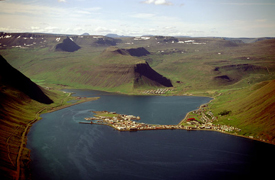
    IsafjordurThe University Centre acts as a contact between Westfjords residents and institutions of higher education. The most important aspect of this work is the University Centre’s function as the West Fjord’s distance-learning institute. Seven universities in Iceland offer distance learning courses and distance learning instruction takes place at the Centre, variously through the Internet or with the help of remote conference technology.

    The Centre also assists university students and teachers from outside the area in establishing contacts in the Westfjords. The Centre provides information on the region as an interesting option and area for research and assists students and scholars in their work on research projects in the Westfjords. The University Centre makes its facilities available to all university-level students who are studying or carrying out research in the Westfjords.

    Preparatory program for university entrance

    The School of Science and Engineering at Reykjavík University offers a preparatory program for students who do not yet qualify for university entrance. The goal of the program is primarily to prepare students for further studies within the School of Science and Engineering. However, the program offers good general preparation for all kinds of university-level studies, and students who complete the preparatory program have a good chance of being accepted to other university programs in Iceland. A special support system is planned for those whose mother tongue is not Icelandic but who have a good command of the language.

    Continuing Education

    the town IsafjordurThe University Centre of the Westfjords offers exciting continuing education opportunities in the field of environmental and resource management, in connection with its cross-disciplinary program in Coastal and Marine Management.

    The master’s courses will be open for external participants, who must, however, fulfill the program’s admission requirements and be approved by the master’s program committee. The courses are particularly useful for those working professionally in research, planning, resource management, environmental assessment, and related areas.

    Coastal and Marine Management Masters Program

    The University Centre of the Westfjords offers a Masters program in environmental and resource management. Coastal and Marine Management is a demanding and ambitious master’s program in environmental and resource management. The program is cross-disciplinary and prepares students for diverse and exciting positions in both the public and private sectors. It is offered in cooperation with the University of Akureyri, one of Iceland´s state-run universities, which has specialized in fisheries science and related matters for many years. Among the fields which the master’s program in Coastal and Marine Management prepares students to work in are resource and land use planning, environmental impact assessment, consulting work, teaching and research. The program is internationally oriented and taught in English, and both students and instructors come from a diverse range of countries. The master’s program in Coastal and Marine Management brings together people of different backgrounds who share their experience, knowledge, and ideas in a small-scale, creative and fertile intellectual environment, with the goal of finding ways of using natural resources in a sustainable way. The University Centre of the Westfjords welcome new faces to join our exciting group of natural resource management specialists. The application deadline for the autumn semester 2009 for Non EU/EEA citizens is February 15th and for EU/EEA Citizens is April 15th. Residents in Iceland can apply for the spring semester 2009, the deadline is December 15th.

    Isafjordur

    For more information about the University Centre of the Westfjords of Iceland, please visit the Centre´s website.

    Coastal and Marine Management Brochure

  • Application for funding from the Nordic Council of Minister

    Application for funding from the Nordic Council of Minister

    Norden

    The Nordic Council of Ministers Arctic Cooperation Programme 2009-2011 is now open for funding applications.

    The deadline for applications will be 15 January 2009. Further information on the priorities of the Programme, criteria’s for applicants and the application form can be found on the NCM website or on the NordRegio website. NordRegio will be responsible for the management of the NCM Arctic Cooperation Programme and possible applications need be sent to NordRegio (nordregio at nordregio.se).

  • Students on Ice

    Students on Ice

    Students on ice banner

    The Feature of the Week at the Arctic Portal is ambitious program “Students on Ice”.

    Students on Ice Expeditions (SOI) organize annual educational expeditions to the Arctic and the Antarctic. Its mandate is to provide students, educators and scientists from around the world with inspiring educational opportunities at the ends of the Earth, and in doing so, help them foster a new understanding and respect for the planet and for each other. To date in just over 8 years, over 1,000 students, educators, experts, and scientists from 32 countries have participated in this unique program.

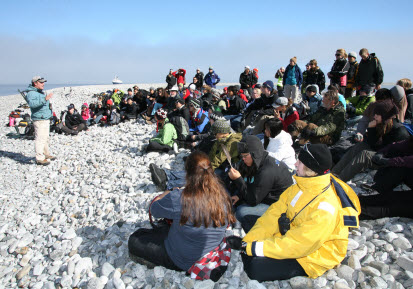
    Students on ice, lectureSOI was founded by adventurer, environmentalist and educator, Geoff Green – a veteran expedition leader of 74 Antarctic expeditions and 31 Arctic expeditions. In 2004, Outpost Magazine chose Geoff as one of the “Top 5 Explorers to Watch”. Over the past fifteen years, Geoff and SOI have worked directly with many IAATO Members, including Quark Expeditions, Polar Star Expeditions, Peregrine Expeditions, Hapag Lloyd, ResidenSea, and Antarpply Expeditions.

    Most recently SOI was endorsed as the official youth expeditions for the International Polar Year (IPY) 2007-2009. The IPY marks a critical opportunity for the world to turn its attention to the state of our Polar Regions, to better understand the global implications, and to seek the necessary actions and solutions required by all of us. This remarkable event offers a timely and exciting opportunity to mentor and inspire the next generations of scientists, researchers and young leaders.

    In between expeditions Students on Ice continues to raise awareness about the global issues that need to be addressed individually and collectively by being part of inspiring outreach activities, such as conferences and speaking engagements. In the context of IPY 2007-2009, Alliance of Natural History Museums of Canada in partnership with Students on Ice is organizing and delivering the Polar Perspectives 2008 Speakers Series and Youth Forums. The goal is to raise awareness about Arctic issues such as the impacts of climate change on the environment, health, culture, sovereignty and indigenous rights. The International Polar Year (IPY) is the largest-ever scientific research program directed at the Polar Regions.

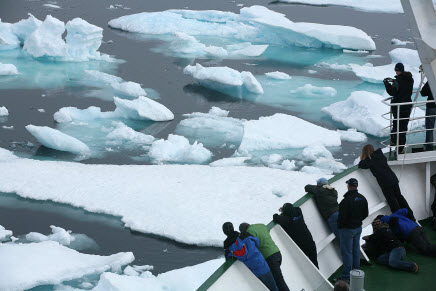
    Students looking at sea-ice from a shipThe aim of Students on Ice is not to simply provide students with a “trip” to a unique destination but rather to give students an opportunity to have an aesthetic experience in some of the most wild and awe-inspiring ecosystems in the world. The objective is not to let students to just pass through a place with camera in hand, but rather to listen to the land; to ‘feel’ these natural places and in turn, explore how humans feel when immersed in such places. The goal of SOI is that students experience a transformative connection with Nature – a connection that changes the way they understand and act in this world.

    On expeditions, several different learning formats are used depending on the topic being explored, location, weather conditions, and the skills and experiences of the education team members in which is assembled each time. These learning formats include: lectures, workshops and hands-on activities that are shore, zodiac, and ship-based in setting. There is an environmental focus on the SOI expeditions’ lectures discussions and activities on current environmental issues facing the regions travelled are implemented through. Climate change is a particular focus on all of Students on Ice expeditions.

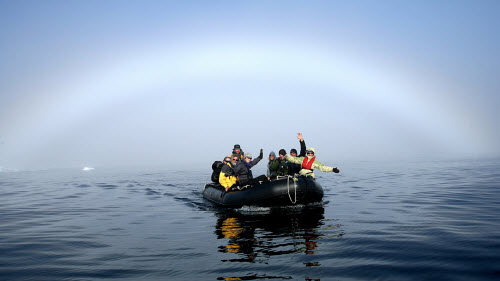
    fogbow - Rainbow in a fogStudents on Ice program, has received numerous awards and citations for its work with young people, education, the environment and polar conservation. Recently, it received the prestigious 2007 Citation of Merit Award from the Explorers Club in New York City. It has also received the Michael Smith Award for Science Promotion in Canada, as well as a special Citation of Merit from the United States Congress.

    The Students on Ice offers a interesting website with comprehensive information about upcoming and previous expeditions which date back to the year 2000. At the website, it is also possible to view unique videos from previous expeditions. Those videos include e.g. “Visit to Walrus Island”, “A Hundred Whales and Two Bears” and “Going Into the Fog”. The site offers information about the Students on Ice staff, with practical background information about each and one of the SOI team. In addition to all that, Students on Ice have a blog with news from Student on Ice Activities.

    The Students on Ice Webpage

  • The International Polar Year

    The International Polar Year

    Arctic Portal news

    The International Polar Year is a large scientific programme focused on the Arctic and the Antarctic. The program officially ran from March 2007 to March 2009 but was closed in September 2011. IPY was organized through the International Council for Science (ICSU) and the World Meteorological Organization (WMO). It was actually the fourth polar year, following those in 1882-3, 1932-3, and 1957-8.

    IPY involved over 200 projects from around the world on Arctic and Antarctic issues. Thousands of scientists from over 60 nations examined a wide range of physical, biological and social research topics. It was also an unprecedented opportunity to demonstrate, follow, and get involved with, cutting edge science in real-time.

    Arctic Portal is a good example of a project which started out as an IPY project.

  • Icelandic Fisheries Portal

    Icelandic Fisheries Portal

    Icelandic Fisheries Portal

    The Feature of the week is the newly opened Icelandic Fisheries Portal. The Portal is a project worked jointly by the Ministry of Fisheries and Agriculture in Iceland, Directorate of Fisheries, Icelandic Marine Research Institute, University of Akureyri and Matís – Icelandic Food Research.

    General Information

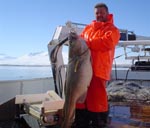
    fishermanThe Icelandic fisheries portal is a gateway to information on the marine ecosystem around Iceland and on Icelandic fisheries. On the Fisheries Portal, you will be able to find information on everything from the ecosystem to the economy.

    The objective of the new and improved Icelandic fisheries portal is to provide easy access to reliable information on the ecosystem and ocean environment around Iceland, on sustainable utilization of the country’s resources, and on the nutrients and healthiness of seafood in general. Statistical information is also available on fisheries and on the importance of utilizing marine resources for the Icelandic economy. All the information is in English.

    The portal is intended to serve as a comprehensive information source for experts and laymen, wanting information on Iceland’s offshore waters and their utilization, as well as on Icelandic fisheries. This could include, for instance, buyers and marketers of Icelandic seafood’s, students both in Iceland and abroad, fisheries professionals and experts as well as environmental groups and the general public.

    Contents of the Fisheries Portal

    The database will include information on the marine ecosystem, its resources and the principal marine products, markets and resource management. Historical overview is also provided along with general information about Iceland, such as geography, the society, infrastructure and politics. As such, the database, will serve as a sort of information display window for fisheries and related issues in Iceland for use by corporations, journalists, scientists, students and the public. The portal will contain general textual information, simple graphs and illustration, as well as more detailed data of use to scientists, for instance

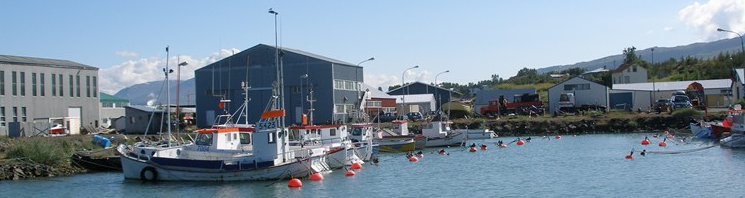
    small harbour

    The URL of the website, operated by the Ministry of Fisheries and Agriculture in Iceland, is http://fisheries.is/

  • Stefansson Arctic Institute

    Stefansson Arctic Institute

    Stefansson Arctic Institute

    Stefansson Arctic Institute logo

    The Stefansson Arctic Institute (SAI) was established in 1998 and operates under the auspices of the Icelandic Ministry for the Environment. Recently, the Institute celebrated its ten year anniversary. Among guests and speakers at the celebration were Ms. Þórunn Sveinbjarnardóttir, Minister for the Environment and Ms. Sigrún Björk Jakobsdóttir, Mayor of Akureyri.

    The Institute bears the name of explorer and anthropologist Vilhjálmur Stefansson (1879-1962). He was born in Canada and both his parents were Icelandic immigrants. Vilhjálmur studied anthropology at Harvard and then explored the Arctic from 1906 to 1918. When he returned he lived in the USA, giving lectures, writing and teaching.

    Vilhjálmur Stefánsson
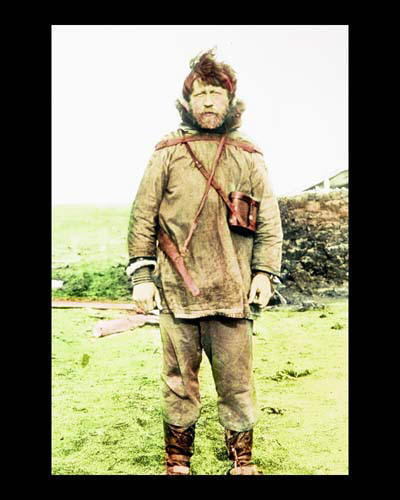
    Vilhjálmur Stefánsson

    Stefansson undertook his first expeditions when he was a student of anthropology at Harvard University. These were journeys to Iceland in 1904 and 1905 for the purpose of obtaining human bones for research in anthropological anatomy. Vilhjálmur Stefansson was best known, however, for his extensive scientific expeditions into the unexplored regions of northern Canada.

    Stefansson’s expeditions constitute impressive achievements, in the fields of both exploration and research, and include numerous elements of the societies and natural environment of the North. Vilhjálmur spent a total of ten winters and seven summers travelling through the northern regions. With his companions, he travelled on foot and by dog sledge, covering a distance of approximately 32,000 kilometers, often in extreme conditions.

    Stefansson wrote over 20 books as well as nearly 400 articles and essays on most subjects in the sphere of Arctic studies. One of Vilhjálmur Stefansson’s best-known books is The Friendly Arctic, and he foresaw that the book’s title presented a challenge to many of his contemporaries who did not share his positive approach to Arctic regions and their inhabitants. Stefansson undertook three arctic expeditions, which included discoveries of new land and the edge of the continental shelf. His journeys and successes are among the marvels of polar exploration.

    Expeditions:

    1906-1907 Anglo-American Expedition explored Mackenzie Delta area of Arctic Canada
    1908-1912 Stefansson-Anderson Arctic Expedition: explored Arctic Canada
    1913-1918 Canadian Arctic Expedition: explored Arctic Canada and discovered Brock, Borden, Meighen and Lougheed Islands

    The legacy of the explorer and anthropologist Vilhjálmur Stefansson is closely connected with human-environmental relations, the sustainable use of natural resources, and the survival and viability of northern communities. Perhaps his legacy is of primary importance because he has, more than anyone else, contributed to a change in the image of the North, from a barren eternally frozen wasteland into a rich region of diverse character that deserves the attention of the international community. We live in changing times and the current focus of awareness has certainly been shifted north. This has been a rapid development, transferring the Arctic regions to a central position with regard to the issues of environmental and climate change, international co-operation and resource governance and use.


    Stefansson Arctic Institute

    The Stefansson Arctic Institute is located in Akureyri in Northern Iceland. The staff at the Stefansson Arctic Institute includes scientists with broad interdisciplinary research background and experience. SAI has enjoyed and further welcomes visits by scholars, to work on and present their research. The role of the Institute is to:

    • promote sustainable development in the circumpolar north and strengthen Icelandic participation in this endeavor,
    • facilitate and co-ordinate arctic research in Iceland,
    • be a forum of co-operation with regards to multidisciplinary research and international events and projects,
    • collect and disseminate research material and information on circumpolar issues,
    • provide facilities for scholars pursuing research relevant to SAI’s agenda,
    • advise the government on northern issues.

    Stefansson Arctic Institute Current Projects

    Arctic Human Development Report

    The Arctic Human Development Report was published in November 2004. The report was prepared under the auspices of the Arctic Council and is an overview and assessment of human conditions in the circumpolar region. The secretariat of the project was at the Stefansson Arctic Institute.

    The Friendly Arctic: A Travelling Exhibition

    The exhibition focuses on Vilhjálmur Stefansson’s life, legacy and vision for the Arctic, featuring a selection of his photographs, recordings, publications, diaries, maps and other items. The exhibit opened in Akureyri Art Museum in November 2000 and has after that visited Reykjavík, Gimli, Winnipeg, Iqaluit in Nunavut, Norwich in Vermont, New York and in Bryggen, Copenhagen. To view a web version of the exhibition, please click here.

    Human Dimensions of Arctic Environments

    This web-based information project is concerned with arctic cultures and environments, with a broad comparative focus on critical issues, problems and opportunities which face the peoples of the Circumpolar North today. Launched by SAI in 2000 with funding from the European Commission, the project involves co-operation with the Arctic Centre in Rovaniemi, Scott Polar Research Institute in Cambridge, the Institute for Arctic Studies at Dartmouth College, University of Iceland Institute of Anthropology and University of Akureyri. The name of the project is The Arctic Is. To view the projects website, please click here.


    International Collaboration

    University of the Arctic

    Designed to meet the needs of northern peoples as they face the challenges of a rapidly globalizing world, the University of the Arctic has begun to make important contributions to higher educational in the emerging circumpolar region. The Stefansson Arctic Institute has a representative in the Council of the University of the Arctic, participates in developing the University’s Bachelor of Circumpolar Studies Program, and contributes to the delivery of UArctic courses at the University of Akureyri. The UArctic webpage.

    Northern Research Forum (NRF)

    The NRF provides a platform for effective, policy-relevant discussion and the sharing of research on northern issues. Open meetings are held biennially with the participation of a wide variety of scientists, policy makers and representatives of other stake-holders. The first NRF was held in Akureyri in November 2000, the second in Veliky Novgorod, NW Russia in 2002, and the third in Yellowknife and Rae Edzo, the Northwest Territories, Canada in 2004. The fourth Open Meeting was held in Oulu, Tornio, Haparanda and Luleå in Sweden and Finland in 2006. The 5th NRF was held in Anchorage, Alaska, in September 2008. The secretariat for the NRF is operated jointly by the Stefansson Arctic Institute and the University of Akureyri. Northern Research Forum Website.

    North Atlantic Biocultural Organization (NABO)

    SAI is the one of NABO’s coordination offices. NABO is a non-governmental regional research co-operative with over 450 members in 14 countries. NABO includes 28 major northern research centers in North America, and northern Europe. NABO webpage.

    The International Arctic Social Sciences Association (IASSA)

    IASSA is governed by an elected eight-member Council and a General Assembly consisting of all members having paid their membership. There is a General Assembly every three years held during the International Congress of Arctic Social Sciences (ICASS) organized by IASSA. Between the General Assemblies IASSA is run by a Secretariat. The Secretariat is located at the Stefansson Arctic Institute.

    Other international initiatives and circumpolar networks in which SAI participates include the International Arctic Science Committee Regional Board, the Nordic Polar Group, and International Conference on Arctic Research Planning.


    Location of the Stefansson Arctic Institute

    The Stefansson Arctic Institute is located in Akureyri, Iceland’s Capital of the North, which is a growing centre of arctic activities and events. Two of Arctic Council’s secretariats are located in Akureyri – CAFF (Conservation of Arctic Flora and Fauna) and PAME (Protection of the Arctic Marine Environments). The Northern Research Forum secretariat is located in Akureyri and the International Arctic Social Sciences Association (IASSA) was recently moved to Akureyri. In addition, Studies in Polar Law for M.A. and LL.M. were launched in the autumn of 2008 at the University of Akureyri. The town of Akureyri, of 17000 people, is gaining reputation for hosting arctic related workshops, conferences and other events. The Arctic Portal Project is also based in Akureyri.


  • Understanding Migration in the Circumpolar North, Social Science Forum at the University of Akureyri

    University of Akureyri

    In the Social Science Forum at the University of Akureyri, Professor Lee Huskey will discuss research being done around the circumpolar north and draws general lessons from the different experiences of northern migration in the Arctic nations. Similarities and interesting differences among patterns and determinants of migration will be discussed. The lecture is held by the University of Akureyri and the Stefanson Arctic Institute.

    Migration is a major influence on the size and demographic structure of the population in Arctic regions. The patterns of migration differ significantly across countries and between indigenous and non-indigenous people. Migration patterns also differ across demographic groups in the North; rates of migration differ by gender, age, and education level. Migration involves long-term social and cultural consequences for communities in the north as well as for the migrants themselves.

    Material necessity is a major determinant of population movement, so the creation or loss of income earning opportunities in the north will affect migration decisions. Migration decisions will also reflect more general estimates of the quality of life offered by different communities. The pursuit of jobs, education, family, and bright lights will each influence migration in the north.

    Public policy will also affect migration. While migration in most Arctic nations is a decision made by households or individuals, in some past periods migration decisions have been a matter of public policy. Public choices about transfer payments and the provision of services and infrastructure influence migration decisions today.

    Lee Huskey is a Professor of Economics at the University of Alaska Anchorage (UAA). He holds a Ph.D. in economics from Washington University in St. Louis.  At the UAA Lee has served as Chairman of the Department of Economics, Director of the Center for Economic Education, and Director of the Experimental Economics program. He was elected President of the Western Regional Science Association in 2005. He has been active in a number of northern pursuits including the Arctic Social Indicators project, the University of the Arctic, and the Northern Research Forum.

    Lee’s current research examines the patterns and determinants of rural-urban migration in Alaska. He is currently the principal investigator for two projects on northern migration funded by the US National Research Foundation and the European Science Foundation which involve social scientists from a number of countries and disciplines. More generally his research has examined economic development in rural regions and particularly the influence of institutions on this development. For further information, see http://exchweb/bin/redir.asp?URL=http://www.cbpp.uaa.alaska.edu/aflh.asp

  • Conference organized jointly by the French presidency of the council of the European union and the principality of Monaco, 9-10 November 2008

    The conference will take place in two phases: One session devoted to discussions between experts which will itself be broken down into two parts: an inventory of environmental research in the Arctic; a focus on existing research tools and current thoughts/discussions on the creation of a network of observation stations in the Arctic; A ministerial session organized around two round tables in which ministers will participate and where recommendations by experts will be debated.

    Background

    The Arctic is the area in the world where the effects of climate change on the environment are most evident, should they deal with the physical environment, the populations or biodiversity. The Arctic basin also houses part of the different types of pollution emitted into the northern hemisphere. It is therefore a privileged field for observing the evolution of pollution with time as well as their effects on polar environment. Monitoring the effects of climate change upon our environment in the long run requires the pursuit of the significant effort made by countries active in scientific research in the Arctic, and their operators. The European Union has undertaken various ambitious programmes in the Arctic (including the DAMOCLES programme). The International Polar Year (2007- 2009) provides an opportunity to increase research efforts: over two thousand projects bringing together thousands of scientists from around 60 countries have been launched. Such efforts are based on observatories which, however, present some weaknesses (heterogeneity, very variable meshing according to the different regions and heterogenic standards). In order to lessen these weaknesses, it is highly desirable to strengthen cooperation between the scientific teams involved and better ensure the quality of measures and the circulation of data. An impulse has already been given to the creation of a network of stations to observe the Arctic, both within the framework of the Arctic Council ?(the SAON group, Sustaining Arctic Observation Networks, which will present its conclusions in April 2009) and within the European framework by way of the European Polar Board. In order for this dynamic to continue beyond the International Polar Year, France, whose polar institute (IPE V) coordinates around 20 research programmes in the Arctic, decided to organize an international conference on the Arctic in the framework of its presidency of the Council of the EU and following the conclusions of the Grenelle environment forum. The Principality of Monaco, which has long had an interest in polar issues, inspired a decision adopted by the Board of Directors of UNEP (United Nations Environment Programme), held in Monaco in February 2008, calling on States ‘to support and strengthen networks to observe the Arctic over coming years’. The Principality offered to organize jointly with France this international conference which will take place in Monaco on 9 and 10 November this year.

    Format of the Conference

    The conference will take the form of a ministerial meeting. Over one and a half days, on 9 and 10 November 2008, it will bring together experts belonging to the international scientific community and governments interested and secondly the ministers involved in Arctic issues. The Conference will bring together around 230 people and is directed at: Representatives of the governments of the 27 EU member states, Norway, Iceland, Principality of Monaco and the home rule authorities of Greenland; Representatives of member States of the Arctic Council or with scientific activities in the Arctic (including China, India, Japan and Republic of Korea); The European Institutions (European Commission, European Parliament, European Environment Agency) ; Representatives of regional and international organizations; Experts belonging to the international scientific community; Representatives of indigenous people; Representatives of civil society; Personalities with knowledge on this issue.

    Expected results

    A political support to the pursuit of scientific research beyond the International Polar Year as well as to intensify the work underway within the SAON group on the network of observation stations in the Arctic in order to provide elements for decision making on the prevention of environment deterioration. The launch of the process necessary to enable the creation of a network of European observatories in the Arctic which would be based on the work of the European Polar Board and the European Polar Consortium, and considered to be a contribution to the ongoing process within the SAON group.

    Conference objectives

    To increase public awareness on the urgent need for action to protect the Arctic from damage caused by degradation of the global environment; To provide a focus on scientific studies carried out in the Arctic within the context of the International Polar Year, broadening them into wider subjects around a central theme: the Arctic as a privileged observatory of global environmental changes, and especially the effects of climate change; To launch a political appeal to pursue scientific research beyond the International Polar Year and to create a network of Arctic observation stations for the protection of the environment.

  • Arctic Indigenous Languages Symposium

    The Arctic Indigenous Languages Symposium will be held in Tromsø, Norway on 19-21 October 2008.

    On the Arctic Indigenous Languages website are published the goals of the symposium and the their vision statement. The vision statement and the goals are:

    The symposium is an exciting initiative that will bring together indigenous peoples from throughout the circumpolar region to build on each other’s knowledge and experience in protecting and revitalizing our indigenous languages.

    The symposium aims to be a forum where Arctic indigenous peoples can learn from one another and develop practical ways to revitalize our languages so they remain strong for generations to come.

    The languages symposium was mandated by the Salekhard Declaration, 2006, which stated that “Ministers representing the eight Arctic States, convening in Salekhard, Russia, for the Fifth Ministerial meeting of the Arctic Council, … Recognizing the cultural diversity in the Arctic represented by more than 40 distinct peoples, cultures and languages … Hereby:”

    Please check back to the Arctic Indigenous Languages website for the latest details on the symposium and many insightful background articles as well as video clips showing individuals from several Arctic peoples speaking their indigenous languages.

    To view Live Webcast from the symposium, please click here, on the Arctic Portal Webcast area. It is also possible to view the recordings of the symposium at the Arctic Portal Webcast Archive.

    “To enhance and promote Arctic Indigenous languages and all the Arctic knowledge contained therein”.

    Their objectives are:

    1. To share best practices from across the Arctic and elsewhere on enhancing and promoting Arctic Indigenous languages.
    2. To engage policy-makers and indigenous experts in discussion of the state of the languages and on revitalization strategies.
    3. To explore the role of language in understanding, maintaining, and increasing Arctic-specific knowledge.
    4. To investigate the many ways language is transmitted through cultural expressions, stories, and literature across the Arctic.
    5. To provide guidance and recommendations on circumpolar-wide language issues to the Arctic Council and indigenous peoples, as well as other bodies such as:

    Arctic states
    UNESCO
    UNPFII
    Other legislative jurisdictions responsible for Arctic Indigenous language policy
    Other interested groups, such as universities and research institutes.