Tag: Akureyri

  • Start of the NRF Open Assembly

    Start of the NRF Open Assembly

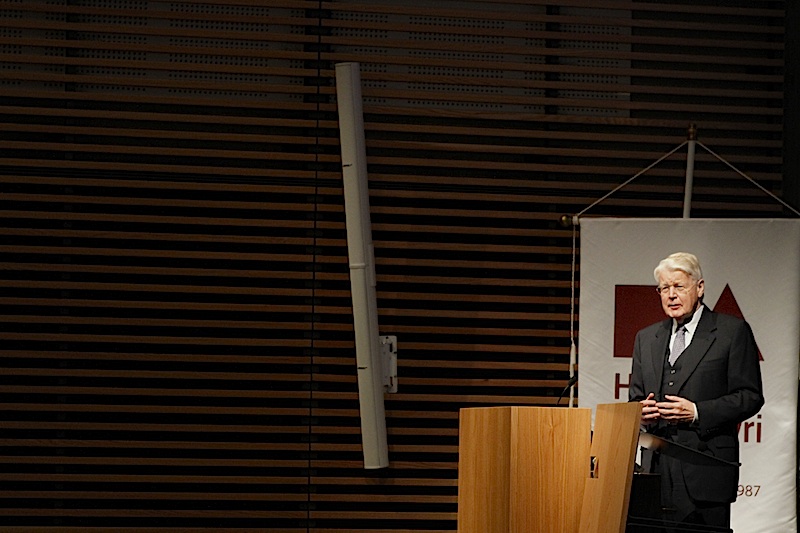
    Ólafur Ragnar Grímsson at the NRF Open Assembly

    The NRF Open Assembly started in Akureyri this morning. Its theme is: Climate Change in Northern Territories, Sharing Experiences, Exploring New Methods and Assessing Socio-Economic Impacts.

    Click here to see the conference program.

    Pictures from day 1.

    The conference started with words of welcome from Rector Stefán B. Sigurðsson, Professor Lassi Heininen and Professor Grétar Þór Eyþórsson.

    But one of the highlights was the opening speech of Mr. Ólafur Ragnar Grímsson, president of Iceland.

    He mentioned that now the eleven biggest economies in the world are now linked to the Arctic through the Arctic Council, amongst them the biggest Co2 emission countries in the world.

    He also welcomed interest from Arctic outsiders due to their work on climate change and their resource knowledge on related issues.

    He demonstrated that China sent an icebreaker across the Arctic in 2012, conducting scientific research, confirming severe consequences of climate change. Consequently the weather in China in January and February was one of the worst in recent years, directly impacted by the Arctic changes.

    Keynote sessions will continue over the two-day conference.

    Recording will be available after the conference.

  • AES call for posters

    AES call for posters

    Arctic Energy Summit

    Arctic Energy Summit that will take place in Akureyri, northern Iceland 8 – 10 of October 2013 has now opened the call for posters.

    In order to encourage knowledge sharing and information exchange between conference participants on their ongoing projects or emerging technology, AES calls for conference posters.

    The 2013 Arctic Energy Summit is also an excellent platform to showcase of the energy – related products, projects or programs to the leading policy makers and professionals working in the field of arctic energy.

    The 2013 Arctic energy Summit is a multidisciplinary event expected to draw several hundred industry officials, scientists, academics, policy makers, energy professionals and community leaders together to collaborate and share leading approaches on Arctic energy issues.

    Click here for more information about the Conference.

    Source

    Arctic Energy Summit

  • AES early registration is now open

    AES early registration is now open

    Arctic Energy Summit

    The early registration for Arctic Energy Summit is now open and available on the website.

    The Conference will take place in Akureyri, Iceland. Located in North Iceland and just 60 kilometers below the Arctic Circle, Akureryri is the largest city in Iceland outside of the Reykjavík capital area with a population of 18,000 people.

    It is the center of trade and services in northern Iceland and is filled with culture.

    The town is notable for having the northernmost botanical garderns, swimming facilities, an 18-hole golf course and great hiking trails. There are many natural wonders including waterfalls, volcanic areas and canyons.

    The 2013 Arctic Energy Summit is a multi-disciplinary event expected to draw several hundred industry officials, scientists, academics, policy makers, energy professionals and community leaders together to collaborate and share leading approaches on Arctic energy issues.

    The 2013 Summit will address energy extraction, production and transmission in the Arctic as it relates to three thematic areas and key questions.

    Source:

    Arctic Energy Summit

  • Climate Change in Northern Territories

    Climate Change in Northern Territories

    Mountain landscape in the arctic

    The Conference: “Climate Change in Northern Territories will take place in Akureyri, northern Iceland 22nd – 23rd of August 2013.

    The registration to the ESPON/ENECON and NRF event is now available. Early registration fee will be available until the 10th of July 2013.

    Bookings for accommodation are done through the registration form and information on the hotels can be found on the registration web page. Please note that accommodation can only be guaranteed through registration until the 10th of July. After this conference guests might have to make reservations on their own.

    In questions regarding travel and accommodation please contact Akureyri Travel at aktravel@aktravel.is or call +354 4600 600.

    Practical information on registration and travelling in Iceland can be found here.

    Click here to download the program of the conference “Climate Change in Northern Territories”.

    Source

    NRF

  • Arctic Energy Summit in Akureyri 2013

    Arctic Energy Summit in Akureyri 2013

    The Church of Akureyri

    The Arctic is sometimes described as the last frontier in the development of energy resources. The Institute of the North’s Arctic Energy Summit will explore energy as a fundamental element of the sustainable development of the Arctic as a lasting frontier. Central to this concept is how  a focus on richness, resilience and responsibility will provide a pathway for sustainable energy development in the Arctic.

    The Arctic’s energy resources – from oil and gas development to renewable resources such as geothermal, wind, hydro and tidal energy – have received increased attention. There has been little corresponding appreciation for how Arctic communities use energy resources and benefit from production of and access to affordable, accessible energy.

    Building on the work done at the highly successful 2007 Arctic Energy Summit and Technology Conference, the 2013 Summit will address energy extraction, production and transmission in the Arctic as it relates to three thematic areas: richness, resilience and responsibility.

    The interactive conference format will include:

    • Keynote speeches
    • Workshops
    • Panel discussions
    • Paper presentations

    This interdisciplinary forum is for scholars, energy industry officials, scientists, academics, policy makers, energy professionals and community leaders who share an interest in—and concern for— sustainable development of the Arctic and its energy resources. To register, or for more

    We welcome submissions that directly address the conference theme, and add substantively to the discussion of one or more of the following questions:

    Richness
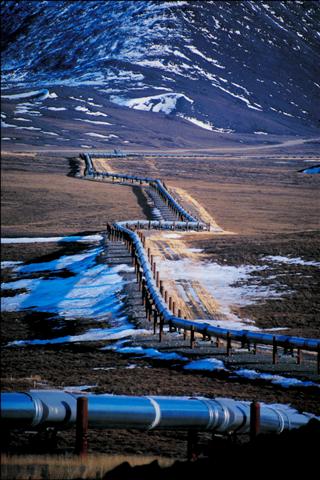
    hot water pipes

    The USGS estimates that more than a quarter of the world’s yet-to-be-discovered oil and gas is in the Arctic. At the same time, geothermal, wind, tidal and hydro resources have the potential to lower the cost of living for northern communities and significantly impact domestic markets.

    • What does this supply of resources mean for the prosperity of northern peoples?
    • What new energy resources are being explored for or developed in the Arctic?
    • How are northern communities enhancing their resource wealth with value-added activities?
    • What role do impact benefit agreements, sovereign wealth funds and other revenue distribution mechanisms play in enhancing national, state, community or tribal prosperity when energy projects are being developed?
    • How is resource wealth used to develop sustainable energy systems for local use?

    Resilience

    Adaptability is critical in the Arctic – peoples of the North have been managing change for millennia. Northern peoples and the environment must respond to rapid shifts in their natural and built environment. The companies doing business in the Arctic must also be innovative and responsive to changing political and environmental landscapes. New technology is guiding development of previously unreachable renewable and extractive energy resources and new shipping routes are ensuring that they can be moved to markets.

    • What strategies are necessary for building social and ecological resilience?
    • How do northern peoples maintain their rich cultures in times of immense economic and environmental change?
    • What risks to resilience does the Arctic face in a time of rapid change and development?
    • What resilience strategies developed for other remote areas can be adapted to the Arctic?
    • How can the built environment in northern communities contribute to community resilience?
    • How does new technology increase the lifespan of northern energy systems and extraction projects?
    • How do nations and communities build resilience in the face of fluctuating energy prices?
    • What technologies are making current resource development possible? What is needed to induce research and development of new technology?
    • How does public policy incentivize investment in the infrastructure and technology needed for further resource development?

    Responsibility

    There are many actors in the Arctic, and an even greater number of different perspectives about each stakeholder’s rights and responsibilities. Of particular significance is how roles shift relative to local, national and international decision-making levels. Geographic scale, too, plays a critical part in defining responsibility.

    • To what degree should Arctic energy resources be developed to meet a global demand?
    • How do we approach energy development that meets the needs of the world, the environment, the people and a company’s bottom line?
    • How does the world’s demand for energy resources influence public policy or create pressure to develop these resources in Arctic nations?
    • Whose responsibility is oil spill prevention and response and how do we incorporate local, private and public assets? How do recent Arctic Council Agreements impact energy development?
    • How can policy-making respond to different levels of concern and management capacity?
    • What does corporate social responsibility mean for the energy industry in the Arctic?
    • Which responsibilities are shared and what is the best way to reach agreement on those?

    TYPES OF SUBMISSIONS ACCEPTED
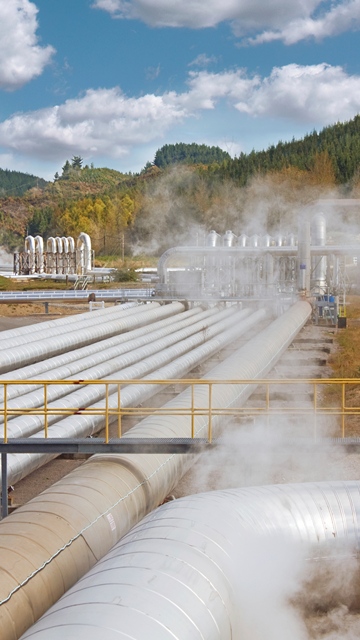
    Geothermal energy

    Abstracts may be submitted for any of the following:

    Paper Presentations
    Paper presentations will each be scheduled for a 15minutes presentation with 5 minutes for questions. Paper presentations can meet any one of the following formats:
    – Original Research: has not been presented or published prior to this conference.

    – Work in Progress: describe early research and novel skeleton ideas in the areas of the conference topics.

    – New Ideas: dedicated to new ideas in their early stage. Contributions might refer to PhD dissertation, testing new approaches, provocative and innovative ideas, out-of-the-box, and out-of-the-book thinking that is related to conference topics. A “New Idea”contribution must be comprehensive, focused, and very well supported.

    Accepted papers will receive further instructions for submission of full manuscripts and slide decks. Full submissions will be due on August 15th, 2013. At least one author of each paper presentation is required to register for the conference following acceptance of the paper.

    For more information contact Iris Matthews at aen@institutenorth.org.

    Panel proposals

    The organizers encourage scientists and industry leaders to contact them with their ideas to organize dedicated panels dealing with controversial and challenging topics and paradigms. Invited panel leaders must include in their abstracts: their background, panelist names, their affiliation, the topic of the panel, as well as short biographies of the proposed panelists.

    The conference organizers will work with closely with panel organizers on the final structure of all panels. For more information, or to discuss a preliminary idea for a panel discussion, contact Iris Matthews at aen@institutenorth.org.

    Workshop proposals
    The organizers also encourage those interested in hosting a workshop on issues complementary to the topics of this conference to contact them with their ideas. The proposed workshop format should be interactive in nature, and designed to engage participants in more deeply thinking and discussing a topic. Organizers encourage a format that includes presentation of an issue or challenge and encourages solution-oriented thinking. Workshop sessions will be given three hour blocks. Abstracts should include workshop organizers names, their affiliation, the topic of the workshop, motivation and rationale for the workshop, as well as short biographies of the proposed speakers and/or moderators for the workshop, as well as intended outcomes from the workshop session.

    The conference organizers will work with closely with workshop organizers on the final structure of all workshops. For more information, or to discuss a preliminary idea for a workshop proposal, contact Iris Matthews at aen@institutenorth.org.

    Poster Session
    Submissions are also being accepted for poster presentations. There will be a designated poster sessions where presenters will have the opportunity to present their posters. The poster session is a good fit for ongoing research projects, case studies and or other technical innovations, and applications, as well as other topics related to the conference themes. The project or theme to be presented should be outlined in the abstract submission. Posters should not be previously published or a previous poster.

    For more information contact Iris Matthews at aen@institutenorth.org.

    HOW TO SUBMIT AN ABSTRACT

    (Photo: GettyImages)

    Abstracts for paper presentations, session proposals, workshop proposals and poster sessions should be submitted to Iris Matthews via email at aen@institutenorth.org by April 15th , 2013.

    Submissions should be no more than 2 pages long and should be ANSI A (8.5 X 11 in.) or ISO A4 (210 X 297 mm) with margins of 1 in or 2.5 cm on all edges and font size not less than 10 pt. The abstract must be converted to Adobe PDF or Microsoft Word format and submitted as an attachment to email. The following information must be included in the abstract submission:

    • Name, mailing address, phone and e-mail of the first author/presenter;
    • Names and affiliations of the co-authors or co-presenters;
    • Complete contact information of the corresponding author if other than the first author;
    • Assignment of abstract category based on the topics that are provided: workshop proposal, session proposal, poster presentation or paper presentation: academic, work in progress or new idea.
    • Short Description: A short summary of the main idea of your proposal. No longer than one paragraph. This will appear in the conference program if the abstract is accepted.
    • Summary of proposal: A synopsis of the paper, panel, workshop or poster to be presented on.

    All submissions must be original, and not have been previously published or presented on. Conference registration is required of all who have an abstract accepted. Please contact iris Matthews at aen@institutenorth.org or 907-440-6418 with any questions.

    IMPORTANT DATES
    2013.04.15 Responses to Call for Papers Deadline
    2013.05.15 Notifications of Acceptance/Denial
    2013.06.30 Early Bird Registration Deadline
    2013.08.15 Final Papers/Presentations Due
    2013.10.08-10 Arctic Energy Summit

    To register, or for more information visit: www.institutenorth.org/arcticenergysummit
  • Climate conference seeks abstracts

    Climate conference seeks abstracts

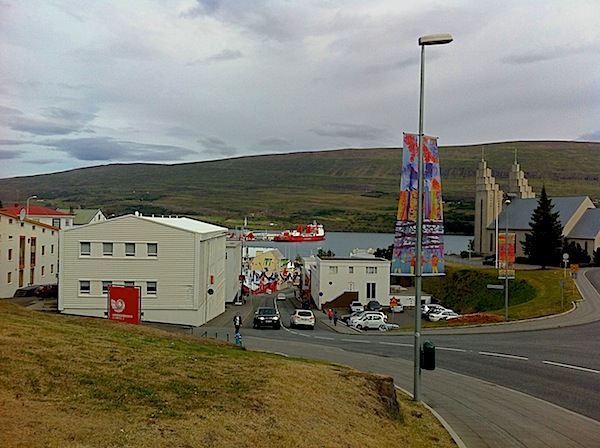
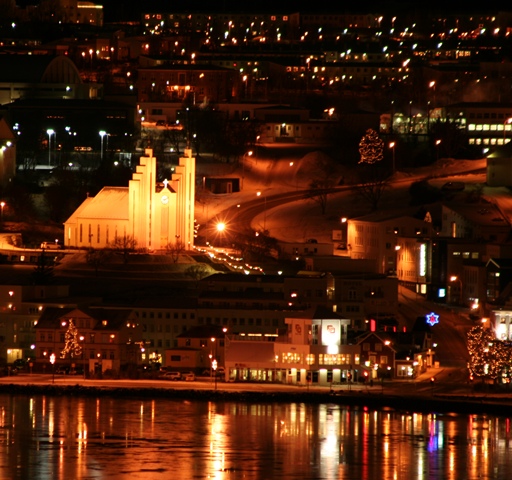
    Downtown Akureyri

    The conference Climate Change in Northern Territories is calling for abstracts. The conference is held in Akureyri, Iceland, in august. The ESPON/ENECON and NRF Open Assembly organize the conference, hosted by the University of Akureyri.

    This is the 2nd call for abstracts for general participation and young researchers. The deadline for submission is the 28th of February, but for young researchers the deadline is 15th of March. The abstracts are to be submitted to nrf@unak.is.

    Further information for young researchers.

    The idea is that this conference will bring together researchers which have similar background but have been focusing on different problems and situations and applied different methodological approaches. Regional and local stakeholders as well as state politicians and policymakers are also target groups for the conference.

    Subthemes are:

    • Territorial socio – economic impacts of climate change
    • Methodologies for assessing socio-economic impact
    • Adaptation to climate change in regions and local communities – examining methods and sharing knowledge

    You will find more information concerning the central theme here.

    Source

    NRF

  • Akureyri 150 Years Old Today

    Akureyri 150 Years Old Today

    Akureyri birthday

    Regardless of the vast wilderness and large uninhabited areas of tundra, snow and ice, the Arctic has a long history of inhabited communities within all eight Arctic states.

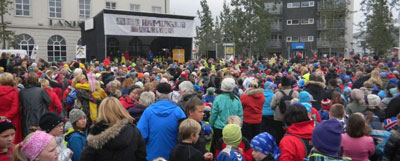
    One of them is Akureyri, the home of Arctic Portal and capital of northern Iceland, which today celebrates its 150th birthday. All 13 kindergartens and 10 primary schools of the town were invited to a feast at the town centre square, in which they participated in a sing-along, listened a local band Hvanndalsbræður and were served a birthday cake.

    Akureyri - 150 years old celebration

    Throughout the year the town has organized a wide range of events celebrating the 150th birthday and among other things many projects have been initiated to exhibit the history of the town.

    Sources

    Akureyri Town Homepage

    Visit Akureyri Homepage

  • The Snow Dragon bound for North Pole

    The Snow Dragon bound for North Pole

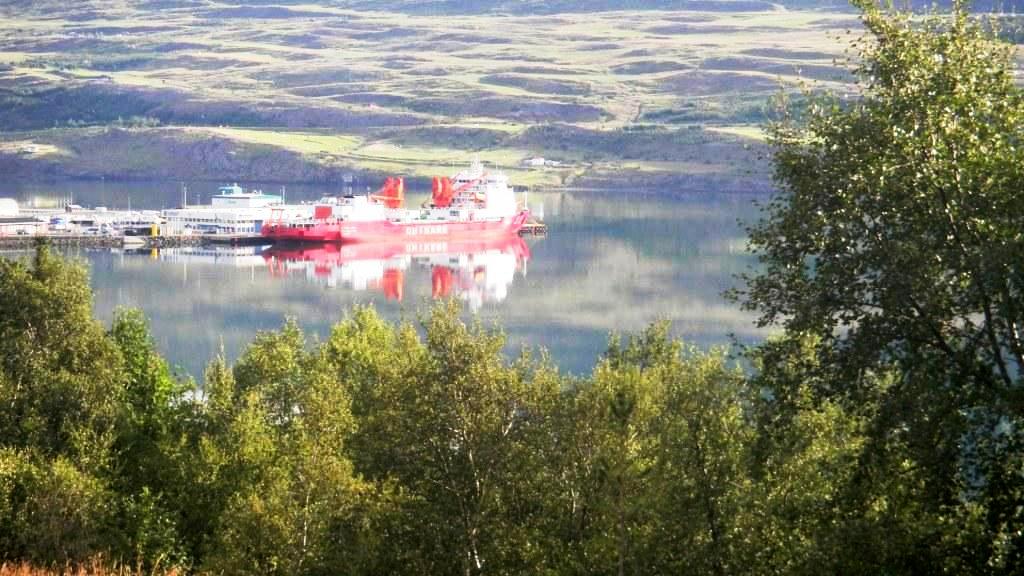
    Xuelong stationed in Akureyri, Iceland

    The Chinese research ice – breaker Xuelong, which left Akureyri in the northern part of Iceland, on Monday evening, is now on the way, to be the first non – Russian icebreaker to sail the transpolar route, straight across the top of the globe.

    Last week, the Snow Dragon completed the Northern Sea Route, reaching Reykjavik, Iceland on Saturday the 17th of August and then after spending the day in Akureyri, started the journey back to Asia.

    The scientists and the crew on board will try to prove that there is a future possibility of using Central Arctic Shipping Route for international navigation during the summer months.

    Currently, the vessel is just about to reach the Barents Sea.

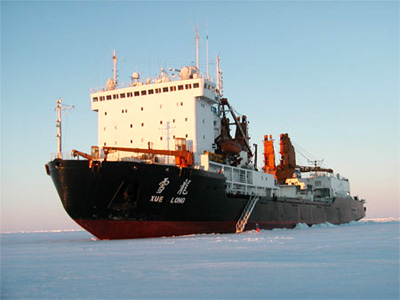
    The M/V Xue Long is an A2-class ice-breaker with capability of breaking ice of 1.1 meters thickness. It was originally built as a cargo ship for Polar Regions by the Kherson Shipyard in Ukraine. After modifications in 1994 it became China’s first research ice-breaker. The vessel belongs to the Chinese Arctic and Antarctic research expeditions (CHINARE).

    The vessel is 167 meters long and 22.6 meters wide. It has a full-loaded draft of 9 meters, a full-loaded displacement of 21,250 tons and a cruising radius of 12,000 nautical miles. Two helicopters can be carried at the same time.

    Source

    Chinare5

  • Towards the North – Xuelong to reach Akureyri on Monday the 20th

    Towards the North – Xuelong to reach Akureyri on Monday the 20th

    Xuelong statistics

    On Monday, 20th of August 2012, the Snow Dragon, research ice – breaker from Polar Research Institute of China, is expected to anchorage in Akureyri in the northern part of Iceland.

    The venue will open for participants at 9.00 (Icelandic local time) with the speech given by the Chairman of Akureyri Town Council Geir Kristinn Aðalsteinsson and the Chinese Ambassador to Iceland – Su Ge.

    Recently, China has achieved dimensional developments of Arctic linkage, especially in understanding of the earth system and global climate change. To raise public and governmental awareness and interests Dr. Huigen Yang and Prof. Deyi Ma will give a presentation on “Chinese Polar Research and CHINARE 5” to highlight the main features of Chinese contribution to the Arctic science and promote international cooperation with regards to science and technology of polar research activities.

    The Icelandic Chinese science cooperation will be further discussed under the chairmanship of Dr. Thorsteinn Gunnarsson from Icelandic Centre for Research (RANNIS).

    China makes big efforts to understand Arctic environmental changes and nature´s evolution, therefore conjugate observation of dayside aurora and new Icelandic – Chinese Joint Aurora Observatory project will be presented and explained by Dr. Hu and Dr. Björnsson to encourage the exploration of unknown frontiers in the deep universe.

    The Snow Dragon on the way to Iceland

    New perspectives on Arctic shipping cooperation will be given by Mr. Egill Nielsson and Prof. Zhang Xia from Polar Research Institute of China jointly with Ms. Embla Oddsdottir from Stefansson Arctic Institute who will introduce the harmonious culture of sustainable Arctic Shipping.

    The rector of the University of Akureyri – Dr. Stefán B. Sigurðsson will be given his closing remarks before whole group will participate the working lunch hosted by the Town of Akureyri.

    The Xuelong will be open for external visitors on Monday, 20th of August from 12.00 – 16.00 p.m. Introduction to the open day will be conducted by the mayor of Akureyri and Chinese ambassador. The visitors will get a chance to meet the staff from Akureyri town council, University of Akureyri,Stefansson Arctic Institute, Arctic Portal and Icelandic Arctic Cooperation Network.

    CHINARE 5 will leave northern Iceland on Monday´s evening, turning its rudder towards Shanghai.

    Please, see the full schedule of Chinare5 Open Day.

    Source

    Chinare5

  • U.S interest in Icelandic energy

    U.S interest in Icelandic energy

    University of Akureyri seen from the sky

    The University of Akureyri hosted a Law Forum today, open for the public. Eric Green, Deputy Chief of Mission at the U.S Embassy in Reykjavik and Gregory P. Sims, Regional Political Officer at the U.S Embassy in Oslo, discussed the U.S foreign policy with regards to Iceland and the Arctic region.

    Eric Green has held the position of the Deputy since August 2011. Before coming to Iceland, he specialized as Minister Counselor for Political Affairs at the U.S Embassy in Moscow. Gregory P. Sims is regional political officer at the U.S. Embassy on Oslo. He joined the State Department in 1988 and has specialized in Russian politics and transnational issues.

    The U.S representatives addressed the issue of U.S interest in Arctic natural resources, but did not clearly stated names of the companies which might be interested in possible oil and gas drilling around the Jan Mayen archipelago. They stated that the planned exploration in the area would cause no significant impacts on the Arctic fish and other wildlife as all current operations around the Arctic are being conducted in environment friendly manner.

    The floor was opened for the discussion to all participants and the proposal for establishing the human rights working group within the Arctic Council was made.

    Participants also discussed the U.S policy with regards to Icelandic domestic affairs. The impact of U.S military base on Iceland´s community was recalled and challenges for new business opportunities on the south cost were mentioned. It was stated that the U.S companies are highly interested in Iceland´s inexpensive, renewable energy and are ready to conduct the business to support the Icelandic economy.

    The U.S representatives made a clear statement that they would be greatly engaged in current Arctic issues and they will consider to take part in on coming 5th Polar Law Symposium which will be held at the Arctic Center in Rovaniemi, Finland, in September 2012.