Tag: antarctica

  • Fastest journey to Antarctica confirmed

    Fastest journey to Antarctica confirmed

    Antarctic arctic trucks

    Icelandic company Arctic Trucks announced today that a new world record of the fastest overland journey to the South Pole has been officially recognized by Guinness World Records.

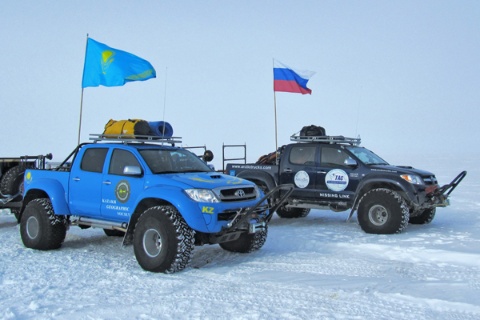
    In December 2010 two Arctic Trucks vehicles crossed 2308km of the Antarctica High Plateau from Novolazarevskaya station (Novo) to the South Pole in 108 hours (4.5 days). The purpose-built AT Expedition vehicles, based around a Toyota Hilux platform, traveled at an average speed to South Pole of 21.4km/h and average fuel efficiency of 2.2km/per liter, with only a single refueling stop on the way.

    An unofficial improvement on the record itself was achieved for the return journey, which was faster still at only 3.5 days, averaging 27.5km/h. No comparable speed or fuel efficiency has ever been recorded for high plateau expeditions in Antarctica. Arctic Trucks built vehicles have now clocked over eighty thousand kilometers on the plateau, proving new benchmarks for speed, range, reliability and fuel efficiency for overland travel in this area.

    “This route to the South Pole is extremely challenging. Our vehicles are operating at altitudes up to almost 3500m, in ultra-low temperatures and in very difficult snow conditions. The vast distance is a challenge in itself, with up to 1500km between fuel depots. We are delighted to celebrate this new world record with the team, which also marks a growing recognition of the power of Arctic Trucks solutions for expedition use,” commented Emil Grímsson, Executive Chairman of Arctic Trucks.

    “There is a fast growing interest from customers who are looking to supplement slower, less fuel-efficient tracked vehicles with faster, lighter and cleaner vehicles. We have great respect for the fragility of Antarctica and our vehicles have opened up new possibilities for scientific research programs to operate more efficiently in this environment.”

    The two Arctic Trucks vehicles used for this round trip were both Arctic Trucks Expedition AT44 models. Arctic Trucks designs and builds these vehicles based around the Toyota Hilux 3.0 liter turbo diesel.

    The expedition was organized by the Kazakhstan National Geographic Society (KNGS) and The Antarctica Company (TAC). The core expedition team consisted of Konstantin Orlov and Stanislav Makarenko from KNGS, Andrey Myller from TAC and Hlynur Sigurðsson from Arctic Trucks.

    Four further expeditions to the South Pole using Arctic Trucks vehicles are planned for the season of 2011, three starting from Novo and one from Patriot Hills.

    Source: ArcticTrucks and Guiness World Records.
  • British to melt Antarctica

    British to melt Antarctica

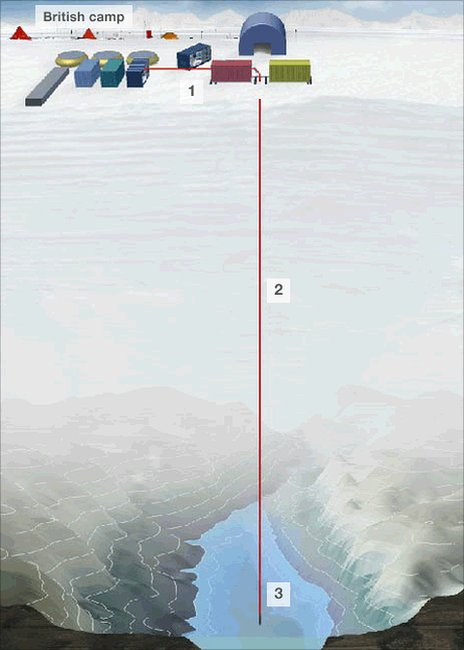
    A hot water drill will melt through the frozen ice sheet

    British expedition is going to Antarctica to search for life. Their plan is to dig, with hot water, three kilometers down the ice.

    The plan is to sample a lake under the ice with hopes to find forms of life, unknown today.

    A bonus is finding clues to future climate change impacts.

    The BBC reports the team is the first to sample a sub-glacial Antarctic lake.

    “Our project will look for life in Lake Ellsworth, and look for the climate record of the West Antarctic Ice Sheet,” said the project’s principal investigator Professor Martin Siegert from Edinburgh University.

    “If we’re successful, we’ll make profound discoveries on both the limits to life on Earth and the history of West Antarctica,” he told BBC News.

    The picture on the right explains how this will be done. The unique equipment is specially made for the assignment, which received 7 million pounds by the UK’s Natural Environment Research Council.

    “This is an unknown environment – we don’t know for example whether there will be dissolved gases in the water,” Matt Mowlem, the designer of the equipment said.

    “So the water at its pressure of 300 atmospheres will be sampled. But when we pull the probe up and the flasks hit the cold air in the borehole, the water will try to freeze; the pressure then increases to around 2,700 atmospheres, and that’s greater than anything experienced in ocean engineering.”

    Once the probe has been hauled up, a coring device will be lowered down the borehole to take samples of the lake floor sediment.

    Click here to see a video of the story by BBC.

  • New truck for Antarctica

    New truck for Antarctica

    Arctic Trucks

    Icelandic company Arctic Trucks has finished building a new six wheeler truck, specially made to drive in the Antarctic. The foundations are a Toyota Hilux.

    The car has enormous amounts of carrying capacity, a unique torqueand exstensive mileage but still spends less fuel then compatible vehicles.

    This is not the first time the Icelanders have made a car for the Antarctic, by no means. They have already led successful expeditions to the South Pole.

    Arctic Trucks has also been in Greenland, in Dubai and even drove to the Magnetic North Pole with famous British TV show Top Gear.

    Arctic Trucks

  • Antarctic Climate Change and Environment

    Antarctic Climate Change and Environment

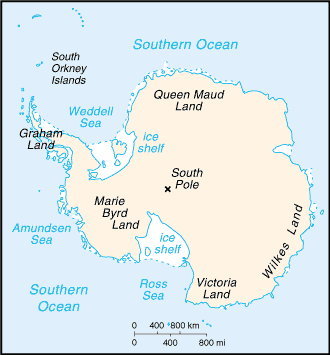
    Antarctica mapThe first comprehensive review of the state of Antarctica’s climate and its relationship to the global climate system was published in the beginning of December 2009 by the Scientific Committee of Antarctic Research (SCAR).

    The newly published report examines the highly complex relationship of Antarctic environment with the global ecosystem that is increasingly affected by human activity. Already some signs of the changed Antarctic environment had been detected, i.e. the Antarctic ozone hole, but the fact is that the climate change has and will most likely have an unprecedented affect on the Antarctic and thus to us all. For example, contains Antarctica 90% of the world’s ice and 70% of the world’s fresh water, which is enough to raise sea level by 63 m.

    The report draws, however, quite interesting picture of the changing environment in the Antarctic. While the overall surface temperature and ice coverage around the continent have remained the same over the past 30 years, some specific parts of Antarctica are experiencing significant change.

    First, the report points out that for the last 30 years the ozone hole has shielded the bulk of the Antarctic from the effects of the global warming. The report maintains that despite the quite extensive changes in the surface temperature and snowfall around the Antarctic the temperature as well as Antarctic overall snowfall have remained at the same level. It is further notable, that while sea ice extent across the Arctic Ocean has decreased markedly over recent decades, around the Antarctic it has increased by 10% since 1980, particularly in the Ross Sea region. This increase is a result of the stronger winds around the continent, changes in atmospheric circulation and the isolating effect of the ozone hole. This is especially interesting, since the Antarctic Circumpolar Current around the continent has warmed more rapidly than the global ocean as a whole resulting in a major change in the Southern Ocean ecosystem. In recent decades the Ocean has become less effective in absorbing CO2 and ecological key species (such as planktonic snails) are expected to be negatively affected by progressive ocean acidification.

    Antarctic dawnOn the other hand, along with higher temperatures, the Antarctic Peninsula on the west coast of the continent, has experienced a marked switch from snowfall to rain during the summer, which has led to rapid expansion of plant communities and the colonization of newly available land by plants and animals. In addition, there has been significant thinning of the West Antarctic Ice Sheet, especially around the Amundsen Sea Embayment, as well as a few smaller coastal areas in East Antarctica, which has resulted in diminishing Krill stocks and changed distribution of Adélie penguins.
    The report predicts that if greenhouse gas concentration in the atmosphere doubles over the next century, the Antarctic will warm around 3°. This increase could contribute to a projected total sea level rise of up to 1.4 metres by 2100.

    For further information, please go to the Scientific Committee of Antarctic Research or access the SCAR publications

  • Svalbard – At the End of the World

    Svalbard – At the End of the World

    Svalbard map

    If you would travel to the end of the world, where would you go? For some world ends in south, but if you would head north you would most likely end up in Svalbard, a group of islands between 74° – 81° N in the Arctic Sea.

    The islands were first discovered in the 16th century by a Dutch explorer Willem Barents and visited by many other nationalities during the next 300 years. Russian trappers were first to winter on the islands between 1715-1850. Norwegians on the other hand did not start regular hunting on the islands before the mid 19th century.

    Until the beginning of the 20th century, Svalbard, as the islands are called today, was “no mans land”. Many negotiations were held to establish a sovereignty over the islands and finally in 1920, a Spitsbergen Treaty was signed establishing a Norwegian sovereignty over the islands. In the Treaty, Svalbard was made a part of the Norwegian Kingdom, giving though all the signatory nations unrestricted right to natural resource exploitation. Due to this right small “foreign” mining communities have been established on the islands over the years, the biggest being the Russian settlement in Barentsburg with today some 500 inhabitants.

    Svalbard archipelago is 63 000 sq.km some 60% being covered by glaciers. Largest islands are Spitsbergen (37 673 sq.km), Nordaustlandet, Barentsøya, Edgeøya and Prins Karls Forland. Largest settlements on the other hand are Longyearbyen, Norwegian administrative centre, with 2 080 inhabitants, Barentsburg, Russian mining community, with 500 inhabitants, Ny-Ålesund, Norwegian international research centre, with 40 inhabitants, Sveagruva, Norwegian mining community, with 210 commuters and Hornsund, Polish research station, with 8 inhabitants.

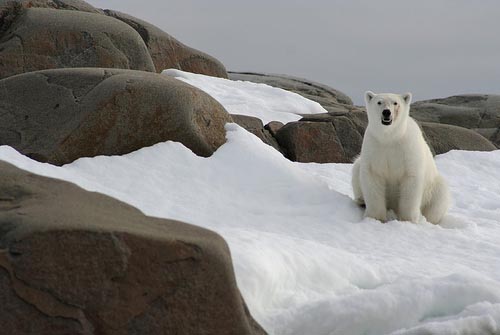
    Polar bear in Svalbard

    Despite of its harsh climate, Svalbard is a home for some Arctic animals. Svalbard Reindeer, Arctic fox, Polar Bear and southern Vole (a foreigner that has settled on the islands) inhabit the islands in addition to wide range of sea mammals and 36 species of birds that nest on the rocky mountain cliffs. Polar bear used to be hunted, but was protected in 1973 and today only 3-4 polar bears are killed yearly. Though the islands are well above the tree-line and only 6-7% of the land area is covered by vegetation a great variety of flowers can also be found in the islands.

    The main industries in Svalbard are mining, tourism and research. For long period the only industry found in the islands was mining, but recently eco-tourism and international research have become increasingly important.

    It is estimated that around 70 000 tourists visit the islands every year arriving either by plane or by sea. Great majority of the visitors are Norwegian, but mainland Europeans are increasingly visiting the islands as well. Most of the tourist, apart from the cruise liners visiting Svalbard for a day or two as part of a longer cruise, come to the archipelago for the extraordinary nature and extreme conditions. Different kinds of organized outdoors activities are among the most popular tourist attractions in addition to archaeological and mining museums, which can be found in Longyearbyen, Barentsburg, Ny-Alesund and Bear Island.

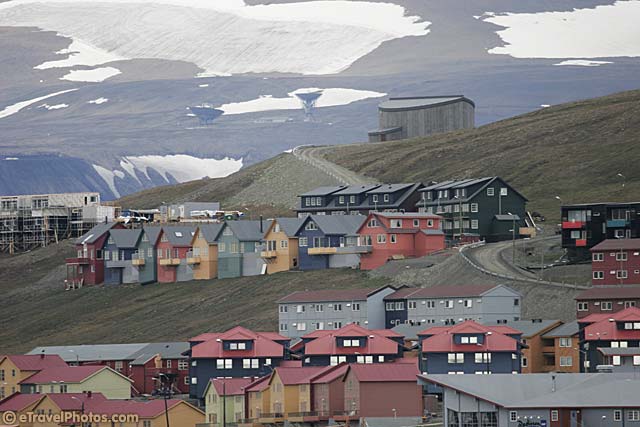
    Longyearbyen, Svalbard

    Svalbard is one of the main areas for Arctic research. Due to its geographical situation it offers an ideal insight in to the Arctic reality. Norway is by far the largest research nation in Svalbard accounting almost for half of the research days on the islands. Russians, Germans and Polish account together for another 40%, together with Norwegians accounting for 84% for the Svalbard research. Norway operates also a University Center in Svalbard (UNIS) which offers higher education at the undergraduate, graduate and postgraduate level in Arctic Biology, Arctic Geology, Arctic Geophysics and Arctic Technology. Yearly, approximately 350 students come to Svalbard for a shorter or longer period half being Norwegian students and half international students.

    Though at the end of the world, Svalbard offers a variety of interesting opportunities for work, education and travel for those interested in the Arctic. To learn more about Svalbard please visit the following homepages:

  • Students on Ice

    Students on Ice

    Students on ice banner

    The Feature of the Week at the Arctic Portal is ambitious program “Students on Ice”.

    Students on Ice Expeditions (SOI) organize annual educational expeditions to the Arctic and the Antarctic. Its mandate is to provide students, educators and scientists from around the world with inspiring educational opportunities at the ends of the Earth, and in doing so, help them foster a new understanding and respect for the planet and for each other. To date in just over 8 years, over 1,000 students, educators, experts, and scientists from 32 countries have participated in this unique program.

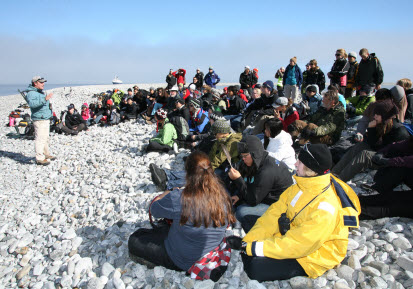
    Students on ice, lectureSOI was founded by adventurer, environmentalist and educator, Geoff Green – a veteran expedition leader of 74 Antarctic expeditions and 31 Arctic expeditions. In 2004, Outpost Magazine chose Geoff as one of the “Top 5 Explorers to Watch”. Over the past fifteen years, Geoff and SOI have worked directly with many IAATO Members, including Quark Expeditions, Polar Star Expeditions, Peregrine Expeditions, Hapag Lloyd, ResidenSea, and Antarpply Expeditions.
    Most recently SOI was endorsed as the official youth expeditions for the International Polar Year (IPY) 2007-2009. The IPY marks a critical opportunity for the world to turn its attention to the state of our Polar Regions, to better understand the global implications, and to seek the necessary actions and solutions required by all of us. This remarkable event offers a timely and exciting opportunity to mentor and inspire the next generations of scientists, researchers and young leaders.

    In between expeditions Students on Ice continues to raise awareness about the global issues that need to be addressed individually and collectively by being part of inspiring outreach activities, such as conferences and speaking engagements. In the context of IPY 2007-2009, Alliance of Natural History Museums of Canada in partnership with Students on Ice is organizing and delivering the Polar Perspectives 2008 Speakers Series and Youth Forums. The goal is to raise awareness about Arctic issues such as the impacts of climate change on the environment, health, culture, sovereignty and indigenous rights. The International Polar Year (IPY) is the largest-ever scientific research program directed at the Polar Regions.

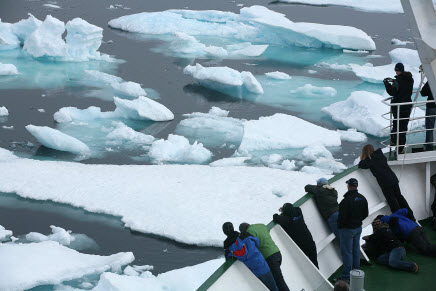
    Students looking at sea-ice from a shipThe aim of Students on Ice is not to simply provide students with a “trip” to a unique destination but rather to give students an opportunity to have an aesthetic experience in some of the most wild and awe-inspiring ecosystems in the world. The objective is not to let students to just pass through a place with camera in hand, but rather to listen to the land; to ‘feel’ these natural places and in turn, explore how humans feel when immersed in such places. The goal of SOI is that students experience a transformative connection with Nature – a connection that changes the way they understand and act in this world.
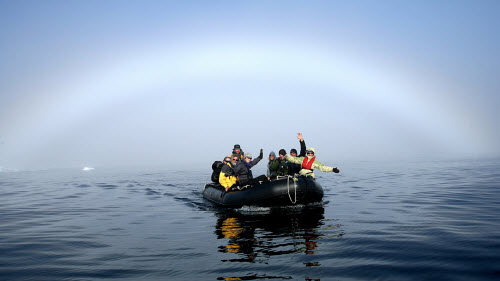
    On expeditions, several different learning formats are used depending on the topic being explored, location, weather conditions, and the skills and experiences of the education team members in which is assembled each time. These learning formats include: lectures, workshops and hands-on activities that are shore, zodiac, and ship-based in setting. There is an environmental focus on the SOI expeditions’ lectures discussions and activities on current environmental issues facing the regions travelled are implemented through. Climate change is a particular focus on all of Students on Ice expeditions.

    fogbow - Rainbow in a fogStudents on Ice program, has received numerous awards and citations for its work with young people, education, the environment and polar conservation. Recently, it received the prestigious 2007 Citation of Merit Award from the Explorers Club in New York City. It has also received the Michael Smith Award for Science Promotion in Canada, as well as a special Citation of Merit from the United States Congress.

    The Students on Ice offers a interesting website with comprehensive information about upcoming and previous expeditions which date back to the year 2000. At the website, it is also possible to view unique videos from previous expeditions. Those videos include e.g. “Visit to Walrus Island”, “A Hundred Whales and Two Bears” and “Going Into the Fog”. The site offers information about the Students on Ice staff, with practical background information about each and one of the SOI team. In addition to all that, Students on Ice have a blog with news from Student on Ice Activities.

    The Students on Ice Webpage