Tag: Arctic frontiers

  • Arctic Frontiers 2014 coming soon

    Arctic Frontiers 2014 coming soon

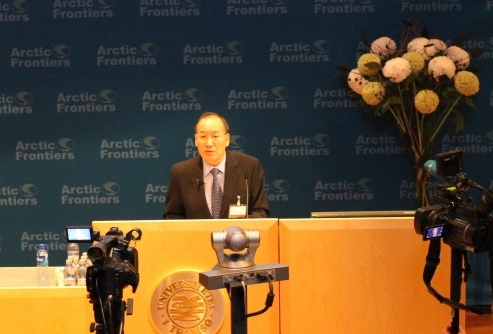
    Zhao Jun during Arctic Frontiers 2013

    Arctic Frontiers 2014 will be held at the University of Tromsø, Norway from Sunday 19 to Friday 24 January 2014. The theme of the conference is ‘Humans in the Arctic’.

    As with previous years the policy section will run for the first two days (Monday 20 and Tuesday 21 January 2014) followed by three days of science (Wednesday 22 January to Friday 24 January).

    Click here to register for the conference. To see the detailed programs for the policy and science sections, please access the conference website.

  • Arctic Frontiers 2014 Call for papers

    Arctic Frontiers 2014 Call for papers

    Hunter in the arctic

    Arctic Frontiers holds its 8th annual conference in Tromsø, Norway, from 19-24 January 2014, with the title: Humans in the Arctic.

    The Arctic Frontiers conference is a central arena for discussions of Arctic issues. The conference brings together representatives from science, politics, and civil society to share perspectives on how upcoming challenges in the Arctic may be addressed to ensure sustainable development.

    Arctic Frontiers 2014 will address two main themes: I) Health, Environment and Society, and II) Offshore Maritime Challenges.

    Health, society and environment

    The environment of the Arctic is changing, and this affects the conditions for humans living in the Arctic for better and for worse. Climate change will lead to less ice and permafrost and thus, increased tourism, fishing, petroleum activities and mining.

    These activities in the High North will give opportunities and impact socio-economy, demography and traditional lifestyle as well as increase contamination and disturb the natural environment. The cumulative impact may affect life, wellbeing, culture and ultimately the health of people living in the region. Healthy adaption to the changes must be planned.

    The latest advances in technology and innovative communication are potentially very effective tools with which to reduce risk related to living and working in the Arctic and also maximize the benefits, thus ensuring sustainable development. How can this be done? Arctic Frontiers 2014 will address the scientific challenges ahead.

    Offshore Maritime Challenges

    The growth in offshore petroleum activities in the Arctic and the renewed interest in cargo transport north of the American and Eurasian continents require improved or new logistic and transport solutions, better guidance to ships and an extended emergency response service including Search and Rescue (SAR).

    This is also the case for increasing tourism and fishery activities in the Arctic. A wide range of challenges are facing the operations due to the extreme distances, climatic and weather conditions, as well as winter darkness. Low temperatures, summer fog, long distances to shore-based resources require a robust communication infrastructure, new warning systems, survival kits, lifesaving equipment, rescue units and operating procedures. The aim of the conference is to discuss these arctic challenges, and to present innovative and viable solutions in order to reduce risk, build resilience and secure commercial operations.

    We invite you to submit an abstract within any of these four parts. All abstracts will be reviewed by members of the four scientific committees for rating of abstract quality and presentation content.

    Four parallel parts will be discussed:

    Health, society and environment

    Live, work and stay healthy in the Arctic

    Health & Environment in the Arctic

    Offshore Maritime Challenges

    Shipping & Offshore in the Arctic

    Arctic Search and Rescue (SAR)

    Interested scientists are invited to submit abstracts to one of these four sessions for both oral and poster presentations.

    Arctic Frontiers is composed of a policy section and a scientific section. This call for papers addresses only the scientific section from 22 January to 24 January 2014.

    The Call for Papers closes on 21 October 2013.

    For more information and online registration, download the complete Call for Papers on the Arctic Frontiers homepage


  • Arctic Frontiers 2013 – Final Remarks

    Arctic Frontiers 2013 – Final Remarks

    Arctic Frontiers

    The increase in human activity in the Arctic region, which is driven by the ever increasing demand for decreasing stocks of natural resources (mineral as well as hydrocarbons), has led to a rise in the need for improved management, monitoring and surveillance of the region.

    The weather conditions may change quickly and dangerously, while the presence of the sea ice poses a risk to ships. For those reasons, the need for frequently updated information has increased.

    Arctic Frontiers has been yearly organized as an independent network and leading meeting place for pan Arctic issues. This year’s Arctic Frontiers took place 20th – 25th January in Tromso, located in the northern part of Norway.

    This year’s event collected close to 150 speakers from variety of countries. The audience accounted close to 2 000 people from various Arctic states and different fields of expertise. Both groups were largely supported by 35 journalists from 15 different countries. This number does not include the many local Norwegian media.

    Leona Aglukkaq, Minister of Health and the Canadian Northern Economic Development presents during the policy sessionFirst two days were occupied by the policy section titled: Geopolitics and Marine Production in a changing Arctic”. This year’s policy session gathered speakers from the eight Arctic countries bringing up issues from charring and managing the Arctic Council, fisheries, oil and gas exploitation and the right and responsibility of the Arctic peoples to manage their territories to the role of armed forces in the Arctic.

    Non-Arctic states were also well represented. The policy session welcomed speeches from the Ambassadors of China and South-Korea as well as from the EU Commissioner for Marine Affairs and Fisheries , while the science section’s geopolitics session expanded the Asian representation to cover diverse range of issues regarding Japans, South-Koreas, Singapore and India’s interests in the Arctic.

    Non – Arctic states, together with the representatives of the Arctic, came up with new principles of how to manage, explore and develop the Arctic in the light of an on – coming change.

    Today the Arctic Region is an emerging energy and mineral province, with the extraction of natural resources projected to increase dramatically in the coming years to decades. New industrial activities, a changing business community and demographic dynamics are to alter the established social and economic structures in several regions of the Arctic.

    In short it can be said, that the non-Arctic countries call for an open and inclusive trans-regional dialogue and resource management and inclusive observer policies for the Arctic Council. In their view, the Arctic is not isolated region within the global economic and resource community, but a part of a global system that should be governed by and benefit all countries in the world.

    It occurred evident that the interest towards the Arctic is growing and southern countries have started to grow increasing interest on the emerging opportunities in the Arctic.

    In addition to the two day policy section, the Frontiers had a comprehensive science section concentrating this year on the above mentioned geopolitics, marine harvest and marine production.

    Speakers during the science sessionThe science section addressed mainly the issues of security, energy and interstate relations in the Arctic. Overall, it identified conditions of continued stability in light of new developments in the northern hemisphere.

    A warming Arctic Region with less ice may involve opportunities in terms of economic activity and increased interstate cooperation, but may also present the Arctic stakeholders with new challenges in terms of how best to meet their interests and at the same time interact with the other stakeholders through mutually beneficiary relations.

    The Arctic potential to become a new, thriving energy region was strongly highlighted during first days of the policy session.

    The circumpolar North holds large quantities of natural gas and oil, both discovered resources and estimated ones. Northern Russia has the largest known reserves of natural gas in the Arctic, but it can also be found in other regions such as Norway, Canada and Alaska.

    Last day of the science session welcomed representatives of non – Arctic states, such as Asian and European states that do not border the region. Those countries and organizations have been increasingly opening their eyes into the changing North. The speakers tried to answer the questions of does their interest consist of and what is their policy towards the Arctic Region.

    The Arctic region has many faces. Historically it has been veiled by an aura of mystique, a frozen wonderland untouched both by the outside and the effects of industrialization, populated by a mysterious group of people from a different phase in the history of man. As interesting and romantic this notion may seem, it holds little or no truth in the Arctic today.

    Happy participants during the coffee breakThe Arctic is literally on top of the world, the earth rotating around the two poles, in the North and the South. But the Arctic is not just about the North Pole – the Arctic region stretches much further in all directions, even splitting the earth into the East and the West, famous identities in the world history.

    This year’s Arctic Frontiers highlighted that the Arctic is not only a historical and cultural region but also a potential for commercial and industrial activities. The meeting showed that the Arctic should be looked at as at the mixture of traditional subsistence activities as well as a part of the global market economy.

    Leena & HMM
  • Science Section begins today!

    Science Section begins today!

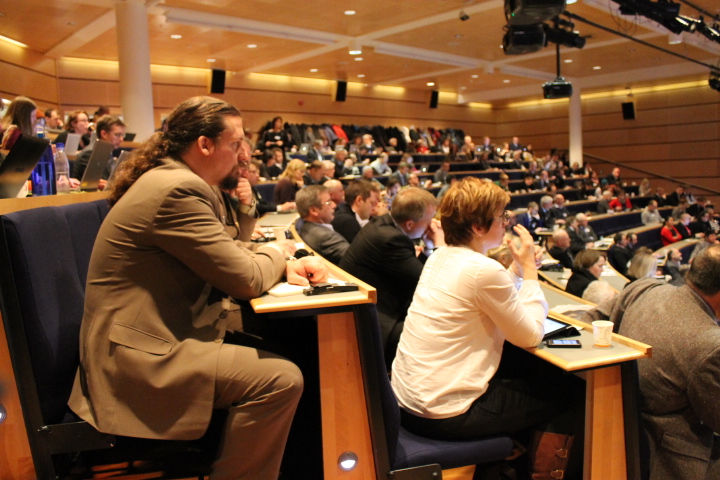
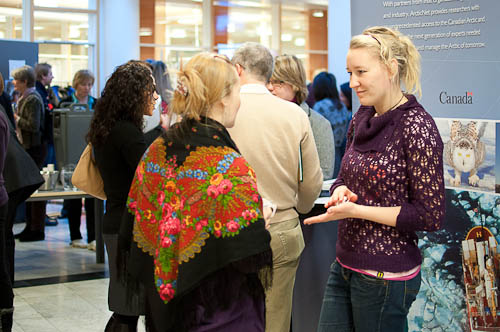
    The audience during science session at Arctic Frontiers 2013

    After 2 days of policy related discussions, the Arctic Frontiers conference that is being held in Tromso, Norway, opens the science section.

    This part will address the issues of security, energy and interstate relations in the Arctic. An overall aim is to identify conditions for continued stability in light of new developments in the region.

    A warming Arctic with less ice may involve opportunities in terms of economic activity and increased interstate cooperation, but it may also present Arctic stakeholders with new challenges in terms of how best to meet their interests and at the same time interact with other stakeholders through mutually beneficiary relations.

    Arctic Frontiers is organised as an independent network and a leading meeting place for pan-arctic issues. The network was established in 2006 and later extended. The science section that start today will end on Friday, 25th of January.

    HMM

  • Arctic Frontiers 2013

    Arctic Frontiers 2013

    Arctic Frontiers

    The 2013 Arctic Frontiers in Tromso Norway is just about to start. This years themes are Geopolitics & Marine Production in a Changing Arctic.

    The organizers will be broadcasting the whole of the policy section on Monday 21 January live on the internet in English and Russian and on Tuesday 22 January in English and Norwegian.

    To connect to the online stream, please follow this link.
    Here are the links for the 22nd of January:

    Here is the full program of the conference.

    Source

    Arctic Frontiers

  • Arctic Frontiers online webcast

    Arctic Frontiers online webcast

    Arctic Frontiers

    The 2012 Arctic Frontiers conference starts in Tromsø on the 22. of January and runs until the 27th. The conference will be broadcasted live online.

    The theme of the conference is Energies of the High North, including nonrenewable and renewable resources of energy. The conference will have both a science section and a policy section which will commence with a “State of the Arctic” segment.

    Numerous interesting lectures will feature in the conference, which is even still open for registration.

    Here is the schedule of the policy section on Monday and Tuesday, due to be shown live. Click here to access the section to watch the conference.

    Monday 25 January, 09:00 to 17:00

    Session I: State of the Arctic 2012 in the context of the global energy outlook

    • 09:30 Thomas B. Johansson, Co-Chair, Global Energy Assessment: Setting the scene – global energy outlook and the Arctic.
    • 10:00 Matt Entenza, Senior Advisor on Energy and the Economy to Minnesota Governor Mark Dayton, USA.
    • 10:30 Esa Härmälä, Director General of the Energy Department, Finland. (Midnight) Sun Belt – Areal of Growth
    • 11:00 Coffee break
    • 11:30 Clément Gignac, Minister of Natural Resources and Wildlife, Quebec, Canada: Development in Québec: the Plan for empowering the North
    • 12:00 Lisa Murkowski, Senator for Alaska, USA: Video speech about priorities for energy politics in the USA and in Alaska.
    • 12:05 Ola Borten Moe, Norwegian Minister of Petroleum and Energy: Norwegian Energy Policy.
    • 12:35 Questions and debate with Minister Borten Moe
    • 13:00 Lunch

    Session II: Energy resources and industrial development in the Arctic

    • 14:00 Marcia McNutt, Executing director of U.S. Geological Survey: Challenges ahead for oil and gas resources in the Arctic.
    • 14:30 Sergey Kungurtsev, representative of the Administration of the Nenets Autonomous District, Russian Federation: Priorities for the development of industry in Nenets Autonomous District.
    • 15:00 Joep Coppes, Vice president of the International Association of Oil and Gas Producers: For a sustainable development in the High North, how can the oil and gas industry contribute?
    • 15:30 Ann Christin Gjerdseth, Chair of OG21, Norway: Sustainable development of Petroleum in the Arctic through superior technology and knowledge.
    • 16:00 Tim Dodson, Executive vice president Statoil, Norway. Unlocking the resources of the north

    Tuesday 24 January, 09:00 to 16:30

    Session II (continued): Energy resources and industrial development in the Arctic

    • 09:00 Salve Dahle, Chairman of Steering committee: Opening day 2
    • 09:00 Aleksey Titovskiy, Head of Foreign Economy Division, on behalf of the Administration of the Yamal-Nenets Autonomous District, Russian Federation: Priorities for the development of industry in the Yamal-Nenets Autonomous District.
    • 09:30 Valborg Lundegaard, Executive Vice President Engineering, Aker Solutions, Norway: Technological achievements in the Arctic for more than 100 years – What are the Arctic challenges facing us now.
    • 10:00 Elisabeth Harstad, Managing Director, DNV Research and Innovation, Norway: Barents 2020 – international industry cooperation for safety standards in the Barents Sea. Are there Pan-Arctic lessons?!
    • 10:30 Coffee break

    Session III: Developing secure and sustainable energy projects in the High North

    • 10:50 Nina Jensen, Conservation Director Policy, WWF-Norway: Climate and energy challenges of the High North.
    • 11:20 Ånund Killingtveit, Professor Department of Hydraulic and Environmental Engineering, NTNU, Norway: Renewable energy – How can it contribute to securing safe and sustainable energy in the High North?
    • 11:50 Martin Fortier, Executive Director ArcticNet Inc., Canada: The Art of Successful Industry-Academia Collaboration: Lessons from the Canadian Arctic.
    • 12:20 Lunch
    • 13:10 Arctic Frontiers Emerging Leaders: Energies of the High North. Introduction by Barry B. White, US Ambassador to Norway
    • 13:40 Anna Naikanchina, Vice president of RAIPON, Russian Federation: Indigenous peoples and energy projects in the Arctic: integration, risks and perspectives
    • 14:10 Emma Wilson, International Institute for Environment and Development, UK: Risk and reward: the role of civil society, business and the state in shaping the impacts of large-scale energy projects in the North.
    • 14:40 Coffee break
    • 15:00 Arctic Lavvo Dialogue – «Energy and Industrial Development and Peoples in the Arctic. » Moderated debate.
    • 16:15 Closing by Salve Dahle, Chairman of Steering committee of Arctic Frontiers

    Sources

    Arctic Frontiers

  • Arctic Frontiers 2012 – call for papers

    Arctic Frontiers 2012 – call for papers

    Arctic Frontiers

    The Arctic Frontiers (AFT) conference is a central arena for discussions of Arctic issues. The conference brings together representatives from science, politics, and civil society to share perspectives on how upcoming challenges in the Arctic may be addressed to ensure sustainable development.

    Arctic Frontiers (AFT) holds its 6th annual conference in Tromsø from 22-27 January 2012, Norway, with the title “Energies of the High North”. Arctic Frontiers 2012 will discuss the global energy outlook, and assess the potential of traditional and renewable energy resources in the North.

    Arctic Frontiers is composed of a policy section and a scientific section. This call for papers addresses only the scientific section from January 25th to January 27th 2012. The parallel sessions address 4 connected, interwoven and interdisciplinary themes:

    1. Arctic Geology, Hydrocarbon Reservoirs & Gas Hydrates
    2. Technological development & Environmental challenges
    3. Social, political and economic aspects of energy projects in the High North
    4. Renewable and Alternative Energy

    Interested scientists are invited to submit abstracts to one of these four sessions for both oral and poster presentations. Deadline for submission of abstracts: October 24th 2011

    For more information, download the complete Call for Papers and the abstract submission form on the AFT homepage

  • Arctic Portal in Arctic Frontiers Conference

    Arctic Portal in Arctic Frontiers Conference

    Arctic frontiers in TromsoArctic Frontiers Conference 2010 in Tromso, Norway was the 4th international Arctic meeting platform for stimulating and motivating pan-Arctic integration. This year’s Arctic Frontiers theme was “Living in the High North”, and had special focus on challenges to the development of sustainable communities.

    The Conference is traditionally divided in to two sections; Policy section and Science section. This years Policy section had two sessions concentrating on Changes in strategies for the Arctic and Sustainable communities in the Arctic. The Science section was on the other hand divided in to four parts, each part representing different aspects affecting Arctic communities. Part I dealt with changes in ice and snow on land, in the seas, and in the ground (the cryosphere) and the distribution of Earth ?s heat and water. Part II concentrated on sustainable communities in the north focusing on the themes of economy, self-governance, well-being and health, while Part III covered issues on changing Marine Biodiversity in the Arctic.

    This years Part IV was of special interest of the Arctic Portal and its partners, the session dealing with E-learning in the High North. The aim of the E-learning part of the conference was to exchange knowledge and research about E-learning in the Arctic communities and regions and specify the learning processes, pedagogy, and appropriate information technologies relevant to distant learners in these communities.

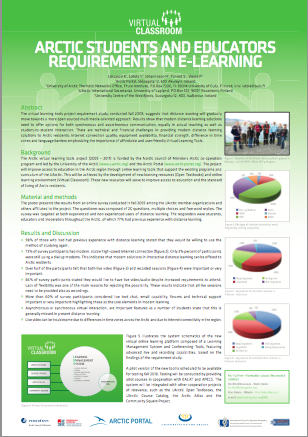
    Virtual Classroom posterThe Arctic Portal together with the University of the Arctic, University Centre of the Westfjords, International Centre for Reindeer Husbandry and Association of Polar Early Career Scientists is developing an online system that supports distance learning in the Arctic. This so called Virtual Classroom will be a virtual learning solution with a two-way communication between the teacher and students with open discussions and capabilities for classroom participation and real-time interaction. The Virtual Classroom will be accessible from any computer, giving that way inhabitants of small rural communities an opportunity to study without having to relocate to larger communities with traditional distance learning equipment / schools.

    The Arctic Portal, together with other project partners, participated in the Arctic Frontiers Part IV poster session introducing results from their user requirement survey conducted in fall 2009. The survey examined the needs and requirements of students and educational staff in UArctic member institutions, providing the project group as well the Arctic Frontiers a valuable information on how the users of theses systems experience current technology and pedagogical preferences.

    The main outcomes of the survey were that a real time interaction with the teacher and other students is highly appreciated. Many students felt that one of the downsides of distance learning is the lack of real time interaction within the class. In addition, many people thought that an access to a recorded lectures was highly preferable to enhance the learning experience. On the other hand, many students expressed their satisfaction with the contemporary distance learning arrangements, since it gave them an opportunity to organize their time and studies as they preferred independent of the schedule of the school.

    To learn more about the Virtual Learning project, please visit the homepage of the project