Tag: arctic ocean

  • Tara Oceans Polar Circle expedition

    Tara Oceans Polar Circle expedition

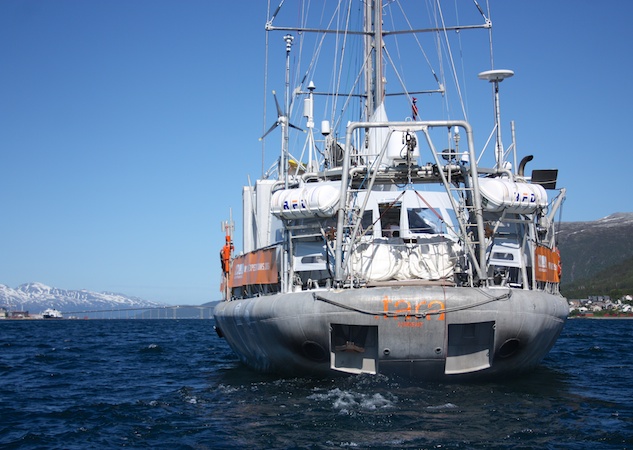
    TARA research schooner

    The Tara research schooner is now in the High North for a new scientific adventure. Over the next seven months, it will travel 25 000 km around the Arctic Ocean via the Northeast and Northwest passages to collect data on polar marine ecosystems and biodiversity and their vulnerability to global change and human activities.

    The Tara Oceans Polar Circle expedition will serve to complete the objective of the Tara Oceans Expedition (2009-2012): to collect plankton in all the oceans of the world. These tiny organisms form the base of the marine food chain, store CO2 and use their photosynthetic activity to act as an immense oxygen pump.

    However, their ecosystems remain one of the least explored fields of oceanography. Biologists and oceanographers will focus their research on the edge of the ice pack, where plankton is most abundant.

    Other issues will also be explored, including the assessment of mercury levels in the atmosphere and in the sea, and the concentration of plastic particles

    Such unprecedented measurements will facilitate our understanding of their impact on the arctic ecosystem.

    Click here to follow the TARA expedition on the internet. Click here to download the information brochure on the expedition.

    Source

    Tara Oceans Polar Circle

  • Two Russian nuclear submarines lifted from the Arctic Ocean

    Two Russian nuclear submarines lifted from the Arctic Ocean

    rusted old oil barrels

    Russia intents to lift up two nuclear submarines who sunk in the Arctic. The submarines are the nuclear powered K-27 and K-159, who sunk in the Kara Sea and the Barents Sea.

    Click here to see a map of sunken nuclear submarines in the Arctic.

    The release of the strategic development of Russia’s Arctic zone saw this proposal, but according to the draft several measurements are included to clean the Arctic waters of pollution.

    There will also be action to remove dangerous waste left behind after the military units on Franz Josef Land, New Siberian Islands and Bely Island.

    The K-27 submarine was dumped in the Kara Sea in 1980 and is lying on 75 meters depth. K-159 sank in the Barents Sea during towing in 2003 and could be laying up to 250 meters under the surface of the sea.

    A joint Russian-Norwegian expedition to the K-27 earlier this autumn concluded that the submarine is not yet leaking radioactivity but that it is urgent to lift it for safe decommissioning.

    International assistance will be needed since Russia does not the capacity to complete the operation on its own. When Kursk was raised in 2001 Dutch companies lifted the submarine.

    Source:

    Barents Observer

    Izvestia

  • Successful journey of the Snow Dragon continues

    Successful journey of the Snow Dragon continues

    The Snow Dragon

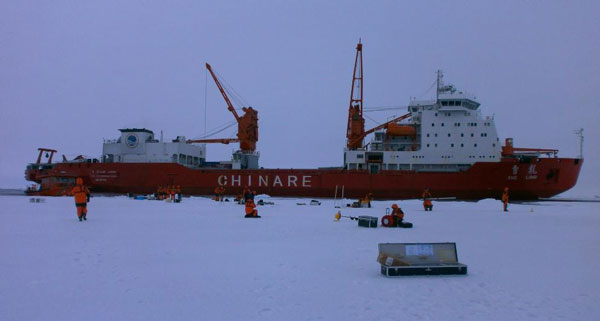
    The journey of the icebreaker Xue Long from Iceland to China, via the Arctic Ocean, has been successful so far. With the decreasing sea ice extent, the research ice-breaker has been able to sail through the Central Arctic Shipping Route without a support from nuclear powered vessel.

    Due to such an ice conditions, the research ice-breaker was able to operate via Fram Strait and carry on a high Arctic region to the east.

    Arctic sea ice extent fell to 4.10 million square kilometers on August 26, 2012. This was 70,000 square kilometers below the September 18, 2007 daily extent of 4.17 million square kilometers.
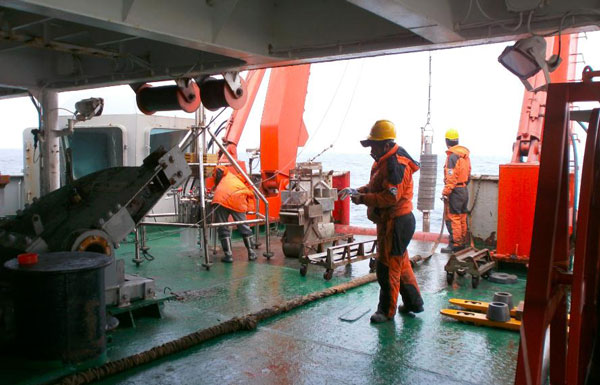
    Geological research: Gravity core launched in the Iceland Sea.

    Oceanographic, biological, geological and geophysical research was carried out in the Iceland Sea and Greenland Sea on the route north and meteorological observations are maintained throughout the expedition.

    Various satellite images are received for navigation through the sea ice.

    Benthic samples, from the shore lines of Icelandic waters were taken in order to prove benthos great increase in region that extends away from the land mass.

    Benthic sampling techniques are essential to habitat mapping studies since they provide the ‘truth’ data on the actual composition of the seafloor. When they are commonly used in conjunction with either a remote sensing or an acoustic technique, they are said to ‘ground truth’ seafloor classifications.
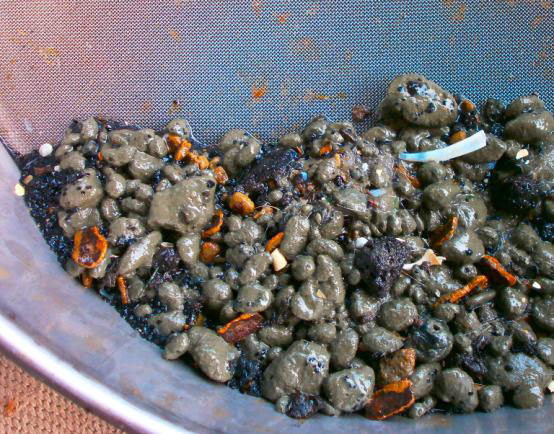
    Benthic sample from the Iceland Sea

    If samples are collected in high enough densities over survey areas they can be used to establish distributions and define habitats.

    Biological and geological/physical samples taken by the Geological Team from the Xue Long are to be taken separately from different grabs.

    Sailing out from Iceland, the Snow Dragon reached the region east of Jan Mayen, where in the good weather it was possible to see the Beerenberg volcano.

    It is the world’s northernmost sub aerial active volcano. The volcano is topped by a mostly ice-filled crater about 1 km (0.6 mi) wide, with numerous peaks along its rim including the highest summit, Haakon VII Toppen, on its western side.

    The upper slopes of the volcano were observed to be largely ice-covered, with several major glaciers including five which reach the sea.

    No scientific research was conducted by teams, nevertheless the elevation was difficult to be missed.

    Currently the vessel is heading up North, aiming to cross the North Pole. The ice conditions were reported as being almost 3 meters thick. The Snow Dragon is partly being followed by the Norwegian coast guard.

    Please, see the route of the Chinese research ice breaker on Interactive Mapping System.

    Source

    CHINARE5
  • Water bulge might cause changing weather

    Water bulge might cause changing weather

    The rise of the bulge

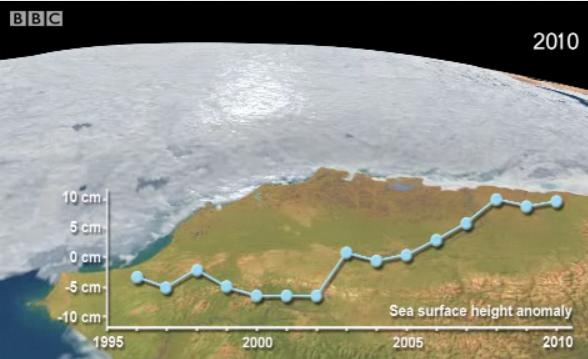
    Scientists have found an enormous dome in the western Arctic Ocean, full of fresh water. The bulge is thought to be around 8000 cubic meters in size and has risen about 15cm in 10 years.

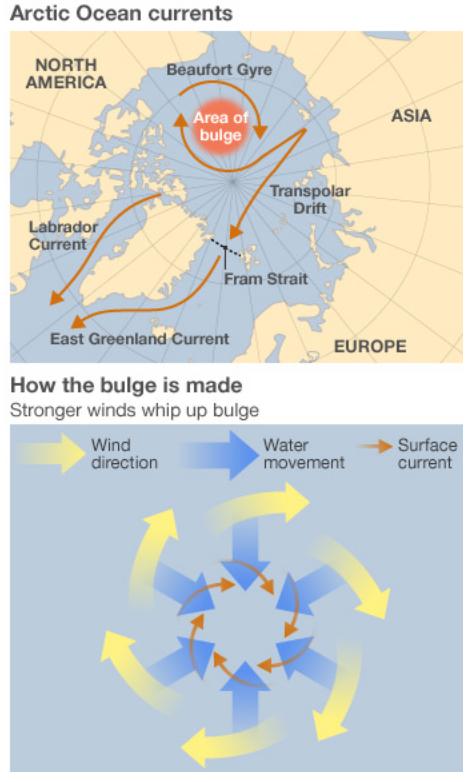
    The image on the right shows the rise of the bulge, rising fast in 10 years. The second picture then shows how a bulge is made.

    “In the western Arctic, the Beaufort Gyre is driven by a permanent anti-cyclonic wind circulation. It drives the water, forcing it to pile up in the centre of gyre, and this domes the sea surface,” explained lead author Dr Katharine Giles from the Centre for Polar Observation and Modelling (CPOM) at University College London to the BBC.

    The making of the bulgeAn ESA satellite was used to discover the bulge. Most of the fresh water is coming from the Russian side of the Arctic.
    Winds and currents have transported this fresh water around the ocean until it has been pulled into the gyre. The volume currently held in the circulation probably represents about 10% of all the fresh water in the Arctic, according to BBC.

    If the fresh water were to enter the North Atlantic in large volumes, the concern would be that it might disturb the currents that have such a great influence on European weather patterns.

    These currents draw warm waters up from the tropics, maintaining milder temperatures in winter than would ordinarily be expected at northern European latitudes.

    “The ice is now much freer to move around,” said Dr Giles to the BBC.

    “So, as the wind acts on the ice, it’s able to pull the water around with it. Depending on how ridged the surface of ice is or how smooth the bottom of the ice is – this will all affect the drag on the water.”

    “If you have more leads, this also might provide more vertical ice surfaces for the wind to blow against.”

    Sources

    BBC

  • Surprising amount of methane found

    Surprising amount of methane found

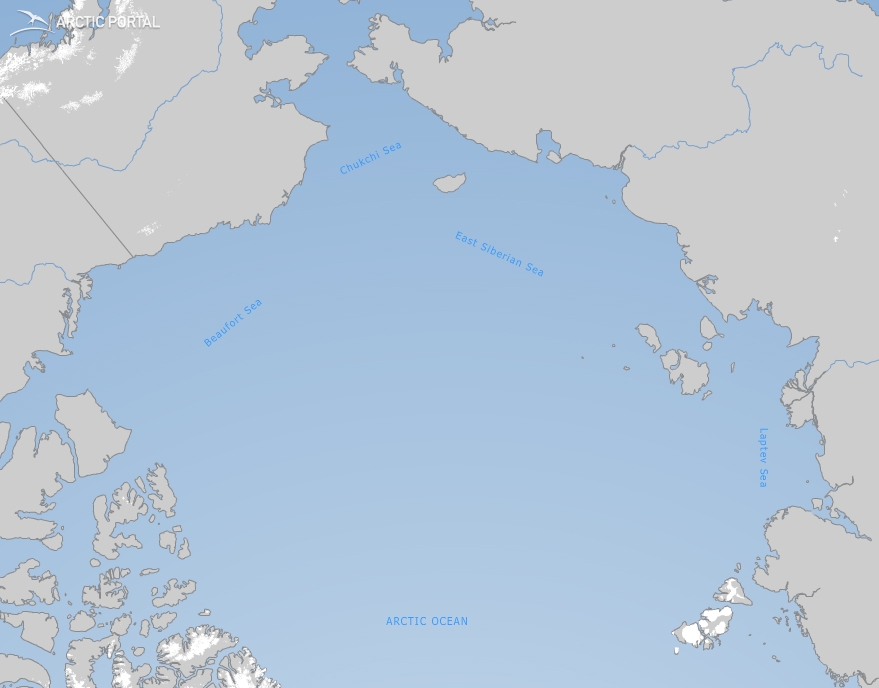
    Map of The Laptev Sea

    Russian scientists are baffled after finding plumes of methane in the Arctic Ocean. The scale and volume of the methane was a huge surprise to the researchers.

    The team was doing research in the East Siberian Arctic Shelf, in the Laptev Sea. The methane, a greenhouse gas 20 times more potent than carbon dioxide, was released from the Arctic seabed.

    Igor Semiletov, of the Far Eastern branch of the Russian Academy of Sciences, said that he has never before witnessed the scale and force of the methane.

    “Earlier we found torch-like structures like this but they were only tens of metres in diameter. This is the first time that we’ve found continuous, powerful and impressive seeping structures, more than 1000 metres in diameter. It’s amazing,” Dr Semiletov said in the Independent.

    “I was most impressed by the sheer scale and high density of the plumes. Over a relatively small area we found more than 100, but over a wider area there should be thousands of them.”

    Source: The Independent

  • Arctic shipping season over

    Map of The North Eastern Sea Route

    The Northern Sea Route shipping season is now over. To much ice in the Arctic ocean hinders any more shipping.

    This is the longest season ever in the route, one month longer then last year.

    The Perseverance was both the first and last vessel this year to go the route, the first one was the 29th of June and the last one today.

    The ship transported stable gas condensate from Murmansk in Russia to China, with the help of a Russian icebreaker.

    Russia’s Ministry of Transport believes cargo transport through the NSR will increase from 1,8 million tons in 2010 to 64 million tons by 2020.

    Source: Barentsobserver

    Click here to read more about the Northern Sea Route.

  • Arctic current warmer than for 2,000 years

    Arctic current warmer than for 2,000 years

    arctic lake

    A North Atlantic current flowing into the Arctic Ocean is warmer than for at least 2,000 years in a sign that global warming is likely to bring ice-free seas around the North Pole in summers, a study showed.

    Scientists said that waters at the northern end of the Gulf Stream, between Greenland and the Norwegian archipelago of Svalbard, averaged 6 degrees Celsius (42.80F) in recent summers, warmer than at natural peaks during Roman or Medieval times.

    “The temperature is unprecedented in the past 2,000 years,” lead author Robert Spielhagen of the Academy of Sciences, Humanities and Literature in Mainz, Germany, told Reuters of the study in Friday’s edition of the journal Science.

    The summer water temperatures, reconstructed from the makeup of tiny organisms buried in sediments in the Fram strait, have risen from an average 5.2 degrees Celsius (41.36F) from 1890-2007 and about 3.4C (38.12F) in the previous 1,900 years. The findings were a new sign that human activities were stoking modern warming since temperatures are above past warm periods linked to swings in the sun’s output that enabled, for instance, the Vikings to farm in Greenland in Medieval times.

    “We found that modern Fram Strait water temperatures are well outside the natural bounds,” Thomas Marchitto, of the University of Colorado at Boulder, one of the authors, said in a statement. The Fram strait is the main carrier of ocean heat to the Arctic

    Source: Reuters / Alister Doyle

  • Northeast Passage

    Northeast Passage shipping route

    The Northeast Passage is in reality a useful sea route. It runs from the northernmost parts of the North Sea across the icy waters of the Arctic Ocean north of Russia, east to the Chukchi Sea and Bering Straits where access to the North Pacific is reached.

    Several straits in the Passage can be classified as international.

    The Northern Sea Route (NSR) is an established commercial seaway that was used for domestic transportation and played an important economic role for the Soviet Union around World War II.

    The course of NSR was defined in a Russian regulation in 1990 and is in fact (rather than theoretically), the middle part of the Northeast Passage.

    To that extent, the Northern Sea Route can be equated with the Northeast Passage if this simple fact is known.

    As with the Northwest Passage, the Northeast Passage is limited for use because of extreme natural conditions based on the geographical location of the passage. However, if climate change continues to effectively bring warmer air to the area, condition of winds, ice and currents might result in more favourable sea route. But that does not resolve the legal issues and questions that rise if foreign ships use it as no specific universal agreement has been settled on that matter.

    In the summer of 2011 sea ice was at an all time low since measuring began. That resulted in extended shipping in the route. In August it took only eight days for the STI Heritage tanker to go from Murmansk in Russia to the Bering Sea. Russia is strengthening its fleet of icebreakers and will continue to use the route when it is possible, which is still only for a few months around the summertime.