Less sea ice coverage and changes in melt patterns in the arctic has various implications for biodiversity of the Arctic regions, the affect is in many cases not clear and it’s full reach not clear, the few facts mentioned below should be considered as examples rather than a full analyze.
The seasonal expansion and melt of sea ice in the Arctic is a defining feature of the highly productive ecosystem.
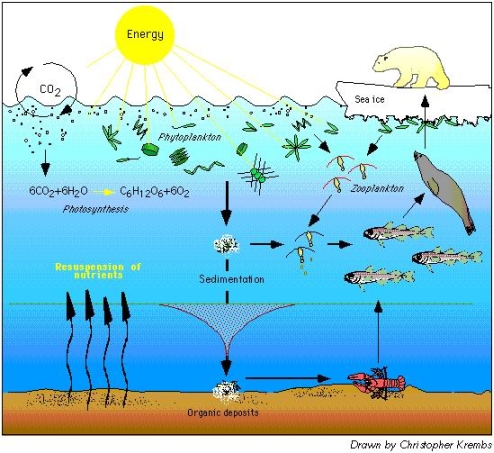
The timing of the phytoplankton bloom, which supplies energy to the entire ecosystem, is regulated by the timing of the ice retreat.
As temperatures increase, less sea ice forms and it melts earlier in the spring, resulting in delayed spring phytoplankton bloom. Algae and tiny animals inhabit sea ice, living in and on the under surface.
In the spring when sunlight is returning, ice in the Arctic melts discharging those plants and animals into the water column where they stimulate a massive phytoplankton bloom. There is more plankton present than can be consumed by the zooplankton and so most of the nutrients fall to the seafloor feeding benthic animals. The ocean bottom in many parts of the arctic are a rich living seafloor providing abundant food for diving predators including walrus, gray whales and spectacled eiders.
Warmer temperatures cause the melt to happen earlier than usual. Under this scenario, there has been less growth of ice algae and it is discharged before sufficient sunlight is present to cause the phytoplankton bloom. The bloom is then delayed until sunlight is available but without the added fuel from the ice algae. Less phytoplankton is produced and it is consumed by zooplankton before it reaches the seafloor. This scenario is considered more favorable to fish in the pelagic zone feeding on zooplankton.
The change in timing of the phytoplankton bloom affects which predators consume the phytoplankton and the effect is carried all the way up the food chain. Colder temperatures and more sea ice normally support benthic (bottom-dwelling) communities like crustaceans and in turn the marine mammals and diving sea ducks that prey on them. In contrast, warmer temperatures and reductions in sea ice result in more food available for fish in the pelagic zone (water column). Scientists are concerned that a loss of spring phytoplankton production may in turn reduce the overall productivity of the Bering Sea ecosystem
Quite a number of animals also directly base their subsistence on the Ice coverage such as polar bear, walrus, hooded seal and the narwhal. Sea Ice provides protection as well from predators like the killer whale also known as Orca whale that now have easier access to prey in arctic waters.
The interlinkage of global warming and retreating sea ice is also likely to change the biological composition in the region as new species move further into the Arctic, with existing species moving further north, often creating challenges connected to their access to their food supply.
The loss of ice will open the Arctic to new levels of shipping, oil and gas exploration and drilling, fishing, hunting, tourism, and coastal development. These, in turn, will add new threats to marine mammal populations, including ship strikes, contaminants, and competition for prey.
Effect on whether patterns
It is a common misunderstanding that melting Sea Ice will contribute to a rise in Sea levels, since the Sea Ice is already floating in the Ocean this would be very minimal and has been estimated to be around 4mm if the entire world Sea Ice melted. The loss of Sea Ice would however contribute to a overall warmer Arctic which will accelerate the melting of the Greenland icecap, which would lead to a Sea level rise of 20 feet or 6 meters. Such a Sea level rise could have quite a significant effect on the globe, the video below illustrates some of the effects of a rise of 6 meters.
[http://www.youtube.com/watch?v=kgCYhU5ISwI&feature=player_embedded]
Effect on the jet stream and planetary weather patterns
Continued loss of Arctic sea ice may dramatically change global weather and precipitation patterns in the decades to come. The jet stream will probably move further north in response to warmer temperatures over the pole, which will bring more precipitation to the Arctic. More frequent and intense droughts over the U.S. and other regions of the mid-latitudes may result from this shift in the jet stream. Changes to the course of the jet stream affect weather patterns for the entire planet, and we can expect impacts on the strength of the monsoons and re-curvature likelihood of hurricanes.
Francis et al. (2009) found that during 1979 – 2006, years that had unusually low summertime Arctic sea had a 10 – 20% reduction in the temperature difference between the Equator and North Pole. This resulted in a weaker jet stream with slower winds that lasted a full six months, through Fall and Winter. The weaker jet caused a weaker Aleutian Low and Icelandic Low during the winter, resulting in reduced winter precipitation over all of the U.S., Alaska, and Northern Europe. In contrast, increased precipitation fell over Spain, Italy, and Japan during these winters. The authors noted that strong La Niña or El Niño events can have a much stronger influence on the wintertime atmospheric circulation, which will overshadow the circulation changes due to summertime Arctic sea ice loss.
Such as the strong La Niña event occurred during the winter of 2007 – 2008. In any case, reduced summertime Arctic sea ice should give most of the Northern Hemisphere a delayed start to winter during most years, for the foreseeable future.
Coastal damage in the Arctic
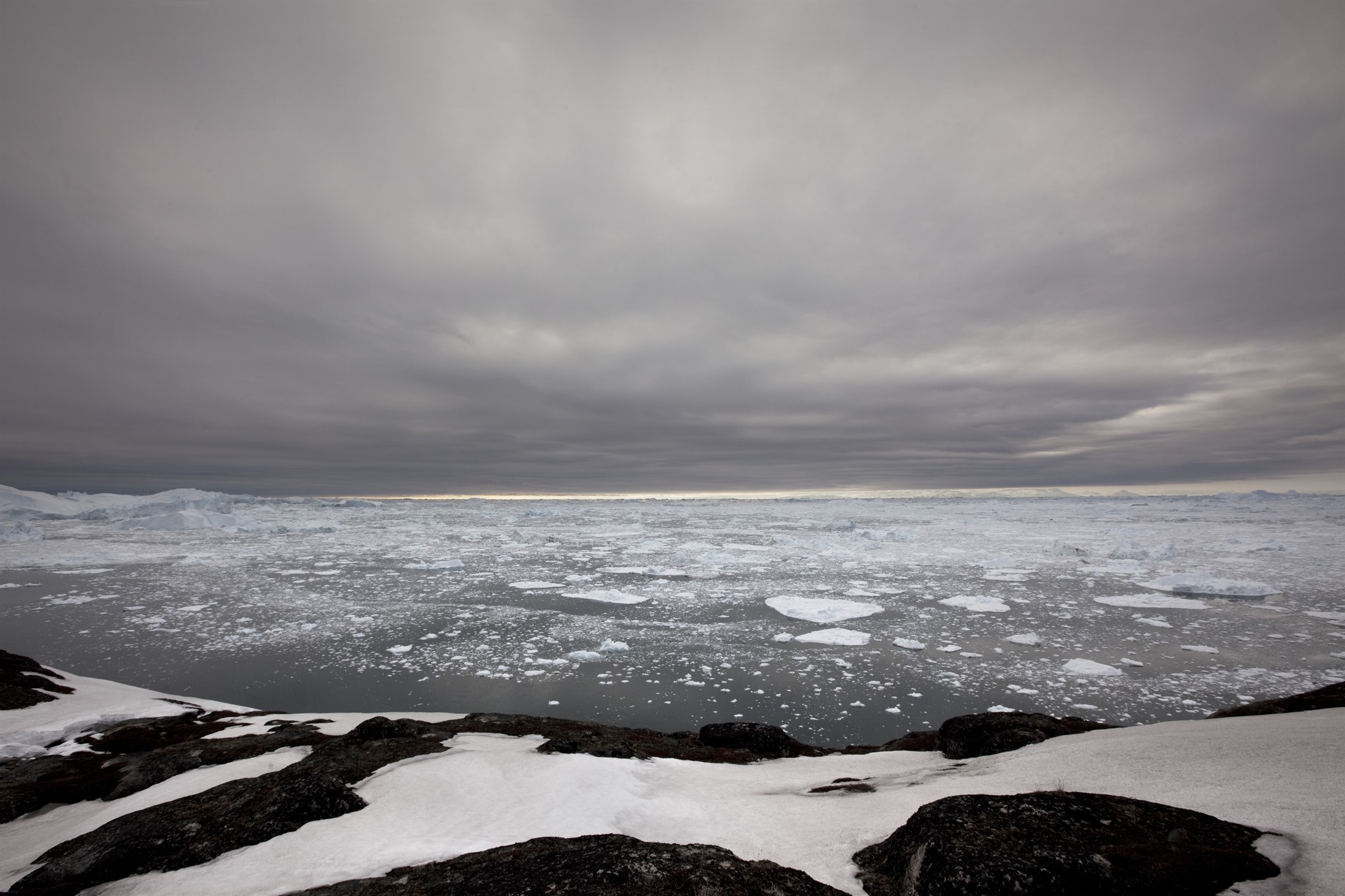
More open water in the Arctic Ocean allows erosion due to wave action to affect the coast for longer periods, particularly during fall, when storms tend to be stronger with higher storm surges. The resulting destruction has already forced residents of the Alaskan town of Shishmaref to vote to abandon their village. More than half the residents of the nearby village of Kivalina were forced to evacuate on September 13 2007, when 25-40 mph winds drove a 3-4 foot high storm surge into the town. The U.S. Army Corps of Engineers built a $3 million sea wall to protect the town, but the wall has not been able to hold against recent storms. Over 100 feet of coastline has been lost in the past three years.
More open water also means more moisture and heat will be available to power storms. These stronger storms will bringer higher winds and higher storm surges to coastal areas in the Arctic over the remainder of the 21st century, resulting in increased erosion and flooding of low-lying areas.
Effect on the local population
Sea Ice affects all people as a part of the whether system that enables humans and other species to exist, but the decline in sea ice will have a more prominent affect local people. Storms are likely to gradually become stronger and more frequent and land erosion by the sea will continue to increase. The declining sea ice and previously unknown changes commonly connected with climate change are having a significant effect on various indigenous groups in the Arctic.
Subsistence activities still have a significant meaning to numerous arctic indigenous groups both from a cultural as well as economic stand-point. Numerous indigenous groups around the Arctic region have been very active in promoting the issues connected to climate change and traditional knowledge increasingly being accepted within the scientific community. Both indigenous groups as well as other inhabitants of the North will have to adapt to the changes at hand and due to the gradual nature of these changes it should be easier to adapt.
The environment has of course been changing for all history even if these changes connected to global warming are unprecedented, many of these changes may offer quite a bit of opportunities alongside the challenges created.
[http://www.youtube.com/watch?v=mX1BOLGgUwA&feature=player_embedded]