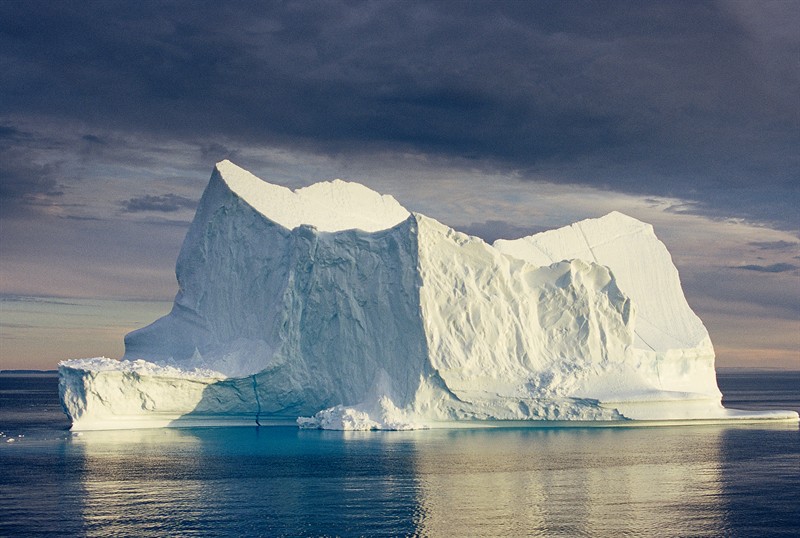
Tag: arctic sea ice

  • May ice edge below average

    May ice edge below average

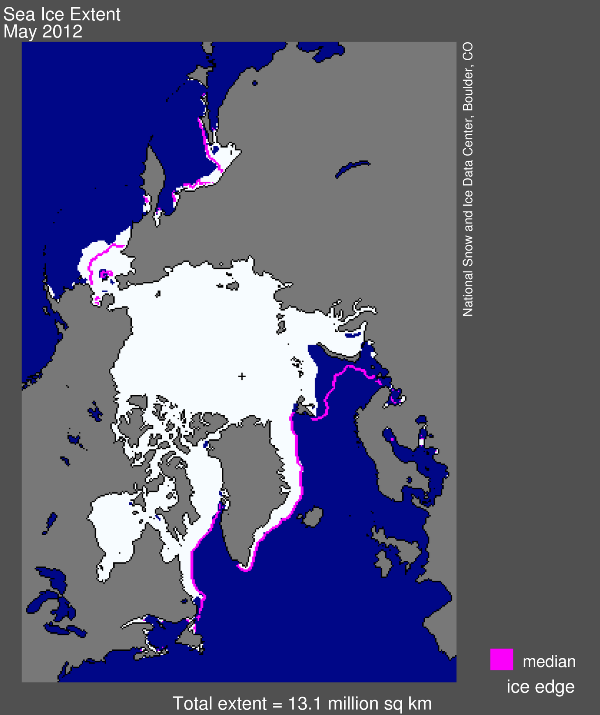
    Sea ice extent in May 2012

    The Arctic sea ice melting season is in full force and the ice edge in May was below average. The ice edge reached near average in late April but the melt happened rapidly in May.

    The Arctic Ocean was fully frozen in May as can be seen on the picture on the right, from the National Snow and Ice Data Center.

    The Arctic sea ice extent for May 2012 averaged 13.13 million square kilometers (5.07 million square miles). This was 480,000 square kilometers (185,000 square miles) below the 1979 to 2000 average extent.

    Ice cover remained extensive in the Bering Sea, continuing the pattern observed this past winter and spring. The anomalously heavy ice conditions were countered by unusually low extents in the Barents and Kara Seas, resulting in Arctic-wide ice conditions that remained below normal. By the end of the month, open water areas had begun to form along some parts of Arctic Ocean coast.

    For May, the Arctic as a whole lost 1.62 million square kilometers (625,000 square miles) of ice, which was 180,000 square kilometers (69,500 square miles) more than the 1979 to 2000 average.

    Air temperatures for May were higher than usual over the central Arctic Ocean and the Canadian Archipelago. Over the Bering Sea, Hudson Bay, and parts of the East Greenland and Norwegian seas, temperatures were slightly below average.

    Source

    NSIDC

  • Long swim ahead for polar bears

    Long swim ahead for polar bears

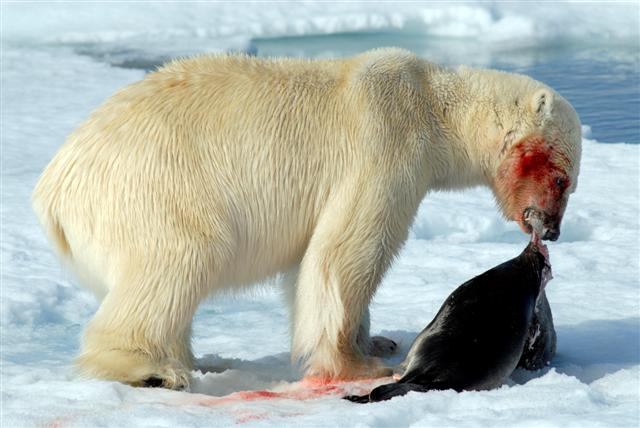
    Polar bear that caught a seal

    The summer is near and the Arctic sea ice has started its retreat. This means hard work for the polar bears in the Arctic.

    Their hunts for food has begun after the winter exile and are now swimming more than ever to eat.

    A research conducted for five years, between 2004 and 2009, shows that the average distance they swam was 154 kilometers.

    Scientist used GPS technology to track 52 adult female polar bears in the Beufort Sea near Alaska. They managed to track 50 swims in total.

    One case studied by the researchers tracked a female polar bear as she swam continuously for more than nine days, covering a distance of more than 687 kilometers. The bear lost 22 per cent of her body mass during the trip. Her cub died during the journey.

    However, many cubs do survive the long swims, says Anthony Pagano, a lead author of the study. He told the Barents Observer:

    “We were able to recapture or observe 10 of these females within a year of collaring, and six of these females still had their cubs,” Pagano said in a press release. “These observations suggest that some cubs are also capable of swimming long distances. For the other four females with cubs, we don’t know if they lost their cubs before, during, or at some point after their long swims.”

    The study, published in the latest issue of the Canadian Journal of Zoology, is the first to use GPS to track polar bears’ long-distance swims. With declining levels of Arctic ice, these long swims could become more and more common.

    There are about 25,000 polar bears in the Arctic. A 2004 survey of the Barents Sea polar bear population found about 3,000 polar bears in the region.

    Source

    Barents Observer

  • Current developments

    Current developments

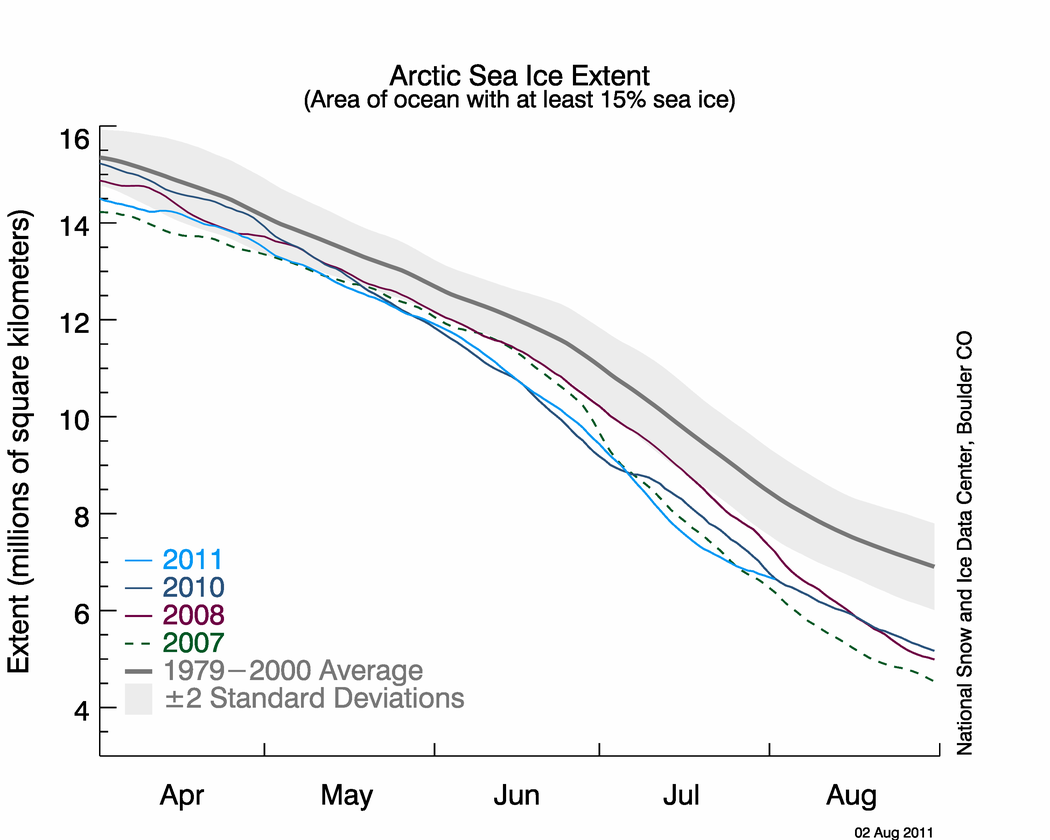
    arctic sea ice Extent 2011

    Reports have been coming in during the summer of 2011 that the summer melt-down has reached a new record low since the beginning of satellite data record ranging back to 1979 as well as other recorded data ranging back to the 50’s.

    The previous record low occurred in 2007. Sea ice coverage also remains below normal everywhere except the East Greenland Sea.

    The Northern Sea route is vastly free of ice. Russians are taking advantage of that, sending numerous vessles through the route, amongst them will be the largest ever tanker to go through the route.

    Average ice extent for July 2011 was 7.92 million square kilometers (3.06 million square miles). This is 210,000 square kilometers (81,000 square miles) below the previous record low for the month, set in July 2007, and 2.18 million square kilometers (842,000 square miles) below the average for 1979 to 2000.

    On July 31, 2011 Arctic sea ice extent was 6.79 million square kilometers (2.62 million square miles). This was slightly higher than the previous record low for the same day of the year, set in 2007.

    “Arctic Dipole anomaly “In a 2008 article titled, Recent radical shifts of atmospheric circulations and rapid changes in Arctic climate system Zhang et al. show that the extreme loss of Arctic sea ice since 2001 has been accompanied by a radical shift of the Arctic atmospheric circulation patterns, into a new mode they call the Arctic Rapid change Pattern. The new atmospheric circulation pattern has also been recognized by other researchers, who refer to it as the Arctic Dipole (Richter-Menge et al., 2009). “ Source: Dr Jeff Masters- Weather Underground

    NASA has compiled a video showing the retreat of sea ice in the summertime 2011. From spring to autumn, this is how the sea ice retreated.
    [http://www.youtube.com/watch?v=6Hv4S90UOBY]

  • Fluctuations in Arctic sea ice

    Fluctuations in Arctic sea ice

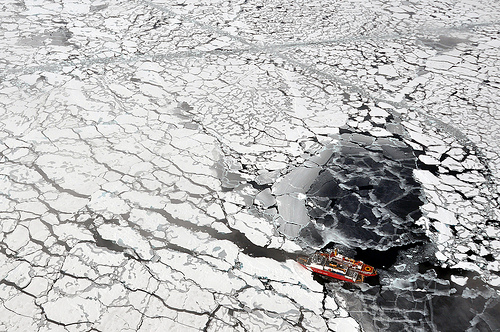
    Icebreaker sailing through arctic sea ice

    The extent of the Arctic sea ice is extremely variable. Danish researches have come to this conclusion.

    Measuring the extent of sea ice is almost impossible. It constantly breaks off the ice caps in the Arctic and then melts after drifting in the ocean.

    The Danish researchers say this is the first time that an idea of past sea ice levels has been extracted from the region.

    “Our key to the mystery of the extent of sea ice during earlier epochs lies in the driftwood we found along the coast,” Svend Funder, one of the researchers said to PlanetSave and added: “Our studies show that there have been large fluctuations in the amount of summer sea ice during the last 10,000 years.”

    8-5000 years ago the temperature was considerably warmer then today. That mens the sea ice was significantly less at the time then now. That means a direct connection between the temperature and amounts of sea ice, Funder says.

  • Arctic Sea Ice

    Arctic Sea Ice

    Sea Ice in Disco Bay

    The Arctic Sea Ice is one of the key symbols of the cold and barren Arctic regions, and affects the lives of both arctic and non-arctic residents.

    Sea Ice significantly contributes to the worlds whether patterns and help to keep the globes temperature down.

    Measurements of sea Ice during 2010 have reinforced the general belief that the sea ice is declining year from year.

    In this coverage the AP will present an overview of these changes as well as some of the possible implementations, opportunities and effects this may have, based of information from leading scientific institutions involved in snow and ice measurements.

    Sea ice being white has a much higher reflection than other earths surfaces, making it function as a giant mirror reflecting the suns radiation into space. This is reflectiveness is referred to as “albeido” It has been estimated that Sea Ice reflects as much as 50-95% of the suns radiation while an open ocean surface only reflects about 10-15%.

    This reflection contributes significantly to keeping atmospheric temperatures cooler. Additionally this keeps the ocean in the northern hemisphere cooler, helping to maintain the planet’s ocean conveyor system. With the rapid decline in Sea Ice, documented in recent years there is the risk of a cicle of warming as higher atmospheric temperatures contribute to loss of sea ice and further loss of sea ice contributes to more atmospheric warming, this effect is known as the “ice-albedo feedback”.
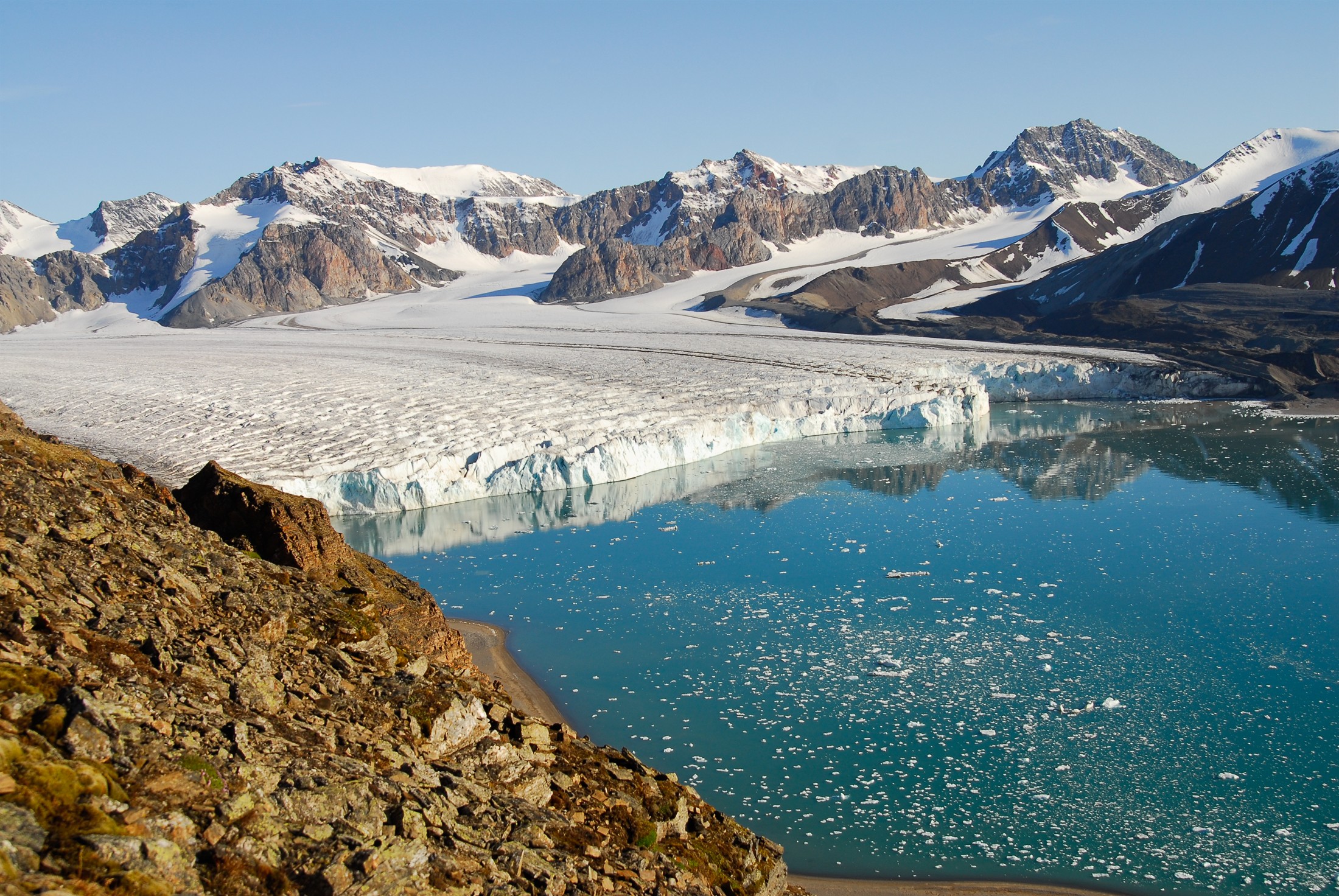
    Glacier Mouth, Krossfjorden, Svalbard

    The prevailing view among climate scientists had been that an ice-free Arctic ocean would occur in the 2070 – 2100 time frame. The February 2007 report from the U.N.-sponsored Intergovernmental Panel on Climate Change (IPCC), warned that without drastic changes in greenhouse gas emissions, Arctic sea ice will “almost entirely” disappear by the end of the century. The recent observations and the Holland et al. model study suggest that it is conceivable that a complete loss of summer Arctic sea ice will occur far earlier.

    In a 2007 interview published in The Guardian, Dr. Mark Serreze, an Arctic ice expert with the National Snow and Ice Data Center, said: “If you asked me a couple of years ago when the Arctic could lose all of its ice, then I would have said 2100, or 2070 maybe. But now I think that 2030 is a reasonable estimate. It seems that the Arctic is going to be a very different place within our lifetimes, and certainly within our children’s lifetimes.”

    While natural fluctuations in wind, ocean circulation, and temperatures are partly to blame for this loss of sea ice, human-caused global warming is also to blame. In the words of Dr. Serreze: “The rules are starting to change and what’s changing the rules is the input of greenhouse gases. This year puts the exclamation mark on a series of record lows that tell us something is happening.”

    Some argue that the process of achieving both consensus and rigor in the IPCC report yields a “conservative” estimate of climate change. It is true that predictions which involve phase changes are among the most difficult for climate models.

    This is made even more challenging for sea ice, which sits in water and is subject to amplified melting by stirring in the water, and is also sensitive to the local salinity of the water. If there are to be surprises in the predictions of climate change, then they are likely to involve phase changes. In a warming climate, this would involve the transition of water from ice to liquid.

    The decline of the Sea ice is likely to have a wide number of impacts to both the world in general and of course specifically the Arctic. These impacts are likely to be both negative and positive.

    The video below was put together by the Arctic Portal using data from the IARC-JAXA project showing the transition in Sea ice from June 2002- 14 July 2010.

    [http://www.youtube.com/watch?v=hpRYCEHJlLc]


    To learn more about the Arctic sea ice:

    Summary – The Greenland Ice Sheet in a Changing Climate.
    Snow, Water, Ice and Permafrost in the Arctic (SWIPA), 2009. Arctic Monitoring and Assessment Programme (AMAP), Arctic Council

    Global Glacier Changes: facts and figures. 2008. United Nations Environmental Programme (UNEP)

    Arctic sea Ice News and Analysis, The National Snow and Ice Data Center (NSIDC)

    Arctic sea-ice ecosystems, Arctic Biodiversity Trend 2010, CAFF, Arctic Council