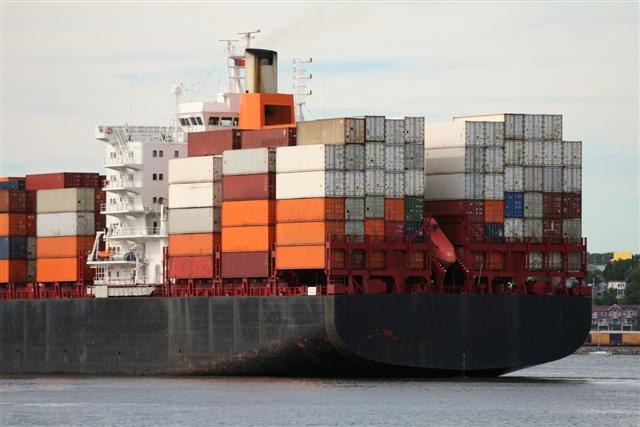
Arctic Shipping is a topic that is of great interest to both nation states as well as local Northern communities. The last four years have shown a trend of record low ice extent, and it is generally believed that the melt will continue to increase.
This development in already leading to increased shipping within the Arctic. During this summer we saw the first high capacity tanker go through the northern passage to Asia as well as the first non-Russian bulk carrier to go through the same route. The opening of the Northern Sea route would have immense effects on global shipping as it would shorten shipping from Asia to Europe and North America significantly.
Such a sea-route and all the benefits which it would entail are however not without consequence as recently been published from a team of U.S and Canadian researchers, including scientists from the University of Delaware. Growing Arctic ship traffic will bring with it air pollution that has the potential to accelerate climate change in the region. Engine exhaust particles is could increase warming by some 17-78 percent.
James J. Corbett, Professor of marine science and policy at UD states ” One of the most potent ‘ short-lived climate forces’ in diesel emission is black caron, or soot. Ships operating in or near the Arctic use advanced diesel engines that release black carbon into one of the most sensitive regions for climate change.
Produced by ships from the incomplete burning of marine fuel, these tiny particles of carbon act like ‘heaters’ because they absorb sunlight — both directly from the sun, and reflected from the surface of snow and ice. Other particles released by ship engines also rank high among important short-lived climate forcers, and this study estimates their combined global warming impact potential.
To better understand the potential impact of black carbon and other ship pollutants on climate, including carbon dioxide, methane and ozone, the research team produced high-resolution (5-kilometer-by-5-kilometer) scenarios that account for growth in shipping in the region through 2050, and also outline potential new Arctic shipping routes.”
Among the research team’s most significant findings:
- Global warming potential in 2030 in the high-growth scenario suggests that short-lived forcing of ~4.5 gigatons of black carbon from Arctic shipping may increase the global warming potential due to ships’ carbon dioxide emissions (~42,000 gigagrams) by some 17-78 percent.
- Ship traffic diverting from current routes to new routes through the Arctic is projected to reach 2 percent of global traffic by 2030 and to 5 percent in 2050. In comparison, shipping volumes through the Suez and Panama canals currently account for about 4 percent and 8 percent of global trade volume, respectively.
- A Northwest Passage and Northeast Passage through the Arctic Ocean would provide a distance savings of about 25 percent and 50 percent, respectively, with coincident time and fuel savings. However, the team says tradeoffs from the short-lived climate forcing impacts must be studied.
- To calculate possible benefits of policy action, the study provides “maximum feasible reduction scenarios” that take into account the incorporation of emissions control technologies such as seawater scrubbers that absorb sulfur dioxide emitted during the burning of diesel fuel. Their scenario shows that with controls, the amount of Arctic black carbon from shipping can be reduced in the near term and held nearly constant through 2050.
What this work highlights is that the development path that trans-arctic shipping must take is one that is environmentally friendly. That scientists cooperate closely with the Arctic Council and the eight nation states there within on climate policy in connection to trans-arctic shipping.
The Northern Sea Routes on map