Tag: arctic states

  • Two working groups, one aim

    Two working groups, one aim

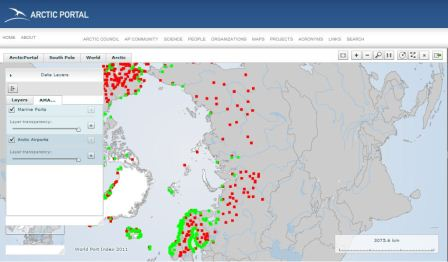
    Interactive Data Map

    Today, the 4th of December, Arctic Transportation Infrastructure Response and Capacity and Sustainable Development in the Arctic workshop brings together aviation and maritime specialists from eight Arctic states in order to discuss gaps in infrastructure around the remote Arctic.

    Two separated groups, during two hours sessions try to create terms that are going to be used internationally in future AMATII database. What is more, maritime and aviation working groups try to find the answer on what legal, regulatory and fiscal mechanisms facilitate inter-modal infrastructure investment.

    Mrs Sarah Barton, facilitator for maritime working group and Mr James Hemsath for the aviation will review and summarize team’s efforts in order to communicate the outcome to international and regional policy makers.

    Later today, participants will have a chance to view and evaluate the Arctic Port and Airport Database and web-based interactive map, which is the primary deliverable of this project. Subject matter expert input will help refine and strengthen this tool.

    The workshop will end with an interactive plenary session, discussing next steps and outlining areas of consideration for a Guidance Document, a deliverable for this Arctic Council project.

    The Conference will continue daily until Thursday.

  • Closer co-operation between the Arctic states

    Search and Rescue operations in the arctic

    Governments of eight Arctic states agreed on closer cooperation with regards to search and rescue operations on the Arctic waters.

    Representatives from Ministries of Defense from Canada, Denmark, Iceland, Norway, Finland, Russia, Sweden and United States met at the Canadian military base in Goose Bay later last week to discuss further cooperation in the High North.

    It was the first time that northern chiefs of defense had an opportunity to meet. Gen. Walter Natynczyk, Chief of the Canadian Defence Staff, said after the meeting that he was very pleased with the discussions amongst the eight generals: “Certainly what we saw was a great sense of a spirit of co-operation amongst everyone. We were able to gain an understanding of the unique challenges each faces with regards to emergency response and for support to our civilian authorities”.

    It was decided that from now on, the representatives of eight Arctic states will meet annually to discuss defense, search and rescue issues in the High North.

    Source: Barents Observer
  • Catch by Countries

    Fisheries in tons for the past 60 years.

    Here is a graph that shows how much six Arctic states caught. The numbers do not include whaling, but the numbers are in tons.

    The numbers date back from 1950, except for Russia.

    This shows the biggest fishing nations in the Arctic.

    It shows very well that USA is the biggest fishing nation, somewhat a surprise for many.

    Russia is also very big in numbers, especially in 1990.

    It is very interesting to compare this to the importance of fishing for the countries, and the export numbers. It shows that although both USA and Russia are hunting a lot, it is not very important for their economy.

  • Fishing Graphs

    Division of the Pacific and Atlantic oceans

    The eight Arctic states all catch fish. The species and quantity naturally varies between them.

    In this section comparison is shown between the states, where they are fishing, what and how much.

    Fishing is a part of every nations export value, but the difference is staggering. For example is fishing the backbone of the Greenlandic economy, counting for around 94% of their export value. Most countries rely on other means, where fishing is not very important.

    The map on the rights shows the Arctic. The Arctic Ocean is aligned with the Pacific Ocean and the Atlantic Ocean.

    The northwestern part of the Pacific is near Alaska but the northeastern part goes from Russia and all the way to Japan.

    The Atlantic Ocean northwestern part is around Canada and the USA, but also stretches up to Greenland.

    The Atlantic´ northeastern part stretches to Europe, to Portugal and up to Russia where the Arctic Ocean takes over.