Tag: arctic

  • Transpolar flights, a shortcut through the Arctic

    Transpolar flights, a shortcut through the Arctic

    Arctic Voyage of Richard Byrd and Umberto Nobile

    “Aviation is a proof that given, the will, we have the capacity to achieve the impossible.”

    Eddie Rickenbacker

    Long before the jet age, commercial aircraft were flying through the Arctic Circle. After the successful voyages of Richard Byrd and Umberto Nobile in 1926, the feasibility of polar aviation was demonstrated in actual practice. Nowadays, commercial traffic, connecting Europe, North America and Asia through the north polar routes is a routine.

    Cross-polar air corridors bring new opportunities for both commercial and private travel markets. Transpolar aviation reduces the burn of fuel by making the travel time shorter what lowers the cost of trans-polar air operations.

    Flying direct paths between many of North American and Asian cities also decreases the environmental threats of greenhouse gases emissions, which are now one of the major concerns of the Arctic States.

    Polar air corridors refer to aircraft routes lying across the uninhabited polar ice cap region, 78 degrees north from the northern latitude what includes areas of northern part of Alaska and most of Siberia. Term of Polar Route was originally adopted in the middle of 20th century and applied to the great circle between Europe and west coast of North America.

    The Polar Route formally opened after the Cold War for commercial flights between Europe and Asian Far East as before that period civilian flights were not able to cross the air space over the Soviet Union and China as those countries were much concerned about the possibility of trans-polar attack.

    Nowadays commercial traffic through the northern hemisphere is operated by various aircraft as Boeing 747 – 400 and Airbus A340, with ranges of around 7000 nautical miles. In 2001, Arctic States adopted policy letter, Guidance for Polar Operations, which outlined a number of specific requirements for polar flight operations, including cold weather conditions, special communication capabilities, fuel freeze strategy, evacuation and recovery plans for abandoned passengers and special monitoring requirements as the aircraft operating in the Arctic rely almost exclusively on satellite communications, where a pilot´s signal is beamed into the space and bounced back to a ground control station.

    Modern aircraft flying the polar route

    Arctic operating planes handle the distances between Europe, Asia and North America and are managed by various airlines. The International Air Transportation Association proposed the establishment of the Pacific Project which would meet the increasing air traffic demand between Asia and North America which is very likely to double by the end of 2025.

    Opening of new and improving strategies on already used air traffic routes offer possibilities to reach various locations in the northern hemisphere in easy and cost efficient way.

    Trans-Arctic shipping routes appear to emerge as the fastest way of transportation between North America and Asia. Flying direct paths across the uninhabited Arctic ice cap region, helps aircraft to reduce the fuel burns, travel time and associated environmental carbon emissions.

    Advanced transportation technology increases the importance of airships for trade and economic development. It is being defined that aircraft able to fly the Polar Routes are the most competitive in northern areas without highly developed infrastructure.

    There are 676 airports currently maintained around the Arctic and majority of them is situated in Alaska, United States. There are 79 airports in Arctic Canada, 71 in Russia, 62 in Denmark (Greenland and Faroe Islands), 56 in Norwegian Arctic including Svalbard, 55 in Finland, 35 in Sweden and close to 20 in Iceland. Not all of them exist as ports of entries for international traffic as those are partly used domestically.

    (Map: Arctic Portal) Air shipping routes Interactive map aims to locate and provide with significant information with regards to Arctic airports. This research will show the mechanisms associated with Arctic air traffic in rather difficult, unique climate and familiarize with Arctic airports locations and information with regards to runway length and elevation to indicate approximate size of the airport and load classification.

    Trans – Arctic aviation leaves a significant scare in the fragile Arctic environment. All forms of air traffic used to cross the Arctic air space emit carbon dioxide and other greenhouse gases, like oxides of nitrogen and water vapor, into the northern atmosphere.

    Emissions of an Arctic airship can vary significantly, according to the size of the aircraft, the number of passengers on board, the distance of journey and the altitude as it was proved that aircraft flying on high altitudes produce more carbon dioxide than those operating on lower altitudes.

    Reducing air travels and Arctic air tourism opportunities seem to be another alternative way to reduce aviation impact on climate change and Arctic environment. If future travel demand could be managed with supplementary ways of transportation, increased taxation would not be needed to be implemented by the Arctic States.

    To read more about Arctic aviation, please enter the Aviation chapter in Arctic Portal Shipping Portlet.

  • New report on melting glaciers

    New report on melting glaciers

    Melting glacier in Svalbard

    A new report of current rates of changes of land ice in the Arctic and North-Atlantic region has been released. It shows that the Greenlandic glacier shrinks by 200 square kilometers every year.

    Helgi Björnsson, a glaciologist at the University of Iceland, says that the Greenlandic glacier is melting rapidly, at twice the rate in the last 10-20 years. The glacier tongue is also stretching further out in the ocean than ever.

    The report states that the world oceans are rising of 3,3 mm every year, and almost 1/5 of that is because of the Greenlandic glacier. Only 20 years ago it was 2 mm less per year.
    The report included research on ice in Greenland, Iceland, Svalbard and Scandinavia.

    Glaciers in Iceland are also getting thinner, by 1 meter every year. Since 1990 glaciers in Iceland has shrunk by 150 square kilometers.

    The report is available here, in the Arctic Portal Library.

    This is the first Interim report of current rates of changes of land ice in the Arctic and North-Atlantic region from the Nordic Centre of Excellence ‘Stability and Variations of Arctic.

    Land Ice’ (SVALI). SVALI is one of three Nordic Centres of Excellence within the Nordic Top Research Initiative sub-programme ‘Interaction between Climate Change and the Cryosphere’. The report (Deliverable D.1.1-7 in the project) is written by the partners in Theme 1 “Observing the present – baseline and changes”.

    The report is a step towards answering one of the key questions to be addressed within SVALI: How fast is land-ice volume in the Arctic and North-Atlantic area changing?

    The report is available here, in the Arctic Portal Library.

    Sources

    Rúv

    SVALI report

  • Just one week away

    Just one week away

    Passenger plane

    Arctic Transportation Infrastructure: Response Capacity and Sustainable Development one important component of the Arctic Marine and Aviation Transportation Infrastructure Initiative (AMATII) – opens Monday, December 3 in Reykjavik, Iceland.

    International relationships are reflected in the workshop’s agenda and point to the global and systemic nature of Arctic transportation.

    The conference will treat about current activities in the Arctic in relation to marine and air transportation.

    The Arctic Maritime and Aviation Transportation Infrastructure Initiative (AMATII) is a platform for addressing critical needs in the Arctic’s aviation and maritime environment.

    The Initiative will approach Arctic air and maritime transportation policy, education, and research from various vantage points and will facilitate ongoing and increased communication and collaboration throughout the Arctic. It will serve as a coordination point for research and will facilitate technology transfer within and between Arctic nations.

    The Arctic Portal will play the active role in the project, developing the database to include the baseline assessment of maritime and aviation infrastructure that will accommodate continual update on Arctic maritime and aviation features.

    The Arctic Portal Interactive Mapping System will be used to illustrate the overlapping spheres of responsibility and capacity. It will be also used as an informative tool for the Arctic´s nations to understand and respond to both needs and capacity of Arctic maritime and aviation infrastructure.

    To read more about the conference and subscribe to the event, please click here. To browse the conference agenda, please access here. Information about workshop logistics, such as hotel and transportation are available here.

    Please, follow the links to read about the Arctic shipping and aviation challenges on the Arctic Portal Shipping Portlet.

    Source

    The Institute of the North

  • Arctic oil: setting risks too high?

    Arctic oil: setting risks too high?

    “A liquid substance that is greasy to the touch and formed by the breakdown of fats in fossil organic material: Oil.”

    (Map: Arctic Portal) Potential oil and gas fields in the Arctic

    This broad definition for oil is valid from everything between crude oil, the black flammable liquid sought by drilling, to the yellow vegetable oil used in cooking.

    Hydrocarbons – as they are often called – are in the broadest sense organic compounds of hydrogen and carbon. These exist in Earth’s subsurface in either liquid form – which is called (crude) oil or petroleum, or they exist in gaseous form, and then called natural gas.

    This week’s feature will answer the question of what is actual definition of Arctic oil and where it can be found. It will try to make you familiar with the long history of the Arctic oil as well as its formation and extraction. It will conclude with few words on environmental protection and prospects of future development.

    Oil rig at sea

    The “tool” to find deposits of oil or gas is the scientific branch of petroleum geology. Petroleum has a reputation as “Mother of all Commodities” as a number of materials are produced on a petroleum base – such as petrol, kerosene, plastics, medicines, basically all forms of organic chemicals. It is the most traded good amongst humans on this planet, followed by coffee and then natural gas. It is also the leading energy source of mankind: The combustion of fossil fuels—coal, oil, and natural gas—provides by far the largest portion of the current supply of energy.

    Within the Arctic, oil is today mainly found in three regions: The Beaufort Sea coast (North Slope of Alaska and the Mackenzie Delta of Canada), the Canadian north-eastern Arctic (Nunavut), and northwest Russia.

    In 2008, the US Geological Survey published an estimate of the undiscovered deposits in the Arctic. The impressive result was, that the area north of the Arctic Circle is expected to hold an estimated 90 billion barrels of undiscovered, technically recoverable oil, 1,670 trillion cubic feet of technically recoverable natural gas, and 44 billion barrels of technically recoverable natural gas liquids in 25 geologically defined areas thought to have potential for petroleum.

    These resources account for about 22 percent of the undiscovered, technically recoverable resources in the world. The Arctic accounts for about 13 percent of the undiscovered oil, 30 percent of the undiscovered natural gas, and 20 percent of the undiscovered natural gas liquids in the world. About 84 percent of the estimated resources are expected to occur offshore.

    Current oil and gas production areas

    Since fossil fuels are not renewable source of energy, their price and costs of production increase in line with increased consumption and diminishing known reserves. This leads to pressure to explore oil from territories earlier regarded as inhospitable.

    The Arctic and its resources are thus coming into focus: Depending on oil prices and the supply of oil from existing producing regions, such as the North Sea and the Middle East, there will likely be an increasing pressure to develop the Arctic reserves. There can already be seen strong indications that Arctic becomes one of the main sources of oil and gas in the twenty-first century.

    Historically there are three main regions in the Arctic linked to oil exploitation: the Beaufort Sea coast (North Slope of Alaska and the Mackenzie Delta of Canada), the Canadian north-eastern Arctic (Nunavut), and northwest Russia (Barents Sea and West-Siberia).

    Within the three, first developments of oil and gas fields took place in Russia (Komi Republic), then in Canada (Alberta) and finally in the USA (Alaska).

    Comparison of the development of oil and gas fields in the circumpolar North reveals two fundamental models of developing these resources: the European (or North Sea) model and the American (USA, and partially Canada) model. Both of which occur with regional peculiarities.

    The European model is often described as an “interventionist” or “state capitalist” system. Often a state-run national oil company plays the central role in developing and managing the resource. Private companies also participate directly, often in cooperation with these national oil companies. In addition the state has strong influence on the administration, issuing and allocation of production licenses including a strong influence on the requirements expected from private companies engaging in this model.

    Oil lies several layers down the earth

    In the so-called American model the state mostly has a regulatory role. Control over production and development is left in a relatively exclusive degree to private companies who obtain and compete for licenses and concessions through auctions.

    A major force of development throughout the circumpolar North came during the 1960’s and 1970’s due to political instabilities of major suppliers from the Middle East region. This made development of oil fields in Arctic and subarctic regions economically feasible and politically advisable. The development led to a number of new oil and gas fields both onshore and offshore as well as to the construction of according transport systems (pipelines).

    For example the Trans-Alaska Pipeline in Alaska was built between 1974 and 1977 and in Northwestern Siberia for a total of 14 years, from 1973 to 1986, at least one major construction project was undertaken either for major oil or gas pipelines each year. Often these megaprojects led to controversies with local population, as either resources were on traditional grounds belonging to indigenous peoples or the installation of oil fields or pipelines affected the traditional ways of subsistence (e.g. reindeer husbandry, fishing, hunting).

    There are numerous examples of megaprojects with a varying degree of involvement and participation of local / indigenous people in benefits and profits. Read more in the Megaprojects chapter of the Energy Portlet.

    Oil or hydrocarbon as it is often called – is in the broadest sense organic compounds of hydrogen and carbon. These exist in earth’s subsurface in either liquid form – which is called (crude) oil or petroleum.

    Petroleum and natural gas are formed from ancient biomass, thus the name “fossil” fuels for fuels based on petroleum or natural gas.

    Heating of prehistoric organic material leads to the formation of crude oil and natural gas. This happens over a long time via a set of complex biochemical and geological processes of pressure and seclusion from air (anaerobic conditions). The organic material usually mixed with mud clay, got buried under strong layers of sediment, thus generating conditions of high pressure and heat.

    This caused organic matter first to develop to a substance called kerogen and then with even more heat applied over geological time, becoming liquid or gaseous hydrocarbons.

    The subsurface reservoirs possibly blend with water and accumulate in chambers beneath the surface: The hydrocarbon compounds produced in this way were probably concentrated by being dissolved in water and transported through sedimentary rocks; the deposits were then trapped in dome-shaped chambers. However, petroleum can also remain oil shale or oil sands – such as in the Athabasca region of Canada.

    Oil barrels Prehistoric zooplankton and algae, plants and animals, from sea or lake bottoms, preserved under anoxic conditions, are the basis of today’s crude oil and natural gas. Prehistoric terrestrial plants are mostly the basis for today’s coal.

    Petroleum extraction is the whole process by which hydrocarbons (petroleum) is extracted and removed from the earth. The process is divided in three different stages: location, drilling and the actual oil extraction and recovery.

    Location of oil is defined by seismic surveys and gravimeters or magnetometers. An oil well is created by drilling into the earth with an oil rig. Offshore an oil rig is the platform from which the well is drilled. The actual hole is filled with a pipe made of steel. The idea is to fortify the integrity of the drilled hole. The bottom of the hole is finally perforated to allow oil to pass into the wellbore. On top of the well a structure with multiple valves is placed, called ironically „christmas tree”.

    The actually oil extraction and recovery after locating and drilling is subdivided into three stages.

    Several effects on the environment are linked to the different stages of oil extraction. Terrestrial, avian and marine fauna, flora and humans are all potentially affected when oil is sought. However, the oil spills still seem to be the biggest threat to fragile Arctic environment. Click here, to see the biggest oil spills that occurred close to the Arctic Circle.

    The Arctic is expected to host around 22% of the world’s remaining undiscovered oil and gas reserves, according to a 2008 assessment from the US Geological Survey. According to this assessment this would equal an estimated total oil and natural gas resource of 412 billion barrels of oil equivalent.

    Oil drilling platformAccording to the Energy Information Administration of the USA, the world total consumption of oil barrels per day in the year 2008 was 85.462, the yearly total being thus 31.193.630 billion barrels. This means that the whole world would be around 13 years to use all of the oil in the Arctic, should the whole 412 billion barrels be extracted and produced.

    Around 78% of the Arctic resources are expected to be natural gas and natural gas liquids (NGL). The West Siberian Basin and East Barents Basin are estimated to be key areas, holding 47% of the total undiscovered resources. 94 percent of the resources within these areas are expected to be natural gas and NGL.

    The North American part of the Arctic is expected to hold mostly oil whereas the Eurasian part of the Arctic seems to promise largely extended gas reserves: About 65% of the undiscovered Arctic oil are expected in the American part of the Arctic, compared to only 26% of the undiscovered Arctic natural gas.

    The major share of undiscovered oil deposits is expected to be in Arctic Alaska: About 30 billion barrels. Second is the Amerasia Basin, just north of Canada, with an estimate of about 9.7 billion barrels of undiscovered oil and third the East Greenland Rift, which is estimated to hold about 8.9 billion barrels of undiscovered oil.

    Altogether, these three North American provinces count for an expected sum of about 48.6 billion barrels of undiscovered oil, corresponding to around 54% of the total undiscovered oil in the Arctic.

    In the Barents Sea recent findings indicate that the Skrugard field contains an estimated amount of 250 million barrel oil reserves. Another field, Goliat is currently under development with an estimated reservoir size of 240 million barrels. It is also expected oil reserves are laying around Greenland; however exploration and test drilling have not yet led to any findings.

    Despite expected large reserves, the future of Arctic oil development is depending on technical, political and environmental challenges. Technical challenges are in general the harsh Arctic conditions that put special demands on men and material. Transport systems such as pipelines need to be constructed and in addition face technical challenges as climate change puts new requirements towards materials and construction technologies.

    the Arctic landscapePossible sovereignty disputes over land and sea areas in the circumpolar North could also delay the development of future oil fields. Regional examples such as from the Barents Sea, show how a long-lasting delimitation dispute can hold development for many decades. It was not until the 7th of July 2011, the day the Norwegian-Russian delimitation treaty in the Barents Sea entered into force that the Norwegian side started immediate prospecting for oil and gas.

    Last but not least there is the challenge of the vulnerable Arctic environment and the indigenous people of the circumpolar North that puts high demands to any oil or gas related project in the region. Increased transport, e.g. by tankers will also require new capabilities to Search and Rescue capabilities as well as oil spill prevention. High costs due to high environmental protection demands could delay or even halt a further development of Arctic oil, especially when cost / benefit calculations compare it with other regions.

    An increasing oil price could make the exploitation of oil shale and oil sand reserves e.g. in subarctic regions more reasonable and feasible than an immediate offshore drilling in the Arctic Ocean or adjacent shelves. Still a growing global demand for energy and challenges with energy security e.g. in the Middle-East region can give additional momentum to develop Arctic oil despite the named challenges.

    So despite an anticipated abundance of resources and a high demand, there are still high costs, high risks and lengthy lead-times to be expected that could potentially delay or even stall any further development of oil fields in the Arctic.

    One has thus to be careful in predicting if and when a significant increase in Arctic oil production is to be expected in the future.

    Text: the Arctic Portal

    Source: The Energy Portlet

  • Arctic oil production questioned

    Arctic oil production questioned

    Oil pollution in the sea

    The chief executive of the energy company Total warns against oil drilling in the Arctic. He says that oil spills would destroy the image of companies.

    Total has had many oil projects in the Arctic, and still has several exploration projects concerning gas, which the executive, Christophe de Margerie, says is easier to deal with than oil spills.

    “Oil on Greenland would be a disaster,” de Margerie told the Financial Times. “A leak would do too much damage to the image of the company”.

    Financial Times states that this is the first time an oil major has publicly spoken out against offshore oil exploration in the region.

    Although not mentioning the fragile nature and environment in the Arctic, rather highlighting the image of the company concerning damage in oil spills, environmentalists are happy with the comments.

    de Margerie emphasized that he was not opposed to Arctic exploration in principle.

    The Financial Times also reports that Royal Dutch Shell had to postpone until next year an attempt to drill into oil-bearing rock off the Alaskan coast after a piece of safety equipment was damaged during testing. It has spent $4.5bn and seven years preparing to drill.

    Many companies are exploring and drilling for oil in the Arctic, ExxonMobil, ENI of Italy and Statoil of Norway amongst them, as well as Russian Giants Gazprom.

    Total’s Arctic projects are concentrated in Russia. As well as its stake in Shtokman, it has interests in a number of onshore developments, such as a big liquefied natural gas venture in Russia’s far north known as Yamal LNG. It also operates a Siberian oilfield called Kharyaga.

    According to a 2008 study by the US Geological Survey, the Arctic contains just over a fifth of the world’s undiscovered, recoverable oil and gas resources.

    Source:

    Financial Times

  • Russia to build a new icebreaker

    Russia to build a new icebreaker

    Cargo Ship

    Russian is building a new icebreaker to be delivered in 2015. The shipbuilding company Baltiisky Yard oversees the project of the 25 megawatt vessel to serve the Russian Arctic.

    The ice breaker will be the biggest of Russia´s diesel-engine icebreakers and designed to operate in heavy winter ice conditions. Russias fleet will include nuclear and non – nuclear powered vessels.

    According to the company, the vessel will be 146,8 meters long and have a deadweight of 22258 tons. It will have a crew of 38 and will be able to operate autonomously for 60 days in up to two meters thick ice.

    The construction contract is worth close to 7,5 billion RUB.

    So far ships have been chartered out on research operations, search and rescue emergencies as well as touristic expeditions.

    Sources

    Maritime Professional

  • Clinton to assure US interest in the Arctic

    Clinton to assure US interest in the Arctic

    Hillary Clinton

    Secretary of State Hillary Clinton will assert U.S. interest in the Arctic this weekend. She is visiting Tromsö in Norway where she will empathize US´s interests in the Arctic.

    According to Reuters, a senior Oslo-based diplomat said of Clinton: “Her aim is to emphasize that the U.S. is keeping its eye on the Arctic and remains very keen. Big firms are investing big money and she wants to say ‘I can do more than one thing at a time, the world is not just Pakistan, Afghanistan and Iraq’.”

    Recently Clinton said that as the Arctic warmed: “It is more important that we put our navigational rights on a treaty footing and have a larger voice in the interpretation and development of the rules. You will see China, India, Brazil, you-name-it — all vying for navigational rights and routes through the Arctic.”

    Although the United States now recognizes the UNCLOS, which defines the rights and responsibilities of nations in their use of the world’s oceans, as a codification of customary international law, it has not ratified it.

    Clinton has previously said she wants the US to do so, but it remains in doubt as of yet.

    The outcomes of the trip to Tromsö will not be of significant political interest, but Clinton will meet “different key persons on Arctic research.”

    Sources

    Reuters

    ABS

    Nordlys

  • Future trajectories for the Arctic investments

    Future trajectories for the Arctic investments

    Earth Globe

    Future trajectories for the Arctic investments – highlights from the new Lloyds´ report: “Arctic opening: opportunity and risk in the High North”

    The Arctic is comprised of a large ocean area and land areas of eight states: Canada, Denmark (Greenland), Norway, Russia, USA (Alaska), Finland, Sweden and Iceland. The Arctic’s most pronounced feature, at least until very recently, has been the large ice-covered ocean. However, significant changes are taking place in the Arctic Region, both on land and especially on the maritime areas.

    The 2004 Arctic Climate Impact Assessment listed the range of impacts that are occurring in a warming Arctic due to the human-influenced climatic change. The report concluded that the air temperature has risen at twice the rate as in the rest of the world in the past few decades and there is increasing evidence of widespread melting of glaciers, permafrost and sea ice.

    The Arctic Region has been under ongoing transformation. Unprecedented and disruptive changes seem to occur more rapidly than anywhere else in the world. Increasing average temperatures cause the rise of the sea level and changes to seasonal length.

    Scientists and researchers from various international and national institutions have tried to predict the date when the Arctic Ocean will become free of sea ice during summers. As suggested by IPCC report, this might occur by the end of 21st century.

    In April 2012 Lloyds, which is the leading insurance market specialist, conducting business in over 200 countries and territories worldwide, presented the report on risks and opportunities in the High North, where the issue of sustainable development was strongly highlighted.

    Over the last decade, Northern Sea Route (NSR) has already started to see the increase of summer cruise traffic, mostly by Russian – owned vessels. However the other activities, from international tourism to scientific research, also present the potential increase in the coming years.

    As the new Lloyds´ Arctic report states, the infrastructure to support investments in Northern Region is very limited. That could cause a great risk to the Arctic unspoiled environment with a complex and very fragile ecosystems. It is suggested that in terms of accidences occurrence, such as an oil spills or blowouts, the consequences for the delicate environment could be more profound than in other world´s regions.

    As estimated by Lloyds, the future investment in the NSR development could go up to 10 million dollars. Growing interest in four key sectors including mineral resource, fisheries, logistics (especially Arctic shipping) and tourism will prove to be significant dimensions in economic development. As predicted by the authors of the report, the epicenter for those investments will reach the area of Barents Sea, northern Russia, Norway, Alaska and eastern Iceland.

    winter

    Already, summer shipping season along the NSR is marked by a new development. In the summer of 2011, the Russian-owned Vladimir Tikhonov was noted as the first supertanker to sail through the NSR with loaded cargo exceeding 120,000 tones of gas condensate. In the same time Japanese – owned Sanko Odyssey, with the load of cargo exceeding 66,000 tons of iron ore concentrate, did complete a voyage from northern Russia to Jingtang in China.

    Summer 2012 is very likely to bring the opportunity for the Korean built and Norwegian – owned tanker, Ribera del Duero Knutsen, to become the first LNG carrier to transit the Northern Sea Route from northern part of Norway to Japan.

    Those indicators show significant interest from the Asian states in the Arctic Region. In May 2012 governments of South Korea and Norway came together to discuss the possibility of future partnership and mutual interest in developing high class infrastructure, including coastguards, search and rescue and hydrographic services for the future traffic increase.

    As the potential oil and gas resources around the Norwegian coast are more predictable, the government expects the Snohvit gas field and the Goliat oil field to attract investments which might reach 9.2bn$.

    As the sailing season extends, shipping companies will face the reduced cost of marine operations as distances between ports in Western Europe and Japan, eastern Russia and north – eastern China or Korea Peninsula, are almost 40 % shorter through the NSR than traditional passage over the Indian Ocean, Red Sea and the Suez Canal.

    Commercial development in the Arctic will truly touch oil and gas reserves around Russian and Norwegian Arctic coast. It is estimated that there is a potential of 845 million m3 hydrocarbon resources in the North Sea, 780 million m3 in the Norwegian Sea and almost 950 million m3 in the Barents Sea around Russian North and Svalbard.

    However, there are still commercial rationales and risks involved in the decision making process as of the geological uncertainties in the Arctic Region. Proven reserves would secure the companies´ financial plans and allow the sooner exploitation.

    Expectation to keep the price of oil in the 80$ – 120$ range requires lowering the cost of production which leads to infrastructure development. It is however expected that other Arctic developments, such as offshore Greenland, with the high production cost, would require major investment in order to stay profitable. To date, Cairn Energy is the only company undertaking exploration in the Greenland Sea. The registered investment of over 1bn $ has not brought a major success. Greenland´s state – owned company, Nunaoil has shown the interest in the investment worth over 10bn$ in West Disko and in the Baffin Bay. Both plans are due in 2040.

    oil pipeline in the sea

    International Energy Agency predicts that the total investments in the oil and gas sector would reach 20,000bn$ between 2012 and 2038. Russia´s great contribution of overall investment, going up to 50bn$ has been made by the Shtokman, far largest potential offshore Arctic project. In oil, TNK-BP plans to spend up to 10bn$ on developing onshore Arctic oilfields in the Yamal – Nenets Autonomous Area, with exports to Asia from 2015 – 2016.

    Canada and United States also renewed their interests in the Arctic. Shell, ConocoPhillips, Statoil, Repsol and Eni won exploration leases for the Beaufort and Chukchi Seas in 2008, paying out a total of 2.66bn$.

    There are many reasons for shipping and drilling companies to put their interests in the Arctic. Northern hemisphere has been much less geologically explored than other regions in the world. It logically gives a chance to discover the world class deposits. However the challenges and drawbacks are almost as many as opportunities. Remoteness, lack of infrastructure and difficult weather conditions which can disturb the production schedules are current logistical bottlenecks.

    Source: Arctic Opening: Opportunity and Risk in the High North
  • Concerns about Arctic methane release

    Concerns about Arctic methane release

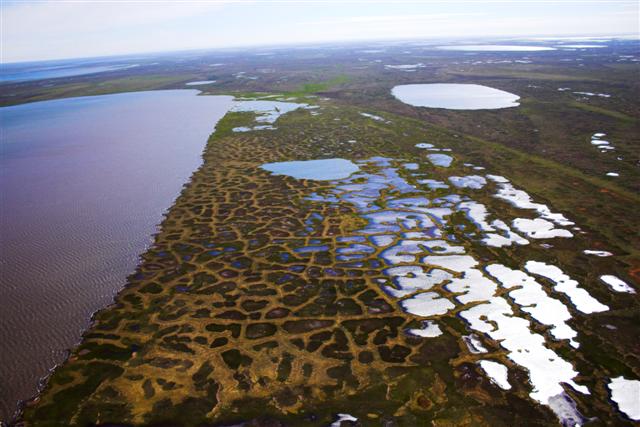
    Permafrost in the Arctic

    New concerns have emerged about methane release i Arctic. A new study, where aerial and ground-based surveys were used to identify sources of methane release, discovered around 150.00 sources.

    The methane seeps found are in Alaska and Greenland in lakes along the margins of ice cover.

    Samples showed that some of these are releasing the ancient methane, perhaps from natural gas or coal deposits underneath the lakes, whereas others are emitting much younger gas, presumably formed through decay of plant material in the lakes.

    “We observed most of these cryosphere-cap seeps in lakes along the boundaries of permafrost thaw and in moraines and fjords of retreating glaciers,” the report, led by Katey Walter Anthony from the University of Alaska at Fairbanks (UAF), said.

    Emphasizing the point that warming in the Arctic is releasing this long-stored carbon.

    “If this relationship holds true for other regions where sedimentary basins are at present capped by permafrost, glaciers and ice sheets, such as northern West Siberia, rich in natural gas and partially underlain by thin permafrost predicted to degrade substantially by 2100, a very strong increase in methane carbon cycling will result, with potential implications for climate warming feedbacks.”

    The region stores vast quantities of the gas in different places – in and under permafrost on land, on and under the sea bed, and – as evidenced by the latest research – in geological reservoirs.

    “The Arctic is the fastest warming region on the planet, and has many methane sources that will increase as the temperature rises,” commented Prof Euan Nisbet from Royal Holloway, University of London, who is also involved in Arctic methane research.

    “This is yet another serious concern: the warming will feed the warming.”

    Source

    BBC

  • Future for Arctic marine use

    Future for Arctic marine use

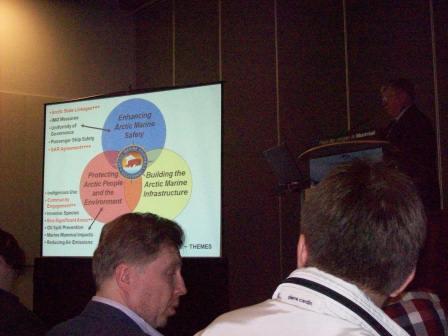
    L. W. Brigham gives the speech on outcomes from AMSA report

    On Wednesday, 25th of April 2012, during the IPY Conference prof. Brigham gave a speech on key drivers and futures for Arctic Marine use.

    He stressed globalization, climate change and geopolitics as key drivers of the profound change in the Arctic. For the Arctic Ocean and marine traffic, this change is driven primarily by Arctic natural resource development and marine tourism. This was one of the key findings of work done by the Arctic Marine Shipping Assessment (AMSA) of the Arctic Council during 2005-09. The scenarios creation effort in AMSA indicated that the two most important (and uncertain) drivers, of many, were (A) the level of natural resource development and trade, and (B) governance (the degree of stability of rules and regulations for Arctic marine navigation).

    Mr Brigham highlighted, that nowadays we see expanded Arctic marine transport systems evolving in offshore Russia, Norway, Greenland, and potentially in the U.S. maritime Arctic in summer 2012. Existing year-round marine transport to the world’s largest nickel mine (Norilsk Nickel) in Northwest Russia, and seasonally to the world’s largest zinc mine in northwest Alaska (Red Dog) are well established. Plans are being made to link a large, high grade iron ore mine on Baffin Island in Canada to European steel producers. All of these marine systems indicate much greater links of the Arctic to the global economy.

    Recent experimental voyages across the Russian maritime Arctic by tankers and bulk carriers confirm plausible, summer marine routes eastbound from northern Norway and the Russian Arctic to markets in China. Cruise ship traffic by medium and large ships continues to increase in western Greenland. Importantly, continued Arctic sea ice retreat creates greater marine access throughout the Arctic Ocean for science and commercial marine operations; longer navigation seasons during the summer are a reality today.

    One of the key factors that must be kept in mind is, despite the extraordinary changes in Arctic sea ice thickness, extent and character (moving to a future Arctic Ocean without multi-year ice), the Arctic Ocean will remain fully or partially ice-covered during the winter and much of the spring and autumn. Polar class ships will be required for future operations once a mandatory Polar Code of Navigation is promulgated by the International Maritime Organization.

    Action is also being taken by the Arctic Council and the Arctic states to address future Arctic marine use: a new binding Arctic Search and Rescue Agreement gained approval in 2011, and a new Arctic Oil Spill Task Force is developing a second instrument to address this critical issue. There is little doubt globalization of the Arctic and regional climate change are closely coupled, and they will have immense influence over future marine use and the strategies developed to protect Arctic people and the marine environment.