Tag: arctic

  • Arctic Wildlife

    Arctic Wildlife

    Introduction

    Polar bearThe Arctic has a unique climate within the earth’s ecosystem. Fearly little of low angle sunlight reaches the Arctic and more energy is radiated from the polar regions than is received. This makes the Arctic climate very harsh and difficult for growth and survival. Great variation in temperature and the contrast between the long and dark winter and the brief and light summer require extreme adaptability of plants and animals. The Arctic contains many species not found elsewhere, and many habitats and ecological processes and adaptations that are unique.

    To survive the Arctic conditions, animals have developed many behavioral and morphological adaptations. They use snow as shelter throughout the winter, accumulate large fat deposits when food is available and change the color and texture of their fur or plumage in winter to insulate their bodies and retain their crypticMursu coloration year round.
    Several mammalian species spend the winter in torpor to escape the coldest period of the year and species such as bear and badger spend their winter sleeping under the snow.

    One of the characteristics of almost all Arctic animals is their ability and willingness to migrate even very long distances in search for food and easier environment.

    Some Arctic species

    The Arctic Char
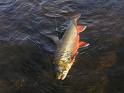
    Arctic CharThe Arctic Char (Salvelinus alpinus (L.)) is the most northern distributed freshwater fish, and part of the small group of salmonid fishes (i.e., salmons, trouts, whitefishes). Chars are a significant component of aquatic and near shore marine ecosystems in the Arctic. Often the only freshwater fish available, they play a major role for the subsistence of local people who fish returning upstream migrants of sea-run char in late summer and early autumn. Arctic Chars are threatened by a wide range of impacts ranging from local exploitation and habitat fragmentation and degradation mostly through oil and gas development, to widespread and pervasive impacts such as climate change and atmospheric contaminant deposition. Moreover, pervasive threats such as climate change affect Arctic aquatic ecosystems in a dramatic way, clearly having a huge impact on its most sensitive ecosystem components. Yet, many aspects of ecological roles of chars are still unknown at present for most northern ecosystems. Clearly, the integrity and continued health and viability of northern aquatic ecosystems are intimately connected to the biodiversity of chars present in those systems.

    Reindeer and Caribou

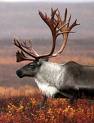
    Reindeer and Caribou (Rangifer tarandus) are distributed circumpolar in every Arctic country. Caribou represent the most dominant large mammal species in CaribouArctic habitats and are an extremely valuable component of Arctic biodiversity and cultural identity of many northern peoples. Caribous are the only member of the deer family where both males and females grow antlers. Pregnant females will retain their antlers until after calving, allowing them to dominate the social hierarchy in late winter. During deep snow years, caribou will move in search of more favorable snow conditions, as more energy is expended digging to the lichens than is derived from feeding. Reindeer and Caribou are a vulnerable yet crucial source of income from Arctic terrestrial ecosystems for northern peoples. Close monitoring of these wild and domestic Rangifer populations is vital in assessing the impact of climate change.
    Gray Wolf
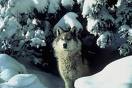
    Grey wolfGray wolves (Canis lupus arctos) currently number about 150,000 worldwide. Some 80% live in the circumpolar countries, although the number actually living in the Arctic is unknown. Canada has the most wolves of any arctic country, with some 50,000 to 63,000 animals inhabiting about 86% of their historical range. About 16,000 of the wolves live north of 60°N. Most of these Arctic populations are considered stable and not at risk. While wolves are abundant in Alaska, northern Canada, and Russia, local overharvests may occur. Habitat loss continues to be a concern for wolf conservation, especially in areas with recovering wolf populations. Wolves are regarded by many as a nuisance species, hampering thus management and recovery plans. The challenge continues to be the development and public acceptance of a flexible conservation plan that accommodates wolves in wilderness, but allows for local conflict management.

    Ivory Gull

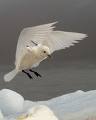
    The Ivory Gull (Pagophila eburnean) is a high Arctic seabird breeding at high latitudes in the Atlantic sector of the Arctic and often associated with sea ice throughout the year. InIvory gull spite of an early discovery the Ivory Gull still remains one of the most poorly known seabird species in the world. There is growing concern in the circumpolar Arctic that the Ivory Gull may be in decline. The most recent information on population trend of Ivory Gulls exists for Canada, Svalbard and Russia. In Canada, the Ivory Gull has a highly restricted range, breeding exclusively in Nunavut Territory. Recent surveys in Svalbard suggest that only a few of the known colonies are still being used there and that the total population is smaller than previously estimated. Information obtained currently on Russian breeding grounds indicate stable populations breeding at some key colonies, although considerable annual fluctuations in numbers of breeding birds occurs. The Ivory Gull has been protected in West Greenland since 1977 under the Greenland Home Rule Order of 5 May 1988 concerning the protection of birds in Greenland. In Svalbard, it has been protected since 1978, under the Svalbard Environmental Protection Act. In Russia, it was listed in the Red Data Book of the USSR (1984) and now is registered as a Category 3 (Rare) species in the Red Data Book of the Russian Federation.
    Climate change

    Climate change is perhaps the greatest threat to the Arctic environment as it exists today. Observed changes in species abundance and distribution, and to permafrost and sea ice, are evidence that climate change is already having an impact. Although the predictions cannot tell what will happen, they do indicate the types of ecological impacts that may occur.

    The impacts are likely to include melting of discontinuous permafrost, changes in distribution of moisture and the northward expansion of the forest. The climate change is further likely to affect the distribution of most plants and animals of the tundra and polar desert and affect the fish and shellfish distribution in the Arctic waters. Loss of permanent sea ice altogether would clearly have tremendous impacts on algae, plankton, fish, and marine mammals that use sea ice.

    Monitoring to detect the impacts of climate change and ultraviolet radiation on Arctic ecosystems is vital, as is further research to understand the dynamics of the systems that will be affected.

    Reference:

    All the information presented above is gathered from the Arctic Council’s Conservation of Arctic Flora and Fauna (CAFF) Working Group’s homepage

    and from the Arctic Flora and Fauna: Status and Conservation report.

  • Arctic Energy

    In the recent years, the world’s attention has turned to the Arctic, not least because of its vast energy resources. Due to the climate change and its significant impact to the Arctic environment resources that have long been unreachable are becoming feasible for exploitation. It is estimated that up to fifth of the world’s undiscovered petroleum resources are to be found in the Arctic while the Arctic’s share of the worlds known resources today is around 12%.

    Russia is by far the most important gas producer in the Arctic. Almost all proven Arctic gas reserves are located in Northern Russia as well as 90% of the proven oil reserves. Together produce Northern Russia and Alaska 97% of the total Arctic oil and gas the Arctic’s total global share of production being around 16%. Furthermore, Russia is considered to contain by far the largest volume of the undiscovered petroleum reserves. Other significant regions where petroleum is to be found are Alaska and the Norwegian Sea, which will in future introduce new oil producing states within the Arctic, namely Greenland and Iceland.

    In the face of the petroleum race in the Arctic, some concerns have been raised about the very fragile Arctic environment. In addition to the actual drilling, transportation of the petroleum will impose the Arctic environment to a severe threat in case of an oil spill or shipwreck.

    Even though the conventional petroleum industry is still today dominant in the Arctic, some renewable energy developments are also taken place in the Arctic. The renewable energy sector is however still quite small compared to the conventional one, but can be expected to grow in the future.

    The newly published  Arctic Energy Portal aims at providing a comprehensive information gateway to the Arctic energy projects, new developments and controversies concerning the resource exploitation. At present, the Portal will concentrate mostly on oil and gas, but as new projects and developments take place in renewable energy sector the Portal will broaden its scope of information and cover renewable sector as well.

  • Organized Crime in the Arctic

    Organized Crime in the Arctic

    The Arctic is rapidly changing and has been doing so for the last couple of decades. During the cold war many regions of the Arctic were a no-mans land crammed full of radar equipment. The Arctic is increasingly opening up on many frontiers. The ice sheet is receding, increasing industrial production and the quest for oil and increased participation in the global market system has increased the role of cash within local economies. Megaprojects have brought in considerable amounts of staff; often single men with a disposable income further increasing the role of the cash economy. Following this development organized crime has been on the rise in the Arctic, and organized crime syndicates are believed to have acquired a firm foothold in the Arctic and are involved in the human- drug- and weapons trafficking, fraud, violent crimes bootlegging and other illegal activities.

    The rise of drug trafficking has been prominent in the Arctic. Recently the Greenlandic police confiscated 118 kilos of Cannabis that is the largest amount that has been confiscated so far in Greenland. The street value of the drugs is estimated to be around 60 million Danish krona.

    Police dog, K-9

    In the Canadian North the authorities have become almost become incapable of monitoring activities within it’s own Arctic boundaries, which are the size of continental Europe, due to increased tourism and industrial production effecting criminal activity . Currently there are just 200 military personnel and 400 police working in the region.

    The Royal Canadian Mounted Police (RCMP) has called for up to 30 new intelligence officers into the Canadian Arctic. Currently there is only one intelligence officer in charge of all three of Canada’s Arctic territories. Chief Supt. Pierre Perron, the RCMP’s director of criminal intelligence, said “To say that we have no capacity in the North is not necessarily true,” he said, “because every officer we do have does operate in some capacity as an intelligence officer.”

    “However, we would like to implement dedicated criminal intelligence officers.”

    Human trafficking is a problem that is often difficult to identify and address. A special task force has been operating since 2005 within the Barents Euro Arctic Region (BEAC) to cooperate in battling human trafficking in the European part of the Arctic. Very few cases of human trafficking have been put on trial in the Arctic but can be expected to rise as the industry rises and the awareness of the problem increases.

    Both Canada and the U.S have voiced concerns about the Arctic being used as a portal for Arms trafficking into the U.S by terrorists as border control is challenging due to the immense the size of the area.

    With the increased activities within the Arctic following global warming it is highly likely that crime as well is on the rise, as accessibility increases and profitability vs. risks continue to rise. The eight Arctic states are however very well aware of the opening up of the Arctic so increased measures in law enforcements would come as a surprise to no one. The Nordic countries, Russia and U.S.A are increasing their military presence in the Arctic, which serves as another form of increased surveillance which one could imagine would be backed up with increased police activities as well

  • Arctic Shipping

    Arctic Shipping

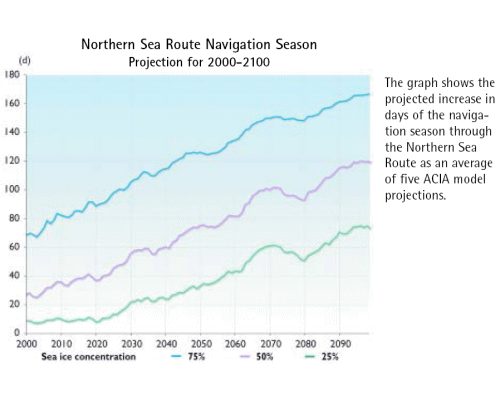
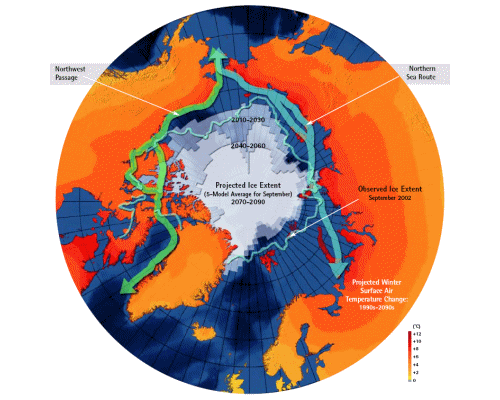
    Northern sea route navigation season projectionThe possibility of a trans-arctic shipping route has intrigued seafarers since the days of the first Arctic explorers, as it would shorten the distance between the Pacific Ocean and the Atlantic Ocean significantly. Challenging weather conditions and the lack of adequate shipping technology trans arctic shipping has not become a viable possibility as of yet. Shipping in the Arctic is on the rise and it is estimated that approximately 6000 vessels are operating annually in the Arctic region, many of them making multiple voyages. Off these 6000 ships operating in the Arctic almost all of them are declinational, conducted for community re-supply, moving natural resources out of the Arctic or marine tourism.

    The fact that the Arctic ice cap has been receding at an unprecedented rate, recent advancements in shipping technologies and an increasing interest in the Arctic’s resources have made the matter one of the most prominent issues in the northern hemisphere. Existing shipping lanes barely manage the current traffic as the Suez and Panama canal’s serve as bottlenecks and are not capable of servicing the largest container vessels of today. It is to be expected that shipment through the Arctic will become a viable option in the future. With growing technology and a receding ice cap the quest for resources companies are reaching further into the arctic region for resources and tourism activities by cruise liners is on the rise.

    shipping routesCurrently there seems to be a consensus that all of these activities will increase further and that trans arctic shipping will become a reality, that it is just a matter of time. There are nonetheless significant challenges, and issues that need to be analyzed and dealt with to prevent environmental disasters and ensure the safety of seafarers. It is clear that the benefits of these activities can be significant, but the environmental hazards are numerous as well. Infrastructure and safety measures are lacking and need to be addressed. There is an ongoing debate if there is a need for mandatory regulations by the IMO. The jurisdiction over the waterway is also disputed most prominently between the U.S and Canada.


    The matter has received substantial attention from researchers and organizations, some of these works can be found in the links bellow.

    Links

    Arctic Marine Shipping Assessment (AMAP) 2009 Report

    Recently published report, which is very detailed and covers most of the outstanding issues, possibilities and challenges connected to shipping activities in the Arctic

    North meets North, navigation and the future of the Arctic Report of a working group of the Ministry for Foreign Affairs Iceland 2006.

    Gives a substantial overview of shipping in the Arctic and what it’s future might hold. It also examines the possibilities of a transshipment port in Iceland.

    Arctic Shipping Activities into the next Decade1

    By: Norwegian Maritime Directorate

    Gives a brief overview over developments in shipping in different parts of Arctic Waters by type and estimates for future development in Arctic shipping.

    Developments in Arctic Shipping

    Produced by the research company Ocean Futures, Oslo for the Norwegian Atlantic Committee

    Guidelines for Ships Operating in Arctic Ice-Covered Waters

    Guidelines developed in 2002 by the International Maritime Organization for operating in Arctic Ice-Covered Waters

    The IMO Guidelines for Ships Operating in Arctic Ice-covered Waters From Voluntary to Mandatory Tool for Navigation Safety and Environmental Protection?

    By: Øystein Jensen

    Interesting report, which discusses if there is a need for mandatory guidelines for ships operating in Arctic Ice-covered waters.

    United Nations Law of the Sea (UNCLOS) /Direct link to the UNCLOS agreement

    International shipping is largely regulated by the UNCLOS agreement. All of the countries of the Arctic besides the U.S have ratified the agreement. They are non-the less to a great extent bound to it as customary international law.

    Maps

    Arctic sea routes

    By UNEP

    Ice Strengthened vessels and icebreakers

    Aker Arctic.

    Finnish company dedicated to building icebreakers and ice strengthened cargo vessels.

    Yamal the Russian Icebreaker

    The Yamal, a nuclear powered Icebreaker: Interesting information about the Russian icebreaker Yamal.

    Conferences and symposiums related to Arctic shipping

    International Symposium on Sea Ice in the Physical and Biogeochemical System

    International Glaciological Society 31 May – 4 June 2010

  • Turmoil in Greenlandic politics

    Turmoil in Greenlandic politics

    Kuupik KleistThe left- wing party Inuit Ataqatigiit (Community of the people, IA) has won the Greenlands parliamentary elections with the support of 43.7% of voters. The ruling party for the last 30 years, the Social Democratic party (Siumut), received 26.5 % of the total vote. The democratic party(demokraatit) received 12.7% of the popular vote and the feeling of community(Atassut) came in fourth with 10.9%

    IA will hold 14 of 31 seats within the newly elected parliament and will still need the support within some of the smaller parties to form a coalition government and receive majority support within the parliament.

    IA leader Kuupik Kleist told supporters that “Greenland deserved this, we can lead this country forward, into a new era” in a celebration ceremony in Nuuk when the outcome of the election became apparent

    Political observers in Greenland believe that this shift can traced to a series of financial scandals involving leading members of the governing Social Democratic Siumut Party. The outcomes of the elections can be said to reveal that the people of Greenland say “no” to these practices and have lost faith in the Siumut party to lead the nation forward in these interesting times. Following the outcome of the elections out-going premier Hans Enoksen, party leader for the past eight years, has resigned as the leader of Siumut and will be replaced by Alega Hammond.

    Aleqa HammondIA will be the first party to govern in Greenland under the newly expanded home-rule agreement, which was approved by popular vote in November 2008. The newly approved home-rule agreement will give the Greenlandic government increased control over their natural resources and allow it to take greater charge of justice and legal affairs and will make the political development of Greenland all the more interesting.

    11.06 News update: Agreement reached for new coalition agreement.

    The new IA coalition partners are Demokraatit and KP, giving the IA coalition a majority of 19 seats in parliament, against the 12 opposition members made up of Siumut and Atassut MPs.

  • Arctic Council Ministerial Meeting in Tromsø

    Arctic Council Ministerial Meeting in Tromsø

    Arctic Council

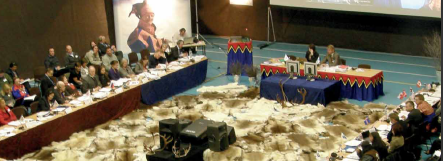
    During this week 27th of April – 1st of May, Tromsø in Northern Norway will be the capital of the Arctic as the city is the venue for The Arctic Councils biennial Ministerial Meeting. Besides this event the Norwegian minister of Foreign Affairs, Mr. Jonas Gahr Støre, together with former US Vice-president, Mr. Al Gore, have called several of the worlds foreign ministers to a conference about the global warming. The conference entitled “Melting Ice: Regional Dramas, Global Wake-Up Call” takes place.

    The two meetings will gather around 400 of the worlds leading experts and politicians on Arctic matters. In addition round 80 journalists and photographers have announced their participation.

    At the end of the ministerial meeting the Chairmanship will be handed over to the Danish delegation. The new chair of the Arctic Council will be MFA Per Stig Møller

    Parts of the “Melting Ice” Conference are broadcasted live at the Arctic Portal Webcast, along with parts of the Arctic Council´s Ministerial Meeting. All videos presented will be archived at the Webcast Archive.

    About the Arctic Council

    Starting in the late 1980s, international cooperation in the Arctic has increased to the extent that a new regional identity is emerging, with numerous political initiatives and new fora.
    The so-called Murmansk Speech by President Mikhail Gorbachev of the Soviet Union is often regarded as the initiating event for current regional cooperation in the Arctic. It had still the Soviet rhetoric on peace but reflected more the processes of glasnost and perestroika in the Soviet Union through its six proposals. The first two were about establishing a nuclear-weapon-free zone in northern Europe and reducing military activities. The others discussed confidence-building measures in northern seas, civilian cooperation in developing natural resources, coordination of scientific research, cooperation in environmental protection, and opening the Northern Sea Route to foreign ships.

    SAO meeting in Kautokeino

    SAO Meeting, Kautokeino, Norway, November 19. – 20. 2008

    Intergovernmental Arctic cooperation officially started in 1989 with the Rovaniemi process in the wake of Mikhail Gorbachev’s Murmansk speech. At the first ministerial meeting in Rovaniemi, Finland, of the eight Arctic states, which also included three northern indigenous peoples organizations, the Arctic Environmental Protection Strategy (AEPS) was signed in June 1991. The initial focus on environmental protection gradually expanded to related fields, notably sustainable development. In 1996, the Arctic states replaced the AEPS with the Arctic Council as a high-level intergovernmental forum for Arctic international cooperation that would include as Permanent Participants a certain number of transnational northern indigenous peoples organisations. Therefore the Arctic Council was established as a high level intergovernmental forum to provide a means for promoting cooperation, coordination and interaction among the Arctic States. The Arctic Council deals with common Arctic issues, with the involvement of the Arctic Indigenous communities and other Arctic inhabitants. These issues are, in particular, sustainable development and environmental protection in the Arctic.

    For further information, please visit the Arctic Council homepage and Melting Ice: Regional Dramas, Global Wake-Up Call Conference homepage.

    Reference

    Arctic Human Development Report
    The Arctic Council

  • University Centre of the Westfjords

    University Centre of the Westfjords

    University center of the westfjords logo

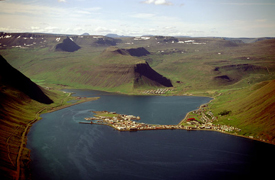
    In the small village of Ísafjörður in the rural area of the Westfjords in Iceland, is a small but ambitiuos University centre. The University Centre of the Westfjords is a non-profit organisation established in March 2005. It has 40 founding members, including all of the country’s institutions of higher education. The Centre began operations in Vestrahús in Ísafjörður in January 2006. The same building houses offices of the Marine Research Institute, the Icelandic Fisheries Laboratories, and the Icelandic Snow Avalanche Research Centre, among others. The Westfjords Regional Development Centre is also located there, and all of the organizations represented in the building share common reception facilities.

    IsafjordurThe University Centre acts as a contact between Westfjords residents and institutions of higher education. The most important aspect of this work is the University Centre’s function as the West Fjord’s distance-learning institute. Seven universities in Iceland offer distance learning courses and distance learning instruction takes place at the Centre, variously through the Internet or with the help of remote conference technology.

    The Centre also assists university students and teachers from outside the area in establishing contacts in the Westfjords. The Centre provides information on the region as an interesting option and area for research and assists students and scholars in their work on research projects in the Westfjords. The University Centre makes its facilities available to all university-level students who are studying or carrying out research in the Westfjords.

    Preparatory program for university entrance

    The School of Science and Engineering at Reykjavík University offers a preparatory program for students who do not yet qualify for university entrance. The goal of the program is primarily to prepare students for further studies within the School of Science and Engineering. However, the program offers good general preparation for all kinds of university-level studies, and students who complete the preparatory program have a good chance of being accepted to other university programs in Iceland. A special support system is planned for those whose mother tongue is not Icelandic but who have a good command of the language.

    Continuing Education

    the town IsafjordurThe University Centre of the Westfjords offers exciting continuing education opportunities in the field of environmental and resource management, in connection with its cross-disciplinary program in Coastal and Marine Management.

    The master’s courses will be open for external participants, who must, however, fulfill the program’s admission requirements and be approved by the master’s program committee. The courses are particularly useful for those working professionally in research, planning, resource management, environmental assessment, and related areas.

    Coastal and Marine Management Masters Program

    The University Centre of the Westfjords offers a Masters program in environmental and resource management. Coastal and Marine Management is a demanding and ambitious master’s program in environmental and resource management. The program is cross-disciplinary and prepares students for diverse and exciting positions in both the public and private sectors. It is offered in cooperation with the University of Akureyri, one of Iceland´s state-run universities, which has specialized in fisheries science and related matters for many years. Among the fields which the master’s program in Coastal and Marine Management prepares students to work in are resource and land use planning, environmental impact assessment, consulting work, teaching and research. The program is internationally oriented and taught in English, and both students and instructors come from a diverse range of countries. The master’s program in Coastal and Marine Management brings together people of different backgrounds who share their experience, knowledge, and ideas in a small-scale, creative and fertile intellectual environment, with the goal of finding ways of using natural resources in a sustainable way. The University Centre of the Westfjords welcome new faces to join our exciting group of natural resource management specialists. The application deadline for the autumn semester 2009 for Non EU/EEA citizens is February 15th and for EU/EEA Citizens is April 15th. Residents in Iceland can apply for the spring semester 2009, the deadline is December 15th.

    Isafjordur

    For more information about the University Centre of the Westfjords of Iceland, please visit the Centre´s website.

    Coastal and Marine Management Brochure

  • Students on Ice

    Students on Ice

    Students on ice banner

    The Feature of the Week at the Arctic Portal is ambitious program “Students on Ice”.

    Students on Ice Expeditions (SOI) organize annual educational expeditions to the Arctic and the Antarctic. Its mandate is to provide students, educators and scientists from around the world with inspiring educational opportunities at the ends of the Earth, and in doing so, help them foster a new understanding and respect for the planet and for each other. To date in just over 8 years, over 1,000 students, educators, experts, and scientists from 32 countries have participated in this unique program.

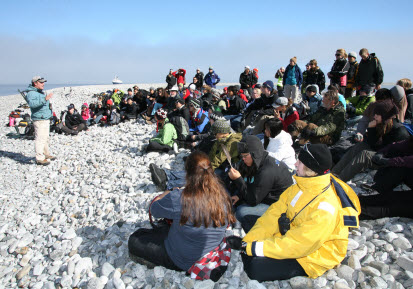
    Students on ice, lectureSOI was founded by adventurer, environmentalist and educator, Geoff Green – a veteran expedition leader of 74 Antarctic expeditions and 31 Arctic expeditions. In 2004, Outpost Magazine chose Geoff as one of the “Top 5 Explorers to Watch”. Over the past fifteen years, Geoff and SOI have worked directly with many IAATO Members, including Quark Expeditions, Polar Star Expeditions, Peregrine Expeditions, Hapag Lloyd, ResidenSea, and Antarpply Expeditions.
    Most recently SOI was endorsed as the official youth expeditions for the International Polar Year (IPY) 2007-2009. The IPY marks a critical opportunity for the world to turn its attention to the state of our Polar Regions, to better understand the global implications, and to seek the necessary actions and solutions required by all of us. This remarkable event offers a timely and exciting opportunity to mentor and inspire the next generations of scientists, researchers and young leaders.

    In between expeditions Students on Ice continues to raise awareness about the global issues that need to be addressed individually and collectively by being part of inspiring outreach activities, such as conferences and speaking engagements. In the context of IPY 2007-2009, Alliance of Natural History Museums of Canada in partnership with Students on Ice is organizing and delivering the Polar Perspectives 2008 Speakers Series and Youth Forums. The goal is to raise awareness about Arctic issues such as the impacts of climate change on the environment, health, culture, sovereignty and indigenous rights. The International Polar Year (IPY) is the largest-ever scientific research program directed at the Polar Regions.

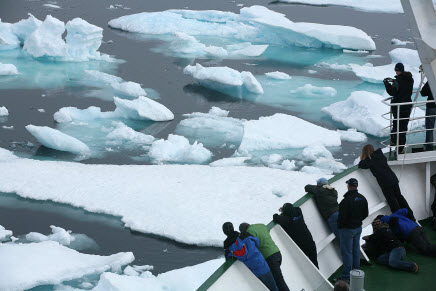
    Students looking at sea-ice from a shipThe aim of Students on Ice is not to simply provide students with a “trip” to a unique destination but rather to give students an opportunity to have an aesthetic experience in some of the most wild and awe-inspiring ecosystems in the world. The objective is not to let students to just pass through a place with camera in hand, but rather to listen to the land; to ‘feel’ these natural places and in turn, explore how humans feel when immersed in such places. The goal of SOI is that students experience a transformative connection with Nature – a connection that changes the way they understand and act in this world.
    On expeditions, several different learning formats are used depending on the topic being explored, location, weather conditions, and the skills and experiences of the education team members in which is assembled each time. These learning formats include: lectures, workshops and hands-on activities that are shore, zodiac, and ship-based in setting. There is an environmental focus on the SOI expeditions’ lectures discussions and activities on current environmental issues facing the regions travelled are implemented through. Climate change is a particular focus on all of Students on Ice expeditions.

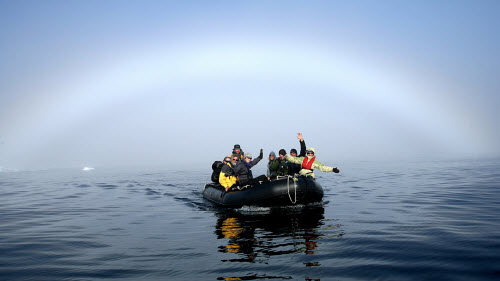
    fogbow - Rainbow in a fogStudents on Ice program, has received numerous awards and citations for its work with young people, education, the environment and polar conservation. Recently, it received the prestigious 2007 Citation of Merit Award from the Explorers Club in New York City. It has also received the Michael Smith Award for Science Promotion in Canada, as well as a special Citation of Merit from the United States Congress.

    The Students on Ice offers a interesting website with comprehensive information about upcoming and previous expeditions which date back to the year 2000. At the website, it is also possible to view unique videos from previous expeditions. Those videos include e.g. “Visit to Walrus Island”, “A Hundred Whales and Two Bears” and “Going Into the Fog”. The site offers information about the Students on Ice staff, with practical background information about each and one of the SOI team. In addition to all that, Students on Ice have a blog with news from Student on Ice Activities.

    The Students on Ice Webpage

  • The International Polar Year

    The International Polar Year

    Arctic Portal news

    The International Polar Year is a large scientific programme focused on the Arctic and the Antarctic. The program officially ran from March 2007 to March 2009 but was closed in September 2011. IPY was organized through the International Council for Science (ICSU) and the World Meteorological Organization (WMO). It was actually the fourth polar year, following those in 1882-3, 1932-3, and 1957-8.

    IPY involved over 200 projects from around the world on Arctic and Antarctic issues. Thousands of scientists from over 60 nations examined a wide range of physical, biological and social research topics. It was also an unprecedented opportunity to demonstrate, follow, and get involved with, cutting edge science in real-time.

    Arctic Portal is a good example of a project which started out as an IPY project.

  • Understanding Migration in the Circumpolar North, Social Science Forum at the University of Akureyri

    University of Akureyri

    In the Social Science Forum at the University of Akureyri, Professor Lee Huskey will discuss research being done around the circumpolar north and draws general lessons from the different experiences of northern migration in the Arctic nations. Similarities and interesting differences among patterns and determinants of migration will be discussed. The lecture is held by the University of Akureyri and the Stefanson Arctic Institute.

    Migration is a major influence on the size and demographic structure of the population in Arctic regions. The patterns of migration differ significantly across countries and between indigenous and non-indigenous people. Migration patterns also differ across demographic groups in the North; rates of migration differ by gender, age, and education level. Migration involves long-term social and cultural consequences for communities in the north as well as for the migrants themselves.

    Material necessity is a major determinant of population movement, so the creation or loss of income earning opportunities in the north will affect migration decisions. Migration decisions will also reflect more general estimates of the quality of life offered by different communities. The pursuit of jobs, education, family, and bright lights will each influence migration in the north.

    Public policy will also affect migration. While migration in most Arctic nations is a decision made by households or individuals, in some past periods migration decisions have been a matter of public policy. Public choices about transfer payments and the provision of services and infrastructure influence migration decisions today.

    Lee Huskey is a Professor of Economics at the University of Alaska Anchorage (UAA). He holds a Ph.D. in economics from Washington University in St. Louis.  At the UAA Lee has served as Chairman of the Department of Economics, Director of the Center for Economic Education, and Director of the Experimental Economics program. He was elected President of the Western Regional Science Association in 2005. He has been active in a number of northern pursuits including the Arctic Social Indicators project, the University of the Arctic, and the Northern Research Forum.

    Lee’s current research examines the patterns and determinants of rural-urban migration in Alaska. He is currently the principal investigator for two projects on northern migration funded by the US National Research Foundation and the European Science Foundation which involve social scientists from a number of countries and disciplines. More generally his research has examined economic development in rural regions and particularly the influence of institutions on this development. For further information, see http://exchweb/bin/redir.asp?URL=http://www.cbpp.uaa.alaska.edu/aflh.asp