Tag: Barents Sea

  • More oil discovered in Skavl

    More oil discovered in Skavl

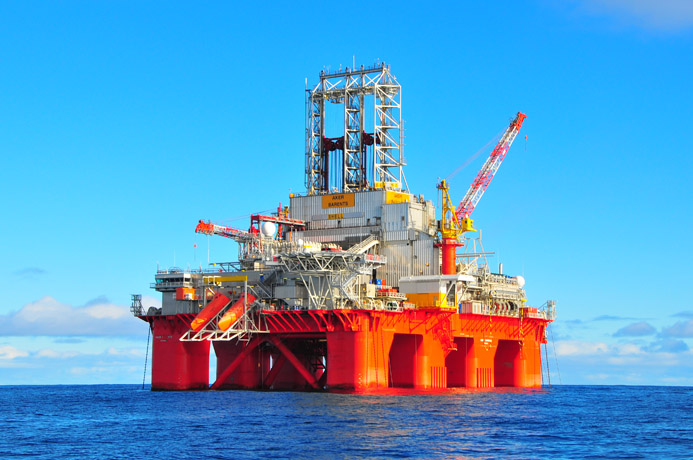
    Oil platform on Barents Sea

    Statoil has recently reported to find more oil resources in the Barents Sea. The hydrocarbon discovery at the Skavl prospect could increase the chances for a new field centre development in the Arctic, says Atle Staalensen from the Barents Observer.

    According to Statoil, the Skavl prospect includes up to 50 million barrels of extractable resources. The well drilled by the rig West Hercules is located only few kilometers from the Johan Castberg and Havis structures in the Barents Sea.

    The new project includes modest volumes of oil, but could still increase the likelihood of a major field development in the area. After finding the Castberg and Havis fields in 2011, Statoil announced that a major breakthrough had been made in the Barents Sea, calling the fields in “the most important discoveries on the Norwegian shelf over the last ten years”.

    Statoil is an international energy company with operations in 34 different countries.

    Statoil is operator for production licence PL532 with an ownership share of 50 percent. The licence partners are Eni Norge AS (30%) and Petoro AS (20%).
    Source: Barents Observer

  • China to drill in Barents Sea

    China to drill in Barents Sea

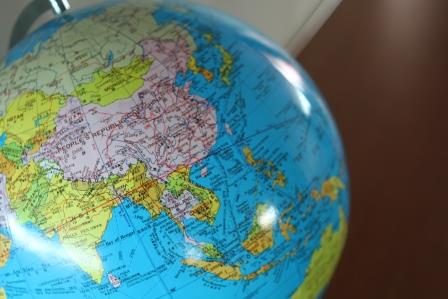
    China on the map

    The Chinese National Petroleum Corporation (CNPC) strikes a deal with Rosneft over the exploration of three fields in the Barents and Pechora Seas.

    As reported by the Barents Observer, the Chinese National Petroleum Corporation (CNPC) struck a deal with Rosneft over the exploration of three fields in the Barents and Pechora Seas.

    The Agreement was signed during the last week’s visit to Russia, paid by the Chinese President – Xi Jinping. The Agreement included Zapadno-Prinovozemelsky structure in the Barents Sea and the Yuzhno-Russky and Medynsko-Varandeysky structures in the Pechora Sea.

    With the cooperation in place, the CNPC becomes Rosneft’s third foreign partner in the Barents Sea. From before, agreements have been signed with Eni and Statoil. In addition, Rosneft has a comprehensive agreement with ExxonMobil in the Kara Sea.

    The Zapadno-Prinovozemelsky is among the least explored areas on the Russian shelf, and resource estimates are sparse. However, the hydrocarbon potential is believed to be considerable considering the highly perspective surrounding areas.

    China has over the last couple of years displayed a quickly increasing interest in Arctic issues. As previously reported, China could already by year 2020 send as much as 15 percent of its international trade through Arctic waters.

    Chinare 5 in northern Iceland during the summer of 2012

    The country is also bidding for a permanent observer status in the Arctic Council. In the summer of 2012, the country sent its icebreaker “Xue Long” (Snow Dragon) in a historic mission along the Northern Sea Route and made an attempt to reach the North Pole.

    Rosneft was one of the last vertically integrated oil companies to emerge from the reorganization and large-scale privatization of Russia’s oil industry in the years following the dissolution of the Soviet Union.

    Today its plans are about to reach implementation of a number of hydrocarbon exploration and development projects in Russia, the United States and other countries, as well as to set up a joint Arctic Research Center (ARC) in St. Petersburg.

    Source

    Barents Observer

  • Two Russian nuclear submarines lifted from the Arctic Ocean

    Two Russian nuclear submarines lifted from the Arctic Ocean

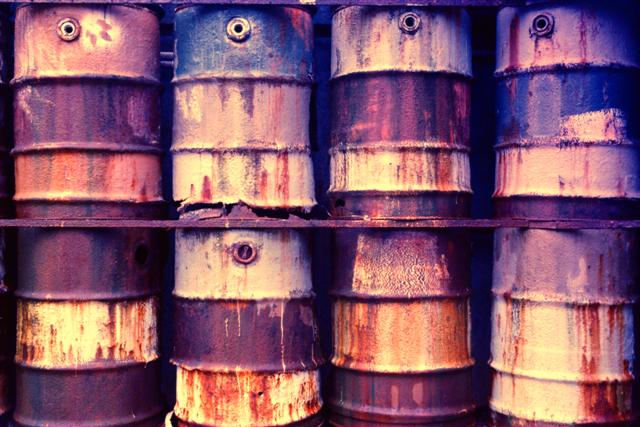
    rusted old oil barrels

    Russia intents to lift up two nuclear submarines who sunk in the Arctic. The submarines are the nuclear powered K-27 and K-159, who sunk in the Kara Sea and the Barents Sea.

    Click here to see a map of sunken nuclear submarines in the Arctic.

    The release of the strategic development of Russia’s Arctic zone saw this proposal, but according to the draft several measurements are included to clean the Arctic waters of pollution.

    There will also be action to remove dangerous waste left behind after the military units on Franz Josef Land, New Siberian Islands and Bely Island.

    The K-27 submarine was dumped in the Kara Sea in 1980 and is lying on 75 meters depth. K-159 sank in the Barents Sea during towing in 2003 and could be laying up to 250 meters under the surface of the sea.

    A joint Russian-Norwegian expedition to the K-27 earlier this autumn concluded that the submarine is not yet leaking radioactivity but that it is urgent to lift it for safe decommissioning.

    International assistance will be needed since Russia does not the capacity to complete the operation on its own. When Kursk was raised in 2001 Dutch companies lifted the submarine.

    Source:

    Barents Observer

    Izvestia

  • Millions to exploration near Jan Mayen

    Millions to exploration near Jan Mayen

    Map of the Jan Mayen area.

    The Norwegian Government plans to map, do seismic surveys and other geological data acquisitions outside Jan Mayen and in the Barents Sea in 2013. A total of 17.6 million Euros have been allocated to the project.

    Minister of Petroleum and Energy Ola Borten Moe wants to continue surveys in the parts of the Barents Sea that were opened for such activity through the Norwegian-Russian Agreement on delimitation of the Barents Sea and Arctic Ocean that came into force on July 7 2011, according to the Barents Observer.

    The proposed area in question is the Norwegian side of the dividing line in the Barents Sea where the Russian and Norwegian borders are. Norway has already conducted seismic acquisition in the southern parts of the new area in the Barents Sea.

    The agreement has specific obligations for cooperation in case there are found any cross-border petroleum deposits. If a deposit extends across the delimitation line, the parties shall enter into an agreement for the exploitation of the deposit as one unit.

    “Norwegian petroleum industry is doing very well. There is a high level of exploration activity, new large discoveries are being made and developed and a lot of work is done to improve recovery at producing fields”, Minister of Petroleum and Energy Ola Borten Moe says to the Ministry’s web site. 

    He also added that although initial surveys had been conducted, a long time could pass until production starts.

    Source:

    Barents Observer

    Norwegian Ministry of Energy

  • Cod expands and heads north

    Cod expands and heads north

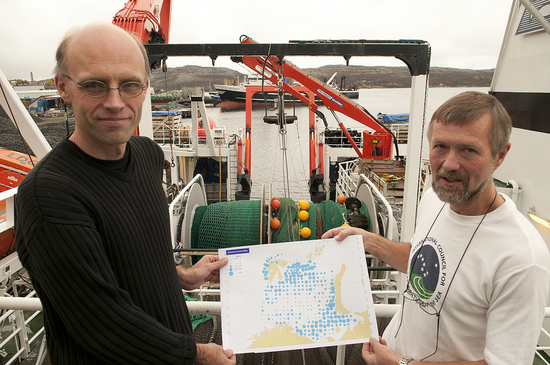
    Marine researchers Bjarte Bogstad and Harald Gjøsæter show map of cod stock dissemination in the Barents Sea

    The cod is moving further north then ever before. Huge amounts of cod have been found northerly in the Barents Sea, as far north as 82 degrees much to researcher’s surprise.

    Russian and Norwegian cooperation in the Barents Sea continues and their newest found is surprising to them.

    “We have never before seen such large amounts of cod so far north in the Barents Sea as this year,” they said according to the Barents Observer.

    The two researchers Bjarte Bogstad and Harald Gjøsæter from Norway completed a survey for 2011 recently.

    The comprehensive research in the Barents Sea found more cod then normal and that it also spread over larger areas.

    The reason is connected to a record high stock of capelin in the northern Barents Sea as well as higher sea temperatures.

    “Sea temperature this autumn is considerable colder than last summer, but still way higher than the average over the last 40 years, explains expedition leader Gjøsæter

    But will this result to higher quotas of cod? “Huge cod stock and widely dissemination all round the Barents Sea does not necessarily mean that we will recommend higher quotas next year,” says Gjøsæter.

  • Shtokman decision in December

    Shtokman decision in December

    Shoktoman

    A final investment decision for the megaproject in the Shtokman gas field is expected in December. The Shtokman field is located 550km offshore Russia in the Barents Sea.

    The estimated price tag of development will be presented in next month to the investors.

    It is believed to be one of the largest gas fields but the project has already been delayed. The partners in the Shtokman project – Norway’s Statoil, France’s Total and Russian gas export monopoly Gazprom – have delayed pipeline gas production from Shtokman until 2016 instead of the originally planned 2013.

    It is expected to require some $15 billion of investment in its first phase alone, according to the BarentsObserver.

    The field, which contains 3.9 trillion cubic metres of gas and 56 million tonnes of condensate, is 550 km offshore at a depth of 340 metres, was discovered by the Soviet Union in 1988 and its start-up has been repeatedly delayed due to problems with financing and the lack of transport infrastructure in place.

  • Gas pipeline to the Barents Sea?

    Gas pipeline to the Barents Sea?

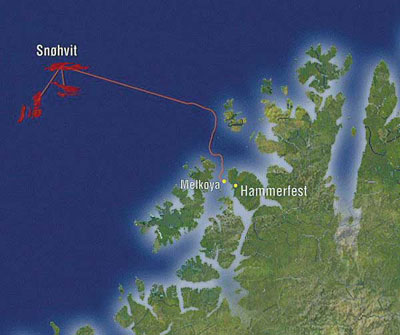
    Snohvit gas fields

    The only gas field in the Barents Sea could soon be connected to the mainland. Snøhvit gas field is so promising; Norway could extend its current pipeline system to get the gas on shore, but only if other areas for gas production can be found.

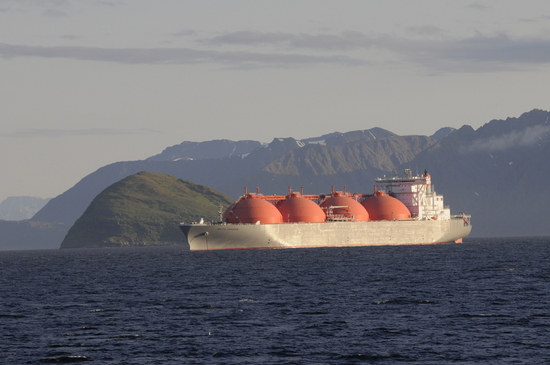
    Huge LNG tankers are used to transport the gas to the markets in Europe and USA, but a new pipeline would be a revolution.

    Norway’s Foreign Minister Jonas Gahr Støre says that this is a possibility, but underlines that the need for more areas to be found are crucial.

    With Russia also planning to extend its pipeline system, some kind of cooperation between the countries has also been discussed.

    Research in the Barents Sea aimed to find gas have been promising in recent years. The cost and time for transport will encourage both Russia and Norway to react
    and the pipelines might be a necessity in a few years time.


    LNG tanker, used for gas transport (From BO news)