Tag: CAFF

  • Award – winning CAFF film now available

    Award – winning CAFF film now available

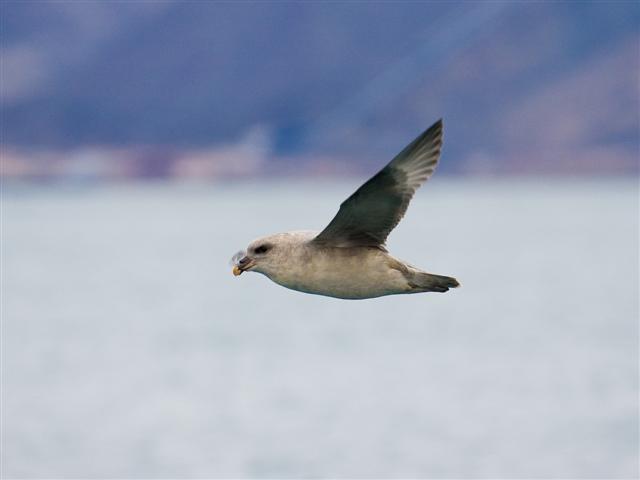
    Bird flying over water

    The film “Status and Trends in Arctic Biodiversity” addresses current biodiversity issues in the Arctic, and ongoing pressures on its ecosystems. It highlights key issues that surfaced in the Arctic Biodiversity Assessment. The film is a collaborative work of the Conservation of Arctic Flora and Fauna (CAFF) working group and UNEP GRID-Arendal.

    Emphasis is placed on the new set of challenges and stressors brought about by climate change and the increase of industrial activities in the region. In view of these challenges, CAFF has set out to provide policymakers and conservation managers with the best available scientific knowledge informed by traditional knowledge on Arctic biodiversity.

    The film was approved by Arctic Council Senior Arctic Officials’ at their meeting in Haparanda in November 2012. Further the film was presented to the eight Arctic Ministers and six Indigenous Peoples representatives at the Ministerial Meeting in Kiruna 15 May 2013.

    “Status and Trends in Arctic Biodiversity” was also awarded first place in the documentary category at the Green Lens Environmental Film Festival which is an annual environmental film competition sponsored by the Northern Illinois University´s Institute for the Study of the Environment, Sustainability and Energy.

    The film is available for the public and can be viewed here.

    Sources

    CAFF

    Arctic Council

  • CAFF presents Biodiversity Assessment

    CAFF presents Biodiversity Assessment

    the Arctic Council ministerial

    Today, 14th of May 2013, Ministers gathered in northern Sweden welcomed the Arctic Biodiversity Assessment, prepared by CAFF (Conservation of Arctic Flora and Fauna) one´s of the Arctic Council six working groups.

    The Arctic Biodiversity Assessment is expected to be the best available science informed source on traditional ecological knowledge and status and trends of Arctic biodiversity. It also contains policy recommendations for biodiversity conservation.

    Tomorrow, on 15 May 2013 the Arctic Council will hold its biennial Ministerial Meeting in Kiruna in the north of Sweden. Approximately 300 people – ministers, delegates from the eight Arctic states (Canada, Denmark, Finland, Iceland, Norway, Russia, Sweden, and the United States), representatives of indigenous peoples, scientists and observers – will gather in to mark the end of the two-year Swedish chairmanship and the beginning of the Canadian chairmanship of the Arctic Council.

    The Arctic Council is a high level intergovernmental forum to provide a means for promoting cooperation, coordination and interaction among the Arctic States, with the involvement of the Arctic issues, in particular issues of sustainable development and environmental protection in the Arctic. The scientific work of the Arctic Council is carried out in six expert working groups.

    Source

    CAFF

  • CAFF signs Memorandum of Understanding with APECS

    CAFF signs Memorandum of Understanding with APECS

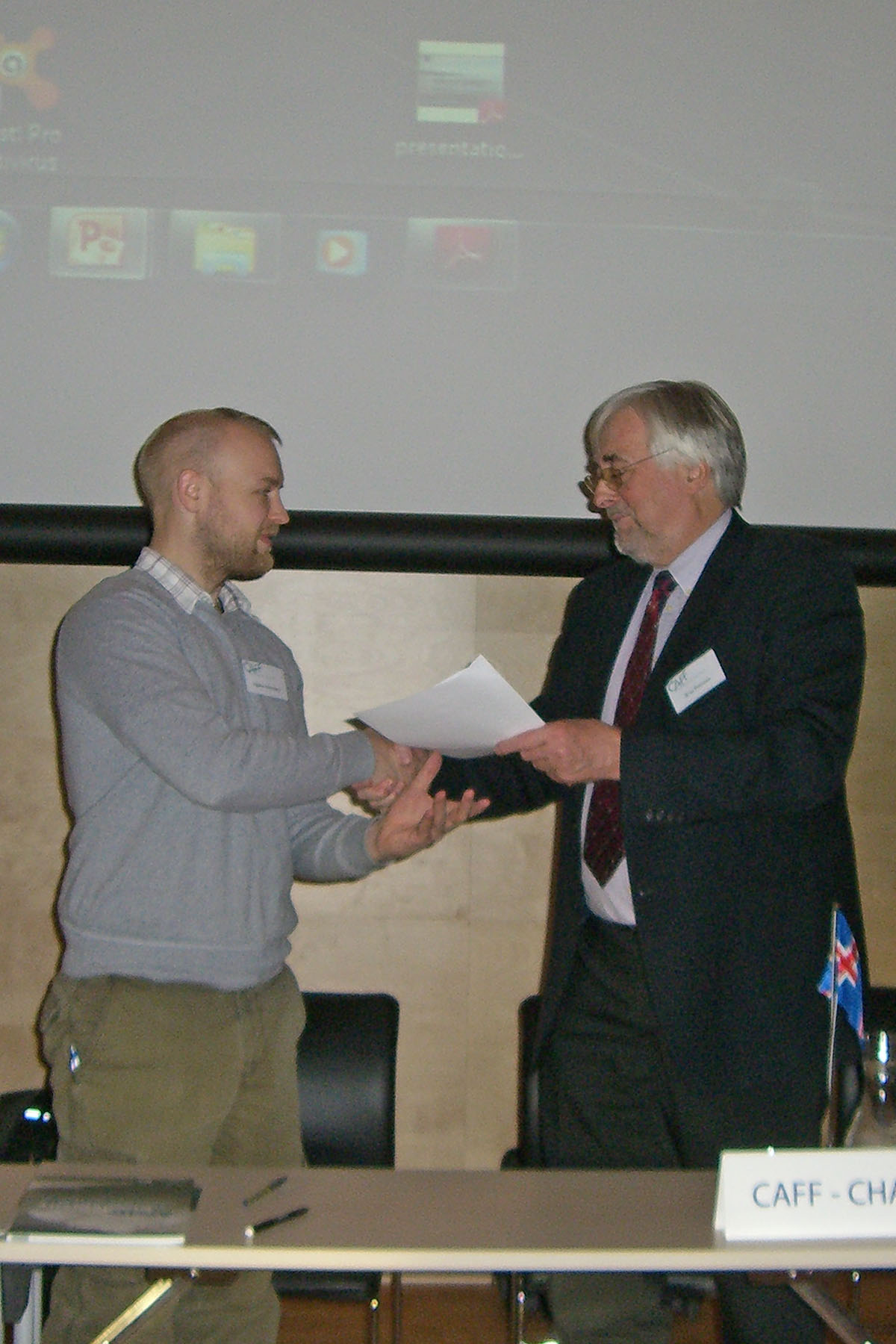
    Memorandum of Understanding signed between CAFF and APECS

    The Arctic Council recognizes in the Tromso declaration that education, outreach, scientific research and capacity building are major tools via which to address challenges in the Arctic.

    And on the third of February, during the XIII CAFF Biennial meeting in Akureyri Iceland, a Memorandum of Understanding was signed to strengthen cooperation between the Conservation of Arctic Flora and Fauna (CAFF) working group of the Arctic Council and the Association of Early Polar Career Scientists  (APECS). The memorandum was signed by Aevar Petersen CAFF Chair and Sigmar Arnarsson on behalf of APECS Chair Allen Pope.

    The objectives and activities of both APECS and CAFF complement one another in that CAFF as a Working Group of the Arctic Council provides a vehicle for knowledge and action in the Arctic region while APECS seeks opportunities for early career researchers to learn from and become engaged in international science and policy projects and programmes. Both parties will benefit from the participation of APECS members in CAFF policy and expert meetings on Arctic biodiversity. APECS members will gain valuable experience while also contributing scientific, innovative, and fresh perspectives to CAFF initiatives.

    The aim is to create a means via which early career scientists can have the opportunity to participate in and gain experience in the circumpolar initiatives undertaken by CAFF as it works towards a more comprehensive understanding of Arctic biodiversity and its status and trends.  Within CAFF activities, emphasis is placed upon regional cooperation that is based upon cooperation between all the Arctic countries and indigenous organizations as well as with international conventions and organizations. CAFF will at the same time benefit from the input of new ideas and participation by young scientists and help to attract and stimulate interest in Arctic biodiversity and help stimulate outreach/communication with the education sector.

    APECS will help to inform its members and partner organizations about the activities of CAFF and its associated partners to help broaden the understanding, representation, and input into CAFF activities through participation of APECS members in CAFF projects including policy and expert meetings. CAFF welcomes this new partnership and foresees a fruitful cooperation with APECS as a representative of the next generation of polar scientists.

  • CAFF XIII Biennial

    Conservation of Arctic Flora and Fauna

    The Thirteenth meeting of the Conservation of Arctic Flora and Fauna Working Group (CAFF XIII), is to be held in Akureyri, Iceland on February 1 – 3rd 2011. Every two years, the Arctic Council Working Group on Conservation of Arctic Flora and Fauna schedules a large meeting in advance of the AC Ministerial meeting.

    CAFF is a Working Group of the Arctic Council and a forum of Arctic professionals, indigenous peoples representatives, and observer countries and organisations. The aim of CAFF is to discussing circumpolar Arctic conservation issues. The major task is to advise the Arctic governments (Canada, Denmark/Greenland, Finland, Iceland, Norway, Russia, Sweden and the United States) on conservation matters.

    The CAFF Program is guided by the CAFF Strategic Plan for the Conservation of Arctic Biological Diversity and biennial CAFF Work Plans. CAFF has four Guiding Principles:

    • The involvement of indigenous and local people and use of traditional ecological knowledge;
    • The use of broad, ecosystem-based approach to conservation and management;
    • Cooperation with other conservation initiatives to minimise duplication and increase effectiveness;
    • Communication of CAFF program activities.

    The CAFF 2006-2008 Work Plan emphasizes cooperation and collaboration with other Arctic Council Working Groups, and organizations outside of the Arctic Council, and makes efforts to actively contribute to the global conservation agenda. This Work Plan responds to the findings and recommendations of the Arctic Climate Impact Assessment, the Arctic Marine Strategic Plan and CAFFs Arctic Flora: Status and Trends.

  • The resolutions from the recently concluded COP10 in Nagoyja Japan, made specific reference to the Arctic Council and Arctic biodiversity.

    The resolutions from the recently concluded COP10 in Nagoyja Japan, made specific reference to the Arctic Council and Arctic biodiversity.

    COP10 Nagoya, Japan

    By TOM BARRY, CAFF Executive Secretary

    The resolutions from the recently concluded COP10 in Nagoyja Japan, made specific reference to the Arctic Council and Arctic biodiversity.

    Under the section on New and Emerging issues, the following resolution was noted:

    [That the 10th Conference of the Parties] invites the Arctic Council to provide relevant information and assessments of Arctic biodiversity, for consideration by the Subsidiary Body on Scientific,Technical and Technological Advic. In particular, information generated through the Circumpolar Biodiversity Monitoring Program of the Arctic Council’s working group on Conservation of Arctic Flora and Fauna(CAFF)

    In early 2009, the CAFF Working Group signed a Memorandum of Understanding with the Convention on Biological Diversity (CBD). Subsequent to that, the CAFF report on “Arctic Biodiversity Trends 2010: Selected Indicators of Change” was designated as the Arctic Council’s contribution towards measuring the CBD target of reducing the rate of biodiversity loss by 2010. Specifically, the CAFF report contributed to:

    • The United Nations 2010 Biodiversity – an international (CBD) target to reduce loss of biodiversity by 2010.
    • The UN International Biodiversity Year (2010)

    Further information at http://www.cbd.int/cop10/.

  • Arctic Biodiversity Assessment – Arctic Biodiversity Trends 2010: Selected indicators of change report

    Arctic Biodiversity Assessment – Arctic Biodiversity Trends 2010: Selected indicators of change report

    CAFF - Arctic Biodiversity Trends 2010CAFF – The Arctic Biodiversity Trends 2010 Report, produced by some of the world’s leading experts of Arctic ecosystems and biodiversity, is the Arctic Council’s contribution to the United Nations International Year of Biodiversity in 2010 and will be a preliminary product under the Arctic Council project ‘Arctic Biodiversity Assessment’ (ABA).

    In 2008, the United Nations Environment Program passed a resolution expressing ‘extreme concern’ over the impacts of climate change on Arctic indigenous peoples, other communities, and biodiversity. It highlighted the potentially significant consequences of changes in the Arctic. The Arctic Biodiversity Trends – 2010: Selected Indicators of Change report indicates that some of those anticipated impacts on Arctic biodiversity are already occurring.

    The report is based on twenty-two indicators and provides a snapshot of the trends being observed in Arctic biodiversity today. The polar bear is one of the most well-known species impacted by changes in the Arctic, but it is not the only one. The indicators show that the Arctic has changed dramatically during recent decades and that unique Arctic habitats for flora and fauna are disappearing. Furthermore, some species of importance to Arctic people or species of global attention are declining.

    The report presents 7 key findings;

    • Unique Arctic habitats for flora and fauna, including sea ice, tundra, thermokarst ponds and lakes, and permafrost peatlands have been disappearing over recent decades.
    • Although the majority of Arctic species are not currently declining, some harvested species of importance to Arctic people or species of global significance are declining.
    • Climate change is emerging as the most far reaching and significant stressor on Arctic biodiversity. However, contaminants, habitat fragmentation, industrial development, and unsustainable harvest levels continue to have impacts. Complex interactions between climate change and other factors have the potential to magnify impacts on biodiversity.
    • Since 1991, the extent of protected areas in the Arctic has increased, although marine areas remain poorly represented.
    • Changes in Arctic biodiversity are creating both challenges and opportunities for Arctic peoples.
    • Long-term observations based on the best available traditional and scientific knowledge are required to identify changes in biodiversity, assess the implications of observed changes, and develop adaptation strategies.
    • Changes in Arctic biodiversity have global repercussions.

    To download the report and to learn more about the Arctic biodiversity please go to the Conservation of Arctic Flora and Fauna (CAFF) Working Group under the Arctic Council homepage or Arctic Biodiversity Trends 2010 reports homepage

  • Arctic Council – the venue for Arctic decision making

    Arctic Council – the venue for Arctic decision making

    Short history of the Arctic Council

    Through times the unknown has always fascinated people. New cultures and undiscovered lands have allured adventurers of all sorts and great stories are told about people who have courageously travelled through landscapes that traditionally have been thought inaccessible. For many centuries, the Arctic was remote and pristine region left outside of scientific exploration as well as world politics. It was not before after second world war with technical advancement and ever increasing need for resources and space that world’s eyes turned to the Arctic. But instead of becoming a new scientific playground furthering our understanding on world’s ecology, the Arctic became militarized region of both the east and the west for four long decades or until the emergence of the perestroika in the Soviet Union which gradually brought the cold war enemies closer and eventually to the same table in 1989.

    The first purely Arctic oriented meeting of the eight Arctic countries – Canada, Denmark, Finland, Iceland, Norway, Sweden, Russia and the U.S. – took place in Rovaniemi Finland in September 1989. The topic of the meeting was the fragile Arctic environment and a potential for joint effort in tackling the very delicate but urgent issue. After intensive cooperation for the next two years, the Arctic Environmental Protection Strategy was initiated in 1991. The AEPS concentrated on cooperation in scientific research and sharing of data on effects of pollution as well as assessing the potential environmental impacts of development activities in the Arctic through its four specific measures, namely Arctic Monitoring and Assessment Programme, Protection of the Marine Environment in the Arctic, Emergency Prevention, Preparedness and Response in the Arctic and Conservation of Arctic Flora and Fauna. The cooperation around the AEPS was quite untraditional for many reasons. First, it was one of the first venues where the cold war parties cooperated together to reach a common goal and secondly it became one of the very few inter-governmental institutions including indigenous peoples of the region in the work from the beginning.

    Arctic sea ice polar bearsIt became, however, soon clear that the Arctic issues and the change happening in the Arctic environment would have such an immense impact globally that it was decided that the AEPS would step aside and new inter-governmental high level forum would be created to deal Arctic environmental issues. In 1996, the Arctic Council, with membership of all eight Arctic states and permanent participation of regional indigenous peoples associations, was established to promote cooperation, coordination and interaction in issues of sustainable development and environmental protection.

    Arctic Council and its Working Groups

    The Arctic Council consists of eight Arctic states; Canada, Denmark, Finland, Iceland, Norway, Sweden, Russia and the U.S and six permanent participants; Aleut International Association, Arctic Athabaskan Council (AAC), Gwich’in Council International (GCI), Inuit Circumpolar Council (ICC), Russian Arctic Indigenous Peoples of the North (RAIPON) and Saami Council. The Arctic Council is governed by Senior Arctic Official (SAO) meetings, which are held twice a year and biennial Ministerial meetings. The chairmanship of the Council rotates between the eights states, each state holding the position for two years at a time. The chair state establishes a secretariat for the period to deal with administrative matters.

    During the past fourteen years the Arctic Council has advanced knowledge about the Arctic environment through its working groups CAFF, PAME, EPPR, SDWG, AMAP and ACAP. In 2009, PAME published a comprehensive assessment on Arctic Marine Shipping pointing out both possibilities as well as downsides of Arctic shipping. CAFF has conducted various large researches and reviews on Arctic biodiversity, latest being the Arctic Biodiversity Trends 2010. ACAP, EPPR and SDWG have as well all introduced valuable material concerning various urgent issues facing the Arctic and AMAP releases regularly assessments on various issues relating to contaminants.

    Contemporary challenges of the Arctic Council
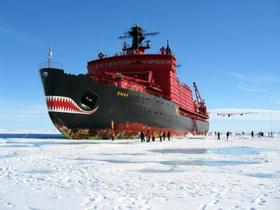
    Icebreaker in the arcticSince the end of the cold war the Arctic has been changing in ever increasing speed. Not only does the international community face immense environmental challenges that will influence every part of the world, but also will the Arctic states face territorial claims, issues concerning maritime transportation and infrastructure, natural resource exploitation and a whole new political setting. The Arctic is becoming a lively international region rich of natural resources and high economic potential. The fact is, however, that there is lacking a common political agenda for the future in the Arctic and a legal framework for the emerging maritime activities. Infrastructure on the Arctic coastline is not ready to welcome the incipient economical activities and the participation procedure of the indigenous peoples in developing the area has not yet been fully established. Most of these activities must be undertaken jointly by all the Arctic nations for them to have real impact. The shortage of the Arctic Council mandate to deal with issues other than environment has led to a situation where decisions are made in isolation creating thus incomplete and fragmented framework for the Arctic region.

    This situation has been understood in the Arctic states and in every established national Arctic Policy the need for stronger Arctic Council is recognized. In the next few years then, the states have a challenge of reforming the Arctic Council to better correspond to the contemporary challenges. The mandate must be broadened to cover issues other than environment as well and the restructured Council must be presented with a higher level image to equal other international actors in the Arctic region.
  • Arctic Side event by CAFF at COP10, Nagoya, Japan

    Arctic Side event by CAFF at COP10, Nagoya, Japan

    Arctic Biodiversity Trends 2010

    Unique Arctic habitats for flora and fauna, including sea ice, tundra, lakes, and peatlands have been disappearing over recent decades, and some characteristic Arctic species have shown a decline. The changes in Arctic Biodiversity have global repercussions and are further creating challenges for people living in the Arctic.

    The above statements are examples on the key findings describing changes in Arctic biodiversity that is presented in ‘The Arctic Biodiversity Trends – 2010: Selected Indicators of Change’, a new report synthesizing scientific findings on the status and trends for selected biodiversity in the Arctic issued by the Conservation of Arctic Flora and Fauna (CAFF) Working Group under the Arctic Council.

    CAFF as the biodiversity working group of the Arctic Council will be holding a side event at the tenth meeting of the Conference of the Parties (COP 10) which is being held in Nagoya, Aichi Prefecture, Japan this October 28th. The CAFF event held during the high level segment of the talks will focus on the challenges and changes facing Arctic Biodiversity and their global significance.

    The event will be held on October 28th at 13:15 – 14:45, Room 234C – Bldg 2 – 3rd Floor