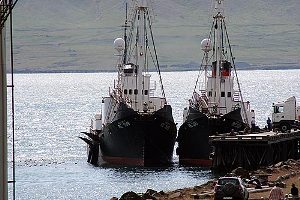
 A website has been launched where tourists are encouraged to boycott Iceland as their vacation destination due to the country’s whaling policy. Iceland is among other nations, such as Canada, Norway, Japan and the United States that carry out whaling. The website “rescuethewhales.org” maintains that Iceland is whaling endangered species. The misunderstanding might arrive from the hunt of fin whales in Icelandic and adjacent waters. According to the International Whaling Commission (IWC) fin whales are endangered in the Southern Hemisphere but not in the North Atlantic Ocean. Assessments of the population status in the central North Atlantic and off West Greenland have shown populations to be in a healthy state.
The aim of the group behind the website, rescuethewhales.org is to damage Icelandic economy by appealing to the public not to visit the country and therefore try to undermine its tourism. It is stated in the website that Iceland is a small country where the economy is small and dependent on few large industries, such as tourism. Icelandic economy is similar to other small economies within the Arctic region, being dependent on natural resources and increasingly on tourism. Actions based in many occasions on emotions, as mentioned at the website, rescuethewhales.org could therefore have severe consequences to economies such as Iceland.
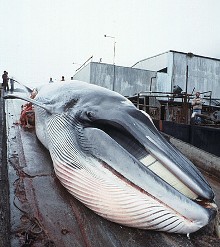 According to the Icelandic fisheries portal, at least 12 species of whales, dolphins, and porpoises occur regularly in Icelandic waters and 11 other have been recorded more sporadically. Out of those 23 species that are recorded around Iceland, two are scientifically assessed and annual catch recommendations based on that, fin whale and minke whale. The Icelandic Ministry of Fisheries and Agriculture considers whaling as sustainable and the Icelandic whaling policy is based on precautionary approach. This means that the whale stocks benefit of the doubt. In context with whaling, a quota is issued where number of whales captured does not exceed future sustainable development of the stock.
The Icelandic Marine Research Institute, in collaboration with the North Atlantic Marine Mammal Commission (NAMMCO) and the IWC estimates that the stock of fin whale around Jan Mayen, Greenland and Iceland is from 21.000 – 24.000 animals. On the basis of the assessment conducted within the Scientific Committees of the IWC and NAMMCO, the Icelandic Marine Research Institute recommended annual catches of up to 150 fin whales as sustainable and precautionary. The catch can go up to 200 animals if adjacent waters in East of Greenland and Jan Mayen are taken into consideration.
As reported by the Icelandic Marine Research Institution, the minke whale stock around Iceland is considered to be close to pre-exploitation abundance, and historic catches were not thought to have affected the stock 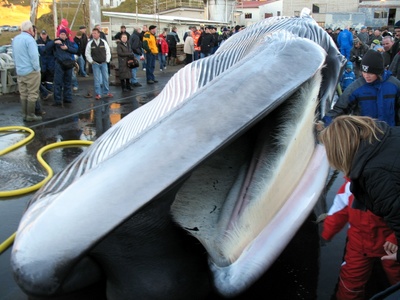 appreciably. An aerial survey conducted in coastal Icelandic waters in 2007 showed lower abundance estimates than previous surveys, or 10 700 and 15 100, depending on the method of analysis. A survey conducted in 2008 showed much higher densities, indicating that the unusually low densities in 2007 were due to a temporary shift in distribution within the population area. Based on a stock assessments conducted by the Scientific Committees of NAMMCO and the IWC, it was recommend by the Icelandic Marine Research Institute that annual catches of common minke whales from the Central North Atlantic stock do not exceed 216 animals in the Icelandic continental shelf area.
The Icelandic Ministry of Fisheries and Agriculture followed the scientific recommendations of the Marine Research Institute and issued annual quota for 2009 – 2014 of 200 fin whales and 200 minke whales. However, in the last two years Icelandic whalers whaled less than 400 animals, meaning that the maximum quota was not reach. As published on the web of the Icelandic Ministry of Fisheries and Agriculture, the country has conducted responsible harvest of marine creatures for years and aims to continue to do, for it is known that the country needs to rely on its renewable marine resources.
The issue of whaling is highly sensitive matter. The discourse, however, should be about responsible and sustainable harvesting of living resources, where current utilization does not threat future development and growth of those resources. Sustainable use of North-Atlantic renewable marine resources and harvest of whales and other species is an important issue and should be applied whenever possible.
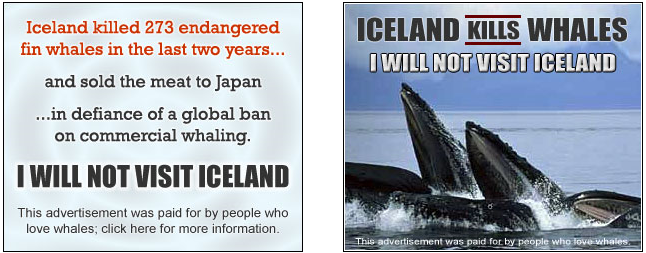
The aim of the anti whaling campaign against Iceland is to damage its economy by appealing to people to boycott Iceland as a travel destination. Whaling is a sensitive issue where advocates portray their views. However some mistakes are sometimes made, as with the rescuethewhales.org campaign. Their logos state that Iceland whales endangered species, which is incorrect. Another mistake is to use humpback whales in the logo to the right. Humpback whales are preserved in Iceland, as in Alaska where the photo is taken.
Sources and further information:
International Whaling Commission
North Atlantic Marine Mammal Commission
Icelandic Marine Research Institute
Icelandic Ministry of Fisheries and Agriculture
Fisheries.is

