Tag: Canada

  • New Arctic Council minister visits Iceland

    New Arctic Council minister visits Iceland

    Leona Aglukkaq and Össur at the meeting

    The Icelandic Minister for Foreign Affairs, Össur Skarphéðinsson met with Ms. Leona Aglukkaq, Canada’s health minister and newly appointed Minister of Arctic Affairs in Iceland yesterday.
    Following her visit to Reykjavík, Aglukkaq will travel to the other Nordic states to introduce Canada’s Chairmanship Programme for the Arctic Council.

    At their meeting the ministers discussed cooperation between the countries and the their policies within the Arctic Council as Canada will take on the chairmanship of the Arctic Council at the council’s ministerial meeting in Kiruna May 15.

    Leona Aglukkaq who will lead the chairmanship, said Canada’s overarching theme would be promoting projects that have practical implications for the inhabitants of the region, including economic growth and the development of natural resources in a sustainable manner, safer Arctic shipping, engagement with industry and the business community and cultural cooperation within the Circumpolar region.

    “Our main agenda is development of the people in the Arctic, sustainable and safe exploitation of resources and safe shipping in the Arctic,” she told Morgunblaðið.

    The Foreign Minister expressed his view that strong regional and political cooperation within the Arctic Council, aimed at constructive projects and agreements is one of the pillars of Iceland’s Arctic policy. The Minsters agreed on the importance of strengthening practical cooperation of the Arctic States on responses to environmental disasters, e.g. by supporting prevention and responses to shipping accidents and oil spill in the Arctic.

    The Foreign Minister also emphasized the importance of developing further ideas on economic cooperation with the possible establishment of Circumpolar Chamber of Commerce. The issue of permanent observers was discussed and the future development of the Arctic Council and its role in the global context.

    After her meeting with the Foreign Minister, Ms. Aglukkaq met Ms. Svandísi Svavarsdóttir, Minister for the Environment and Natural Resources and experts from institutes working with Arctic affairs in Iceland.

    Sources

    Ministry of Foreign Affairs

    Morgunblaðið

    The Arctic Council website

  • Cold winter conditions in the Arctic

    Cold winter conditions in the Arctic

    Climate conditions have been negative

    States for 2012 was climate conditions in Scandinavia, Siberia, Alaska and Canada have been colder than average this winter.

    The National Snow and Ice Data Center reports that the Arctic sea ice extent for December 2012 was well below average, driven by anomalously low ice conditions in the Kara, Barents, and Labrador seas.

    NSIDC states that the winter has been dominated by the negative phase of the Arctic Oscillation, bringing the cold climate around the Arctic.

    The Arctic Oscillation is an Arctic climate index with positive and negative phases, which represents the state of atmospheric circulation over the Arctic. The positive phase brings lower-than-normal pressure over the polar region, steering ocean storms northward, bringing wetter weather to Scotland and Scandinavia, and drier conditions to areas such as Spain and the Middle East.

    Reports today also show that the average temperature for USA for 2012 was above average, showing different climate than in the Arctic, outside of Alaska.

    Sources

    NSIDC

    NOAA 1

    NOAA 2

  • No oil leak from stranded rig

    No oil leak from stranded rig

    Stranded oil rig

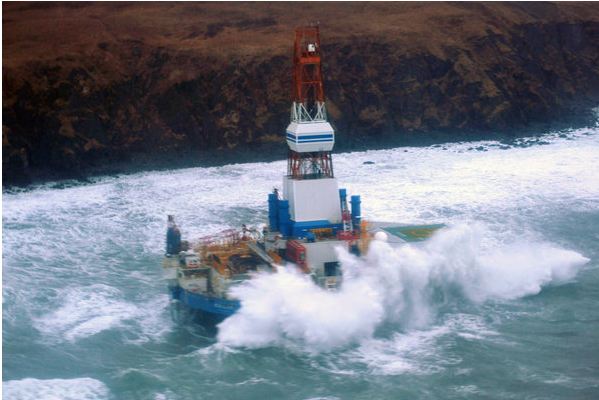
    An oil rig stranded in severe storms near the island Kodiak in Anchorage, Canada. No oil is leaking from the rig.

    The drillship is called Kulluk, owned by Royal Dutch Shell. The US coastguard was concerned about any leak but overflights confirmed that no leak has occurred.

    Coast Guard Captain Paul Mehler said the Kulluk had 143,000 gallons of ultra-low-sulfur diesel and 12,000 gallons of other oil products on board.

    The grounding of the drillship, weighing nearly 28,000 gross tons and operated by Noble Corp, is a blow to Shell’s $4.5 billion offshore program in Alaska.

    The rig had been headed to Puget Sound for maintenance and upgrades when it broke away from one of its tow lines on Monday afternoon and was driven to rocks just off Kodiak Island that night. The 18-member crew had already been evacuated by the Coast Guard on Saturday because of risks from the storm.

    With winds reported at up to 60 miles (100 km) an hour and Gulf of Alaska seas of up to 35 feet (11 m), responders were unable to keep the ship from grounding, the Coast Guard said.

    Sean Churchfield, operations manager for Shell Alaska, could not explain why the Kulluk had been caught in the weather. “I can’t give you a specific answer, but I do not believe we would want to tow it in these sorts of conditions.”

    Susan Childs, emergency incident commander for Shell, believed that a significant spill was unlikely because of the Kulluk’s design, with diesel fuel tanks isolated in the center of the vessel and encased in very heavy steel.

    Shell is waiting for weather to moderate to begin a complete assessment of the Kulluk.

    Sources

    Independent

    Reuters

  • Environmental concerns for caribou

    Environmental concerns for caribou

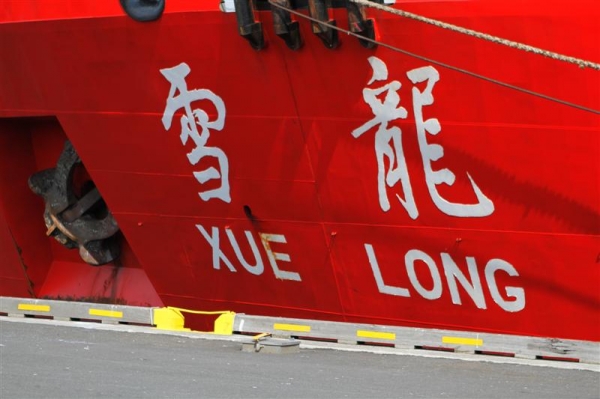
    Chinese icebreaker Xuelong.

    Canada is set to look into a mining project to be funded by China. Four federal ministers will come together to decide how to conduct an environmental review for the Izok Corridor proposal.

    It could bring many billions of dollars into the Arctic but would also see development of open-pit mines, roads, ports and other facilities in the centre of calving grounds for the fragile Bathurst caribou herd.

    “This is going to be the biggest issue,” said Sally Fox, a spokesperson for proponent MMG Minerals, a subsidiary of the Chinese state-owned Minmetals Resources Ltd.

    It would be hard to exaggerate the proposal’s scope. Centred at Izok Lake, about 260 kilometres southeast of Kugluktuk, the project would stretch throughout a vast swath of western Nunavut.

    Izok Lake would have five separate underground and open-pit mines producing lead, zinc and copper. Another site at High Lake, 300 kilometres to the northeast, would have another three mines.

    MMG also wants a processing plant that could handle 6,000 tonnes of ore a day, tank farms for 35 million litres of diesel, two permanent camps totalling 1,000 beds, airstrips and a 350-kilometre all-weather road with 70 bridges that would stretch from Izok Lake to Grays Bay on the central Arctic coast.

    MMG plans a port there that could accommodate ships of up to 50,000 tonnes that would make 16 round trips a year — both east and west — through the Northwest Passage.

    Izok Lake would be drained, the water dammed and diverted to a nearby lake. Three smaller lakes at High Lake would also be drained. Grays Bay would be substantially filled in.

    The result would be a project producing 180,000 tonnes of zinc and another 50,000 tonnes of copper a year.

    The four ministers, of Northern Development, Transport, Natural Resources and Fisheries and Oceans — have three choices. They can send the project back to MMG and ask for changes, they can choose to let the board run hearings itself or they can decide the project’s effects would be broad enough to require the involvement of other governments in hearings.

    Source

    The Record

  • Canadian sea bed camera

    Canadian sea bed camera

    Sea bed camera

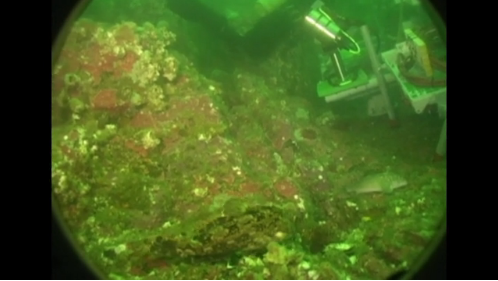
    An underwater monitor station has been installed on the Canadian Arctic sea floor, near Cambridge Bay in Nunavut. It allows for live views of the sea bed. Installation was in the hands of Ocean Networks Canada, based at the University of Victoria.

    Dr. Kim Juniper said the observatory is already generating interest among scientists who want to use the site for their own work.

    “Essentially using what we’ve put in there as a basis to provide some background for some other research,” he said.

    Juniper said it’s a preview to the kind of work expected at the High Arctic Research Station, which is expected to open in 2017.

    So far, the mini-observatory has caught shrimp and fish on camera, and has recorded ice thickening at the rate of one centimetre a day.

    Beth Sampson, a science teacher at Kiilnik High School in Cambridge Bay, said it’s the kind of real-life science that appeals to her as a teacher.

    “It also has a video camera on it, so it’s live-streaming data, and you’ll be able to see things that live in the water that might be swimming past or crawling past on the ocean floor. So it’s exciting to be able to see a side of the ocean that we don’t see from the surface.”

    Sampson’s Grade 11 biology students got the see the apparatus before it went under water. She is now working on a plan to use the data in science projects next school term.

    The underwater observatory is a scaled-down version of similar observatories in seafloor networks off the coast of Vancouver Island.

    Source

    Alaska Dispatch

  • Canada meets Sweden for Arctic Council

    Canada meets Sweden for Arctic Council

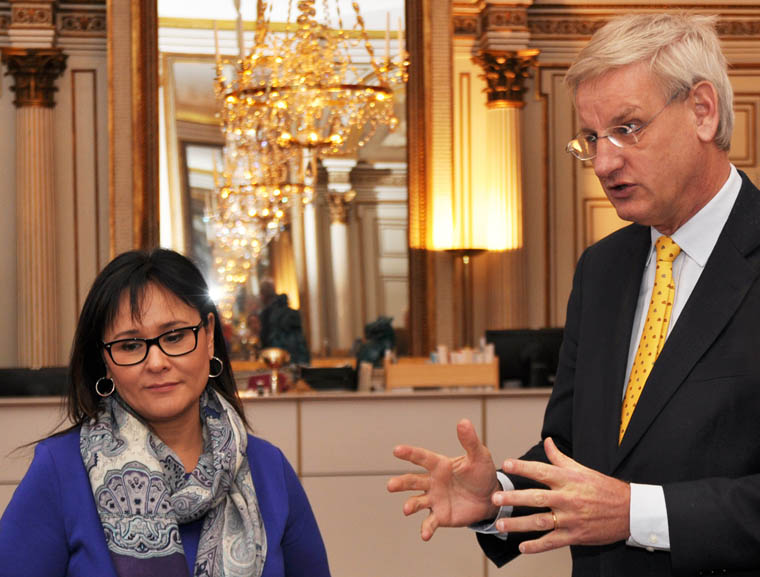
    Leona Aglukkaq and Carl Bildt at the press conference

    Canada will take over chairmanship in the Arctic Council in May 2013 from Sweden. The two countries have close cooperation for a smooth process when Canada takes its second chair of the council.

    Established in 1996, all eight Arctic States have held the Chair for the Arctic Council, with Sweden now completing the round.

    Sweden Minister for Foreign Affairs Carl Bildt met Canada’s Minister for the Arctic Council Leona Aglukkaq last week. Canada will serve as chair under Ms. Aglukkaq’s leadership, for the period 2013–2015. The work of the Arctic Council to protect the environment from oil spills, and Canada’s plans for its upcoming Chairmanship, were discussed at the meeting.

    Ms. Aglukkaq is now visiting the member states to introduce herself as the person who will lead Canada’s two-year chairmanship period. Tuesday it was the turn of Sweden and Minister for Foreign Affairs Mr. Carl Bildt.

    “We have worked to become more visible globally with regard to climate change, and to draw attention to the fact that climate change is occurring twice as fast in the Arctic than in the rest of the world. Awareness of this is now much greater in the global debate. This must be translated into political action, which takes a little longer. But I think we have made progress, for example on the issue of black carbon in the Arctic.” said Mr. Bildt.

    “Our priorities focus on development for people in the north: responsible resource development, safe shipping and sustainable circumpolar communities. The final priorities will be finalised when consensus has been reached in the Arctic Council at the Ministerial Meeting in Kiruna in May,” said Ms. Aglukkaq.

    During its chairmanship of the Arctic Council in 2011–2013, Sweden has worked to strengthen environmental protection during oil exploration in the Arctic. This has been achieved by developing safety standards based on best practice in the industry and negotiating an international agreement on cooperation in the event of oil spills. Sweden has also led efforts to establish the new permanent secretariat of the Arctic Council in Tromsø, Norway, which will open in May 2013, the Arctic Council website says.

    Sources

    Arctic Council

    Swedish Chairmanship

  • Read about IPY 2012 in Montreal

    Read about IPY 2012 in Montreal

    From the Arctic Portal side event

    The IPY 2012 conference in Montréal, Canada, was a fitting end to the International Polar Year. Around 3000 people attended the conference in the Palais de Congrés.

    Arctic Portal had four representatives in the conference, where our work was presented at various locations.

    We also took over 100 photos in Montréal.

    Click here to read about the conference and IPY.

  • Joint Canadian-Russian council?

    Joint Canadian-Russian council?

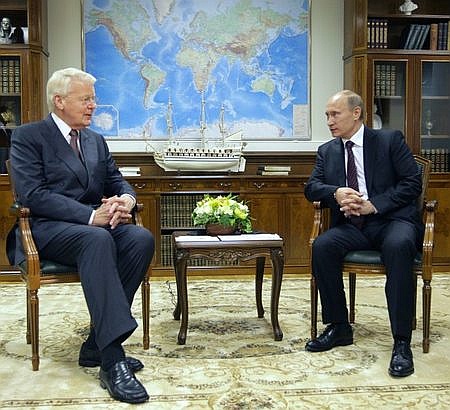
    Vladimir Putin and Ólafur Ragnar Grímsson

    The relationship between Canada and Russia is set to strengthen with an establishment of a joint research council. The countries relationship is thought to be stiff.

    “We have normal relations,” said newly elected president Vladimir Putin said, adding that he would like to meet with Stephen Harper, prime minister of Canada, at coming G8 and G20 summits. “The volume of trade is very low. Perhaps that is part of the problem.”

    Putin spoke to a group of six newspaper editors invited to his residence outside Moscow. In response to questions about Canadian relations, he said he would push for a joint scientific team, and pointed to a successful Russia-Norway approach to Arctic sovereignty.

    “The border of the continental shelf needs to be determined by scientists,” he said. He also tried to calm concerns over Russian exploration. “You needn’t suspect us of some kind of unilateral action. Yes, we have been exploring the shelf. What’s wrong with that?”

    The words from Putin are encouraging as Canada and Russia share boarders in the middle of the Arctic Ocean where land claims are being disputed. A joint research council could help the relationship between the two Arctic giants across the Arctic Ocean in the search for resources in the north.

    Source: The Globe and Mail

  • Canada first to withdraw from Kyoto

    Canada first to withdraw from Kyoto

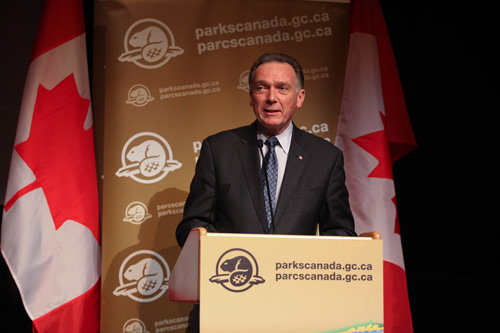
    Peter Kent minister of the environment

    Canada has announced it will withdraw from the Kyoto protocol. Peter Kent, minister of the environment, confirmed this last night.

    Canada will be the first country to withdraw from the global treaty. “It does not represent a way forward for Canada,” Kent said.

    The Kyoto Protocol was established in Japan in 1997 and restricts emissions of pollutants and fights climate change by more means.

    He said meeting Canada’s obligations under Kyoto would cost $13.6bn (10.3bn euros): “That’s $1,600 from every Canadian family – that’s the Kyoto cost to Canadians, that was the legacy of an incompetent Liberal government”.

    Kent also critizised that USA and China were not a part of Kyoto and therefore greenhouse emissions would continue to rise.

    He also said that the text of the Durban agreement agreed this weekend “provides a loophole for China and India”, it represents “the way forward”.

    Source: BBC

    See also: New climate deal at COP17


    New climate deal at COP17

  • Polar bears a special concern

    Polar bears a special concern

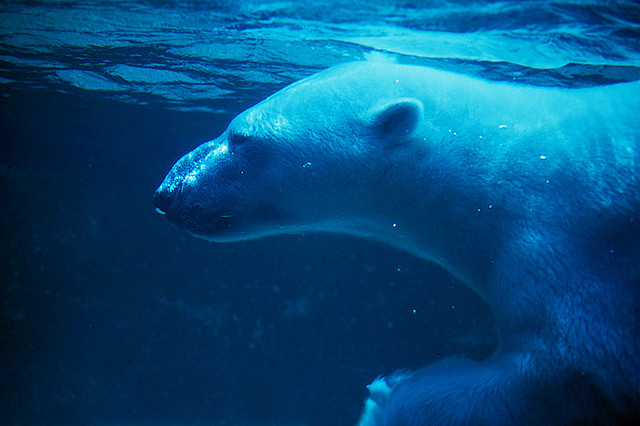
    Polar bear swimming underwater

    Canada will take special measures to protects its polar bears. Federal Environment Minister Peter Kent has declared the polar bear a “species of special concern”.

    Officials will now create a management plan in hopes of easing human threats to the species.

    “Canada is home to two-thirds of the world’s polar bear population and we have a unique conservation responsibility to effectively care for them”, Kent said.

    Currently, about 534 polar bears are hunted each year in Canada but the population is around 15.500.

    Source: NTN24