Tag: China

  • Chinese merchant ship crosses Arctic

    Chinese merchant ship crosses Arctic

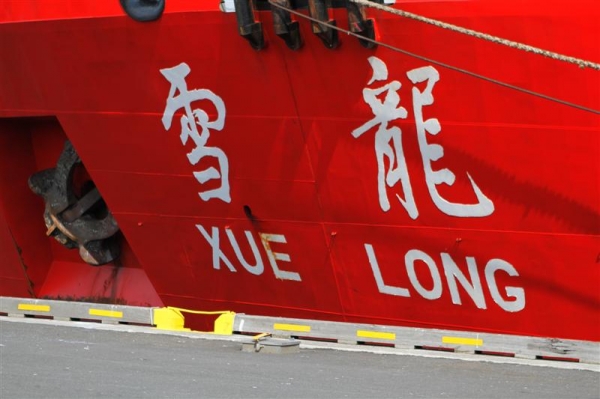
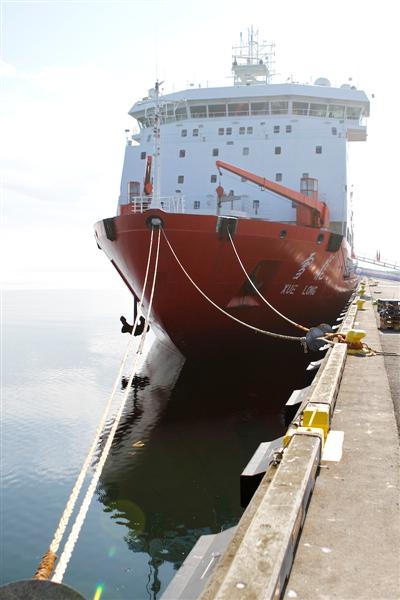
    Xue Long - The Snow Dragon

    Arctic shipping is reaching its peak this year, now in late summer. Earlier a 19.000 ton cargo vessel from China became the first Chinese merchant ship to travel from its homeland to Europe via the Northern sea route.

    The Yong Sheng, a 19,000-tonne vessel operated by state-owned Cosco Group, set sail on August 8 from Dalian, a port in northeastern China, bound for Rotterdam. According to an announcement on Cosco’s website, the journey via the Bering Strait could shave as much as 15 days off the traditional route through the Suez Canal and Mediterranean Sea.

    There are three main shipping routes through the Arctic, the Norhern Sea route, the Western sea route and the Central shipping route.

    The longer Northeast Passage, the Financial Times writes, at approximately 5,400km, has the advantage of offering a relatively straight journey over the top of the Eurasian landmass. Its shorter North American rival, by contrast, twists and turns through narrow, dangerous channels in the Canadian Arctic. The Northwest Passage claimed the life of explorer Sir John Franklin and the crews of his two ships, HMS Erebus and HMS Terror, in 1847.

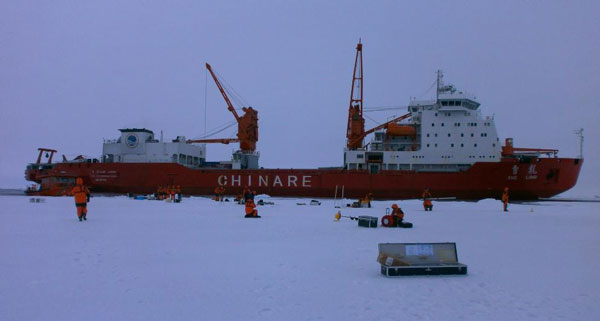
    But China has already demonstrated that the Central sea route might be the best route, as the ice gets thinner by the years, with the Chinare5 expedition in 2012.
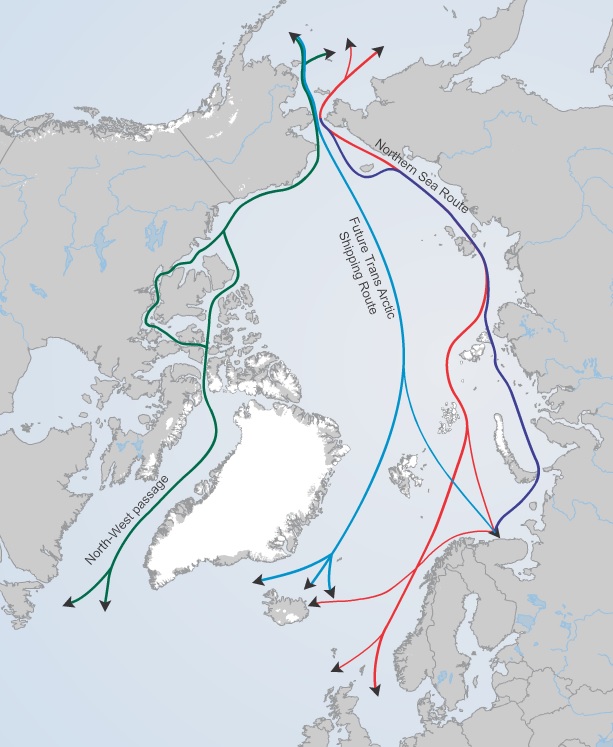
    The arctic shipping routes - map

    Arctic shipping is taking off faster than the other big economic prospect for the polar region, oil exploration, where companies such as Royal Dutch Shell and Cairn Energy have been plagued by delays.

    But analysts caution that it will be years before the route, which is only passable for a few months, is commercially viable let alone a rival to the Suez Canal, which handled more than 17,000 ships in 2012.

    “Climate change is certainly opening new Arctic shipping routes,” said Cameron Dueck, a Canadian author who sailed the Northwest Passage in 2009. “But the most common routes through the [Arctic] continue to have ice even in the warmest years, meaning shipping companies will have to be selective and opportunistic in using them.”

    Valentin Davydants, captain of Russia’s Atomflot fleet of nuclear-powered icebreakers, estimates that by 2021 15m tonnes of cargo will use the full route. In addition, 15m tonnes of liquefied natural gas and 10m tonnes of oil will use the route partially to leave Russia’s northern Arctic shore.

    That pales into insignificance compared with sea freight in the Suez Canal where in 2011 almost 18,000 vessels transported 929m tonnes of cargo.

    “You might see some oil and gas leave Russia – but I think the day that container ships will choose to use the northern sea route for economic reasons is quite a long way off,” said one of Norway’s biggest shipowners.

    But some see great potential if the Arctic route can bring its costs down, which is indeed happening as the melting sea ice means icebreakers are no longer required under Russian rules for all journeys

    Besides the Suez Canal, the traditional maritime route linking China to the EU passes through the contested South China Sea, the Strait of Malacca and pirate-infested waters in the Indian Ocean.

    The voyage between Dalian and Rotterdam along this southerly route takes 48 days. By sailing the Northeast Passage, the Yong Sheng is expected to reach its destination on September 11 – a transit time of only 35 days.

    China, which claims to be a “near-Arctic state”, has become more aggressive in asserting its interests in the northern Pacific and Arctic oceans. In May, Beijing secured “permanent observer” status at the Arctic Council, a group uniting the eight countries with territory in the polar region.

    Source
    Financial Times

  • China plans to invest in Russia

    China plans to invest in Russia

    Russian harbor

    Chinese investors are interested in building deep water harbor in Arkhangelsk Oblast, according to Deputy Governor of the region. It is believed that a new deep water harbor is the natural ending point of the infrastructure development around the area.

    Alsufyev and Dmitry Deart, who is Head of the Department for Transport, have just returned from China, where they took part in the third meeting in the joint Russian-Chinese working group on the Belkomur project.

    They presented the deep-water harbor project to Chinese investors, who showed “principal interest” in developing the port of Arkhangelsk, the regional administration’s web site reads.

    The planned deep-water port in Arkhangelsk, which is included in Russia’s transport strategy for the period to 2030, will have an annual capacity of 30 million tons.

    Source

    Barents Observer

  • China to drill in Barents Sea

    China to drill in Barents Sea

    China on the map

    The Chinese National Petroleum Corporation (CNPC) strikes a deal with Rosneft over the exploration of three fields in the Barents and Pechora Seas.

    As reported by the Barents Observer, the Chinese National Petroleum Corporation (CNPC) struck a deal with Rosneft over the exploration of three fields in the Barents and Pechora Seas.

    The Agreement was signed during the last week’s visit to Russia, paid by the Chinese President – Xi Jinping. The Agreement included Zapadno-Prinovozemelsky structure in the Barents Sea and the Yuzhno-Russky and Medynsko-Varandeysky structures in the Pechora Sea.

    With the cooperation in place, the CNPC becomes Rosneft’s third foreign partner in the Barents Sea. From before, agreements have been signed with Eni and Statoil. In addition, Rosneft has a comprehensive agreement with ExxonMobil in the Kara Sea.

    The Zapadno-Prinovozemelsky is among the least explored areas on the Russian shelf, and resource estimates are sparse. However, the hydrocarbon potential is believed to be considerable considering the highly perspective surrounding areas.

    China has over the last couple of years displayed a quickly increasing interest in Arctic issues. As previously reported, China could already by year 2020 send as much as 15 percent of its international trade through Arctic waters.

    Chinare 5 in northern Iceland during the summer of 2012

    The country is also bidding for a permanent observer status in the Arctic Council. In the summer of 2012, the country sent its icebreaker “Xue Long” (Snow Dragon) in a historic mission along the Northern Sea Route and made an attempt to reach the North Pole.

    Rosneft was one of the last vertically integrated oil companies to emerge from the reorganization and large-scale privatization of Russia’s oil industry in the years following the dissolution of the Soviet Union.

    Today its plans are about to reach implementation of a number of hydrocarbon exploration and development projects in Russia, the United States and other countries, as well as to set up a joint Arctic Research Center (ARC) in St. Petersburg.

    Source

    Barents Observer

  • First China-Nordic Arctic Symposium

    First China-Nordic Arctic Symposium

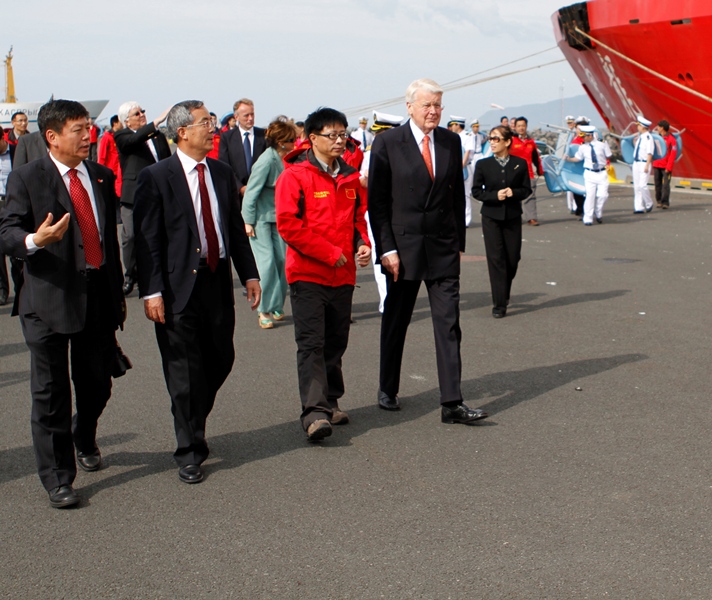
    The president of Iceland visiting Xue Long, the Snow Dragon, in Iceland

    The first China-Nordic Arctic Cooperation Symposium will be held in China this summer. The Polar Research Institute of China hosts the symposium in cooperation with the Icelandic Center for Research.

    Participants will be Chinese and Nordic institutions.

    The conference dates are 4th – 7th of June 2013 and the venue will be in Shanghai.

    The theme of the conference is “China-Nordic Cooperation for Sustainable Development in the Arctic: Human Activity and Environmental Change”.

    Call for abstracts for presentations have been opened. Proposals are welcomed from researchers affiliated With Nordic and Chinese universities, research institutes and/or think tanks. All presentations should focus on Arctic-related issues, Within one ofthe session topics:

    • Session I: Arctic Shipping and Resource Exploration
    • Session II: Research Cooperation on Climate Change
    • Session III.: Arctic Policies and Governance
    • Session IV: Anthropos andthe Arctic in the Anthropocene

    The symposium will be a significant step towards the establishment of the China-Nordic Arctic Research Center, located at PRIC in Shanghai. Following the symposium in Shanghai on 4-6 June, there Will be an organized excursion for the participants on 7 June.

    The deadline for the abstracts (250-400 words) is the 15th of March and should be send to Zhang Xia, Head of Strategic Studies Division at PRIC, Zhangxia@pric.gov.cn and Dr. Thorsteinn Gunnarsson, Head of Division at RANNIS, e-mail: thorsteinng@rannis.is. The abstracts should also follow a short CV.

    Further information is given by Mr. Egill Thor Nielsson, Visiting Scholar at PRIC: egillnielsson@gmail.com.

    Sources

    Rannís

    Polar Research Institute of China

  • Greenland will not favor EU over China

    Greenland will not favor EU over China

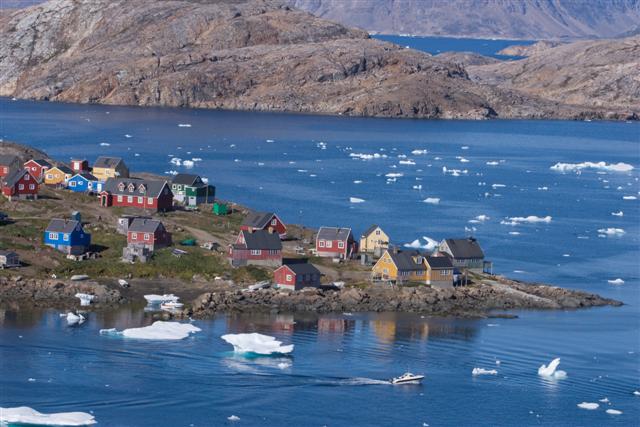
    town in Greenland

    The prime minister of Greenland says he will not favour the EU over China or other investors when granting access to highly prized rare earth minerals. Kuupik Kleist said it would not be fair “to protect others’ interests more than protecting, for instance, China’s”.

    The BBC reports and points out that Greenland is not in the EU, even though Denmark is.

    The EU, US and Japan are in dispute with China over its restrictions on exports of rare earths.

    China currently produces 97% of the world’s rare earths, vital in the manufacture of mobile phones and other high-tech products.

    The dispute has gone to the World Trade Organization (WTO). Last year China argued that its export restrictions were needed to protect the environment, conserve supplies and meet domestic demand.

    Currently Greenland’s rare earth resources are being intensively investigated. The European Commission estimates that those resources could total 9.16% of the global rare earth deposits.

    “All are welcome if they meet our conditions and our requirements to operate in Greenland,” Mr Kleist said.

    The EU sees “especially strong potential” in Greenland’s deposits of niobium, platinum, rare earths and tantalum, among the elements on an EU “critical raw materials” list.

    The share of European exploration companies operating in Greenland is only 15%. More than 50% are from Canada and Australia.

    Mr Kleist, speaking in the Danish capital Copenhagen, said Greenland needed to develop its resources, as it was too reliant on fishing and subsidies from Denmark.

    “I do not see thousands of Chinese workers in the country as a threat,” he said, quoted by Denmark’s Ritzau news agency. He vowed to resist EU pressure concerning Greenland’s policy on rare earths.

    Source

    BBC

  • Arctic brings cold weather to China

    Arctic brings cold weather to China

    A man works in a frozen river in Taiyuan, Shanxi province

    The year 2012 was unusually cold in China, which may be a result of the record loss of Arctic sea ice. “Observation and data analysis showed that Arctic sea ice loss may cause cold and snowy winters in parts of Asia,” Chen Yu, senior engineer of the National Climate Center in China states.

    The Arctic sea ice saw it record low extent on September 16th 2012.

    The China Daily reports and Chen explains that when sea ice melts in the Arctic, the water temperature increases. When that happens, the air becomes moister and is more likely to form cold fronts.

    According to the China Meteorological Administration, in December most of China suffered colder weather than usual. On Dec 24, frequent cold fronts led to temperatures in 21 monitoring stations hitting record lows.

    And the cold weather continued and the weather has been cold since late December.

    Kang Zhiming, weather forecaster of the National Meteorological Center, said weather models showed the temperature will not rise until late January.

    “The weather authorities will keep a close eye on any changes in the weather, especially before Spring Festival, in order to give timely information to transport and related departments, particularly in the event of extreme weather,” Kang said.

    China has a research station in Ny Alesund, on Svalbard, and among other projects is monitoring weather and sea ice from the station.

    Source

    China Daily

  • Environmental concerns for caribou

    Environmental concerns for caribou

    Chinese icebreaker Xuelong.

    Canada is set to look into a mining project to be funded by China. Four federal ministers will come together to decide how to conduct an environmental review for the Izok Corridor proposal.

    It could bring many billions of dollars into the Arctic but would also see development of open-pit mines, roads, ports and other facilities in the centre of calving grounds for the fragile Bathurst caribou herd.

    “This is going to be the biggest issue,” said Sally Fox, a spokesperson for proponent MMG Minerals, a subsidiary of the Chinese state-owned Minmetals Resources Ltd.

    It would be hard to exaggerate the proposal’s scope. Centred at Izok Lake, about 260 kilometres southeast of Kugluktuk, the project would stretch throughout a vast swath of western Nunavut.

    Izok Lake would have five separate underground and open-pit mines producing lead, zinc and copper. Another site at High Lake, 300 kilometres to the northeast, would have another three mines.

    MMG also wants a processing plant that could handle 6,000 tonnes of ore a day, tank farms for 35 million litres of diesel, two permanent camps totalling 1,000 beds, airstrips and a 350-kilometre all-weather road with 70 bridges that would stretch from Izok Lake to Grays Bay on the central Arctic coast.

    MMG plans a port there that could accommodate ships of up to 50,000 tonnes that would make 16 round trips a year — both east and west — through the Northwest Passage.

    Izok Lake would be drained, the water dammed and diverted to a nearby lake. Three smaller lakes at High Lake would also be drained. Grays Bay would be substantially filled in.

    The result would be a project producing 180,000 tonnes of zinc and another 50,000 tonnes of copper a year.

    The four ministers, of Northern Development, Transport, Natural Resources and Fisheries and Oceans — have three choices. They can send the project back to MMG and ask for changes, they can choose to let the board run hearings itself or they can decide the project’s effects would be broad enough to require the involvement of other governments in hearings.

    Source

    The Record

  • Successful journey of the Snow Dragon continues

    Successful journey of the Snow Dragon continues

    The Snow Dragon

    The journey of the icebreaker Xue Long from Iceland to China, via the Arctic Ocean, has been successful so far. With the decreasing sea ice extent, the research ice-breaker has been able to sail through the Central Arctic Shipping Route without a support from nuclear powered vessel.

    Due to such an ice conditions, the research ice-breaker was able to operate via Fram Strait and carry on a high Arctic region to the east.

    Arctic sea ice extent fell to 4.10 million square kilometers on August 26, 2012. This was 70,000 square kilometers below the September 18, 2007 daily extent of 4.17 million square kilometers.

    Geological research: Gravity core launched in the Iceland Sea.

    Oceanographic, biological, geological and geophysical research was carried out in the Iceland Sea and Greenland Sea on the route north and meteorological observations are maintained throughout the expedition.

    Various satellite images are received for navigation through the sea ice.

    Benthic samples, from the shore lines of Icelandic waters were taken in order to prove benthos great increase in region that extends away from the land mass.

    Benthic sampling techniques are essential to habitat mapping studies since they provide the ‘truth’ data on the actual composition of the seafloor. When they are commonly used in conjunction with either a remote sensing or an acoustic technique, they are said to ‘ground truth’ seafloor classifications.

    Benthic sample from the Iceland Sea

    If samples are collected in high enough densities over survey areas they can be used to establish distributions and define habitats.

    Biological and geological/physical samples taken by the Geological Team from the Xue Long are to be taken separately from different grabs.

    Sailing out from Iceland, the Snow Dragon reached the region east of Jan Mayen, where in the good weather it was possible to see the Beerenberg volcano.

    It is the world’s northernmost sub aerial active volcano. The volcano is topped by a mostly ice-filled crater about 1 km (0.6 mi) wide, with numerous peaks along its rim including the highest summit, Haakon VII Toppen, on its western side.

    The upper slopes of the volcano were observed to be largely ice-covered, with several major glaciers including five which reach the sea.

    No scientific research was conducted by teams, nevertheless the elevation was difficult to be missed.

    Currently the vessel is heading up North, aiming to cross the North Pole. The ice conditions were reported as being almost 3 meters thick. The Snow Dragon is partly being followed by the Norwegian coast guard.

    Please, see the route of the Chinese research ice breaker on Interactive Mapping System.

    Source

    CHINARE5

  • The 5th Chinese National Arctic Research Expedition

    The 5th Chinese National Arctic Research Expedition

    The departure ceremonyIn beginning July of 2012 the Snow Dragon started its expedition to the Arctic. The voyage was launched from Qingdao in China. The 5th Chinese National Arctic Research Expedition (CHINARE 5) will sail for around 6 weeks before reaching Iceland in August.

    The voyage to Iceland will strengthen the two countries Arctic research cooperation further and during its stay in Iceland the public will have an opportunity visit the Snow Dragon.

    Xuelong, the Snow Dragon, is the icebreaker of the Polar Research Institute of China (PRIC). It is the largest non-nuclear powered icebreaker in the world. It was built as an ice-strengthened cargo ship, in Ukraine in 1993 but is now a floating laboratory with state of the art facilities and equipment for polar research. It was modified in 1994. The Xuelong is 167m long, almost 23 meters wide and the ice class is B1 level, it can break through 1.1m of ice, including 20cm of snow by 1,5 knots continuously.

    It is both a supply vessel for the four research stations PRIC has, one in Svalbard and three in Antarctica, and a scientific research platform in both Poles.

    This will be the fifth expedition of the icebreaker in the Arctic; the others took place in 1999, 2003, 2008 and 2010. Although CHINARE 1 and 2 were only one-year projects they provided a framework for comparative research in the future within the investigated areas. CHINARE 3 and 4 were conducted under the International Polar Year (IPY) and raised the knowledge level in China about the Arctic’s rapid changes.

    The Xuelong, research vessel for the 5th Chinese expedition, is equipped with advanced systems for self-contained navigation and for weather observation, both extremely important qualities for polar expeditions. There are also excellent facilities for the scientist.

    The icebreaker has a data processing center and seven laboratories with over 500sq meters of working space, it has operational equipment, a freezer to store samples, a low temperature cultivation room, a clean laboratory, a marine biological laboratory, a marine chemical laboratory, a geological laboratory, and a CTD winch, a biological winch, a geological laboratory, and a hallow-section device of EK-500 model.

    (Map: Arctic Portal) The Snow Dragon´s expected route.

    Furthermore it contains three operating boats and a helicopter for the transportation and research purposes in the Arctic and Antarctic regions.

    China is now designing a new research icebreaker, to be launched in 2014. It will be equipped with the most advanced appliances for marine, polar and astronomical research. The icebreaker will be stronger then the Xuelong, able to sail through rougher ice conditions.

    The scientists and staff on board the Snow Dragon work in several fields of research. The field work area is very broad and covers Bering Sea, Chukchi Sea, Chukchi Plateau, Canada Basin and the High sea of Norwegian Sea.

    Several research points will be re-visited, from the other four Chinese National Arctic Research Expeditions. Most of them are located in the Bering Sea, the Chukchi area and the Canada basin.

    However, the High Norwegian Sea will be explored by CHINARE for the first time. China is famous from their research stations in Ny Alesund and Svalbard. The opportunity to explore the Norwegian High Sea greatly contributes to the stations ‘scientific research.

    The main subjects of research in the expedition are divided into four fields: physical oceanography and sea ice, marine meteorology, marine geology, marine chemistry and atmospheric chemistry, marine biology and ecosystem research.

    The research´s main objectives are to include the survey of the marine environment and sea – ice – air system, geologic record of rapid changes in the marine environment and the research on the carbon flux, nutrients and bio geochemical cycle in the Arctic.

    (Photo: Getty Images) The Snow DragonHowever, what is more important, during the expedition, the scientists try to study the impact of Arctic changes on Chinese climate and investigate the Arctic ecosystem response to global change.

    Click here to read more about the research fields during the 5th Chinese Arctic expedition.

    The expedition is jointly organized by the Chinese Arctic and Antarctic Administration (CAA) and the State Oceanic Administration of China (SOA). The Polar Research Institution of China (PRIC) is the research body of CAA.

    Please, be referred to CHINARE Portal to find out more about the expedition. To read more about the Arctic shipping, please access the Shipping Portlet and visit Interactive Mapping System.

    Source: Chinare Portal

    Source:

    Chinare Portal

    See also:

    Click here to enter the Arctic Portal News Portlet

  • China´s 5th Arctic Expedition heads to Iceland

    China´s 5th Arctic Expedition heads to Iceland

    The estimated route of the Snow Dragon

    China´s fifth Arctic expedition is en route to the Arctic. The Snow Dragon, Xuelong, left Qingdao in China on the 2nd of July.

    It will sail through the Northern Sea rout, carrying out various ressearch objectives in four fields. The fields are Physical Oceanography and Sea Ice, Marine Geology research, Chemistry and Atmospheric Chemistry and Biology and ecolosystem research.

    Arctic Portal is a cooperative partner in the project and a website about the expedition has opened at Chinare5.

    The Snow Dragon’s expedition to Iceland is an important token of the two countries Arctic research collaboration for years to come. Its arrival comes in light of the parties increased cooperation in Arctic affairs during recent years, which recently saw a framework agreement signed by the two governments. The Snow Dragon’s arrival in Iceland will further strengthen these ties and make way for mutually beneficial research for both sides.

    During its stay in Iceland the public will have an opportunity visit the Snow Dragon.

    This will be the first time that a Chinese Arctic expedition will sail through the Northern Sea Route.
    It is estimated that the 15.000km voyage will land in Reykjavík in the middle of August, before visiting Akureyri and then heading back to China.

    Please visit Chinare5 for more information.