Tag: cod

  • Cod quota rise for Iceland

    Cod quota rise for Iceland

    Fish caught in a net

    The Marine Research Institute has released its annual report which suggests Iceland should receive a 10 per cent rise in its cod quota.

    The report, the State of Marine Stocks in Icelandic Waters 2012/2013 and Prospects for the Quota Year 2013/2014, published figures that indicate the North Atlantic nation should be allocated a significant increase in the amount of cod it is permitted to catch.

    Based on the assessment, there should be a 10 percent increase in the total amount of cod the country is permitted to catch in the next fishing year, rising to 215,000 tons. According to the MRI’s figures, the spawning stock and reference stock of cod has increased rapidly over recent years.

    In March this year, ICES evaluated the haddock harvest control rule to be “precautionary” and conform with the MSY. The Icelandic government adopted the rule in April which, based on the harvest control rule, would see the country stick to the MRI’s recommendation of a total allowable catch of 38,000 tons of haddock during the 2013/2014 fishing year.

    The MRI report states that many of the country’s commercial stocks remain in balance and are only exploited moderately. Due to this, changes in quota recommendations and stock sizes are usually affected by changes in recruitment patterns.

    Source

    Ice News

  • Cod still moving north

    Cod still moving north

    Cod catch rates

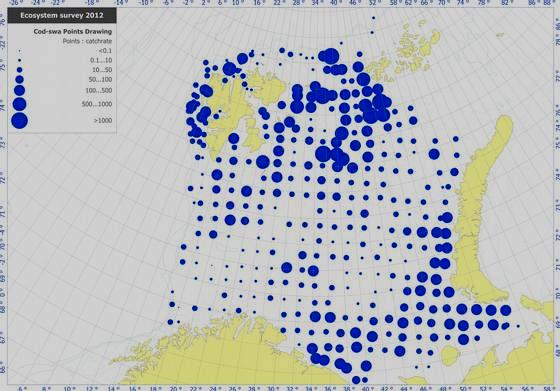
    Arctic Cod is still moving northward and recent findings recorded the furthest distribution of the species. Arctic Cod was recorded at 82 degrees and 30 minutes north this year, by the Russian research vessel Vilnjus.

    “The cod is moving northward and eastward. It also looks like it has enough food,” oceanographer Harald Gjøsæter.

    Gjøsæter was the expedition leader in the Barents Ocean and he says that the stocks are still growing.

    But the movement north is due to two things, Gjøsæter says. “The water is warm enough for the Cod and there is enough food,” he says.

    The scientists use both trawl and acoustic instruments to map the fish stocks in the Barents Sea, and the studies show that the distribution of cod stocks and the capelin stocks are overlapping each other. “The capelin stocks are also strong. “

    Gjøsæter also states that quotas for next year need to be precise but he is optimistic that the stocks are in good condition.

    Source

    Norwegian Institute of Marine Research

    Barents Observer

  • Cod growing due to global warming

    Cod growing due to global warming

    Cod in Icelandic waters

    Researchers in agriculture had anticipated the North Sea cod to get smaller over time due to global warming. A new study shows quite the opposite, they are actually growing due to global warming.

    The study was introduced in Global Change Biology, an international journal.

    “When the seawater gets warmer, all life processes in the cod speed up,” says Peter Grønkjær, an associate professor of marine ecology at the Department of Biological Sciences at Aarhus university, who headed the study. “This causes the cod to digest their food faster and makes them convert it into extra muscle tissue,” he added.

    Overfishing has started a process in which the cod spend their energy on reproducing themselves rather than on growing bigger.

    “But over the past 30 years the increased ocean temperatures have compensated for the anticipated decrease in cod size,” says Grønkjær.

    He also states that global warming seldom has positive effects on the cod, but this change is the odd point. “But this doesn’t mean that the warming of the North Sea is generally good for the cod. The higher temperatures alter the ecosystem, which causes the composition of the crustaceans that the cod feed on to change too. And that makes it harder for the fry to survive.”

    The researchers made the discovery by reviewing figures from the International Council for the Exploration of the Sea (ICES).

    These figures showed that the ocean temperatures at various times that the average sizes of the fish at various times, that the location of the fish at various times and that when the fish became sexually mature at various times.

    “By linking all this data together, we can conclude that the weight change is caused by changes in the temperature,” says Grønkjær.

    The new findings will be used for developing strategies for how cod stocks in the North Sea can be preserved.

    Sources

    Science Nordic
    Videnskab

  • The Cod Wars – Iceland vs. Britain

    Icelandic patrol ships nears an English trawler

    The cod wars were political disputes between the governments of Iceland and Britain over fisheries management in the Icelandic maritime waters. The disputes were numerous between the years 1948 and 1976 and are called the Cod wars. The cod wars were numerous; they can be counted as three or even four.

    The first dispute was in 1950. The territorial waters were moved up to 4 miles much to Britain’s annoyance since they utilized the Icelandic fisheries. Because of the four mile limit, they could not fish as much as before. This decision created a lot of conflict and Icelandic fish was banned from England, up until 1956 when the dispute ended.

    The second dispute was in 1958. The territorial waters were moved to 12 miles according to the United Nations Geneva Convention on Law of the Sea. Britain was again furious, sending the vessel HMS Russell to Iceland.

    It’s captain accused the captain of Icelandic coastal guard vessel Ægir of trying to sink the vessel. Protests were held in Reykjavik against Britain were held but the dispute ended in 1961.

    The third dispute was in 1972. Iceland would yet again move its territorial waters, not up to 50 miles. And again the Brits were unhappy, sending army vessels to Iceland to protect the British boats, who were fishing within the 50 mile territorial zone.

    For the first time the Icelanders used a new weapon they invented themselves.

    On September 5th 1972 the Icelanders encountered an unmarked trawler fishing northeast of Iceland. The captain of the trawler refused to divulge the trawler’s name and number, and, after being warned to follow the Coast Guard’s orders, played Rule Britannia over the radio.

    The net cutters

    That resulted in Iceland deploying the net cutter into the water for the first time and Ægir sailed along the trawler’s port side. The fishermen tossed a thick nylon rope into the water as the patrol ship closed in, attempting to disable its propeller. After passing the trawler, Ægir veered to the trawler’s starboard side.

    The net cutter, 290 meters in length, went behind the patrol vessel, sliced one of the trawling wires. As Ægir came about to circle the unidentified trawler, its angry crew threw coal as well as garbage and a large fire axe at the Coast Guard vessel.
    A truce was made in 1973.

    The fourth dispute was in 1975 when Iceland moved its territorial waters up to 200 miles. Britain refused to oblige and kept fishing in Icelandic waters. Only 24 hours after the law passed Iceland used the wire cutters again, now on Primella trawler from Hull.

    The disputes were getting dangerous and Britain kept sending navy vessels to Iceland which instead used their wire cutters.

    After the nations met in Oslo in 1976 the disputes finally ended.

    Iceland had many good weapons which led to them winning all the battles.

    Firstly they could point out that if Britain would break any laws Iceland would resign from NATO and therefore dismiss the US Army from Iceland. That was a strong weapon.

    Secondly the laws were in favour of Iceland and many supported the small nation against the big old empire.

    And lastly it was clear that Britain could not use army vessels to protect their trawlers when fishing forever.

    Source: The Cod Wars

  • Overview of Arctic Fishing

    Traditional fishing in Greenland

    The civilizations of northern Europe commercialized fishing, taking cod and herring in the seas off Norway and European Russia. During the past and recent years the Arctic and the Sub-Arctic was and will be a valuable food production area and has supplied over the years valuable nutrition for the south.

    Historically the Arctic supported the urbanization of the south, providing the cities with oil from whale and shark products that was used for lamp posts, production of soap, and for lubrication of machinery of the industrial revolution.

    Arctic fishermen and whalers of the past are long known for their overfishing and whaling. Oil was a valuable product and in high demand in the beginning of the industrial revolution.

    The cod fisheries in the Canadian Grand Banks became available as soon as the vessels where good enough. Naturally fishing increased with better technology and the when exports were more frequent.

    This even led to over fishing in the Arctic, especially in the Barents Sea and the northern Norwegian Sea, in the second half of the 20th century.

    The fishing fleets in Norway and Russia turned to capelin but déjà vu, the stocks were overharvested in a few years.

    Conservation measures have seen the stocks strengthened but the stock in the Barents Sea has gained ground again.

    Around Iceland, a big fishing nation, the stocks have also collapsed but are not in any danger. Iceland still relies heavily in fishing, but not as much as before.

    Fishing in the Bering Sea has come under scrutiny in recent years because of its potential involvement in the decline in the number of Sea Otters and pinnipeds.

    Traditional racks for the drying of cod

    Historically, fishing for salmon species, herring and halibut have been important.

    Visitors to south-western Alaska need only read the menu if a local restaurant to recognize that salmon and halibut are a source of local pride, and catching of those species are a popular tourist attraction.

    Salmon fishing is also important in the Russian side of the sea as well as for Japanese trawlers.

    In the 1970 and 1980s the fishing of the Walleye Pollock increased dramatically, with annual catches of up to 20 million tones eventually being recorded.

    However catching then dropped sharply n the area, probably because of overfishing and the rise in water temperature.

    Fisheries in the Arctic have changed significantly throughout the history where subsistence based fisheries have been the core value. The catch from the sea has made the Arctic and the Sub-Arctic area inhabitable due to the abundance of nutrition from both fishes and sea mammals. Those species made life in the cold bearable.

    During the recent years, an understanding of the importance of the biodiversity in the Arctic has increased. Regulations, quotas and bans of fishing and hunting have been implemented in order to preserve the delicate Arctic environment.

  • Cod expands and heads north

    Cod expands and heads north

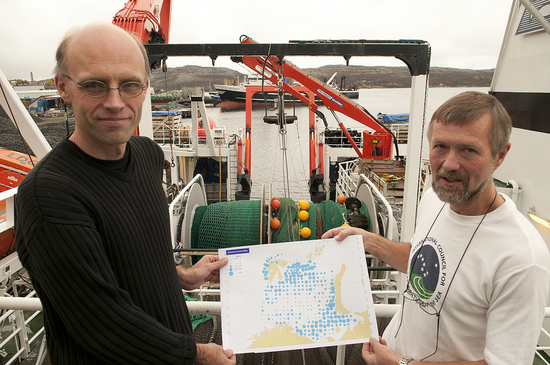
    Marine researchers Bjarte Bogstad and Harald Gjøsæter show map of cod stock dissemination in the Barents Sea

    The cod is moving further north then ever before. Huge amounts of cod have been found northerly in the Barents Sea, as far north as 82 degrees much to researcher’s surprise.

    Russian and Norwegian cooperation in the Barents Sea continues and their newest found is surprising to them.

    “We have never before seen such large amounts of cod so far north in the Barents Sea as this year,” they said according to the Barents Observer.

    The two researchers Bjarte Bogstad and Harald Gjøsæter from Norway completed a survey for 2011 recently.

    The comprehensive research in the Barents Sea found more cod then normal and that it also spread over larger areas.

    The reason is connected to a record high stock of capelin in the northern Barents Sea as well as higher sea temperatures.

    “Sea temperature this autumn is considerable colder than last summer, but still way higher than the average over the last 40 years, explains expedition leader Gjøsæter

    But will this result to higher quotas of cod? “Huge cod stock and widely dissemination all round the Barents Sea does not necessarily mean that we will recommend higher quotas next year,” says Gjøsæter.