Tag: Conservation of Arctic Flora and Fauna

  • CAFF XIII Biennial

    Conservation of Arctic Flora and Fauna

    The Thirteenth meeting of the Conservation of Arctic Flora and Fauna Working Group (CAFF XIII), is to be held in Akureyri, Iceland on February 1 – 3rd 2011. Every two years, the Arctic Council Working Group on Conservation of Arctic Flora and Fauna schedules a large meeting in advance of the AC Ministerial meeting.

    CAFF is a Working Group of the Arctic Council and a forum of Arctic professionals, indigenous peoples representatives, and observer countries and organisations. The aim of CAFF is to discussing circumpolar Arctic conservation issues. The major task is to advise the Arctic governments (Canada, Denmark/Greenland, Finland, Iceland, Norway, Russia, Sweden and the United States) on conservation matters.

    The CAFF Program is guided by the CAFF Strategic Plan for the Conservation of Arctic Biological Diversity and biennial CAFF Work Plans. CAFF has four Guiding Principles:

    • The involvement of indigenous and local people and use of traditional ecological knowledge;
    • The use of broad, ecosystem-based approach to conservation and management;
    • Cooperation with other conservation initiatives to minimise duplication and increase effectiveness;
    • Communication of CAFF program activities.

    The CAFF 2006-2008 Work Plan emphasizes cooperation and collaboration with other Arctic Council Working Groups, and organizations outside of the Arctic Council, and makes efforts to actively contribute to the global conservation agenda. This Work Plan responds to the findings and recommendations of the Arctic Climate Impact Assessment, the Arctic Marine Strategic Plan and CAFFs Arctic Flora: Status and Trends.
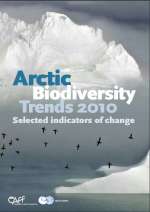
  • Arctic Biodiversity Assessment – Arctic Biodiversity Trends 2010: Selected indicators of change report

    Arctic Biodiversity Assessment – Arctic Biodiversity Trends 2010: Selected indicators of change report

    CAFF - Arctic Biodiversity Trends 2010CAFF – The Arctic Biodiversity Trends 2010 Report, produced by some of the world’s leading experts of Arctic ecosystems and biodiversity, is the Arctic Council’s contribution to the United Nations International Year of Biodiversity in 2010 and will be a preliminary product under the Arctic Council project ‘Arctic Biodiversity Assessment’ (ABA).

    In 2008, the United Nations Environment Program passed a resolution expressing ‘extreme concern’ over the impacts of climate change on Arctic indigenous peoples, other communities, and biodiversity. It highlighted the potentially significant consequences of changes in the Arctic. The Arctic Biodiversity Trends – 2010: Selected Indicators of Change report indicates that some of those anticipated impacts on Arctic biodiversity are already occurring.

    The report is based on twenty-two indicators and provides a snapshot of the trends being observed in Arctic biodiversity today. The polar bear is one of the most well-known species impacted by changes in the Arctic, but it is not the only one. The indicators show that the Arctic has changed dramatically during recent decades and that unique Arctic habitats for flora and fauna are disappearing. Furthermore, some species of importance to Arctic people or species of global attention are declining.

    The report presents 7 key findings;

    • Unique Arctic habitats for flora and fauna, including sea ice, tundra, thermokarst ponds and lakes, and permafrost peatlands have been disappearing over recent decades.
    • Although the majority of Arctic species are not currently declining, some harvested species of importance to Arctic people or species of global significance are declining.
    • Climate change is emerging as the most far reaching and significant stressor on Arctic biodiversity. However, contaminants, habitat fragmentation, industrial development, and unsustainable harvest levels continue to have impacts. Complex interactions between climate change and other factors have the potential to magnify impacts on biodiversity.
    • Since 1991, the extent of protected areas in the Arctic has increased, although marine areas remain poorly represented.
    • Changes in Arctic biodiversity are creating both challenges and opportunities for Arctic peoples.
    • Long-term observations based on the best available traditional and scientific knowledge are required to identify changes in biodiversity, assess the implications of observed changes, and develop adaptation strategies.
    • Changes in Arctic biodiversity have global repercussions.

    To download the report and to learn more about the Arctic biodiversity please go to the Conservation of Arctic Flora and Fauna (CAFF) Working Group under the Arctic Council homepage or Arctic Biodiversity Trends 2010 reports homepage