Tag: Denmark

  • MobilityDK is now open for applications

    MobilityDK is now open for applications

    Spring in Faroe Islands

    UArctic is launching a MobilityDK pilot model, which provides travel support for student, teacher, and researcher mobility activities.

    MobilityDK is a part of the UArctic Danish Mobility Project, the goal of which is to support mobility for the Kingdom of Denmark’s Arctic education activities, and mobility from the Kingdom of Denmark to Arctic educational activities in different areas of the Arctic through the UArctic network.

    Financial grants are being offered in two separate categories. Teaching and research staff as well as students mobility provides financial support from and to Danish, Greenlandic and Faroese members of UArctic.

    The goal of the mobility is to support broad institutional networking within UArctic, contributing to the development of mobility agreements, joint research projects, joint education programs, and activities of Thematic Networks.

    Furthermore, the staff mobility is to promote initiation of new Thematic Networks with engagement from Danish, Greenlandic and Faroese institutions.

    The goal of the mobility is to support broad institutional networking within UArctic, contributing to the development of mobility agreements, joint research projects, joint education programs, and activities of Thematic Networks. Furthermore, the staff mobility is to promote initiation of new Thematic Networks with engagement from Danish, Greenlandic and Faroese institutions.

    The deadline for applications is August 15th 2013 and all decisions will be made by August 30th.

    MobilityDK is a pilot program to provide with financial support for mobility of students, teachers and researchers within the Kingdom of Denmark.

    The model is supported by the Danish Agency for Science, Technology and Innovation.

    For more information and to apply, please visit University of the Arctic.

    Source

    UArctic

  • Denmark to claim the North Pole

    Denmark to claim the North Pole

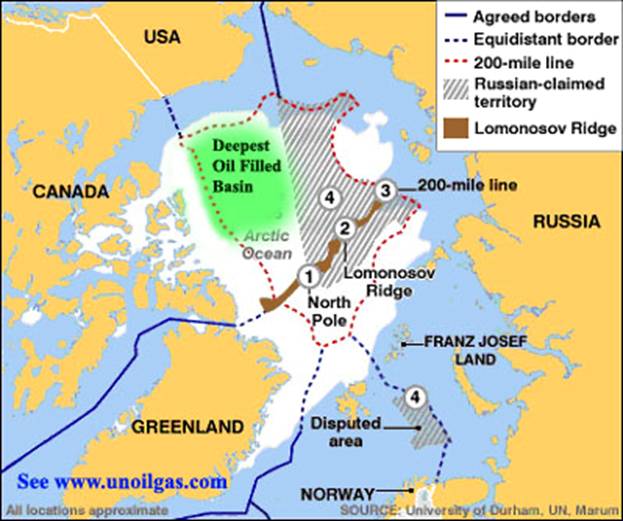
    Arctic Boundaries map

    Today, 31st of July 2012, Denmark dispatches the official expedition from Svalbard off northern Norway, in order to gather seismic and depth data to substantiate a future possible claim on the North Pole.

    Before 2014, Kingdom of Denmark will make an official claim to the North Pole possibly setting a tug – of – war with Russia and Canada over the seabed resources lying on the top of the world.

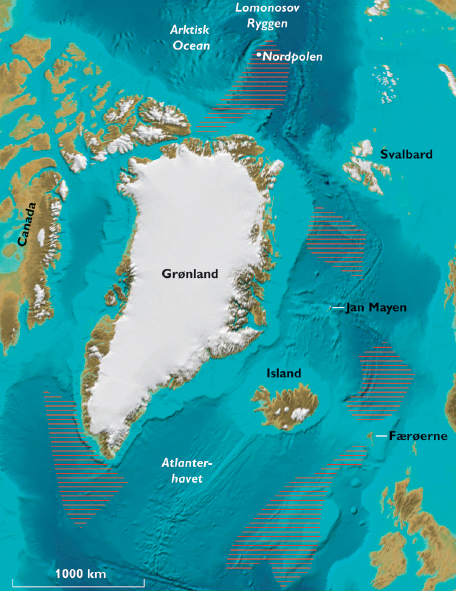
    Danish claim would be made under the United Nations Convention of the Law of the Sea (UNCLOS). It would map five sections of continental shelf to include four of them around Faroe Islands and one around Greenland with the area reaching the North Pole. Both, Greenland and Faroe Islands are self – governing territories under the Kingdom of Denmark.

    It is a fact, that melting Arctic sea ice will in very near future greatly open the door for inexpensive exploitation of northern oil and gas resources.

    The Danish claim is to include the area of roughly 150.000 sq km north of Greenland. However, to be able to proceed with the statement, Denmark will have to prove by providing scientific data, that the Lomonosov Ridge which lies across the North Poole, is the extention of Greenlandic land mass.

    Up until now, Denmark managed to identify five potential claim areas around the southern part of Greenland and south of Faroe Islands.

    It is the Commission on the Limits of the Continental Shelf that is eligible to assess the validity of those claims.

    United Nation Convention on Law of the Sea entered into force and by the year of 1998 was accepted by 127 states. Few governments, which did not ratify the Convention, in between United States, Belgium and Canada, have already signed the Implementation Agreement, what surly shows that even when not ratified, the Convention with its universal approach, contributes with a great impact, to domestic rules of various countries.

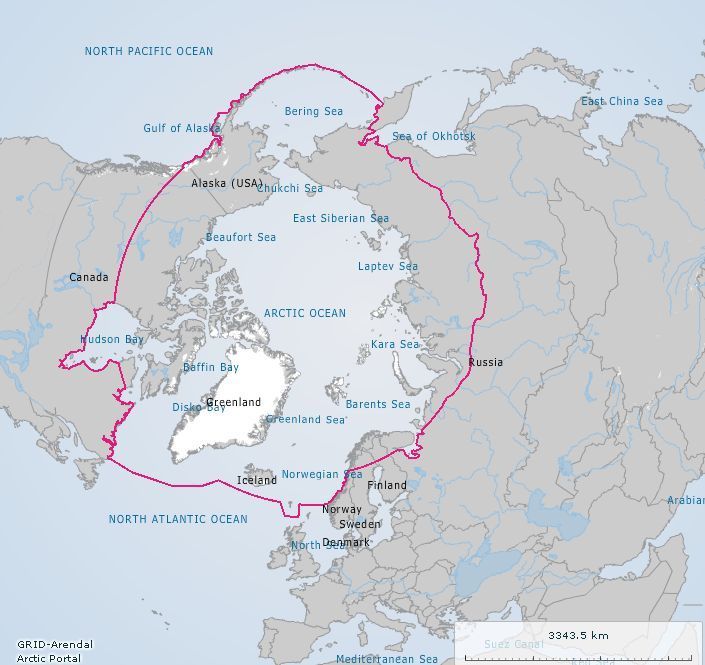
    The map on the right presents the current Arctic boundaries. Please, click here to access more Arctic – related interactive maps.

    Source

    The Moscow Times

  • Nordic Council of Ministers

    Nordic Council of Ministers

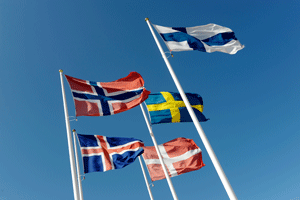
    Flags of Scandinavian countries

    The cornerstone of Nordic cooperation is the Nordic Council, which represents Denmark, Finland, Iceland, Norway, Sweden, the Faroe Islands, Greenland and Åland.

    The “Norden” consists of two separate but interoperable entities, The Nordic Council, an official inter-parliamentary body, and the Nordic Council of Ministers, a forum for Nordic inter-governmental cooperation. In addition to the Council and the Council of Ministers, there are more than 20 official Nordic institutions – and about the same number of unofficial ones. The Nordic Innovation Centre (NICe), NordForsk, Nordic Culture Point, Nordic Project Fund (NOPEF), the Nordic Centre for Welfare and Social Issues and the Nordic School of Public Health (NHV) are full Nordic institutions, as are the Nordic houses in Iceland and the Faroe Islands. One of the main institutions in the second category is the Nordic Investment Bank (NIB), which has been jointly owned by the five Nordic and three Baltic states since 2005. Another key organisation is the Nordic Cultural Fund, which supports culture in the Region as well as Nordic projects elsewhere in the world.

    Norden

    The Nordic Council is the official inter-parliamentary body. Formed in 1952, it has 87 elected members from Denmark, Finland, Iceland, Norway and Sweden, as well as the three autonomous territories (Greenland, the Faroe Islands and Åland). The members are all national MPs nominated by the party groups in their home parliaments. There are no direct elections to the Council. It is run by a Presidium and convenes for an annual autumn meeting called the Session, which passes recommendations to the national governments. The main priorities in the work of the Nordic Council are: climate, environment and energy; education and research; and welfare and culture.

    The cornerstone of the cooperation is The Helsinki Treaty, which regulates official cooperation between Denmark, Finland, Iceland, Norway and Sweden. It was signed on 23 March 1962 and came into force on 1 July 1962. The main objective of the treaty is to maintain and develop further co-operation between the Nordic countries in the legal, cultural, social and economic fields, as well as in those of transport and communications and environmental protection. In addition, the treaty establishes a foundation for joint positioning in matters of common interest which are dealt with by European and other international organisations and conferences.

    The Council of Ministers is the official inter-governmental body. The prime ministers have overall responsibility for its work. In practice, this responsibility is delegated to the ministers for Nordic cooperation and the Nordic Co-operation Committee, which co-ordinates the day-to-day work. Despite its name, the Council of Ministers, which was founded in 1971, consists of several councils. These councils meet a couple of times a year. At present, there are 11 of them.

    On of the areas of Nordic cooperation is the Arctic. The Nordic countries cooperate to improve the quality of life for the indigenous peoples in the northern areas and to promote social and cultural development for the Arctic people. Nordic cooperation also strives to protect the sensitive and characteristic Arctic nature, and to ensure sustainable use of the region’s resources, and protection of its biological diversity.

    An Advisory Expert Committee was established in conjunction with the adoption of the new Arctic Co-operation Programme in 2002. The Arctic Expert Committee is made up of Nordic members of the Arctic Council and representatives from the autonomous territories. In Nordic Council terms the Arctic Expert Committee will offer advice to the Ministers for Co-operation and the Nordic Co-operation Committee on matters relating to the Arctic.

    Following the increasing importance of the Arctic region in international politics, the Nordic Council will discuss the controversial question of a Nordic strategy for the Arctic Region in its meeting in Reykjavik, 21-23 March, 2012 . The meeting will also discuss oil extraction in the Arctic and recommendations for allocating responsibilities in the event of environmental incidents. A plenary session will be in the Icelandic parliament on Friday 23 March, 08:30-11:45 local time.

    Sources: Norden.org, Nordic Co-operation

  • Greenland seeks help to lift EU ban

    Greenland seeks help to lift EU ban

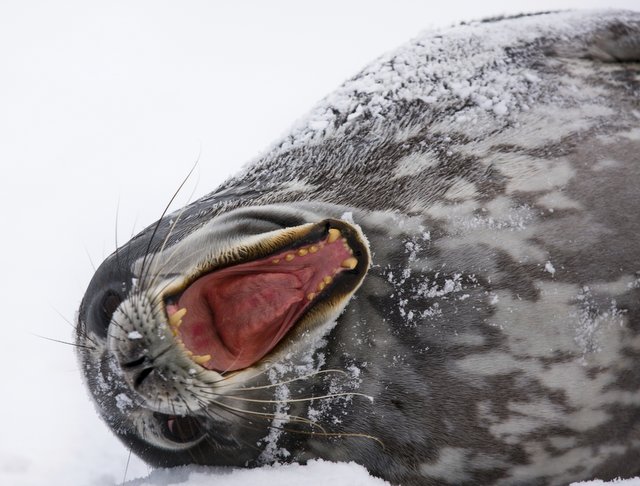
    Seal is yawning

    Greenlanders are counting on Denmark to raise the issue of EU ban on import seal products, due to a burgeoning seal population in the Arctic regions. Denmark has the presidency of the EU which it took over i the beginning of 2012.

    Politiken reports that the Greenland Fisheries and Hunters Organisation KNAPK is hoping that the important seal hunting will be lifted so the seal population will continue to grow normally, and fish stocks as well.

    “Hunting seal and sealskin production ensures employment throughout Greenland and in particular in the outlying regions. Seal hunting and skin production helps raise living standards and livelihoods for hunters in our country,” KNAPK Chairman Leif Fontaine told Sermitsiaq in Greenland.

    Fontaine says that the EU’s ban has wrecked the worldwide trade in indigenous seal products, but equally importantly is threatening both the seal population and fish stocks in the Arctic regions. “We are concerned that the import ban on seal products is harming the eco-systems in our waters,” Fontaine says, adding the increasing population of seals is a ‘ticking bomb’ under the Greenland fishing industry.

    “Greenland’s Nature Institute has documented that the 17.5 million seals in the North Atlantic at 16 million tonnes of fish and shellfish each year,” Fontaine says. “At the same time we are seeing emaciated seals across all of the Arctic and are concerned that the seals are dying of hunger,” he adds.

    Fontaine notes that Denmark is legally bound to secure the livelihoods of indigenous Greenland hunters.

    Sources

    Politiken

    Sermitsiaq

  • Danish oil and gas until 2050?

    Danish oil and gas until 2050?

    EEZ of the Arctic Ocean

    Denmark will be self-sufficient with oil and gas, at least until 2050. These new numbers are much higher then anticipated.

    This is the view of Peter Helmer Steen, director of the state oil company Nordsøenheden.

    The Danish Energy Organization had already predicted that Denmark would be self sufficient until 2020, so if true this news is fantastic for the energy conscious country.

    Steen states that with better technology this is possible and because new oil reserves are in Danish territory in the Arctic.

    Denmark has great belief for oil in the Greenlandic ocean, and other areas as well.

    Source: DRK

  • Denmark wants China near AC

    Denmark wants China near AC

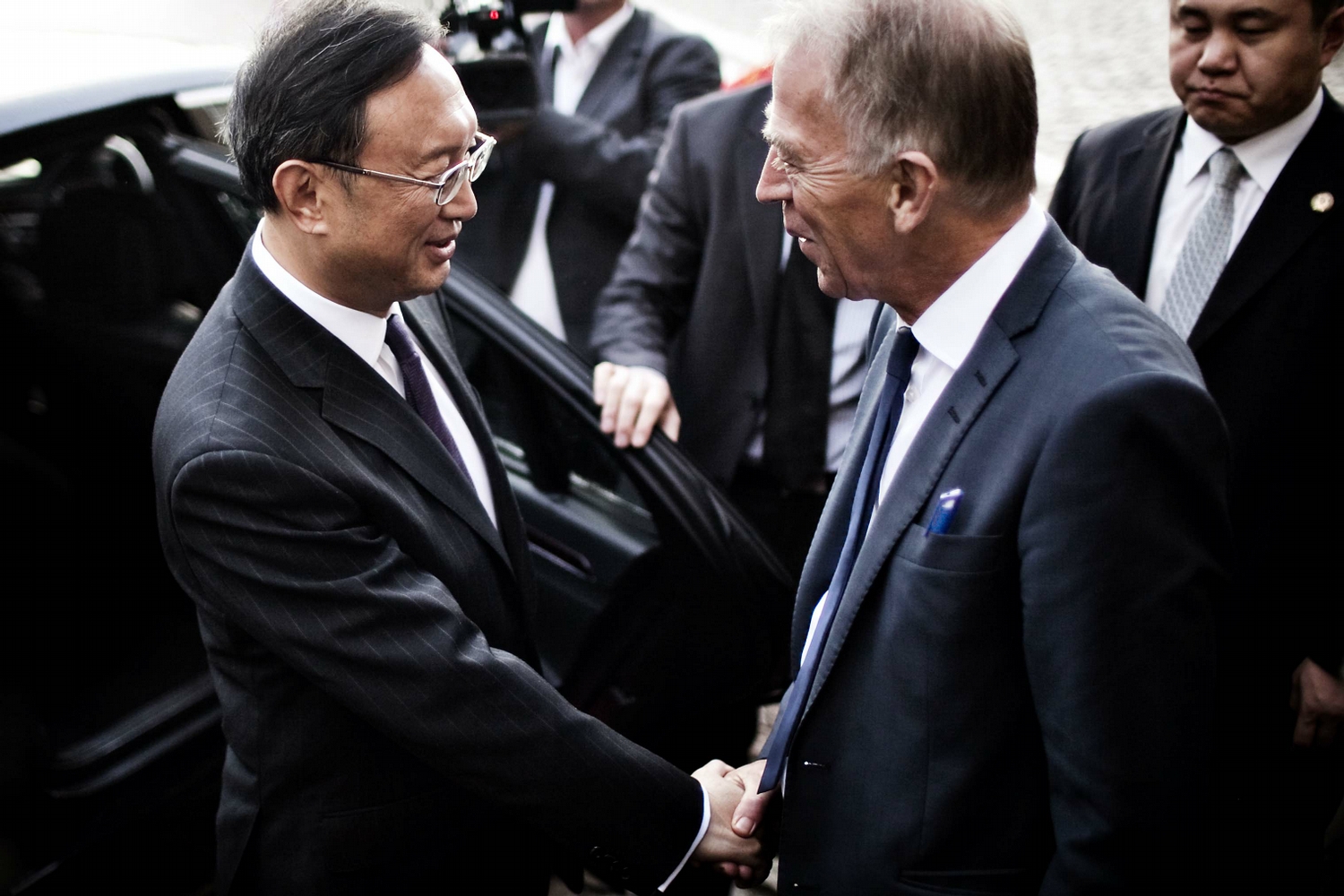
    Foreign Minister Yang Jiechi amd Villy Søvndal

    Denmark is looking to pave the way for China to the Arctic Council. Denmark wants China to become a permanent observer state in the organization.

    China has a temporary hearing to the Council today. Denmark stood down from its role as Chair at the ministerial meeting in Nuuk in May this year, and Sweden took over.

    “It is in the best interest for Denmark to help China to come closer to all the decision making in the Arctic,” Villy Søvndal, Minister of Foreign Affairs in Denmark said to Danish newspaper Berlinske Tidene.

    “It’s not only in the interest of Denmark, but the whole Council, that nations with great interest in the Arctic can follow what happens there,” he said.

    Denmark (including Faroe Islands and Greenland), Iceland, Finland, Sweden, Norway, Russia, Canada and USA are members of the Council.

    Six working groups of indigenous people have permanent participant status but Denmark wants China to be on par with permanent observer states. They are six and are France, Germany, The Netherlands, Poland, Spain and the United Kingdom.

    Søvndal says that China can’t be ignored because of the size and importance of the country.

    Søvndal also states that this will not lead to Denmark’s position weakening. “Definitely not, this is not a hug change, but an important one.”

    China has applied for the position which has not been given to the country, yet. Mixed feelings surround big players like China and the European Union getting the Permanent Observer status, especially amongst the indigenous people.

    Søvndal predecessor, Per Stig Møller, agrees with the Minister. “We are interested in that more countries understand the difficulties around the Arctic. It is positive that more countries want to observe the decisions made in the Council.”

    The decision will be made in the next ministerial meeting, in Sweden in 2013.

    Source: Berlinske Tidene

  • Four horse race?

    Four horse race?

    Map of the North Pole

    Denmark has confirmed it will make a claim for the North Pole. Four out of five states around the pole have the right to make these claims and Denmark is the last one in line to do so.

    The Commission on the Limits of the Continental Shelf (CLCS) oversees territorial claims in the Arctic.

    “The Kingdom has submitted documentation to the CLCS for claims relating to two areas near the Faroe Islands and by 2014 plans to submit documentation on three areas near Greenland, including an area north of Greenland which, among others, covers the North Pole,” read the Danish Arctic Policy, released last week.

    Upon ratification of the United Nations Convention on the Law of the Sea (UNCLOS), the countries have ten years to make their claims to an extended continental shelf. If these claims are confirmed by CLCS, the country will receive exclusive rights to resources on or below the seabed of that extended shelf area.

    That means alot can be at stake. Due to this, Norway (1996 ratification), Russia (1997), Canada (2003) and Denmark (2004) launched projects to provide a basis for seabed claims on extended continental shelves beyond their exclusive economic zones.

    Canada has not sent its claims, but Denmarks has or will research these areas to claim the North Pole (from 176.dk). has time until 2013 to do so.

    USA has signed but not ratified the contract. That means they cannot make any territorial claims unless they do so. All four states have now confirmed that claims will be sent (or will be in time), so the over used cliché about the Race to the North Pole is between four countries. That is unless USA ratifies UNCLOS, which it has hinted will happen with Hillarys Clinton words about making that her “priority”.

    Look at the Interactive Arctic Portal map to see the Exclusive Economic Zones in the Arctic. Light blue is a territory nobody can claim. Yet.

  • Denmark releases Arctic strategy

    Denmark releases Arctic strategy

    Researchers standing with the Danish flag

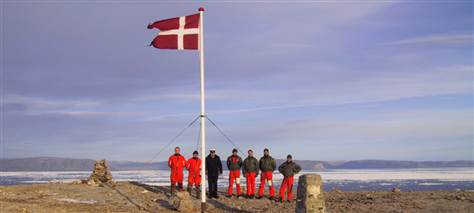
    Denmark has released its Arctic Strategy up to the year 2020. Denmark reins both in Greenland and the Faroe Islands and their interest are numerous in the Arctic.

    The Arctic strategy will make it possible for the three parts of the Kingdom to address the challenges in a coordinated way, the strategy report states.

    “The purpose of this strategy is to focus attention on the Kingdom’s strategic priorities for future development in the Arctic towards 2020. The aim is to strengthen the Kingdom’s status as global player in the Arctic.”

    Denmark aims to strengthen its position in Arctic matters, but underlines close cooperation with its neighbors and partners in the area.

  • When the ice disappears – Denmark as a major Arctic power

    When the ice disappears – Denmark as a major Arctic power

    nar_isen_forsvinder

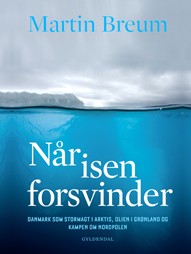
    “For the first time in human history a new sea opens before our feet and long time dreams of the old king of Denmark, Christian IV, comes true, long after his passage, where sailing through the north to China is possible”. This is mentioned in a book that Denmarks largest publishing house, Gyldendal, has recently published, “‘When the ice disappears – Denmark as a major Arctic power, the oil in Greenland and the fight over the North Pole”.

    The book is its first on Denmark’s modern involvement in the Arctic. It is a critical, investigative book by a journalist, who has followed the Arctic for some time. Interviewees for the book include Greenland premier Mr. Kuupik Kleist and former Danish minister of Foreign Affairs, Mr. Per Stig Møller. The book is aimed at the general public, and covers such topics as why Denmark took the lead in the process leading to the Ilulissat-declaration of 2008. It investigates the political reasoning behind Denmark’s expected claim to the seabed in the Arctic Ocean up past the North Pole, and it goes deep into the discussion in Greenland for and against oil. It finally examines Denmark’s approach to security in the high north and revisits some key historical pointers: The Norwegian claim to parts of East Greenland in 1931, the German Nazi endeavors in East Greenland during the Second World War and other threats to Danish sovereignty over Greenland.

    The author, Martin Breum, graduated from the Danish School of Journalism in 1982 and has since then been reporting from political conflicts from all over the world. In the later years a new focus on climate change has caught his interest. The book is in Danish only

    Further information and graphics

  • Sustainable Development Working Group meeting in Copenhagen

    Sustainable Development Working Group meeting in Copenhagen

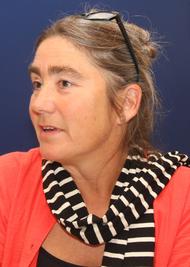
    The Arctic Council Sustainable Development Working Group has concluded it’s regular meeting in Copenhagen Denmark 10-11 Nov. The transaction being made between the Norwegian chairmanship between 2006-2009 and the Danish Chairmanship creates a perfect opportunity to give a general overview of the SDWG and cover some of the work that has been done under the Norwegian chairmanship. The Danish chairmanship will be led by Marianne Lykke Thomsen as head chair of the working group.

    Marianne Lykke Thomsen

    The Working Group on sustainable Development was established at the first Arctic council Ministerial meeting in september 1998 in Iqualuit, Nunavut, Canada. ” The objective of the SDWG is to protect and enhance the economies, culture and health of the inhabitants of the Arctic, in an environmentally sustainable manner. Currently the Sustainable Development Working Group is involved in projects in the areas of children and youth, health, telemedicine, resource management, cultural and ecological tourism, and living conditions in the Arctic.” It is clear that the SDWG has a very broad mandate as can be seen in both the Sustainable Development Terms of Reference (1998) as well as the Sustainable Development Framework Document (2000) that the SDWG has a very broad framework.

    Projects are not directly managed by the SDWG. Lead countries in each project report to the SDWG at regular meetings and other SDWG participants offer their comments. Each project has one or more lead countries as well as a project team of experts from participating Arctic states. The outcome of this work can bee seen by following the links below to current releases of the SDWG under the Norwegian chairmanship as well as a link to prior projects.

    Reports of SDWG Projects and Activities