Tag: Dreki area

  • Norway takes part in exploration in Iceland

    Norway takes part in exploration in Iceland

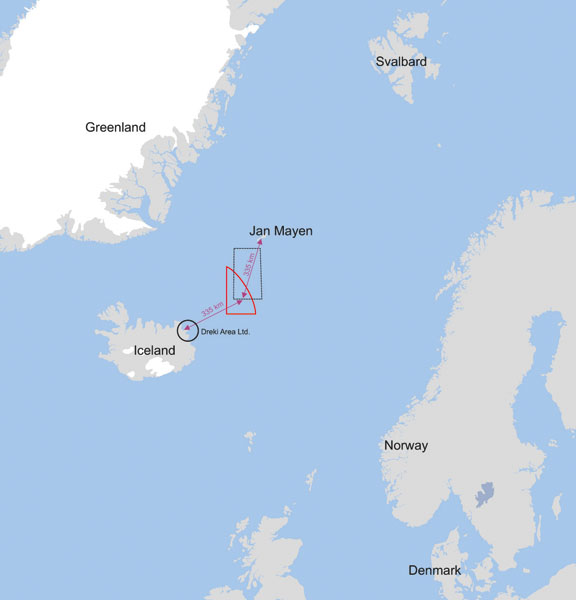
    The Dreki area on a map

    The National Energy Authority of Iceland (NEA) has today finished processing two applications for licences for exploration and production of hydrocarbons in the Dreki Area. The Ministry of Petroleum and Energy in Norway has today, 3 December 2012, notified NEA of their decision to participate in both licences to a 25 % share in accordance with the agreement between Iceland and Norway.

    NEA sought the opinions of the Ministry for the Environment and the Ministry of Fisheries and Agriculture in accordance with the hydrocarbons act and evaluated the opinions based on the applications and the work programmes involved.

    Furthermore, NEA made a careful evaluation of the technical and geological capacity of the applicants to handle the extensive activities associated with the licence. Finally, NEA studied the financial capacity of the parent companies of the applicants in order to ensure that the applicants have sufficient financial strength to conduct the activities for the long-term and can handle the corresponding environmental and safety elements.

    Following the processing of NEA of the applications

    Blue: Valiant Petroleum ehf. and Kolvetni ehf.  Red: Faroe Petroleum Norge AS, Branch in Iceland and Iceland Petroleum ehf.

    at the end of October, NEA made a decision to grant licences to Faroe Petroleum Norge AS, Branch in Iceland and Iceland Petroleum ehf., on the one hand, and Valiant Petroleum ehf. and Kolvetni ehf., on the other.

    Furthermore, the Norwegian authorities were notified of the decision, draft licences sent for their perusal and a formal answer requested on whether they intended to participate in the licences in accordance with the agreement between Iceland and Norway from 1981, which entails the right of Norway to participate in licences within the area of the agreement up to a 25 % share.

    The anticipated licensees have read the draft licences and submitted their comments, which NEA has taken into account as has been agreed by the parties involved. Norway has also participated in this process through the Ministry of Petroleum and Energy, i.e. gone through the draft licences and submitted comments to NEA.

    The Ministry of Petroleum and Energy in Norway has today, 3 December 2012, notified NEA of Norway’s decision to participate in both licences to a 25 % share in accordance with the agreement between Iceland and Norway.

    The licences cannot by issued before the Norwegian Parliament has approved the decision on the participation by the Kingdom of Norway through the State-owned oil company Petoro AS. Following this and the signing of the parties to the licences of their joint operating agreements, NEA will grant the licences, probably in the beginning of January of next year.

    A third application was received from Eykon Energy ehf. The processing of this application was delayed and the applicant given a respite until 1 May 2013 to find an additional participant in the licence that receives approval by NEA on having sufficient expertise, experience and capacity to undertake the licenced activities. NEA will take the application for final processing subsequent to receiving information on such a new participant in the application.

    Sources
    NEA

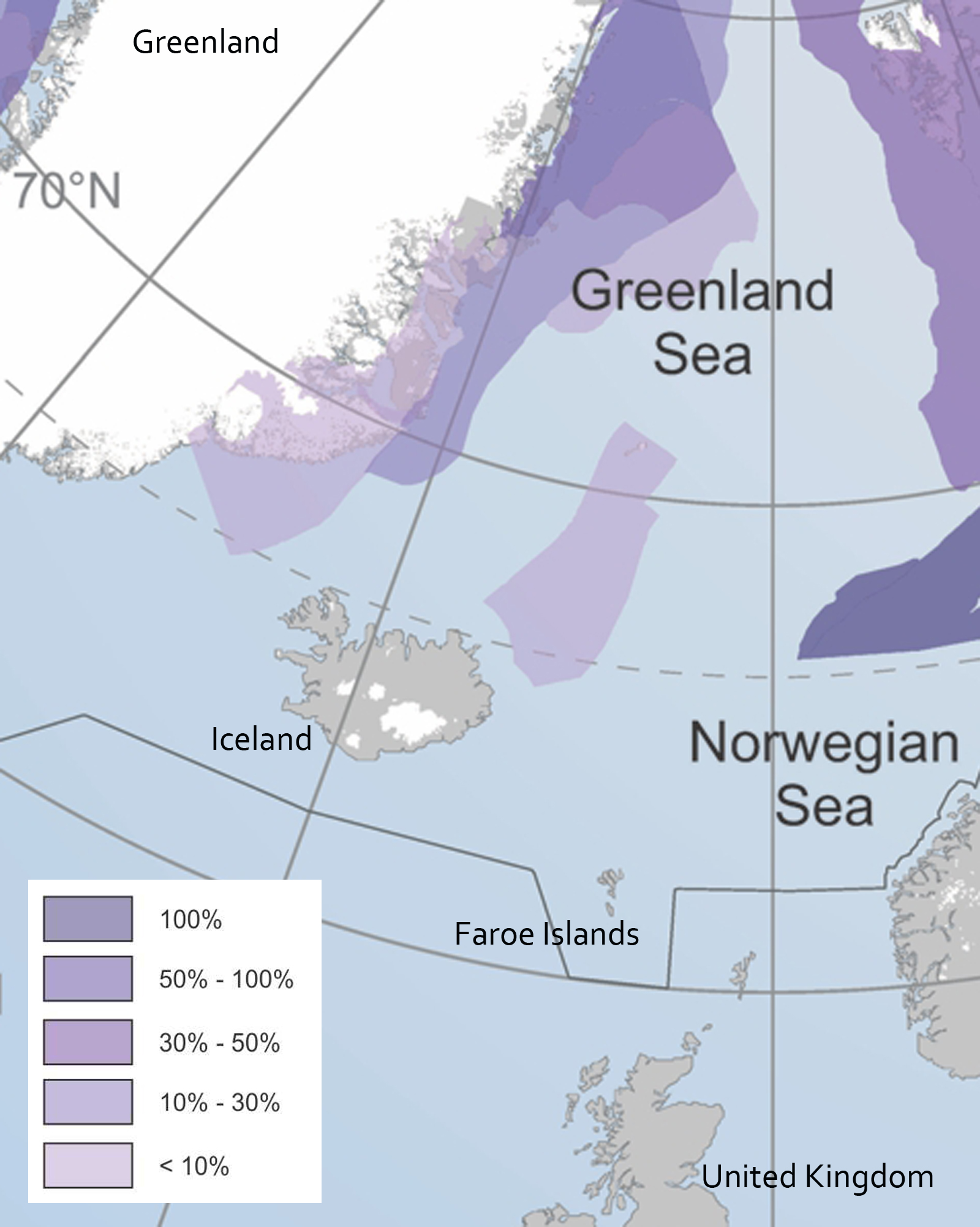
    Map of potential oil and gas areas

  • Three offers for the Dreki Area

    Three offers for the Dreki Area

    Map of the Dreki area

    Three offers were submitted for search of oil in the Dreki Area. Icelanders are part of them all.

    There are high hopes for the Dreki Area and all points to oil being in the Jan Mayen ridge. A part of the area is in Icelandic waters.
    The first invitation to bid in the search was three years ago. Two offers were submitted now. Icelanders are happy three offers were submitted midst in the crisis.
    The offers are from Eykon, an unregistered company in Iceland. It looks at the project as one for the future. “We have international sponsors with us but we are doing the ground work. These partners are experienced in searching for oil in similar circumstances as in Jan Mayen,” Heiðar Már Guðjónsson from Eykon said.

    The next offer is from Faroe Petroleum and Íslenskt Kolvetni ehf. Faroe is a 15 year old company based in Scotland, with a staff of 50. It explores the British, Norwegian and the Faroese waters.

    The last one is from Valiant Petroleum og Kolvetni ehf. “Valiant, and Faroe Petroleum, are big companies so this is very positive,” Gunnlaugur Jónsson from Kolvetni ehf. said.

    The chief of the National Energy Authority in Iceland was excited about the result. “These are three companies with knowledge in the area. This is a very good result and goes beyond our biggest expectations,” Jóhannesson said.

    The minister of energy in Iceland said that the best possible result of the oil search would that very high income would be a reality in Iceland, for a short time, in about 10 years’ time.
    The National Energy Authority will answer the bidders before the end of November.

    Source

  • New study confirms oil formations in Dreki

    New study confirms oil formations in Dreki

    Dreki area map

    Results from a new study show that oil can most certainly be found in the Dreki area. Two companies, TGS and Volcanic Basin Petroleum Research (VBPR) collected samples that confirmed this.

    High hopes have remained for a long time that oil could be found in the Dreki area. The map shows where it is; both Iceland and Norway have the rights for resources in the area.

    The two companies collected over 200kg of samples from a 1000m high rig underwater. The samples were taken from 12 areas.

    According to Icelander Kristinn Einarsson from the National Energy Authority in Iceland, says that this confirms that oil formation is a fact and this is the best result yet that oil can indeed be found in the area.

    “The samples are taken from rocks from the Jurassic period, 200-150 million year old rock formations,” Kristinn told RÚV.

    Prior to last summer no rocks older than 50 million years had been drilled or sampled in this area. Advanced geochemical analyses of the recovered sediments suggest active seepage of Jurassic oil and a working hydrocarbon system.

    A comprehensive project report is available for immediate delivery. The report is highly relevant for the current Icelandic Licensing Round but also for deep water exploration along the European and Greenlandic continental margins. For the report, see the energy authority website.

    Bidding for the search will open in April.

    Sources

    RÚV (Icelandic National Television)

    National Energy Authority in Iceland

  • High hopes for Dreki oil

    High hopes for Dreki oil

    Map of the Dreki area

    There are high hopes for oil in the Dreki Area, south of Jan Mayen and North of Iceland.

    Norway and Iceland are joint owners of the area and could potentially benefit both countries.

    New samples are impressive and could increase interest in the area. Although the samples are positive, they are confidential, and will only be given to those who will search in the area.

    Specialist from Norway met their colleagues from Iceland last week. These samples were on the agenda, and next explorations which will be conducted soon.

    Þórarinn Sveinn Arnarsson, project manager for the Icelandic Energy Administration, told RÚV that further exploration is mostly on the Norwegian side.

    “A new exploration will most likely go to the area next summer, but that will also depend on what else we find from the last survey, samples are still being researched,” he said.

    A report from the company that conducted the research will be ready next month.

    Bidding for the search will then open in April.

    Sources

    RÚV (Icelandic National Television)

  • Big hope for oil in Dreki Area

    Big hope for oil in Dreki Area

    Map of the dreki area

    New research strengthens the belief that there is oil in the seabed around Jan Mayen.

    Jan Mayen is a Norwegian archipelago north of Iceland. The Map shows the EEZ around Jan Mayen, which Norway is entitled to. However, the Dreki Area is also within Iceland’s jurisdiction so the country could benefit if oil is found.

    “The samples from the seabed around Jan Mayen is stunning, the oldest bedrocks are 260 million years old. The analysis of the material is surprising,” Sissel Eriksen, exploration director of Norwegian Petroleum Directorate told Geo365.no.

    “We had hoped, but not expected, to find so ancient sedimentary rocks around Jan Mayen. The influence of volcanic rocks in the area is less than we previously thought – volcanic rocks generally have no potential for oil and gas. But this means we have rocks that may contain material that forms the oil and gas. Two important prerequisites for potential petroleum deposits are thus met,” says Eriksen.

    The expedition was in July this year with agreement with Icelandic authorities. The samples were taken from both the Icelandic and Norwegian side of the Jan Mayen ridge.

    Environmental impact assessment will be next in line for the oil research in the Dreki area.

    Source: Geo365.on

  • Oil benefits for Iceland and Faroes

    Oil benefits for Iceland and Faroes

    Oil in the southern part of the Arctic

    In the southern part of the Arctic the dream of oil is still alive. Iceland is hoping to find oil in the Dreki area but the crisis hit country could benefit by other means.

    In the eastern part of Greenland lie vast resources of oil.

    Greenlands problem is the countries infrastructure. With scarce population, long distances and gruesome transport, Iceland could be the perfect partner in Greenlands oil adventure.

    The western part of Iceland could use a boost like an oil adventure. Icelandic oil from the Dreki area would also be sent to the Westfjords, if found.

    Greenland is hopeful that oil can be utilized around the year 2020.

    But near the Faroe Islands there is also some hope for oil. South of the Faroes, around the EEZ-lines of Faroes and the UK, utilizing of oil could start as soon as next year.

    With new technology British scientist have reduced the cost of oil utilization of around 30%, making the project feasible, and profitable for UK.

    This could mean the Faroes would get a slice of the oil cake, boosting the small nation’s economy significantly.

    Source: BBC

  • Dreki area exploration offers opened

    Dreki area exploration offers opened

    Dreki Area map

    The National Energy Authority of Iceland (NEA), has today, announced the second Licensing Round for hydrocarbon exploration and production licences on the Icelandic Continental Shelf. The offer will be open from October 3, 2011 until April 2, 2011.

    The blocks on offer in the Second Licensing Round are located in the Dreki Area, northeast of Iceland. The area covers 42,700 square kilometers. Water depths range mostly from 800-2000 meters, which is well within the reach of currently available and tested technology for undersea oil drilling.

    Seismic surveys and other geophysical measurements indicate that oil and gas could be found in the Dreki Area as they have been in adjacent and geologically similar areas. Further research, including exploratory drilling, is necessary to verify whether oil or gas exists in the Dreki Area.

    There will be stringent requirements on security and work safety as well as on environmental protection similar to the requirements in the neighbouring countries. Use of the best available technology will be demanded to reduce the environmental impact and risk of accidents and mishaps.

    A Strategic Environmental Assessment has been completed for the Dreki Area and considerable research has been done on the marine biosphere, climate and sea conditions in the area. There is no danger of sea ice under present climatic conditions and the wave heights are lower than off the west-coast of Norway. This research is important in evaluating the impact of oil exploration. No major obstacles were found to oil exploration.
    Source: NEA