The relationship between the physical effects of climate change and effects on the ecosystem is complex. It is impossible to tell what climate change will to do biological resources in the Arctic.
Many ideas have been set forward in the main consequences of climate change to the Arctic marine area.
This highlights some of these thoughts:
- Climate change is a much more rapid warming of the Arctic surface temperatures in comparison with the rest of the world. As a consequence, Arctic waters will warm more rapidly as well.
- Climate change will lead to substantial reductions of Arctic sea ice coverage and thickness.
- Reduced salinity due to influx of fresh water as a consequence of melting sea ice (which is essentially salt free) and glacial ice.
- Other oceanographic and meteorological changes (e.g. more storms and waves) in particular due to changes in air and water temperature and sea ice coverage.
- Increasing acidification of the world’s oceans due to increasing uptake of CO2 (which is not just relevant to the Arctic marine area).
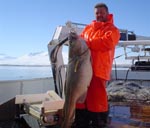
One general conclusion to what climate change will do is that “moderate warming will improve the conditions for some of the most important commercial fish stocks, as well as for aquaculture. This is most likely to be due to enhanced levels of primary and secondary production resulting from reduced sea-ice cover and more extensive habitat areas for subarctic species such as cod and herring. Global warming is also likely to induce an ecosystem regime shift in some areas, resulting in a very different species composition.”
The composition of Arctic marine ecosystems will undoubtedly change, both qualitatively and quantitatively. Some species will at some stage disappear and others (e.g. due to northward migration) will be added and the relative importance of species in abundance will change as well. These changes will of course be spatially and temporally differentiated. Where new fishing opportunities will occur (on the high seas or within coastal state maritime zones) and with respect to which species or categories of species (e.g. shared, anadromous, straddling or highly migratory) is also difficult to predict.
Similarly which states – Arctic Ocean coastal states or other states – will benefit or suffer and how subsistence fishing will be affected, among other things by competition with commercial fisheries. Finally, as reduced ice overage and thickness will also enable other human activities – most importantly shipping and offshore hydrocarbon activities – these activities may compete with fishing in a spatial sense or affect them by pollution and other impacts.
The impact of current and future Arctic fisheries on the marine environment and marine biodiversity in the Arctic is not likely to be fundamentally different from impacts to the marine environment and biodiversity in other parts of the globe. Arctic fisheries could lead to overexploitation of target species and a variety of impacts on non-target species, for instance on dependent species due to predator-prey relationships, on associated species due to by-catch and on benthic species due to bottom fishing techniques.

In view of the broad spatial scope of the Arctic marine area, such undesirable effects are without doubt already occurring, even though not necessarily on a very serious scale.
The effects of a temperature rise on the production by the stocks of fish and marine mammals presently inhabiting the area are more uncertain. These depend on how a temperature increase is accompanied by changes in ocean circulation patterns and thus plankton transport and production. In the past, recruitment to several fish stocks in the area, cod and herring in particular, has shown a positive correlation with increasing temperature.
This was due to higher survival rates of larvae and fry, which in turn resulted from increased food availability. Food is transported into the area via inflows of Atlantic water, which have also caused the ocean temperature to increase. Hence, high recruitment in fish is associated with higher water temperature but is not caused by the higher water temperature itself.
Provided that the fluctuations in Atlantic inflows to the area are maintained along with a general warming of the North Atlantic waters, it is likely that annual average recruitment of herring and cod will be at about the long-term average until around 2020 to 2030.This projection is also based on the assumption that harvest rates are kept at levels that maintain spawning stocks well above the level at which recruitment is impaired.
How production will change further into the future is impossible to guess, since the projected temperatures, particularly for some of the global models, are so high that species composition and thus
the interactions in the ecosystem may change completely.
Conclusion:
- Climate change will affect fisheries
- The extent is impossible to predict
- Already happening, but not on a serious scale
- Some species might dissapear and other might migrate to the Arctic
- The effect on marine mammals is unknown
Source: Arctic Transform & ACIA report