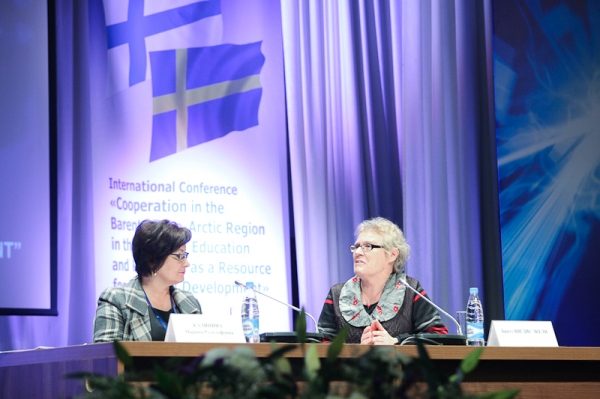
Leading researches and experts, politicians, representatives from business and authorities are attending the conference “Cooperation in the Barents Euro-Arctic Region in the field of education and research as a resource for regional development”.
The conference is held in the Northern (Arctic) Federal University (NArFU).
The conference yesterday started with the plenary session. Ingvild Broch, Coordinator External Review made a short overview of cooperation in the spheres of education and research in the BEAR and pointed out some future challenges. She touched upon some important historical facts of international cooperation between Russia and Scandinavian countries. Marina Kalinina, Vice-rector of International cooperation, NArFU spoke about “University as a Driving Force of Change” and named the priority goals of the Northern (Arctic) Federal University.
Harry Malinen, Senior expert of the University of Lapland and Lapland University Consortium (Finland) talked about the opportunities for the universities within EU framework. He paid special attention to existing international programs in the Barents region and EU relevant for those who work within research and education area. Anatoly Smirnov, the President of the National Institute for Research of Global Security finished the plenary session with his report about information technologies in the Barents region.
Later this day a new cooperation agreement was signed between NArFU and Finnmark College. Ingvar Hauge, the senior advisor of Finnmark University College and Elena Kudryashova, the Rector of NArFU signed the document that marks the beginning of a new stage in the history of collaboration between two universities. This agreement aims to develop partnership in educational and exchange programs as well as other important issues.
“Murmansk and Arkhangelsk universities are the most important partners for us in Russia. I would like to bring forward cooperation in the fields like language, tourism, economics, social works, management of natural resources. And the most important sight of this cooperation is perhaps student and academic exchange, what I think we can bring forward,” Ingvar Hauge commented.
After a short coffee break the participants of the conference went on parallel sessions that focused on different issues of Barents region cooperation and its connections to cooperation with business and industry, challenges in education, and carrier paths in BEAR for youth.
Consul General of Sweden in St.Petersburg Mr. Jan Nyberg, visited NArFU in the framework of the conference this day as well. During a working meeting with Elena Kydryashova and Marina Kalinina he discussed the issues of cooperation between Russian and Swedish universities. Jan Nyberg also had an excursion around the campus and had a meeting with the students and lecturers from the Institute of Philology and Cross-Cultural Communication, who study Swedish language.
During closing plenary session the participants had a possibility to sum-up the result of intensive sessions’ work and to share their findings and proposals for the new Kirkenes Declaration.
Source

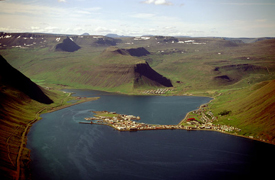 The University Centre acts as a contact between Westfjords residents and institutions of higher education. The most important aspect of this work is the University Centre’s function as the West Fjord’s distance-learning institute. Seven universities in Iceland offer distance learning courses and distance learning instruction takes place at the Centre, variously through the Internet or with the help of remote conference technology.
 The University Centre of the Westfjords offers exciting continuing education opportunities in the field of environmental and resource management, in connection with its cross-disciplinary program in Coastal and Marine Management.