Tag: European Union

  • Excitement about EU Arctic Information Centre

    Excitement about EU Arctic Information Centre

    Director of the Arctic Centre Paula Kankaanpää, Lady Catherine Ashton, Minister for Foreign Affairs Erkki Tuomioja and Ambassador Hannu Halinen.

    The EU Arctic Information Centre will bring the Arctic closer to the European Union, and vice versa. Catherine Ashton, High Representative of the Union for Foreign Affairs and Security Policy and Vice President of the Commission, visited Rovaniemi and the Arctic Centre of the University of Lapland in Finland last week.

    She travelled together with Erkki Tuomioja, Finnish Minister for Foreign Affairs. They attended an invitation seminar at the Arctic Centre discussing the plan to establish the EU Arctic Information Centre as a network of institutions, with a hub in Rovaniemi.

    The EU Arctic Information Centre has been proposed by a group of leading Arctic research institutions. It will be a network model with nodes by expert institutions in Europe and a hub in the Arctic region of EU.

    The idea in this proposal is to organize European cooperation to inform and communicate about the Arctic, its environment, communities, cultures and peoples through the Information Centre. The new Centre will also offer requested information material to the experts, decision makers and the general public on arctic issues.

    The proposal follows the Arctic statements of the European Union (Commission 2008 and the Council 2009) that have high importance for sustainable development of the Arctic regions.

    Ms. Ashton and Mr. Tuomioja were very positive in the meeting. Ashton noted that “this is a very important place because it’s also the birth place of both the Northern dimension and the Arctic Council. And I will be completely upfront in saying I can think of nowhere better for the Arctic Information Centre to be but here.”

    The proposed Centre would have numerous positive effects and Ashton was positive it could be established in the near future. And minister Tuomioja noted that it just needed a final decision.

    “EU is preparing to establish an Arctic Information Centre in Rovaniemi. To reach that a decision prepared according to the Commission rules is still required. In Rovaniemi there was a confident mood that the decision will be ready soon and the comments given by Ashton did not weaken this confidence, to say the least”, wrote minister Tuomioja in his blog after the visit.

    Ashton also talked with the leaders of Sami parliaments of Finland, Norway and Sweden. She continued her Arctic trip to Kiruna (Sweden), Tromsö (Norway) and Svalbard.

    Sources
    Tha Arctic Centre

  • EU in the Arctic

    EU in the Arctic

    EFS - Ericon Aurora Borealis

    Arctic has for a long time interested expeditioners and many journeys have been initiated throughout the past one and a half century. For a long time, very few expeditioners made it through the harsh conditions, but due to the climate change it has started to look like that trans-Arctic shipping is becoming a possibility both for researchers and transportation.

    Since the end of the cold war, there has been done immense amount of research in the Arctic and the Arctic Council has been created arounf the environmental sphere of the area. In recent years, the political situation also has again become an issue and quite a few new Arctic policies have been initiated both by Arctic and non-Arctic states.

    The European Union physical connection to the Arctic is through northern Finland and Northern Sweden, but politically it cooperates with various Arctic countries through the EEA or as a neighbour and business associate.

    Both the EU Commission and the Parliament have recently initiated an Arctic communication, where they aim at preventing and mitigating the negative impacts of climate change as well as supporting adaptation to inevitable changes. Further the commision will commit to implement already existing obligations, rather than propose new legal instruments for the area.

    Here following, the EU‘s role and activities in the Arctic will be discussed and links provided to the relevant sections in the EU web portal.

    Historical perspective to the European Union in the Arctic

    Northern Dimension

    The first real EU policy initiative in the peripheral north was the Northern Dimension, which is a cooperation program of European Union, the Russian Federation, Norway and Iceland to support sustainable development, stability, welfare and security in the northern parts of Europe. It was initiated in 1999 and covers various subjects, such as energy, transportation, the environment, nuclear safety, justice and home affairs, the fight against organised crime, health care, the promotion of trade and investment, cross-border cooperation, information technology and research. In addition to the EU and state partners the Council of the Baltic Sea States (CBSS), the Barents Euro-Arctic Council (BEAC), the Arctic Council (AC), the Nordic Council of Ministers (NCM) and various international financial institutions, such as the European Bank for Reconstruction and Development (EBRD), the European Investment Bank (EIB) and the Nordic Investment Bank (NIB) and NGOs, trade unions etc. participate as observers.

    The Northern Dimension ran from 1999 til 2006 until a new Northern Dimension policy was launched jointly by the leaders of the EU, Russia, Norway and Iceland at a meeting in Helsinki in November 2006. The new Northern Dimension provides a joint framework for addressing the challenges of Northern Europe, especially its fragile environment and the socio-economic problems facing its inhabitants. It will further reflect the EU/Russia Common Spaces as relevant for this region.

    ERICON AURORA BOREALIS (European Research Ice Breaker Consortium)

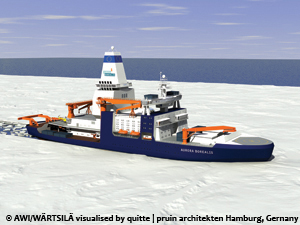
    Another EU initiative in the polar regions is the ERICON AURORA BOREALIS ice breaker initiative, which is a hypermodern research vessel designed to handle the cool summers and freezing winters of the polar oceans and to drill deep into the sea floor.

    The AURORA BOREALIS will be the most advanced research vessel in the world; a platform with state-of-the-art technology for polar science. With its all-season capability it will provide a tool for tackling major scientific challenges, which has not been possible before. It will be a real floating European university in polar sciences.

    The project was initiated in Alfred Wegener Institute for Marine and Polar Research (AWI) in the Helmholtz Association, Germany in 2004. Funded by the German government, it detailed the engineering work for the vessel’s construction and resulted in a complete technical design in mid-2009.

    The project started a new phase in March 2008s, when the ship’s development generating the strategic, legal, financial and organisational frameworks for the construction and running of AURORA BOREALIS was initiated. Apart from the necessary administrative structures for joint European ownership and operations of the vessel, a common scientific managing body has to be set up to handle large-scale, multi-year, mission specific research programmes. The final aim of the project is to reach an agreement with European countries and European Commission committing to the construction and operation of the vessel.


    Contemporary Developments

    Policy Issues in Arctic relevant sectors


    Scientific Issues

    European Science Foundation


    European Polar Board


    • EPB – news
    • European Polar Summit
    • Polar Alert
    • EuroPICS
    • EuroANDRILL
    • EPB Publications