Tag: fisheries

  • Climate change and Fisheries

    Dried fish, traditional produce in Lofoten, Norway

    The relationship between the physical effects of climate change and effects on the ecosystem is complex. It is impossible to tell what climate change will to do biological resources in the Arctic.

    Many ideas have been set forward in the main consequences of climate change to the Arctic marine area.

    This highlights some of these thoughts:

    1. Climate change is a much more rapid warming of the Arctic surface temperatures in comparison with the rest of the world. As a consequence, Arctic waters will warm more rapidly as well.
    2. Climate change will lead to substantial reductions of Arctic sea ice coverage and thickness.
    3. Reduced salinity due to influx of fresh water as a consequence of melting sea ice (which is essentially salt free) and glacial ice.
    4. Other oceanographic and meteorological  changes (e.g. more storms and waves) in particular due to changes in air and water temperature and sea ice coverage.
    5. Increasing acidification of the world’s oceans due to increasing uptake of CO2 (which is not just relevant to the Arctic marine area).

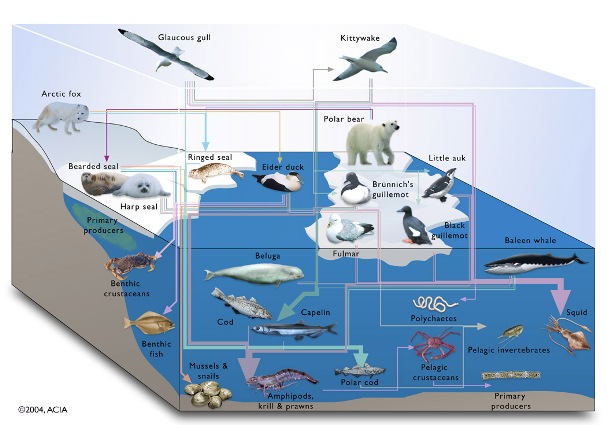
    One general conclusion to what climate change will do is that “moderate warming will improve the conditions for some of the most important commercial fish stocks, as well as for aquaculture. This is most likely to be due to enhanced levels of primary and secondary production resulting from reduced sea-ice cover and more extensive habitat areas for subarctic species such as cod and herring. Global warming is also likely to induce an ecosystem regime shift in some areas, resulting in a very different species composition.”

    The composition of Arctic marine ecosystems will undoubtedly change, both qualitatively and quantitatively. Some species will at some stage disappear and others (e.g. due to northward migration) will be added and the relative importance of species in abundance will change as well. These changes will of course be spatially and temporally differentiated. Where new fishing opportunities will occur (on the high seas or within coastal state maritime zones) and with respect to which species or categories of species (e.g. shared, anadromous, straddling or highly migratory) is also difficult to predict.

    Similarly which states – Arctic Ocean coastal states or other states – will benefit or suffer and how subsistence fishing will be affected, among other things by competition with commercial fisheries. Finally, as reduced ice overage and thickness will also enable other human activities – most importantly shipping and offshore hydrocarbon activities – these activities may compete with fishing in a spatial sense or affect them by pollution and other impacts.
    The impact of current and future Arctic fisheries on the marine environment and marine biodiversity in the Arctic is not likely to be fundamentally different from impacts to the marine environment and biodiversity in other parts of the globe. Arctic fisheries could lead to overexploitation of target species and a variety of impacts on non-target species, for instance on dependent species due to predator-prey relationships, on associated species due to by-catch and on benthic species due to bottom fishing techniques.

    Fishing nets

    In view of the broad spatial scope of the Arctic marine area, such undesirable effects are without doubt already occurring, even though not necessarily on a very serious scale.

    The effects of a temperature rise on the production by the stocks of fish and marine mammals presently inhabiting the area are more uncertain. These depend on how a temperature increase is accompanied by changes in ocean circulation patterns and thus plankton transport and production. In the past, recruitment to several fish stocks in the area, cod and herring in particular, has shown a positive correlation with increasing temperature.

    This was due to higher survival rates of larvae and fry, which in turn resulted from increased food availability. Food is transported into the area via inflows of Atlantic water, which have also caused the ocean temperature to increase. Hence, high recruitment in fish is associated with higher water temperature but is not caused by the higher water temperature itself.

    Provided that the fluctuations in Atlantic inflows to the area are maintained along with a general warming of the North Atlantic waters, it is likely that annual average recruitment of herring and cod will be at about the long-term average until around 2020 to 2030.This projection is also based on the assumption that harvest rates are kept at levels that maintain spawning stocks well above the level at which recruitment is impaired.
    How production will change further into the future is impossible to guess, since the projected temperatures, particularly for some of the global models, are so high that species composition and thus

    the interactions in the ecosystem may change completely.

    Conclusion:

    • Climate change will affect fisheries
    • The extent is impossible to predict
    • Already happening, but not on a serious scale
    • Some species might dissapear and other might migrate to the Arctic
    • The effect on marine mammals is unknown

    Source: Arctic Transform & ACIA report

  • Atlantic Ocean species Catch

    Species in the western Atlantic Ocean

    Five species fill up just over 50 percent of the fisheries in the northwest Atlantic Ocean.

    The Northern prawn is the biggest factor, counting for 17% of the total catch.

    The American sea scallop is the sexond biggest factor, 14% and the Atlantic herring is at 11%. The Atlantic menhaden is at 10%.

    The picture on the rights shows the number for 2008.

    In the northeast Atlantic Ocean, which stretches around Europe, the Atlantic herring is by far the biggest factor. It counts for almost 30% of the total catch.

    The blue whiting, is also popular, at 16% and the Atlantic cod is only at 9%.

    Catch by species in the northeast

    Herring is the biggest factor in the northeastern part. Along with blue whitting and the cod they count up for 50% of the total catch.

    Six other species fill up approximately 25% of the total catch, the Atlantic mackerel, European sprat, aithe (Pollock), Sandeels (Sandlances), Haddock and Capelin.

    Others are numerous but count for much less.

    The Atlantic herring is important both in the east and the west, but other species are not as connected between the two sides.

  • Value of fisheries

    Fish export value by countries

    Fishing is the most important economy in Greenland, and a huge factor in Iceland.

    Although the numbers might not be as big in value as in Canada and Russia for example, fishing in Greenland counts for a total of 94% of the countries economy. Shrimps are 63% of that number.

    Comparison between the numbers in tons can bee seen here.

    Iceland exports fish in large style, but aluminum is another big export value.

    Other Arctic countries are all around 1% of fisheries regarding export value.

    In USA the number is around half a percent, but closer to 1.5 in Russia.

    The picture on the right shows the importance of fishing in the Arctic, where Greenland and Iceland stand out.

  • Economical opportunities

    Economical opportunities

    Arctic Portal news

    Northward shift of species might also have great economical opportunities for those countries and areas that are dependable on fisheries.

    A northward shift of species might bring in more economically valuable species into the area from the south and therefore benefit the local fisheries.

    Some shift in fisheries technologies will be needed, but that poses not a great threat, for human adaption is very flexible.

    A southern ward specie such as the Atlantic Mackerel has been shifting northwards due to warming waters.

    This has caused economical opportunities for countries such as Iceland and the Faroe Islands.

    The Atlantic Mackerel is valuable specie and could come as economical substitute specie for capelin, however the role of the Mackerel in the food web of the Arctic and the Sub Arctic is not known.

    Due to its size, it is not dependable food source for other species such as the Cod or the Pollock. Also, signs lead to that the Mackerel eats spawns, fingerlings and other small fishes, such as small herring and capelin.

    Therefore the Mackerel might be in direct competition with currents species for nutrition.

    It is however unknown if climate change will support growth of other smaller species that might come in substitution for current nutrition for higher species like Cod or Pollock

  • The Northward Shift

    fishing hole in the ice

    Climate change poses both threats and opportunities for Arctic fisheries. Those concerns include indicators of a major ecosystem northward shift, meaning that species will shift northwards in order to find ideal habitat conditions.

    Such shift has ambiguous effects, especially in economical terms, meaning that traditional species that are harvested might leave traditional waters, moving from one Exclusive Economic Zone to another and or into unfishable waters

    Some will lose their ideal habitat, since a northward shift is not infinite and species that are weaker to adjustment will lose in the competition for their ideal habitat. That poses a threat to the traditional commercial fisheries for countries and areas that are economical dependable of traditional fisheries of such species.

    Marine Food Web

    As an example, a northward shift of coldwater specie like capelin might have enormous affect to the biodiversity in the Arctic. Capelin feeds mainly from zoo plankton and is an important food source for many valuable benthic and pelagic species, such as Atlantic cod and Pollock.

    A northward shift of the capelin, due to warmer waters, might therefore affect other stocks significantly, even though warmer waters do not affect those species directly. The basis for growth of the Atlantic cod is capelin and without such important food source the cod needs to find substitute specie, like shrimp (which is also coldwater specie that is moving further north), herring, spawns, fingerlings or other smaller species.

    Species in the higher levels of the Arctic food web need to adapt by finding other food sources or simply move along with the current food source. One direct effect of climate change to one specie might
    therefore affect indirectly too many other species that depend on that species.

  • Icelandic Fisheries Portal

    Icelandic Fisheries Portal

    Icelandic Fisheries Portal

    The Feature of the week is the newly opened Icelandic Fisheries Portal. The Portal is a project worked jointly by the Ministry of Fisheries and Agriculture in Iceland, Directorate of Fisheries, Icelandic Marine Research Institute, University of Akureyri and Matís – Icelandic Food Research.

    General Information

    fishermanThe Icelandic fisheries portal is a gateway to information on the marine ecosystem around Iceland and on Icelandic fisheries. On the Fisheries Portal, you will be able to find information on everything from the ecosystem to the economy.

    The objective of the new and improved Icelandic fisheries portal is to provide easy access to reliable information on the ecosystem and ocean environment around Iceland, on sustainable utilization of the country’s resources, and on the nutrients and healthiness of seafood in general. Statistical information is also available on fisheries and on the importance of utilizing marine resources for the Icelandic economy. All the information is in English.

    The portal is intended to serve as a comprehensive information source for experts and laymen, wanting information on Iceland’s offshore waters and their utilization, as well as on Icelandic fisheries. This could include, for instance, buyers and marketers of Icelandic seafood’s, students both in Iceland and abroad, fisheries professionals and experts as well as environmental groups and the general public.

    Contents of the Fisheries Portal

    The database will include information on the marine ecosystem, its resources and the principal marine products, markets and resource management. Historical overview is also provided along with general information about Iceland, such as geography, the society, infrastructure and politics. As such, the database, will serve as a sort of information display window for fisheries and related issues in Iceland for use by corporations, journalists, scientists, students and the public. The portal will contain general textual information, simple graphs and illustration, as well as more detailed data of use to scientists, for instance

    small harbour

    The URL of the website, operated by the Ministry of Fisheries and Agriculture in Iceland, is http://fisheries.is/