Tag: gas

  • Putin urges Shtokman decision

    Putin urges Shtokman decision

    Oil tanker

    Russian president Vladimir Putin urges oil companies to make their final decision on the Shtkoman gas project. The Shtokman area is one of the riches gas wells in the world.

    Putin met with Statoil´s CEO, Helge Lund, on Friday, but Gazprom (owned by the Russian government) is the leading player in the field. Statoil (owned by the Norwegian government) holds a 24 percent share of the Shtokman Development AG, the joint venture responsible for the project. Gazprom holds 51 percent, while Total (from France) holds 25 percent.

    This ownership could change in the nearest future.

    “You have a very good and big project with Gazprom” Putin said to Lund. “The huge production assets of Shtokman have global significance and we have to make active progress,” Putin said, according to the Barents Observer.

    Statoil could exit from the project and discussions with Gazprom are taking place. Speculations surrounding Shell to take over from Statoil have emerged.

    Reports say that Gazprom wants to get rid of Statoil, due to conflicting views on the project development model.

    Statoil has officially supported Gazprom’s intention to skip the project’s pipeline part and instead develop Shtokman as a 100 percent LNG project.

    Statoil has long stressed that project development costs need to be reduced and that tax breaks must be introduced. The development costs for the project’s first phase have reportedly grown to about $30 billion, up from the originally planned $20 billion.

    Statoil has invested around $1.5 billion in the Shtkoman project, which it could lose if pulling out.

    Source
    Barents Observer

  • Danish oil and gas until 2050?

    Danish oil and gas until 2050?

    EEZ of the Arctic Ocean

    Denmark will be self-sufficient with oil and gas, at least until 2050. These new numbers are much higher then anticipated.

    This is the view of Peter Helmer Steen, director of the state oil company Nordsøenheden.

    The Danish Energy Organization had already predicted that Denmark would be self sufficient until 2020, so if true this news is fantastic for the energy conscious country.

    Steen states that with better technology this is possible and because new oil reserves are in Danish territory in the Arctic.

    Denmark has great belief for oil in the Greenlandic ocean, and other areas as well.

    Source: DRK

  • Arctic Energy

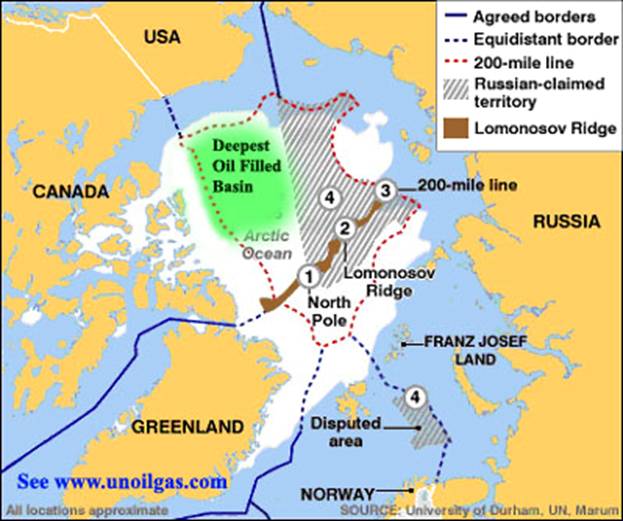
    In the recent years, the world’s attention has turned to the Arctic, not least because of its vast energy resources. Due to the climate change and its significant impact to the Arctic environment resources that have long been unreachable are becoming feasible for exploitation. It is estimated that up to fifth of the world’s undiscovered petroleum resources are to be found in the Arctic while the Arctic’s share of the worlds known resources today is around 12%.

    Russia is by far the most important gas producer in the Arctic. Almost all proven Arctic gas reserves are located in Northern Russia as well as 90% of the proven oil reserves. Together produce Northern Russia and Alaska 97% of the total Arctic oil and gas the Arctic’s total global share of production being around 16%. Furthermore, Russia is considered to contain by far the largest volume of the undiscovered petroleum reserves. Other significant regions where petroleum is to be found are Alaska and the Norwegian Sea, which will in future introduce new oil producing states within the Arctic, namely Greenland and Iceland.

    In the face of the petroleum race in the Arctic, some concerns have been raised about the very fragile Arctic environment. In addition to the actual drilling, transportation of the petroleum will impose the Arctic environment to a severe threat in case of an oil spill or shipwreck.

    Even though the conventional petroleum industry is still today dominant in the Arctic, some renewable energy developments are also taken place in the Arctic. The renewable energy sector is however still quite small compared to the conventional one, but can be expected to grow in the future.

    The newly published  Arctic Energy Portal aims at providing a comprehensive information gateway to the Arctic energy projects, new developments and controversies concerning the resource exploitation. At present, the Portal will concentrate mostly on oil and gas, but as new projects and developments take place in renewable energy sector the Portal will broaden its scope of information and cover renewable sector as well.