Tag: Greenland

  • Western Greenlands melts fast

    Greenland heat map

    The melting of the Greenlandic glacier is rapid. The record of 2010 was not broken this year, yet it was over the long term average melt.

    The National Oceanic and Athmospheric Administration (NOAA) has compiled the melting days in an image which shows where the melting occurs.

    Melting was exceptionally high over the western mid-elevations, and the map shows the area swathed in orange.

    In some places, the melt season lasted up to 30 days longer than average (the top of the scale corresponds to anomalies 25 days or more), and it affected 31 percent of the ice sheet surface, making 2011 one of just three years since 1979 where melt area exceeded 30 percent.

    According to the Arctic Report Card, ice mass loss from Greenland in 2011 was about 430 gigatons, enough ice to raise global sea level by just over 1 millimeter.

    Source: NOAA

  • Greenland rises after melt

    Greenland rises after melt

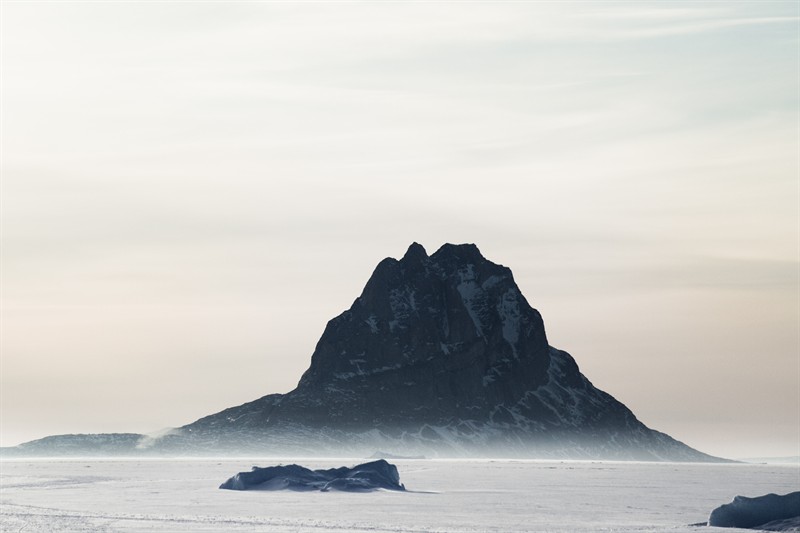
    Foggy peak in Uummannaq, Greenland

    Greenland is rising from the sea. A new study released on Friday shows a startling revelation to scientists who study global warming.

    Scientist from Ohio State University used a network of high profile GPS stations to measure the uplift. The results show that the rate of ice loss has accelerated in southern Greenland by 100 billion tons.

    Michael Bevis led the exploration. “Pulses of extra melting and uplift imply that we’ll experience pulses of extra sea level rise,” he said about the results.

    This means the sea has risen and splashed further, and with more power, on the ice which then melts faster. He states that this is partly due to global warming.

    Previous studies have recorded measurements indicating that as that ice melted away, the bedrock beneath it rose. In some places the land rose 5cm in only 5 months. The medium rise was 0.5 cm.

    Source: The State Column

  • Value of fisheries

    Fish export value by countries

    Fishing is the most important economy in Greenland, and a huge factor in Iceland.

    Although the numbers might not be as big in value as in Canada and Russia for example, fishing in Greenland counts for a total of 94% of the countries economy. Shrimps are 63% of that number.

    Comparison between the numbers in tons can bee seen here.

    Iceland exports fish in large style, but aluminum is another big export value.

    Other Arctic countries are all around 1% of fisheries regarding export value.

    In USA the number is around half a percent, but closer to 1.5 in Russia.

    The picture on the right shows the importance of fishing in the Arctic, where Greenland and Iceland stand out.

  • Rock and roll satellite

    Rock and roll satellite

    ice saltellite

    ESA’s ice satellite is collecting data in the two poles, and the project is going well. The satellite is to give precise measurements of the vast ice sheets that blanket Greenland and Antarctica.

    Since its launch 18 months ago, CryoSat-2 has been collecting data to improve our understanding of the relationship between ice and climate, according to ESA website.

    For the first time a map of the Arctic sea-ice thickness was released, by ESA. The ice-satellite is to thank for that map and it is still colleting data.

    To ensure the precision of the measurements, an operation is under way to roll the satellite from side to side as it flies over the flat oceans. This maneuver is to calibrate CryoSat’s radar altimeter for measuring ice thickness, especially over the margins of ice sheets.

    The altimeter has two antennas mounted on a bench about a meter apart. When it is working in the ‘SARIn’ mode, both antennas are used in parallel: one emits a signal and both receive the signals that bounce back.  

    Normally, this bench is parallel to Earth’s surface. But at the edges of the ice sheets, the ice surface is not always flat and the slopes affect the return signals.

    Harsh conditions in space – with huge temperature differences between Sun and shade – can lead to the deterioration of CryoSat’s instruments, which can also lead to measurement errors.

    ice satellite

    In order to quantify these errors, ESA ground controllers are working to recalibrate the altimeter.

    They are rolling the satellite to simulate the ice slopes and holding it in this position for several minutes. This must be done while CryoSat is over large, flat surfaces. For satellite altimeters, oceans are Earth’s largest flat surfaces.

    It will also check whether errors are related to CryoSat’s varying thermal conditions – like when exposed to the Sun or in the shade.

    “With the results from the different sets of rolls over different ocean surfaces and at different ambient conditions, we are aiming to characterize the instrument to a precision better than we thought we could make at the time of the launch,” said Tommaso Parrinello, CryoSat mission manager.

    During several maneuvers on Monday and Tuesday, the satellite is rolling 0.4º to both sides while over the Indian and Pacific oceans, before returning to its original position.

    “The preparations for the roll activities have been quite challenging,” explained Nic Mardle, spacecraft operations manager.

    “Although we had experience of these activities from the commissioning phase, we had to iterate a few more times with the planning and mission control teams so that we could support exactly what was required.”

    Satellites have already shown that the extent of sea ice in the Arctic is diminishing. In fact, this year’s minimum has set a new record low.

  • Denmark releases Arctic strategy

    Denmark releases Arctic strategy

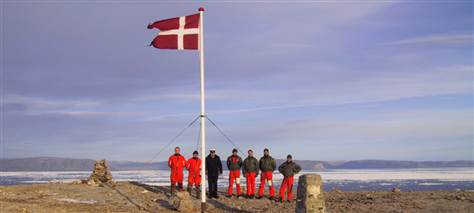
    Researchers standing with the Danish flag

    Denmark has released its Arctic Strategy up to the year 2020. Denmark reins both in Greenland and the Faroe Islands and their interest are numerous in the Arctic.

    The Arctic strategy will make it possible for the three parts of the Kingdom to address the challenges in a coordinated way, the strategy report states.

    “The purpose of this strategy is to focus attention on the Kingdom’s strategic priorities for future development in the Arctic towards 2020. The aim is to strengthen the Kingdom’s status as global player in the Arctic.”

    Denmark aims to strengthen its position in Arctic matters, but underlines close cooperation with its neighbors and partners in the area.

  • Greenpeace activists cling to Arctic drill rig

    Greenpeace activists cling to Arctic drill rig

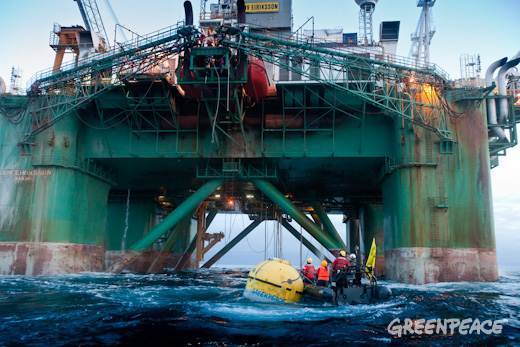
    Greenpeace activists in Greenland

    On Sunday Greenpeace activists climbed up an oil rig off Greenland’s coast in an attempt to stop the Scottish oil company, Cairn Energy, from starting deepwater drilling in the arctic waters. The activists arrived at the rig in inflatable speedboats launched from the Greenpeace ship Esperanza, which had avoided a Danish warship shadowing them for days.

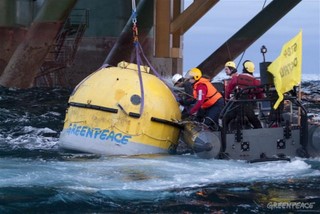
    The environmental group said the activists scaled the Cairn Energy rig early Sunday and are now hanging under it in a “survival pod”, which is occupied by two Greenpeace members. It said the group has enough food and water to stay there for 10 days. Cairn Energy had earlier this month won permission to drill up to seven oil exploration wells off the Arctic island’s west coast.

    Greenpeace has criticized Cairn, which is the only company drilling in the area, for not taking the extra precautions needed to avoid accidents such as the 2010 Gulf of Mexico oil spill.

    Greenpeace activists stuck to a pod in Greenland

    The company has said that they “seeks to operate in a safe and prudent manner” and pointed out that authorities in Greenland have established stringent operating regulations, similar to those applied in the Norwegian North Sea.
    Greenpeace said it hopes the action can stall Cairn’s plans to complete the exploration before winter, forcing the company to abandon the search for oil for another year. for they claim that if drilling is delayed for just a short time, Cairn could struggle to meet a tight deadline to complete the exploration before winter ice closes in, forcing it to abandon the search.

    Cairn Energy is currently the only company drilling in the area, but Greenpeace has warned that an arctic oil rush could be set off if the company strikes oil this summer.

    “We are preventing it from drilling because an oil spill up here would be nearly impossible to deal with due to the freezing conditions and remote location,” States Greenpeace campaigner Ben Ayliffe. “A BP-style blow-out off the Greenland coast would make the Deepwater Horizon clean-up look simple.”

    Greenpeace activists also climbed aboard the Leiv Eiriksson rig when it left a port in Istanbul in April, but were forced to abandon that protest due to bad weather. Last year, activists also tried to stop drilling in the area by climbing onto Cairn’s Stena Don rig.

    Source: physorg
    Greenpeace

  • A Shift to Arctic Oil

    A Shift to Arctic Oil

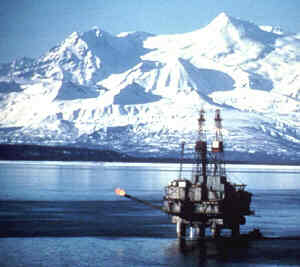
    offshore oil platform

    Unrest in the Middle East means the potential oil riches in Arctic areas like Greenland are more important than ever, the island’s premier said on Wednesday, criticizing environmental groups that want to hamper exploration.

    Greenlan enjoys self-rule as part of the Kingdom of Denmark, has issued 20 licenses for oil and gas exploration in Baffin Bay on its West coast. Some estimates put Greenland’s offshore oil reserves at 20 billion barrels.

    Kuupik Kleist said that there is a strong focus on the Arctic, especially because of the richness of natural resources. The very last days’ developments in the Middle East have put more (emphasis) on this focus.

    We are of course influenced and also highly affected by what’s happening on world markets,” Mr. Kleist said at an Ottawa conference on the Arctic.

    Speaking separately, Greenland’s industry and mineral resources minister, Ove Karl Berthelsen, said exploration licenses for blocks in the Greenland Sea to the east would be auctioned in 2012 and 2013. Firms with licenses include U.S.-based ConocoPhillips and Exxon, Canada’s Encana, Norway’s Statoil, France’s GDF Suez, Britain’s Cairn Energy, Royal Dutch Shell Plc, Denmark’s Maersk and DONG Energy, and Greenland’s national oil company Nunaoil.

    Kuupik Kleist

    Although environmental groups say the Baffin Bay exploration blocks are particularly vulnerable to oil spills and should be kept off limits, Kuupik Kleist made it clear there is no turning back where he said that if Greenland should stay away from exploiting its mineral resources, some other place on Earth will do it.

    Greenland, dependent on the fishing industry and funding from Denmark, says it needs the money to cope with pressing social needs. Mr. Kleist stated that the status quo is not an option, since Greenland is faced with big huge challenges in all areas, social, educational, health and infrastructure.

    The Greenland government says while there are risks to offshore drilling, modern technologies mean the dangers are much lower than in the past. Last year, Greenpeace protesters boarded a drilling rig operated by Cairn Energy to highlight what they said were the dangers of a spill in one of the world’s most remote regions.

    You see environmental groups coming now to the Arctic area and trying to hinder activities conducted by indigenous governments… Why didn’t they do that like 100 years ago, 50 years ago or even just 15 years ago?” said Kleist. “I think Greenpeace has a lot of work to do in other places in the world. Greenland is not the most dangerous place.

    Source: Reuters

  • High Temperature in the North – Cold in the south

    High Temperature in the North – Cold in the south

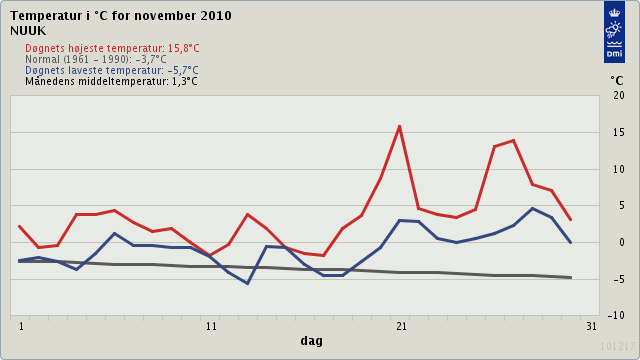
    temperature in Nuuk

    During November and the beginning of December, there has been unusual weather phenomenon over Greenland and Iceland causing unusual high temperature in the area. It is reported on the 29th of November that in the capital of Greenland, Nuuk, that the temperature was as high as 16° C (61°). According to the Danish Meteorological office, the mean temperature in November 2010 in Nuuk was 1,6° C (36° F), while the annual mean temperature in November is -3,7°C (25° F). So far in December, the mean temperature has been 1° C (34° F), which is seven degrees over the annual mean temperature, which is -6,2°C (21° F). This unusual high temperature has though not occurred in Iceland were the mean temperature was close to the annual mean. Still, the temperature went as high as 12, 4°C (11 °F) along the south coast. In December, the temperature at the south coast of the island went as high as 15° C (59 °F). Such high numbers in Iceland are not common in Iceland even though for the mean temperature is quite high, due to the Gulf Stream. However, this is unusual in Greenland.

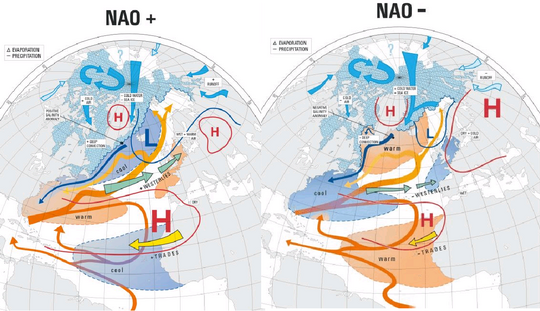
    This unusual weather conditions might be explained with the so called North Atlantic Oscillation (NAO). This weather phenomenon in the North Atlantic Ocean is fluctuation in the difference of atmospheric pressure at sea level between Iceland in the north and the Azores in the south. There is a correlation between those two areas, meaning that when there is a high pressure over Iceland, there is a low pressure over the Azores and vice versa. The east-west oscillation motion of this pressure difference then controls the strength of the direction of the westerly winds which are the main cause for abnormal weather activity in the North Atlantic region and in Central Europe.

    NAO positive/negative effects on the weather

    In November till April, the NAO is responsible for much of the variability of weather in the North Atlantic region, causing wind speed and direction to change, which further cause changes in temperature and moisture. When the NAO is positive it causes mild temperature in West and Central Europe and cool climate in Greenland and Labrador. When the NAO is negative it causes a shift, meaning that West and Central Europe becomes colder when it warms up in Greenland, Labrador and Iceland.

    The winter of 2009-10 in Europe was unusually cold, especially during December, January and February and caused many inconveniences in the continent. It is theorized that this may be due to solar activity but this cold winter is also coincided with an exceptionally negative phase of the NAO.

    Sea ice

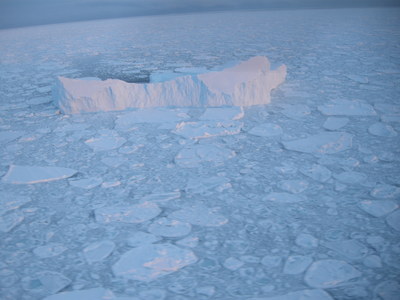
    The NAO also causes changes in sea ice distribution at the east coast of Greenland. The NAO is in negative position, causing more westerly wind to blow. Also, the NAO generates better conditions for the sea is to formulate at the north east coast of Greenland. Du to this, a sea ice warning has been issued by the Icelandic Metrological Office in Iceland. According to surveillance of the Icelandic Coast Guard on the 9th of December the sea ice edge was around 20 nautical miles from the North west coast of Iceland. A day later, on the 10th of December, the sea ice edge was only 10 nautical miles from the shore. This is caused by a strong westerly wind, caused by the NAO, which blows sea ice into Icelandic waters. The sea ice has drifted further west into Icelandic waters but away from shore. However, with strong northern winds, the ice might reach shore at some northern peninsulas. This can cause inconvenience for sea-farers and fishermen since the sea ice can block the sea route North West of Iceland. Due to this, transportation of fish needs to be on land since vessels can be shut from the home harbour. The Ice is however sparse with denser ice in between. Five large icebergs have been also spotted and is the highest one estimated to be around 110 meters (360 feet). Such large icebergs are as not usual in this area. A reason for increased icebergs might be due to warmer climate. Warmer climate causes the ice-shelf around Greenland to weaken and break up, causing increased icebergs in adjunct waters.

    The NAO phenomenon is negative position now, causing unusual weather in Greenland and somewhat in Iceland. However, the most of the inconvenience caused by the NAO occurs in Central Europe. The winter in Europe has been very cold so far in 2010 and is predicted to stay so until the beginning of the new year of 2011. This has been linked to the NAO, however, there might be another reason. For example, the Icelandic low pressure – which normally sits between to the west of Iceland and Greenland – has appeared regularly to the east of Iceland and so allowed exceptionally cold air into Europe from the Arctic. Together those two form a unusual weather conditions in the area. However, there is no doubt of an unusual and or a changing climate.

    Iceberg in Icelandic waters

    Sources:

    Icelandic Meteorological Office
    Danish Meteorological Institute
    The Icelandic Coastguard

  • EU and Greenland broil over Arctic Environment

    EU and Greenland broil over Arctic Environment

    Diana Wallis

    Vice president of the EU, Diana Wallis has accused Greenland and other Arctic nations of failing to ensure the environment in the Arctic is properly protected Wallis said she could imagine “people on the streets” protesting if wider international stewardship is not guaranteed. These allegations go hand in hand with the E.U pushing for a ban on deep water drilling since the BP accident in the Gulf of Mexico.

    Holm Oslen

    Greenland’s deputy foreign minister Inuuteq Holm Oslen, has as a response accused the EU of suffering “panic reactions” after the BP spill and said that though he welcomes focus and attention on environmental issues he was suspicous towards the motives behind the statement. Oslen was quoted saying ” What we don’t welcome is the notion that there should not be any industrial development in the name of environmental protection. What the rest of you have been benefiting from should not be denied to us in the Arctic,” he said.

    Source: Arctic Focus

  • Oil discovery of the Coast of Greenland

    Oil discovery of the Coast of Greenland

    Offshore oil platform

    Cairn Energy, a oil and gas exploration company based in Ireland has reported the first oil discovery in Greenland. Previously the company had discovered natural gas. In the companies statement Chief Executive Bill Gammel says that “The presence of both oil and gas confirms an active, working petroleum system in the basin and is extremely encouraging at this very early stage of our exploration campaign for the Sigguk block and the entire area”.

    The two types of oil which have been found are being chemically analysed. The oil was retrieved at depths of between 300m and 500m and a third prospect is at an earlier stage of drilling.

    The territory’s waters may hold 50 billion barrels of crude and gas, according to the U.S Geological Survey. Additionally to Cairn Energy, Exxon Mobil Corp and Chevron Corp also own rights in Greenland.

    The drilling has met quite a bit of protest from Greenpeace activists, which boarded the Greenland drilling rig last month to protest about deep drilling. Four people were arrested after giving up their occupation of the rig when weather conditions worsened.