Tag: Iceland

  • Call for SCF applications

    Call for SCF applications

    Earth globe, polar view

    Science Cooperation Fund – the Agreement between Iceland and Norway to promote the Arctic studies and help with students and staff mobility between those two Arctic countries, encourages to apply for exchange scholarships and staff mobility grants before tomorrow´s deadline.

    The purpose of the fund is to encourage scientific cooperation between higher education institutions, research organizations and research groups in Norway and Iceland in the field of Arctic science or other activities as decided by the joint Icelandic-Norwegian Committee.

    Grants are awarded for travel and accommodation cost in relation to the participation of individuals or groups in scientific conferences and/or joint meetings in Norway and Iceland.

    In this context Arctic science encompasses research, monitoring, education and dissemination of knowledge that relate to both distinctive and common denominators of nature, culture, economy and history of the Arctic region with a bilateral and/or international perspective.

    Grants will be awarded according to lump sums for travel and subsistence costs.

    For more information, please visit the Science Cooperation Fund website.

  • Interview with Ólafur Ragnar Grímsson

    Interview with Ólafur Ragnar Grímsson

    Ólafur Ragnar Grímsson, the President of Iceland

    Yesterday, 23rd of April 2013, Lögfræðingur, a peer-reviewed law journal of the University of Akureyri, published the interview with the President of Iceland – Ólafur Ragnar Grímsson.

    Ólafur has been a vigorous advocate for peaceful and democratic evolution in the Arctic. He maintains that Iceland has a critical role within the cooperation of nations in the Arctic.

    Ólafur emphasizes that the evolution of the Arctic must be fundamentally based on science.

    Lögfræðingur met the President on 7 February 2013 at his residence Bessastaðir to discuss Arctic issues, Arctic development and the nature of the management and legal framework that is the key to cooperation between the Arctic countries.

    Click here to download the article.

    Source

    Lögfræðingur 2013

  • Invitation to Iceland

    Invitation to Iceland

    Northern Iceland

    Marine and Coastal Culture Tourism in Northern Territories – Akureyri Iceland – 18-19th June

    A conference that will focus on the fishing environment in northern territories will take place in the University of Akureyri, 18-19 June 2013. The conference is organised by the Stefansson Arctic Institute in collaboration with the University of Akureyri Research Centre, NORA, the Icelandic Tourism Research Centre, Norwegian Seafood Centre and the Icelandic Lighthouse Society.

    Marine and coastal culture tourism is growing in popularity in various ways. Some tourists want to learn about life in coastal villages, experience nature and tranquility as well as the wilderness. Others want to experience the excitement of driving charter boats, diving, surfing, go speedboating or hiring a boat and try their luck at fishing. Then there are those who want to sail from port to port and country to country on board gigantic cruise ships.

    How does this fit in with cultural heritage, everyday life, social development, self sufficiency, fishing quotas and environmental policies of the Nordic nations? How can the Nordic nations collaborate in this area? Do these diverse aspects of tourism have collaborative opportunities? These challenges will be discussed at the conference where further questions will be pondered through group work and perhaps more answers and collaborative possibilites found.

    Skogafoss in the south of Iceland

    The main workshop themes will be how we meet the challenges of:

    • The development of marine and coastal culture tourism in Norway, Iceland, Greenland and the Faroe Islands.
    • Opportunities and threats, self sufficiency and environment – the effect of marine and coastal culture tourism and the image of the Northern Territories.
    • In what areas can we collaborate?

    There will also be excursions where tourism related businesses and museums will be visited.

    See the conference program.

    The conference is open to all but registration is needed for planning purposes.

    Registration deadline: 10 May 2013

    Conference fee: ISK 12000 / DKK 545

    Registration & hotel bookings (limited vacancy): conference@aktravel.is, tel. +354 4600600

    For further information contact Sigurbjörg Árnadóttir: sibba@svs.is.

    Source

    Stefansson Arctic Institute

  • Iceland and Norway advertise funds

    Iceland and Norway advertise funds

    Ducks swimming in Reykjavík pond

    The foreign ministries of Iceland and Norway have established two funds as a part of their cooperation in the field of Arctic studies and Arctic scientific research.

    The ministers of foreign affairs signed a three year Memorandum of Understanding in Akureyri on September 29, 2011, concerning co-operation. It indicated key activities, including the establishment of a Nansen Professorship in Arctic Studies at the University of Akureyri, Norwegian and Icelandic Arctic Science Cooperation Fund and Exchange scholarships for Icelandic and Norwegian Students in Arctic Studies.

    Exchange scholarships for Icelandic and Norwegian Students in Arctic Studies are one of the key activities in this co-operation. The purpose of the exchange scholarship program is to encourage the exchange of students between higher education institutions in Norway and Iceland in the field of Arctic science.

    Students at all levels (bachelor, master, doctoral) can apply if they are enrolled at Icelandic and Norwegian higher educational institutions. Priority will be given to Master and Ph.D. students and students wishing to study at Norwegian and Icelandic universities that are members of the University of the Arctic network.

    The purpose of the science fund is to encourage scientific cooperation between higher education institutions, research organizations and research groups in Norway and Iceland in the field of Arctic science or other activities as decided by the joint Icelandic-Norwegian Committee. Grants are awarded for travel and accommodation cost in relation to the participation of individuals or groups in scientific conferences and/or joint meetings in Norway and Iceland. In this context Arctic science encompasses research, monitoring, education and dissemination of knowledge that relate to both distinctive and common denominators of nature, culture, economy and history of the Arctic region with a bilateral and/or international perspective.

    More information can be found here.

    Sources

    Arctic Studies

    Foreign Ministry of Norway

    Foreign Ministry of Iceland

  • Oldest animal alive was in Iceland

    Oldest animal alive was in Iceland

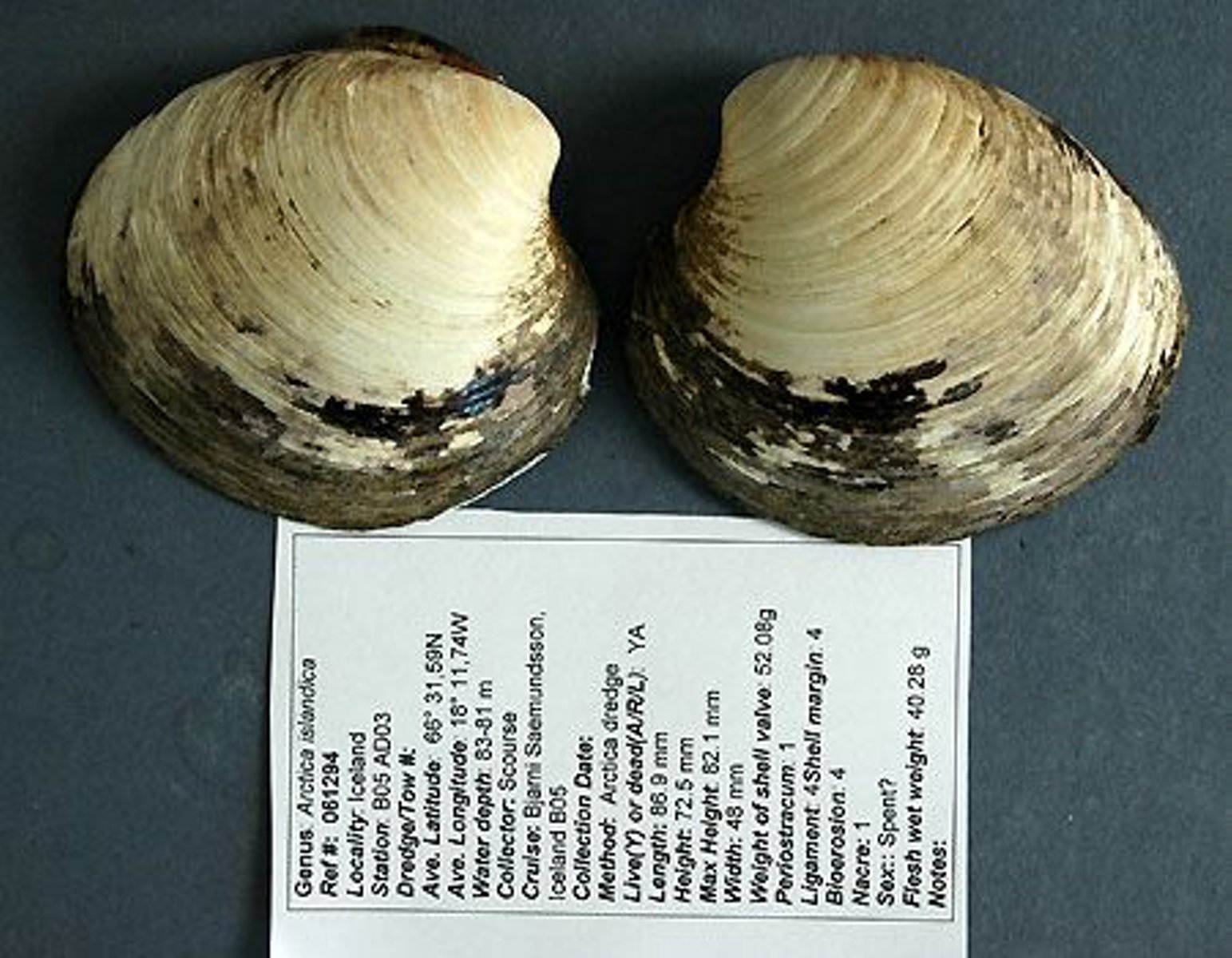
    The Ocean quahog

    The oldest animal alive was found in Icelandic waters in 2007. The research ship Bjarni Sæmundsson pulled up a 507 year old Ocean quahog, on the depth of 83 meters just outside of the island Grímsey.

    It was 11cm in diameter and was the oldest animal on earth. It was killed in order to conduct research.

    Renowned Icelandic scientist Haraldur Sigurðsson covers the topics in his website.

    Arctica islandica is quite common around Iceland and is known for reaching high age. It buries itself in sand or clay on the ocean floor and moves very little during its life course.

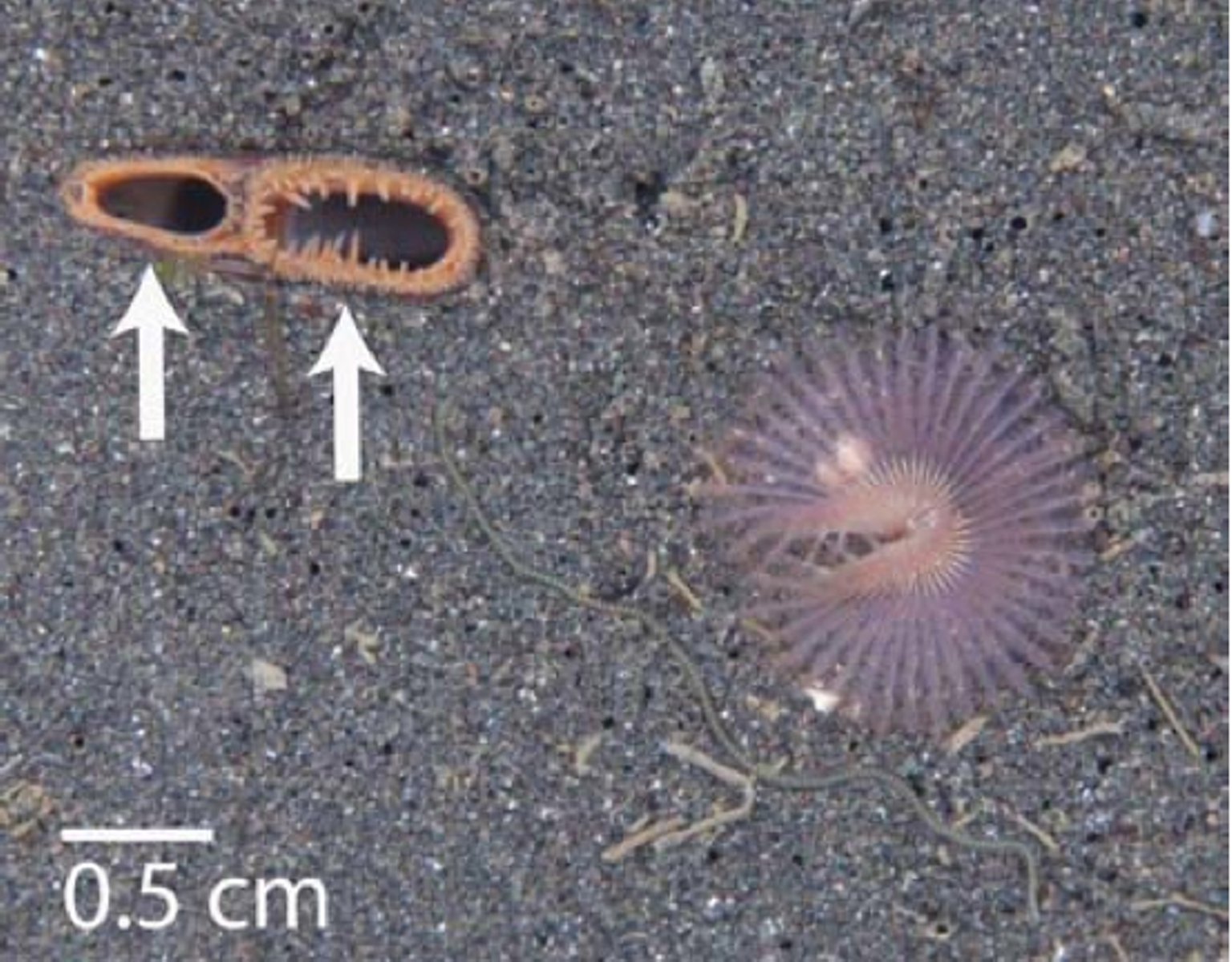
    The second picture shows how the breathing Ocean quahog, breathing sea in the bigger opening, and out the smaller one.

    It grows immensely, for its size, over the summertime but very little over the winter. That leaves age markings on its shell, just like on trees.

    Ocean quahog is widespread around the world; it is common for aquaculture and is fished in USA for example, around 20 thousand tons per year. The annual catch around the world is thought to be around 150 thousand tons.

    Ocean quahog breathing

    The finding gained recognition at the time, amongst scientist around the world, especially from Britain and Germany.

    Sources

    Haraldur Sigurðsson

    Ocean quahog on Vistey

  • New Arctic Council minister visits Iceland

    New Arctic Council minister visits Iceland

    Leona Aglukkaq and Össur at the meeting

    The Icelandic Minister for Foreign Affairs, Össur Skarphéðinsson met with Ms. Leona Aglukkaq, Canada’s health minister and newly appointed Minister of Arctic Affairs in Iceland yesterday.
    Following her visit to Reykjavík, Aglukkaq will travel to the other Nordic states to introduce Canada’s Chairmanship Programme for the Arctic Council.

    At their meeting the ministers discussed cooperation between the countries and the their policies within the Arctic Council as Canada will take on the chairmanship of the Arctic Council at the council’s ministerial meeting in Kiruna May 15.

    Leona Aglukkaq who will lead the chairmanship, said Canada’s overarching theme would be promoting projects that have practical implications for the inhabitants of the region, including economic growth and the development of natural resources in a sustainable manner, safer Arctic shipping, engagement with industry and the business community and cultural cooperation within the Circumpolar region.

    “Our main agenda is development of the people in the Arctic, sustainable and safe exploitation of resources and safe shipping in the Arctic,” she told Morgunblaðið.

    The Foreign Minister expressed his view that strong regional and political cooperation within the Arctic Council, aimed at constructive projects and agreements is one of the pillars of Iceland’s Arctic policy. The Minsters agreed on the importance of strengthening practical cooperation of the Arctic States on responses to environmental disasters, e.g. by supporting prevention and responses to shipping accidents and oil spill in the Arctic.

    The Foreign Minister also emphasized the importance of developing further ideas on economic cooperation with the possible establishment of Circumpolar Chamber of Commerce. The issue of permanent observers was discussed and the future development of the Arctic Council and its role in the global context.

    After her meeting with the Foreign Minister, Ms. Aglukkaq met Ms. Svandísi Svavarsdóttir, Minister for the Environment and Natural Resources and experts from institutes working with Arctic affairs in Iceland.

    Sources

    Ministry of Foreign Affairs

    Morgunblaðið

    The Arctic Council website

  • The Icelandic oil adventure has begun

    The Icelandic oil adventure has begun

    Icelandic oil adventure signing

    “Today is the beginning of oil adventures in Iceland” was said on the day the National Energy Authority of Iceland signed the first licenses for exploration and production of hydrocarbons Icelandic waters, more specific in the Dreki Area.

    Two licenses were granted, to Faroe Petroleum Norge AS, Branch in Iceland, Iceland Petroleum ehf. and Petoro Iceland AS, on the one hand, and Valiant Petroleum ehf., Kolvetni ehf. and Petoro Iceland AS on the other.

    The Norwegian Parliament approved the decision on the participation by the Kingdom of Norway through the State-owned oil company Petoro AS in accordance with the agreement between Norway and Iceland from 1981.

    There is one license to Faroe Petroleum Norge AS as an operator with 67,5% share, Íslenskt Kolvetni with 7,5% share and Petoro Iceland with 25% share. The other license is to Valiant Petroleum ehf. as an operator with
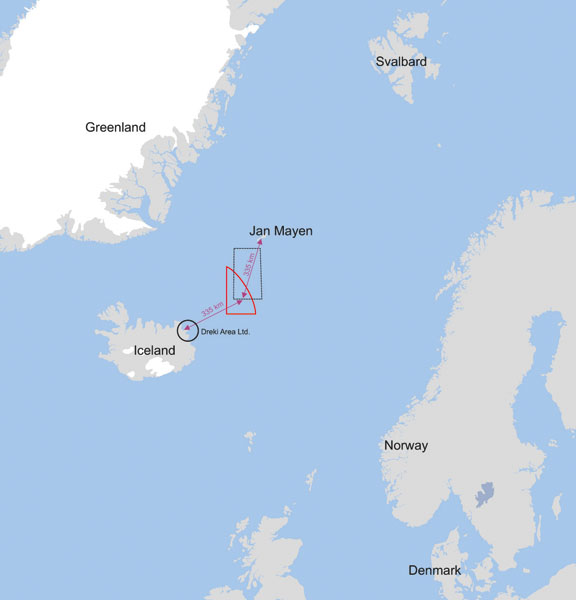
    The Dreki area map

    56,25 % share, Kolvetni ehf. with 18,75 % share og Petoro Iceland AS with 25 % share.

    The Norwegian Minister of Petroleum and Energy, Mr. Ola Borten Moe, was present at the signing of the licenses as the state oil company of Norway, Petoro, will participate in both licenses.

    “All leads to Iceland becoming an oil nation,” says chief of exploration Terje Hagevang, Norwegian working at the British company Valiant Petroleum. Hagevang researched the area for his master’s program and for a long time has been suggestion the Jan Mayen ridge is rich in oil reserves.

    This will be the first oil exploration in Icelandic waters. The Dreki-Area is shown on the map here on the right local communities in North-East of Iceland have already started on preparations to service the exploration.

    „This is very important, just like when the oil adventures began in Norway in 1695-1966. The adventure is here and it has a future for petroleum activities in Icelandic waters. This is the start of it, ” Hagevang said to Stöð 2 in

    Iceland.

    Hagevang has reported that the Jan Mayen ridge, which includes the Dreki-Area, is as rich in petroleum as the Norwegian sea. „New research has strengthened this belief. It shows that the area has everything to produce petroleum.”

    The first rig in the area is expected in 2017 or 2018, likely to be deployed in the Norwegian side at first.

    Steingrímur J. Sigfússon, minister of Industry and Innovation in Iceland, welcomed the Norwegian knowledge of oil exploration and said that this was a landmark for the country.

    The two licenses are valid from today through 4.1.2020.

    Blue: Valiant Petroleum ehf. and Kolvetni ehf.  Red: Faroe Petroleum Norge AS, Branch in Iceland and Iceland Petroleum ehf. Click to enlarge. Photo by NEA.

    The License for Valiant Petroleum ehf, Kolvetni ehf, Petoro Iceland AS

    Letter of Agreement
    The License for Faroe Petroleum Norge AS, Íslenskt Kolvetni ehf. Petoro Iceland AS.
    Letter of Agreement

    Sources

    NEA
    Stöð 2

    Map of potential oil and gas areas

  • Iceland to establish a national oil fund

    Iceland to establish a national oil fund

    President Grímsson has been instrumental in Iceland's Arctic development

    The president of Iceland has announced that the country plans to set up a national wealth fund to safeguard revenue from potential oil discoveries as it opens up to exploration.

    The Dreki area will be explored further next year and high hopes are that reserves will be found in the area.

    Iceland has no history of oil exploration and no national oil wealth exists.

    Faroe Petroleum Plc (FPM), Valiant Petroleum Plc (VPP) and Petoro AS will be the first foreign explorers to search Icelandic waters for oil and gas. They are betting that the geology matches that of the Shetland Islands, where BP Plc and Total SA are drilling, according to Faroe.

    “Since we look at this resource as a national wealth, there will be a national wealth fund that would be established, but this is more of a general policy at this time,” Grimsson said in an interview with Bloomberg in London this week. Explorers “have to do their work. It will take some years.”

    Icelandis already working with the member states of the Arctic Council to prevent oil spills in the North Atlantic and share equipment and technology for search and rescue operations.

    Future oil industry regulations will be “within the framework of the Nordic as well as European cooperation,” Grimsson said. They will be modeled on Iceland’s geothermal and hydropower industry, he said.

    Source

    Bloomberg

  • Norway takes part in exploration in Iceland

    Norway takes part in exploration in Iceland

    The Dreki area on a map

    The National Energy Authority of Iceland (NEA) has today finished processing two applications for licences for exploration and production of hydrocarbons in the Dreki Area. The Ministry of Petroleum and Energy in Norway has today, 3 December 2012, notified NEA of their decision to participate in both licences to a 25 % share in accordance with the agreement between Iceland and Norway.

    NEA sought the opinions of the Ministry for the Environment and the Ministry of Fisheries and Agriculture in accordance with the hydrocarbons act and evaluated the opinions based on the applications and the work programmes involved.

    Furthermore, NEA made a careful evaluation of the technical and geological capacity of the applicants to handle the extensive activities associated with the licence. Finally, NEA studied the financial capacity of the parent companies of the applicants in order to ensure that the applicants have sufficient financial strength to conduct the activities for the long-term and can handle the corresponding environmental and safety elements.

    Following the processing of NEA of the applications

    Blue: Valiant Petroleum ehf. and Kolvetni ehf.  Red: Faroe Petroleum Norge AS, Branch in Iceland and Iceland Petroleum ehf.

    at the end of October, NEA made a decision to grant licences to Faroe Petroleum Norge AS, Branch in Iceland and Iceland Petroleum ehf., on the one hand, and Valiant Petroleum ehf. and Kolvetni ehf., on the other.

    Furthermore, the Norwegian authorities were notified of the decision, draft licences sent for their perusal and a formal answer requested on whether they intended to participate in the licences in accordance with the agreement between Iceland and Norway from 1981, which entails the right of Norway to participate in licences within the area of the agreement up to a 25 % share.

    The anticipated licensees have read the draft licences and submitted their comments, which NEA has taken into account as has been agreed by the parties involved. Norway has also participated in this process through the Ministry of Petroleum and Energy, i.e. gone through the draft licences and submitted comments to NEA.

    The Ministry of Petroleum and Energy in Norway has today, 3 December 2012, notified NEA of Norway’s decision to participate in both licences to a 25 % share in accordance with the agreement between Iceland and Norway.

    The licences cannot by issued before the Norwegian Parliament has approved the decision on the participation by the Kingdom of Norway through the State-owned oil company Petoro AS. Following this and the signing of the parties to the licences of their joint operating agreements, NEA will grant the licences, probably in the beginning of January of next year.

    A third application was received from Eykon Energy ehf. The processing of this application was delayed and the applicant given a respite until 1 May 2013 to find an additional participant in the licence that receives approval by NEA on having sufficient expertise, experience and capacity to undertake the licenced activities. NEA will take the application for final processing subsequent to receiving information on such a new participant in the application.

    Sources

    NEA

    Map of potential oil and gas areas

  • Two windmills rise in Iceland

    Two windmills rise in Iceland

    The windmills being moved

    Iceland will have two new windmills set up this winter. They were transported to its location this week, but Iceland has a short history of windmill use.

    Iceland is rich in energy and geothermal power is the major input, of 2/3 of Iceland’s energy production. Iceland imports around 14% of its energy sources.

    Hydroelectric power accounts for almost 20% of the energy production but hopes for the windmills are high. Energy company Landsvirkjun is setting up the windmills, each is 900kw but in total their energy production will be around 5,4 Gwh per year.

    They are 55m high and each blade is 22m in length. The total height is therefore 77m.

    In wind at 15m per second they produce its peak total, but if the wind goes below 3m they automatically stop to produce. It peaks in between 15m and 28m per second wind and stops again if the wind goes beyond 34m.

    German company Energon produced the windmills and will help with insertation in December. They should be able t run full speed in January.

    Energy production in Iceland in 2011 - Pie chart

    Landsvirkjun says on their website that the windmills are a part of research- and development program for sustainable energy in Iceland, and that several areas are well equipped for windmill use.

    Windmills are generally 0,5-1 kw and Landsvirkjun says that it is very well possible for Iceland to produce 50-100 Gwh per years with windmills within a few decades.

    Sources

    Mbl.is

    Landsvirkjun

    Iceland Statistics