Tag: Iceland

  • Successful journey of the Snow Dragon continues

    Successful journey of the Snow Dragon continues

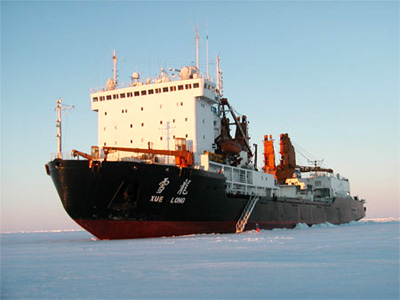
    The Snow Dragon

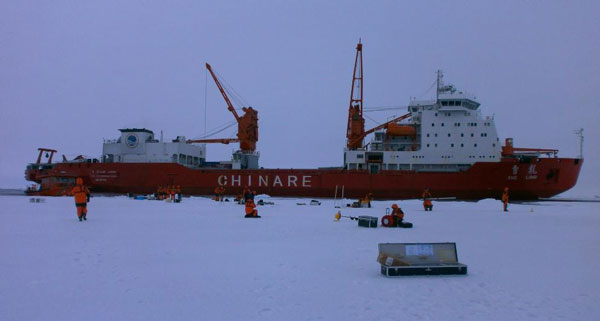
    The journey of the icebreaker Xue Long from Iceland to China, via the Arctic Ocean, has been successful so far. With the decreasing sea ice extent, the research ice-breaker has been able to sail through the Central Arctic Shipping Route without a support from nuclear powered vessel.

    Due to such an ice conditions, the research ice-breaker was able to operate via Fram Strait and carry on a high Arctic region to the east.

    Arctic sea ice extent fell to 4.10 million square kilometers on August 26, 2012. This was 70,000 square kilometers below the September 18, 2007 daily extent of 4.17 million square kilometers.

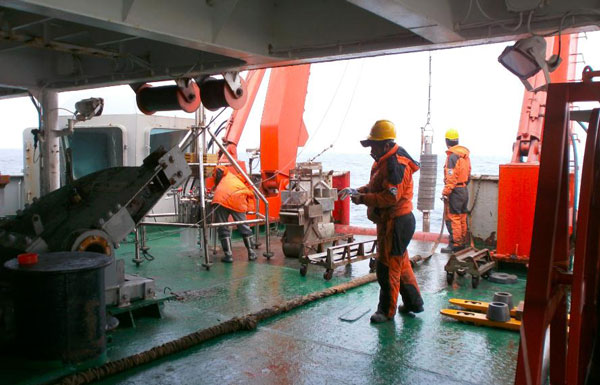
    Geological research: Gravity core launched in the Iceland Sea.

    Oceanographic, biological, geological and geophysical research was carried out in the Iceland Sea and Greenland Sea on the route north and meteorological observations are maintained throughout the expedition.

    Various satellite images are received for navigation through the sea ice.

    Benthic samples, from the shore lines of Icelandic waters were taken in order to prove benthos great increase in region that extends away from the land mass.

    Benthic sampling techniques are essential to habitat mapping studies since they provide the ‘truth’ data on the actual composition of the seafloor. When they are commonly used in conjunction with either a remote sensing or an acoustic technique, they are said to ‘ground truth’ seafloor classifications.

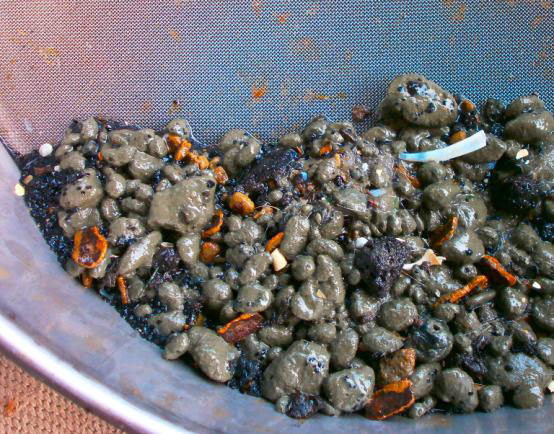
    Benthic sample from the Iceland Sea

    If samples are collected in high enough densities over survey areas they can be used to establish distributions and define habitats.

    Biological and geological/physical samples taken by the Geological Team from the Xue Long are to be taken separately from different grabs.

    Sailing out from Iceland, the Snow Dragon reached the region east of Jan Mayen, where in the good weather it was possible to see the Beerenberg volcano.

    It is the world’s northernmost sub aerial active volcano. The volcano is topped by a mostly ice-filled crater about 1 km (0.6 mi) wide, with numerous peaks along its rim including the highest summit, Haakon VII Toppen, on its western side.

    The upper slopes of the volcano were observed to be largely ice-covered, with several major glaciers including five which reach the sea.

    No scientific research was conducted by teams, nevertheless the elevation was difficult to be missed.

    Currently the vessel is heading up North, aiming to cross the North Pole. The ice conditions were reported as being almost 3 meters thick. The Snow Dragon is partly being followed by the Norwegian coast guard.

    Please, see the route of the Chinese research ice breaker on Interactive Mapping System.

    Source

    CHINARE5

  • Towards the North – Xuelong to reach Akureyri on Monday the 20th

    Towards the North – Xuelong to reach Akureyri on Monday the 20th

    Xuelong statistics

    On Monday, 20th of August 2012, the Snow Dragon, research ice – breaker from Polar Research Institute of China, is expected to anchorage in Akureyri in the northern part of Iceland.

    The venue will open for participants at 9.00 (Icelandic local time) with the speech given by the Chairman of Akureyri Town Council Geir Kristinn Aðalsteinsson and the Chinese Ambassador to Iceland – Su Ge.

    Recently, China has achieved dimensional developments of Arctic linkage, especially in understanding of the earth system and global climate change. To raise public and governmental awareness and interests Dr. Huigen Yang and Prof. Deyi Ma will give a presentation on “Chinese Polar Research and CHINARE 5” to highlight the main features of Chinese contribution to the Arctic science and promote international cooperation with regards to science and technology of polar research activities.

    The Icelandic Chinese science cooperation will be further discussed under the chairmanship of Dr. Thorsteinn Gunnarsson from Icelandic Centre for Research (RANNIS).

    China makes big efforts to understand Arctic environmental changes and nature´s evolution, therefore conjugate observation of dayside aurora and new Icelandic – Chinese Joint Aurora Observatory project will be presented and explained by Dr. Hu and Dr. Björnsson to encourage the exploration of unknown frontiers in the deep universe.

    The Snow Dragon on the way to Iceland

    New perspectives on Arctic shipping cooperation will be given by Mr. Egill Nielsson and Prof. Zhang Xia from Polar Research Institute of China jointly with Ms. Embla Oddsdottir from Stefansson Arctic Institute who will introduce the harmonious culture of sustainable Arctic Shipping.

    The rector of the University of Akureyri – Dr. Stefán B. Sigurðsson will be given his closing remarks before whole group will participate the working lunch hosted by the Town of Akureyri.

    The Xuelong will be open for external visitors on Monday, 20th of August from 12.00 – 16.00 p.m. Introduction to the open day will be conducted by the mayor of Akureyri and Chinese ambassador. The visitors will get a chance to meet the staff from Akureyri town council, University of Akureyri,Stefansson Arctic Institute, Arctic Portal and Icelandic Arctic Cooperation Network.

    CHINARE 5 will leave northern Iceland on Monday´s evening, turning its rudder towards Shanghai.

    Please, see the full schedule of Chinare5 Open Day.

    Source

    Chinare5

  • China´s 5th Arctic Expedition heads to Iceland

    China´s 5th Arctic Expedition heads to Iceland

    The estimated route of the Snow Dragon

    China´s fifth Arctic expedition is en route to the Arctic. The Snow Dragon, Xuelong, left Qingdao in China on the 2nd of July.

    It will sail through the Northern Sea rout, carrying out various ressearch objectives in four fields. The fields are Physical Oceanography and Sea Ice, Marine Geology research, Chemistry and Atmospheric Chemistry and Biology and ecolosystem research.

    Arctic Portal is a cooperative partner in the project and a website about the expedition has opened at Chinare5.

    The Snow Dragon’s expedition to Iceland is an important token of the two countries Arctic research collaboration for years to come. Its arrival comes in light of the parties increased cooperation in Arctic affairs during recent years, which recently saw a framework agreement signed by the two governments. The Snow Dragon’s arrival in Iceland will further strengthen these ties and make way for mutually beneficial research for both sides.

    During its stay in Iceland the public will have an opportunity visit the Snow Dragon.

    This will be the first time that a Chinese Arctic expedition will sail through the Northern Sea Route.
    It is estimated that the 15.000km voyage will land in Reykjavík in the middle of August, before visiting Akureyri and then heading back to China.

    Please visit Chinare5 for more information.

  • Iceland supports China in Council efforts

    Iceland supports China in Council efforts

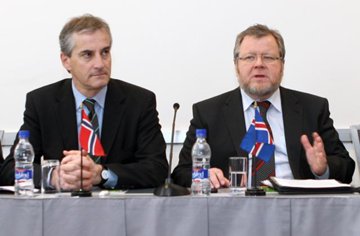
    Össur Skarphéðinsson and Jonas Gahr Störe

    Iceland supports China in its effort to become a permanent observer in the Arctic Council. Norway opposes.

    China currently has an ad-hoc observer status along with the European Union, Italy, Japan and South Korea. They all have to send request to observe each meeting, but they are usually granted.

    China, EU, Italy and South Korea were all denied a permanent observer status in 2009.

    Permanent observers receive invitations for most Arctic Council meetings and they have an easier way to participate in Council-related projects.

    Iceland is now trying to smooth the stiff relations between China and Norway. Össur Skarphéðinsson, the foreign minister of Iceland, has spoken to both the premier of China, Wen Jiabao, and his colleague from Norway, foreign minister Jonas Gahr Støre, about the issue.

    Össur hopes for a better understanding between the nations.

    He states that the Arctic Council is in the process of creating obligations for states to fulfill if they wish to receive the permanent observer status.

    Sources

    Fréttablaðið

  • Activities in Dreki in 2-3 years

    Activities in Dreki in 2-3 years

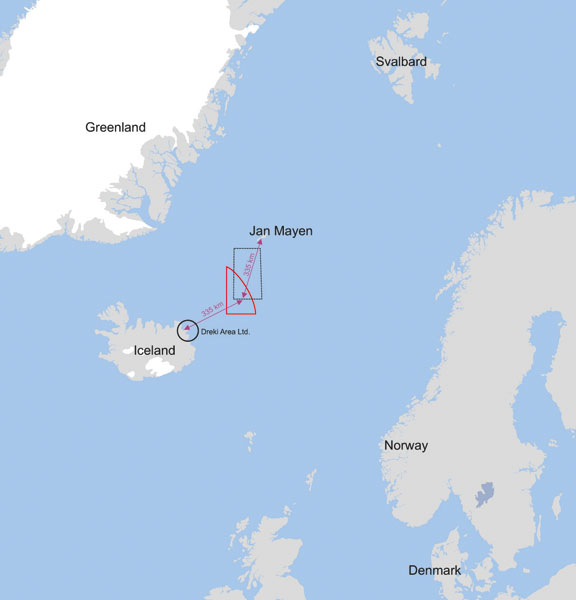
    Map of the Dreki area

    Iceland is excited as the first hints of oil discovery have been confirmed in the Dreki area, north of Iceland. One aspect for local communities is the service for the station.

    A service station would mean jobs for the people in the communities, many desperate for employment after the crisis in Iceland. Municipalities in the northern part of Iceland have been exploring the possibilities of a service station for some time.

    Icelandic company ODR has been working with service suppliers Asco in the search for the best area.

    The role of ODR is storing and distributing petroleum products for the owners and operation of specialized maintenance for service stations and own equipment.

    Asco runs sixteen service stations in five continents.

    They found out that three areas are most prominent, in Akureyri, Húsavík and Reyðarfjörður. Vopnafjörður and Þórshöfn are also in consideration. An intention letter has been signed with the first three municipalities.

    The service station would also service oil search in eastern Greenland, as well as the Dreki area.

    It is thought that the first activities in the area will be in 1-3 years, when an oil rig would be positioned in the area.

    The two Asco representitives have also looked at the infrastructure in the communities. “All these places are under consideration,” Hörður Gunnarsson from ODR said.

    “It is also possible to service the search from Greenland, from other service stations in Iceland because of the distances and the infrastructure in Iceland,” Runar Hatletvedt from Asco in North Europe said.

    Hörður added: “It is important not to get ahead of yourself now and not over invest. But the possibilities are there,” he said.

    Runar said that “based on past experience that we might see the first activities in 1-3 years, probably 2-3 years. It is realistic.”

    Hörður noted that it could also take up to 10 years for some activities, but it is clear that Iceland has great interests in the area and monitors the activities very closely.

    Sources

    Channel 2

  • Three offers for the Dreki Area

    Three offers for the Dreki Area

    Map of the Dreki area

    Three offers were submitted for search of oil in the Dreki Area. Icelanders are part of them all.

    There are high hopes for the Dreki Area and all points to oil being in the Jan Mayen ridge. A part of the area is in Icelandic waters.
    The first invitation to bid in the search was three years ago. Two offers were submitted now. Icelanders are happy three offers were submitted midst in the crisis.
    The offers are from Eykon, an unregistered company in Iceland. It looks at the project as one for the future. “We have international sponsors with us but we are doing the ground work. These partners are experienced in searching for oil in similar circumstances as in Jan Mayen,” Heiðar Már Guðjónsson from Eykon said.

    The next offer is from Faroe Petroleum and Íslenskt Kolvetni ehf. Faroe is a 15 year old company based in Scotland, with a staff of 50. It explores the British, Norwegian and the Faroese waters.

    The last one is from Valiant Petroleum og Kolvetni ehf. “Valiant, and Faroe Petroleum, are big companies so this is very positive,” Gunnlaugur Jónsson from Kolvetni ehf. said.

    The chief of the National Energy Authority in Iceland was excited about the result. “These are three companies with knowledge in the area. This is a very good result and goes beyond our biggest expectations,” Jóhannesson said.

    The minister of energy in Iceland said that the best possible result of the oil search would that very high income would be a reality in Iceland, for a short time, in about 10 years’ time.
    The National Energy Authority will answer the bidders before the end of November.

    Source

  • NASA research plane in the Arctic

    NASA research plane in the Arctic

    NASA research plane in the arctic

    NASA has sent an Earth Resources (ER-2) high-altitude science aircraft to Iceland to study the Greenlandic ice-sheet.

    The specially designed aircraft will carry out research for about 4 weeks in the high North. It will be based in Keflavík International Airport in Iceland.

    A statement from the US embassy of Iceland details the purpose of its mission:
    “The mission will assist global warming research by developing better methods to measure the melting of the ice in Polar regions. The ER-2 aircraft will fly high-altitude missions over Greenland in April to test the accuracy of a newly developed laser, the Multiple Altimeter Beam Experiment Lidar, or MABEL. The laser simulates a similar instrument planned for NASA’s IceSat-2 environmental satellite scheduled for launch in 2016.”
    According to NASA, this is a part of a much larger mission called Operation IceBridge. Conducted in the Arctic in March and April and the Antarctic during October and November, NASA says, the mission is “the largest survey of Earth’s polar ice ever flown.”

    The plane is a science laboratory in the air. It routinely flies around 70.000 feet and above, twice the height of a regular commercial airplane.

    NASA ER-2s have played an important role in Earth science research because of their ability to fly into the lower stratosphere at subsonic speeds, enabling direct stratospheric sampling as well as virtual satellite simulation missions. The aircraft’s unique capabilities enable studies such as stratospheric ozone concentrations over Antarctica and the Arctic.

  • System of Individual Transferable Quotas

    System of Individual Transferable Quotas

    Fisherman on a shipVarious characteristics of Icelandic economy seem to confirm the fact, that an affluent society, where the GDP per capita in 2007 was $66,240.30, is heavily dependent on the fisheries. According to recent analysis, export of fish products in foreign trade, account for around 75% of all marine goods export in Iceland and 50% of the foreign exchange income from marine goods in general.

    Following these statistics, it was found out that the total, direct and indirect fisheries’ contribution is estimated to be within the borders of 40% – 45% of GDP and might differ around 5% by looking at different sources. Using other words, without the fishery based economy, Icelandic GDP would be estimated as 60% of the current one. However, not only the state’s economy is strongly based on fisheries.

    The analysis must take into account, that the fisheries determine the major of citizens personal, individual income and income distribution, and what is more, in some part of Iceland as for instance West Fiords, around Husavik or Ólafsfjordur and many others, they are virtually the only basis for any economic activity. More than 40 different kinds of species in Iceland are harvested for the commercial purpose and the total annual catch in recent years, up to 2008, has fluctuated around 1.5 up to 2.2 million metric tons.

    It would be worth to mention, that according to the statistics from 2008, the most significant species for Icelandic fisheries are cod, which accounts for about 30% of total catch, beside that one, very valuable are also haddock, redfish and pollock which percentage in total catch can be generally estimated for around 15 % of a total catch.

    According to the latest news, there has been certain tendency regarding development of property rights in fisheries. Some of the European countries as Denmark, including Faroe Islands, United Kingdom or Ireland, performed the National Quota Management, some of them as Netherlands, New Zealand and Iceland, implemented the ITQs system. It has to be mentioned, that Iceland, where the private property has been generally believed to be fundamental to motivate the economy efficiency and productivity on land, took a leading role in this development and as one of the first countries to introduce individual vessel quotas and individual transferable quotas in major offshore fisheries.

    fish caught in a netHistorical data show that in Iceland, vessel catch quotas were implemented in 1975 in the herring fishery, in 1979 these were made transferable, and in the 1980s started to be used in all fisheries within exclusive economic zone and Icelandic vessels operating outside of this area, creating the current ITQ system.

    Addressing this discussion, it seems to be necessarily to analyze the conventional property rights in Iceland from the legal point of view. Icelandic property rights are neither fixed nor absolute and recognized as sort of privilege which allows to exclude others form some benefits. This concept places the one who holds the rights in certain position in respect to the others who are obligated to follow those rules.

    On the other hand, the legal theory states that property right is an aggregate and collection of rights. In this bundle we have to include the authority to control something and to dispose it to the others. The concept behind the implementation of ITQs system lays in the theory that it is a right to fish which is a subject of the concept, not the ownership of marine natural resources itself. It shows to be obvious that no one can posses the rights to the fish unless it has been caught. The natural marine resources are the common property of Icelandic nation.

    Current ITQs system has been based on the general provisions of the property rights. It was implemented by the Icelandic Fisheries Management Act of 1990 and changed through next two decades. The last alteration of this document took place in 2006 and provides with the essential features of current ITQ system. Though there might be notice disjunction between the art.1 and art. 4 of the FMA where the first states: “The exploitable marine stocks of the Icelandic fishing banks are the common property of the Icelandic nation.´ while the other seems to negate this statement: “No one may pursue commercial fishing in Icelandic waters without having a general fishing permit.”

    This allows to come to the conclusion, that the Icelandic fisheries management system is the closed shop system. Regarding ITQs, this feature puts an emphasis on their exclusive nature. It seems to occur as self evident, that one licensee cannot exclude all others from fishing. Analyzing the document, it can be said that the parties which enjoy a fishing license, in the same time enjoy the exclusive right to run commercial or professional fisheries in Icelandic waters. According to the FMA, current quota system represents shares in total allowable catch. TAC is set annually by the Minister of Fisheries and based on the recommendation from the Marine Research Institute which on the other hand relies on the information from the fishermen and researchers. All commercial fishing activities are subject to these quotas. Currently there are 15 species which are subject to TAC and in the same time to ITQs system. The quota share is multiplied by the TAC to give the quantity which each vessel is concerned during the fishing year in question. This is referred to as the vessels´ catch quota. Permanent quota shares and annual catch quotas are divisible and transferable to other fishing vessels. The allocation of quotas is subject to a fishing fee. Individual enterprises may not control more than the equivalent of 12% of the value of the total quotas allocated for all species, and 12% to 35% for individual species.

    The dispute arises when the one starts to think about the transferability of both, TAC and ITQ. The rule says that both of them can be transferred without any restrictions, though the Ministry of Fisheries must agree to distribute them fairly among the geographical regions. After it is done, according to the FMA we can point out the option, where the holder of an ITQ can, wholly of partly transfer its share to another licensed vessel. New regulations implemented in 1990 made it very common to sell the share by private holders, because the extreme amount of money was offered by the big enterprises.
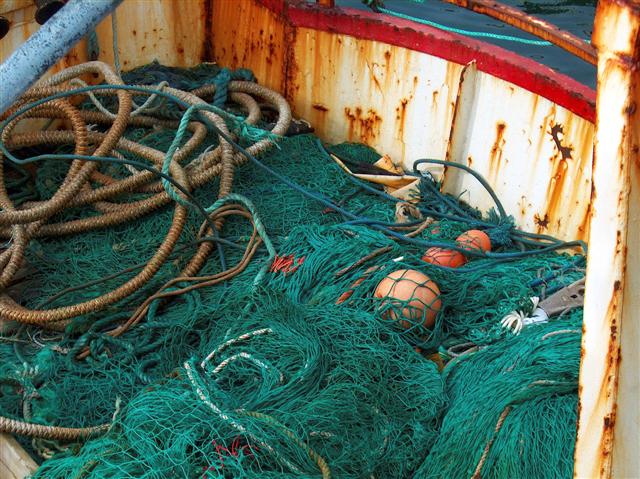
    ships fishing gearIcelandic ITQs system has or could have, great impact on economic efficiency and what fallows, the maximization of wealth not only among the quota holders but also other citizens who, indirectly benefit from fisheries industry. By implementing ITQs system in Iceland, the interest in the fisheries, coming from big national corporations, was noticed. Those companies, larger entitles different from the Icelandic government, began to actually achieve economy of scale, what means that they were able to give out the product on the lower cost, what means the lower price, because of the progressing massive production and fish processing.

    While the ITQs system is being implemented, decision making process starts to depend on the market and current economic situation, rather than being done by non market focused entitles in bureaucratic way, what means faster and more efficient for economy ways. Iceland seems to be very good example for such an observations but similarity might be noticed also in New Zealand, where actually the government’s fishery policy became more efficient when the private sector started to provide with services as opposed to the public ones.

    Icelandic ITQ system, shares some of the features with its utopist idea of its impact on economic efficiency. However, there are particular aspects of this dimension, which differ from the theoretical ideal and subtract from its economic efficiency. In the Icelandic ITQ system, which is strongly associated with fishing vessels, only those who actually own vessels with a valid fishing license, can own quotas. What is more, the total holdings of quotas cannot exceed the fishing capacity of the vessel in question. This regulation severely restricts the set of potential holders of ITQs and clearly subtracts from the ability of the quota market to generate the most economically beneficial allocation of those.

    The Fisheries Management Act of 1990 implemented a clause setting a limit on the quota holdings of any single vessel, what stated that no vessel can have a larger TAC share than it could catch within the fishing year. Art.13 of FMA states the maximum fishing quota share for fishing vessels owned by individual parties, whether natural or legal persons, or owned by connected parties. Nevertheless, it came to the point that eleven largest firms in Iceland hold about 33% of the demersal quotas and about 32% of all ITQs. Fifty biggest harvesting companies, in 1997 (the last available data) held more than 60% in all ITQs in the beginning of that fishing year.

    Icelandic ITQs system increases the economic efficiency by lowering the cost of harvesting, cost of production and price of the out coming product. It allows cheaper labor power and decrease the time spent on the sea by the single fisherman. After actual implementation of ITQs, the human’s migration from small villages in the far north or north – east, down to bigger agglomerations, where the large companies are operating, was noticed. Versions of the ITQs fisheries management have been occurring in Icelandic fisheries since early 1980s and its performance should be considered objectively. The evidence on the economic benefits of the ITQ system is becoming clearer and the TAC for some species will be increased in the near future. The regional impact of the ITQs system shall be taken into account.

    Source: Center of the Icelandic Ministry of Fisheries and Agriculture
  • Drilling into Hell

    Drilling into Hell

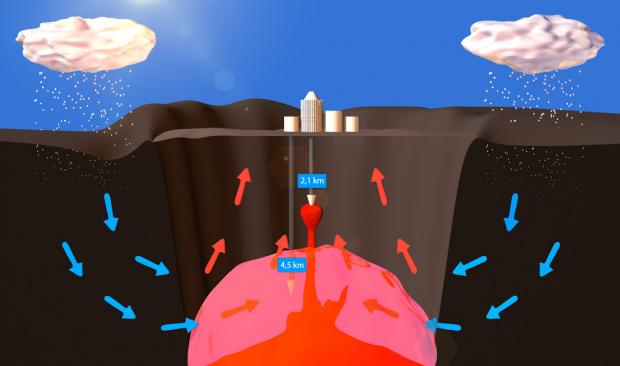
    A simplified diagram of the Krafla Caldera, a collapsed depression in the terrain. IDDP-1 was originally designed to drill to a depth of 4.5 kilometres, down to the pink area where water becomes supercritical, neither water nor steam. Instead the drilling was halted at around two kilometres down because drillers hit a pocket of magma, liquid rock. (Figure: Per Byhring, forskning.no). Click to enlarge.

    The main geothermal power station in Iceland is starting to draw heat from hell. In the North of Iceland, the Crater Hell, or Víti to the natives, portrays running water near glowing magma.

    The geothermal area in the north was always a feasible option for the Icelanders to utilize the vast energy resources, lying deep in the midst of the melting hot lava. But for a long time many doubted whether Krafla would ever actually enter operation, when large-scale volcanic eruptions started only two kilometres away from the station, posing a serious threat to its existence. Work continued, however, and the station went on stream early in 1977.

    The crater erupted in 1724 and the eruption lasted for 5 years. The last eruption was a small one which lasted for nine years, between 1975 and 1984.

    The area will erupt again, but Icelandic scientists have drilled a two-kilometer deep well into the crater to judge opportunities for utilizing this deep geo-energy.

    “This is the hottest production well in the world, with a temperature of 450° C and a pressure of 140 bars, in other words about 140 times that of normal air pressure at sea level,” says Guðmundur Ómar Friðleifsson, who heads the project, to Science Nordic.

    The Icelanders are trying a novel and bold technology before the next eruption occurs. They are drilling as close to the magma chamber as they can. Here they will extract from five to ten times the energy they currently get from the drill holes that serve the power plant.

    In the vicinity of the magma, ground water is so hot and compressed that it is no longer a mixture of water and steam, but rather a superheated dry steam. This superheated steam can liberate more energy than normal steam driving the turbines that convert it into electricity.

    Following a failed attempt at drilling deep further from the volcano, IDDP decided to drill right at Krafla, but not without making thorough preparations. Drilling of the well dubbed IDDP-1 started in March 2009. Iceland was then in the midst of its worst ever economic crisis but work continued nevertheless.

    Initially everything went according to plan. Then the troubles started. The drill string got stuck and was twisted off. New holes had to be drilled next to the old one. Delays ran into weeks.

    Nor could the engineers drill the first and widest well down to 2,400 metres as planned. They decided to call it quits at a depth of 1,958 metres. This proved fortunate because soon all their problems were clear – as glass.

    The last rock they’d reached was solidified natural glass, obsidian. The engineers had drilled right into a pocket of melted rock – into magma. Geologists calculated the thickness of this pocket at 50 metres or more in order to have remained in a molten state inside the cooler rock ever since the magma chamber formed in the 1970s and ’80s.

    The obsidian created a 20-metre glass stopper in the bottom of drill hole IDDP-1. The engineers pumped cold water into the hole and the rock heated it up for months. This allowed them to appraise the heat flow.

    “We are still measuring the heat conduction from the well,” says Friðleifsson, who has managed IDDP since the beginning of 2000.

    Even though IDDP-1 is the hottest production well on the planet and the water is superheated, it has less pressure and heat than the scientists and engineers behind the IDDP originally hoped to reach beneath Krafla.

    “The well IDDP-1 will produce from 25 to 35 megawatts. This is about half of what the entire rest of the Krafla power plant currently generates. Landsvirkjun is now planning to use steam from this well in power production by year’s end,” says Friðleifsson.

    Sources

    Science Nordic

    Landsvirkjun

  • Nordic Council of Ministers

    Nordic Council of Ministers

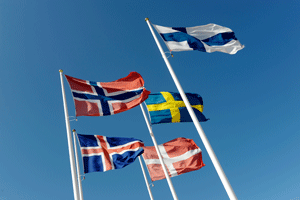
    Flags of Scandinavian countries

    The cornerstone of Nordic cooperation is the Nordic Council, which represents Denmark, Finland, Iceland, Norway, Sweden, the Faroe Islands, Greenland and Åland.

    The “Norden” consists of two separate but interoperable entities, The Nordic Council, an official inter-parliamentary body, and the Nordic Council of Ministers, a forum for Nordic inter-governmental cooperation. In addition to the Council and the Council of Ministers, there are more than 20 official Nordic institutions – and about the same number of unofficial ones. The Nordic Innovation Centre (NICe), NordForsk, Nordic Culture Point, Nordic Project Fund (NOPEF), the Nordic Centre for Welfare and Social Issues and the Nordic School of Public Health (NHV) are full Nordic institutions, as are the Nordic houses in Iceland and the Faroe Islands. One of the main institutions in the second category is the Nordic Investment Bank (NIB), which has been jointly owned by the five Nordic and three Baltic states since 2005. Another key organisation is the Nordic Cultural Fund, which supports culture in the Region as well as Nordic projects elsewhere in the world.

    Norden

    The Nordic Council is the official inter-parliamentary body. Formed in 1952, it has 87 elected members from Denmark, Finland, Iceland, Norway and Sweden, as well as the three autonomous territories (Greenland, the Faroe Islands and Åland). The members are all national MPs nominated by the party groups in their home parliaments. There are no direct elections to the Council. It is run by a Presidium and convenes for an annual autumn meeting called the Session, which passes recommendations to the national governments. The main priorities in the work of the Nordic Council are: climate, environment and energy; education and research; and welfare and culture.

    The cornerstone of the cooperation is The Helsinki Treaty, which regulates official cooperation between Denmark, Finland, Iceland, Norway and Sweden. It was signed on 23 March 1962 and came into force on 1 July 1962. The main objective of the treaty is to maintain and develop further co-operation between the Nordic countries in the legal, cultural, social and economic fields, as well as in those of transport and communications and environmental protection. In addition, the treaty establishes a foundation for joint positioning in matters of common interest which are dealt with by European and other international organisations and conferences.

    The Council of Ministers is the official inter-governmental body. The prime ministers have overall responsibility for its work. In practice, this responsibility is delegated to the ministers for Nordic cooperation and the Nordic Co-operation Committee, which co-ordinates the day-to-day work. Despite its name, the Council of Ministers, which was founded in 1971, consists of several councils. These councils meet a couple of times a year. At present, there are 11 of them.

    On of the areas of Nordic cooperation is the Arctic. The Nordic countries cooperate to improve the quality of life for the indigenous peoples in the northern areas and to promote social and cultural development for the Arctic people. Nordic cooperation also strives to protect the sensitive and characteristic Arctic nature, and to ensure sustainable use of the region’s resources, and protection of its biological diversity.

    An Advisory Expert Committee was established in conjunction with the adoption of the new Arctic Co-operation Programme in 2002. The Arctic Expert Committee is made up of Nordic members of the Arctic Council and representatives from the autonomous territories. In Nordic Council terms the Arctic Expert Committee will offer advice to the Ministers for Co-operation and the Nordic Co-operation Committee on matters relating to the Arctic.

    Following the increasing importance of the Arctic region in international politics, the Nordic Council will discuss the controversial question of a Nordic strategy for the Arctic Region in its meeting in Reykjavik, 21-23 March, 2012 . The meeting will also discuss oil extraction in the Arctic and recommendations for allocating responsibilities in the event of environmental incidents. A plenary session will be in the Icelandic parliament on Friday 23 March, 08:30-11:45 local time.

    Sources: Norden.org, Nordic Co-operation