Tag: Iceland

  • France and Iceland agree Arctic cooperation

    France and Iceland agree Arctic cooperation

    Össur Skarphéðinsson

    France has agreed to cooperation with Iceland regarding the Arctic. The foreign ministers of the two countries met this week to finalize the agreement.

    Mr. Össur Skarphéðinsson of Iceland and Mr. Alain Juppé of France met and discussed several matters.

    “We agreed to a cooperation regarding the Arctic. This is in line with our policy of engaging cooperation related to relative projects with as many nations as possible,” Össur said to Fréttablaðið.

    France will invite Icelandic researchers to their stations, both in Ny Alesund in Svalbard and to Antarctica. Iceland will invite French specialist to Akureyri for research there.

    Close cooperation between the University of Akureyri and the established University Pierre and Marie Curie will be engaged.

    Iceland will also participate in a big project related to economic and social impacts of climate change in the Arctic.

    Sources

    Fréttablaðið

  • Oil service station in Iceland?

    Oil service station in Iceland?

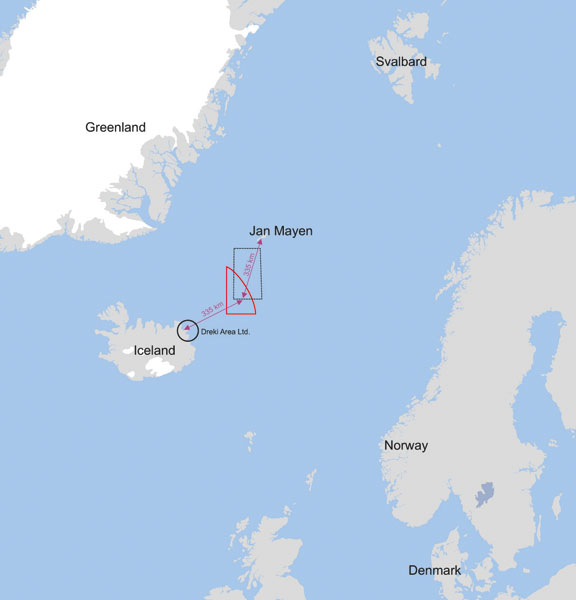
    Map of the Dreki area

    Norwegian company Sagex Petrolium has requested information about servicing for oil entities in the eastern part of Iceland. Looking to the Dreki area, oil processing could be feasible in the area in the near future.

    The request was sent to Norwegian authorities. The area is just south of Jan Mayen, but the most promising oil area is around 260km from the islands.

    The distance to the nearest harbour in Iceland is 400km. The advantage is that Iceland has infrastructure in place and a good airport and deep fjords, convenient for sailing.

    Jan Mayen is not feasible since the infrastructure is small and the airport primative. It would mean a lot of money and nature röskun for the area.

    Although oil is thought to be in the area, it is not clear if it is in workable state.

    The municipality of Þórshöfn, Langanesbyggð, is already working on possible oil servicing areas in the eastern part of Iceland, in conjunction with the town of Vopnafjörður.

    Sources

    Stöð 2 TV Channel

  • Huge unused energy resource in Iceland

    Huge unused energy resource in Iceland

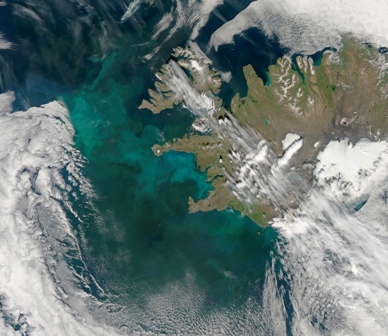
    Satellite image of Iceland

    Iceland is falling behind when it comes to usage of tidal power. The small nation in the Northern Atlantic is surrounded by ocean, yet it has failed to use its forces for energy.

    Research on tidal power has been miniature in Iceland. Geothermal energy has been the focal point.

    A total of 21 members out of 63 in the Parliament in Iceland have put forward a suggestion of more research and more money looks likely to be put in the research.

    A database of information will be set up in Iceland on the usage, which is long overdue. An expert thinks that this is one of the biggest unused energy resources in Iceland.

    Icelandic company Valorka has been granted the IIA 2011 awards for its invention, the Valorka turbine.  IFIA (International Federation of Inventors) grants this awards and the company has high hopes for the turbine.

    Valdimar Össurason is the inventor and owner of Valorka. “The Irish have researched their potential energy efficiency from tidal power to around 240tw hours per year. If we localize that to Iceland, it would be 330tw hours per year. That is 20 times the energy usage in Iceland, per year,” he said.

    A prototype for testing underwater will be made is his research is successful.

    Sources

    Fréttablaðið

  • High hopes for Dreki oil

    High hopes for Dreki oil

    Map of the Dreki area

    There are high hopes for oil in the Dreki Area, south of Jan Mayen and North of Iceland.

    Norway and Iceland are joint owners of the area and could potentially benefit both countries.

    New samples are impressive and could increase interest in the area. Although the samples are positive, they are confidential, and will only be given to those who will search in the area.

    Specialist from Norway met their colleagues from Iceland last week. These samples were on the agenda, and next explorations which will be conducted soon.

    Þórarinn Sveinn Arnarsson, project manager for the Icelandic Energy Administration, told RÚV that further exploration is mostly on the Norwegian side.

    “A new exploration will most likely go to the area next summer, but that will also depend on what else we find from the last survey, samples are still being researched,” he said.

    A report from the company that conducted the research will be ready next month.

    Bidding for the search will then open in April.

    Sources

    RÚV (Icelandic National Television)

  • Iceland stands by its name

    Iceland stands by its name

    Iceland, covered with snow and ice.

    Iceland showed last week why it is indeed ice-land. This amazing photograph taken by a NASA satellite is from the Earth Science department of the University of Iceland.

    The picture was taken the 9th of December at 12.58.

    The freezing temperatures last week went down to -27 in Northeast Iceland, in Mývatn. The record low temperature is for Iceland is -38, the year 1918 often dubbed the “Frosty Winter”.

    The image, which you can expand by clicking, shows that sea ice is stretching from the North to Iceland.

    Only a few days later the temperature was above 0 again.

    This truly is Iceland.

    University of Iceland
    NASA

  • Icelandic glaciers melting fast

    Icelandic glaciers melting fast

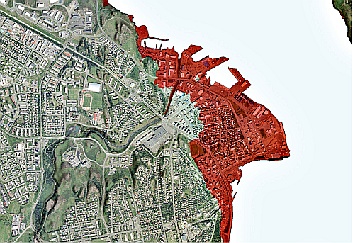
    Reykjavík if sea levels rise 6m.

    Iceland could lose all its glaciers in a few hundred years. A glacier expert predicts a 6m rise of the sea.

    DV newspaper reports that climate change is melting the glaciers and in about 200 years the glaciers could all be gone.

    “Climate change has hit us with full force. This is very visible in the Arctic,” glacier expert Tómas Jóhannesson told DV.

    It is only 6000-8000 years ago Iceland was glacier free.

    Rise of sea levels will continue but in the 20th century the levels rose of about 2mm each years, around 20cm the whole year.

    Akureyri if sea levels rise 6m.

    “Now the rise if about 3mm a year,” Tómas said and this will continue to rise.

    Naturally this is of great importance in Holland and the Dutch predict 1m rise of sea levels in the 21st century.

    If the Greenlandic glacier would melt it would raise the sea levels of about 6m. DV had expert draw maps of how towns in Iceland would look like if the sea levels rise the whole 6m.

    Source: DV

  • New Icelandic guard ship celebrated

    New Icelandic guard ship celebrated

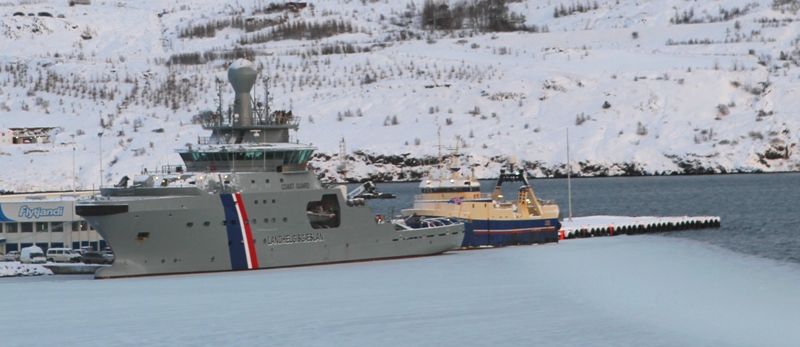
    Thor in the port of Akureyri.

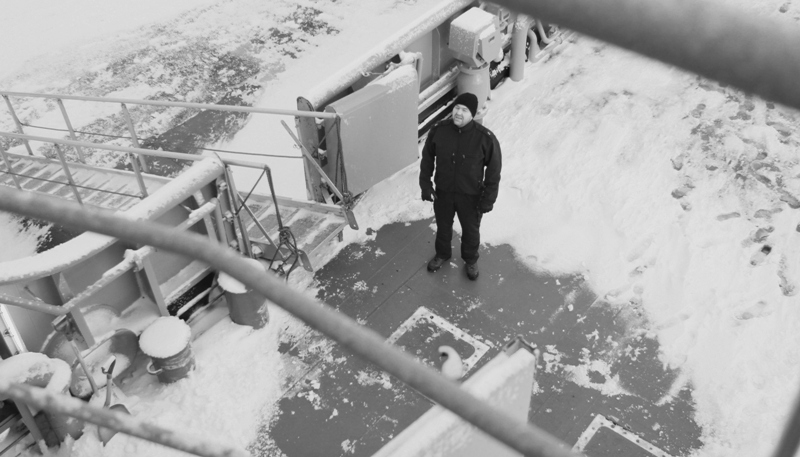
    “No, congratulations to you!” one of the crew in new Icelandic guard ship Þór (named after the God of Thunder) told me as I walked aboard to have a look around. “This belongs to all Icelanders, and they should all be proud if it,” he said and smiled.

    And what a revolution it is!

    The ship is designed to be efficient in a number of challenging circumstances. It can serve as headquarters for national emergencies, it has an oil rinsing system built to prevent oil spills to disperse, it has a powerful system to fight fires and countless other activities.

    Crew member on board

    It can give helicopters fuel; it can measure depth and search underwater, can carry up to six containers, cars and provide electricity to land if needed.

    “Yeah, its taken a while to learn all of the things we need to learn on a new ship,” a crew member admitted.

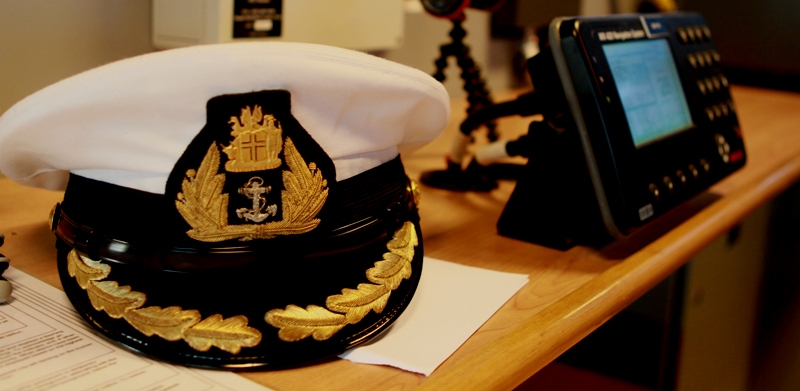
    It also has a gun, but as the captain said, “it’s mostly for decoration. I think it is from World War 2!” The cannon is active, but its role is more symbolist than for usage. The guard ship is therefore mostly unarmed.

    Property of the Captain

    The shape is a tow boat, and the impressive thickness of the tow wires is actually built to tow up to 250 tons. The complex system also allows the ship to GPS-lock in a position with another ship, for example staying North-East and 70 meters from another ship.

    The ship is 93.80 meters long, 16 meters wide, 32 meters high and 3920 tons. Its maximum speed is 19.5 knots.

    It is specially built for sailing in ice covered waters, the strength is 1B (1A Super is for 1.0 m thick ice, 1A for 0.8m and 1B: 0.6 m. thick ice.

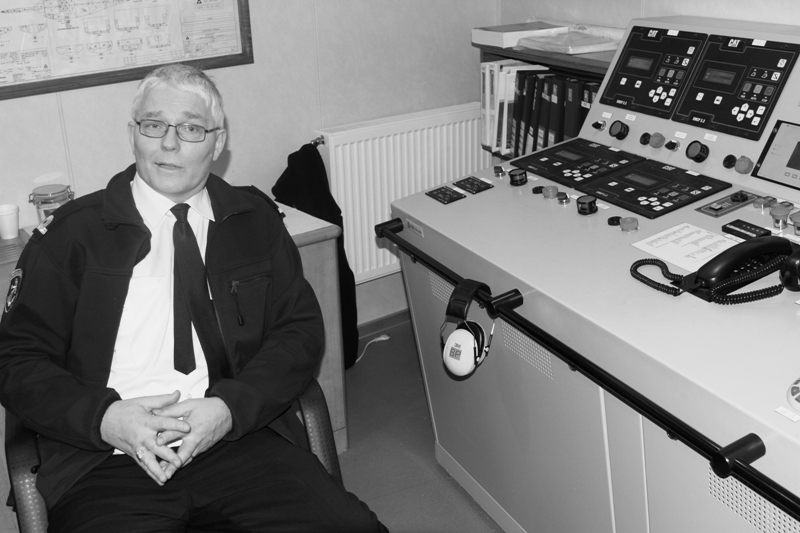
    Chief engineer at the coast guard ship Thor

    Increased shipping around Iceland meant that a new ship was a necessity. With the Northern Sea Route increased traffic, this is a great addition to the Icelandic fleet.

    It can help monitoring and with search and rescue in the Arctic Ocean. With Iceland also drilling for oil in the Dreki Area, a guard ship is essential, especially if production will begin in the area.

    The multi-tasking ship brings a smile to the Icelandic coast guard, and the celebration by going around Iceland, opening it up for the people, shows their pride.

    “This ship is truly a revolution,” the captain proudly states. And rightly so.

  • The Cod Wars – Iceland vs. Britain

    Icelandic patrol ships nears an English trawler

    The cod wars were political disputes between the governments of Iceland and Britain over fisheries management in the Icelandic maritime waters. The disputes were numerous between the years 1948 and 1976 and are called the Cod wars. The cod wars were numerous; they can be counted as three or even four.

    The first dispute was in 1950. The territorial waters were moved up to 4 miles much to Britain’s annoyance since they utilized the Icelandic fisheries. Because of the four mile limit, they could not fish as much as before. This decision created a lot of conflict and Icelandic fish was banned from England, up until 1956 when the dispute ended.

    The second dispute was in 1958. The territorial waters were moved to 12 miles according to the United Nations Geneva Convention on Law of the Sea. Britain was again furious, sending the vessel HMS Russell to Iceland.

    It’s captain accused the captain of Icelandic coastal guard vessel Ægir of trying to sink the vessel. Protests were held in Reykjavik against Britain were held but the dispute ended in 1961.

    The third dispute was in 1972. Iceland would yet again move its territorial waters, not up to 50 miles. And again the Brits were unhappy, sending army vessels to Iceland to protect the British boats, who were fishing within the 50 mile territorial zone.

    For the first time the Icelanders used a new weapon they invented themselves.

    On September 5th 1972 the Icelanders encountered an unmarked trawler fishing northeast of Iceland. The captain of the trawler refused to divulge the trawler’s name and number, and, after being warned to follow the Coast Guard’s orders, played Rule Britannia over the radio.

    The net cutters

    That resulted in Iceland deploying the net cutter into the water for the first time and Ægir sailed along the trawler’s port side. The fishermen tossed a thick nylon rope into the water as the patrol ship closed in, attempting to disable its propeller. After passing the trawler, Ægir veered to the trawler’s starboard side.

    The net cutter, 290 meters in length, went behind the patrol vessel, sliced one of the trawling wires. As Ægir came about to circle the unidentified trawler, its angry crew threw coal as well as garbage and a large fire axe at the Coast Guard vessel.
    A truce was made in 1973.

    The fourth dispute was in 1975 when Iceland moved its territorial waters up to 200 miles. Britain refused to oblige and kept fishing in Icelandic waters. Only 24 hours after the law passed Iceland used the wire cutters again, now on Primella trawler from Hull.

    The disputes were getting dangerous and Britain kept sending navy vessels to Iceland which instead used their wire cutters.

    After the nations met in Oslo in 1976 the disputes finally ended.

    Iceland had many good weapons which led to them winning all the battles.

    Firstly they could point out that if Britain would break any laws Iceland would resign from NATO and therefore dismiss the US Army from Iceland. That was a strong weapon.

    Secondly the laws were in favour of Iceland and many supported the small nation against the big old empire.

    And lastly it was clear that Britain could not use army vessels to protect their trawlers when fishing forever.

    Source: The Cod Wars
  • Russia and Iceland sign agreement

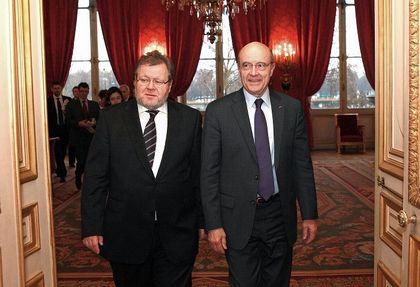
    Iceland and Russia have signed a cooperation agenda regarding geothermal energy.

    The agreement was signed yesterday by Icelandic Minister of Industry Energy and Tourism, Katrín Júlíusdóttir, and Sergey Shmatko, the Minister of Energy in Russia.

    Russia wants to utilize geothermal energy better and Iceland seeks new ways to utilize the vast geothermal resources in the country.

    Both countries believe they will gain significantly from the cooperation.

    An energy summit in Moscow this week saw Ms. Júlíusdóttir address geothermal matters in Iceland and the forthcoming cooperation with Russia.

    As Arctic Portal has reported, Iceland has looked to Russia for more cooperation and the agreement signed this week was a step in that direction.
    Source: Ministry of Foreign Affairs in Iceland

  • Value of fisheries

    Fish export value by countries

    Fishing is the most important economy in Greenland, and a huge factor in Iceland.

    Although the numbers might not be as big in value as in Canada and Russia for example, fishing in Greenland counts for a total of 94% of the countries economy. Shrimps are 63% of that number.

    Comparison between the numbers in tons can bee seen here.

    Iceland exports fish in large style, but aluminum is another big export value.

    Other Arctic countries are all around 1% of fisheries regarding export value.

    In USA the number is around half a percent, but closer to 1.5 in Russia.

    The picture on the right shows the importance of fishing in the Arctic, where Greenland and Iceland stand out.