Tag: impact

  • Shipping Impacts

    Oil spill

    The Arctic contains some of the last physically undisturbed areas on the planet, something that is becoming very rare in modern times. In recent decades, and especially during this millennium, the Arctic has also been undergoing extraordinary environmental changes. The Arctic is known as a storehouse of massive supplies of natural resources, which is increasing pressure on their extraction due to high commodity prices and a growing worldwide demand for them.

    Increasing regional and coastal marine transport to support the exploration and extraction of oil, gas and hard minerals, coupled with the increasing presence of the global marine tourism industry, can bring various users to the maritime Arctic. The potential impacts of these new marine uses can become significant. However, speculative they might seem, social, environmental, cultural and economic impacts will become a reality, and have, to a certain extent.

    Environmental impacts

    The environmental consequences of increased commercial shipping in the Arctic could become quite serious, not only from accidental oil spills, but also from increased pollution caused by operational discharges of oils and chemicals. Arctic ecosystems can be affected by pollution, noise, alien species, ships colliding with marine mammals, and general disturbance, including loss of feeding and breeding areas.

    Problems can be caused by ships involved in oil and gas exploration and exploitation, including tankers, as well as by general cargo vessels, naval vessels, fishing vessels, tourist cruise ships, and even scientific research vessels. Despite the seriousness of rare catastrophic oil spills, chronic low-level pollution over many years from all kinds of ships poses the greatest threat to the environment and may affect all ecosystems within a given area.

    Contaminants accumulate in the body fat of Arctic organisms because they have evolved to store food for use in their bodies when none is available in the frozen environment. These contaminants are then passed up through the food chain, even to human beings.

    Environmental protection measures

    Increased shipping activity in the Arctic raises the potential for increased numbers of shipping accidents with the detrimental human and environmental effects that might follow.

    Prevention of marine accidents and actions designed to strengthen the effectiveness of preventive measures, can be critical for Arctic marine shipping given the difficulties of responding once an incident has occurred. Preventive measures include ensuring that vessels operating in the Arctic meet appropriate design, construction and equipment standards; that vessel personnel have the specialized skills needed for operating in Arctic conditions.

    Emergency response is particularly challenging in the Arctic for a variety of reasons, including the remoteness and great distances that are often involved in responding. Additionally, the impacts of cold, ice and a harsh operating environment on response personnel and equipment; and the lack of coastal infrastructure and communications to support and sustain a response of any significant magnitude, is immense.

    International conventions relating to ship construction, crewing standards and other aspects of maritime safety apply in all ocean areas for vessels that are flagged in States that are parties to the conventions. However, these standards are not necessarily adequate for ships operating in the environmentally fragile, dangerous and remote polar waters.

    Polar Bear in Svalbard

    Impact of tourism

    Tourism has increased dramatically in the Arctic, because of increased awareness of its beauty and undisturbed nature and also because of a desire to see it before the ice melts and the animals disappear.

    However, excessive tourism could cause environmental damage both from the usual problems caused by an increasing number of vessels and because waste from garbage and sewage would have to be disposed of.

    More generally, if all the new single-year sea ice melts, navigation in the Arctic could remain hazardous for some time to come, as multi-year ice will linger and so will icebergs, in particular those calving off melting glaciers.

    This could result in more accidents, causing further problems, including pollution by leaking heavy fuel oil from cruise ships.

    Source:
    The AMSA report (2009)
  • Trans-Arctic Shipping

    Trans-Arctic Shipping

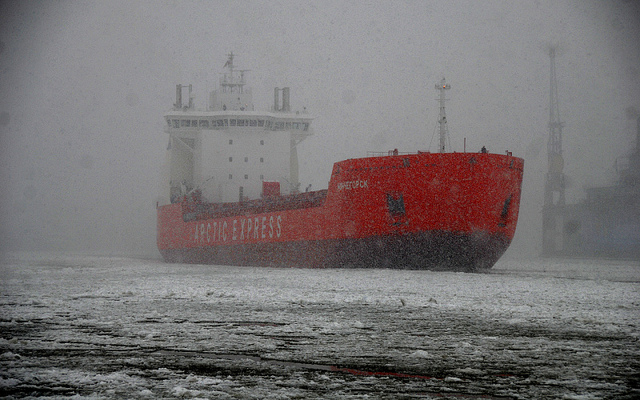
    Cargo Ship

    The Arctic is comprised of a large ocean area and land areas of eight states: Canada, Denmark (Greenland), Norway (Svalbard), Russia, USA (Alaska), Finland, Sweden and Iceland. The Arctic’s most pronounced feature, at least until very recently, has been the large ice-covered ocean. However, significant changes are taking place in the Arctic area, both on land and especially on the maritime areas.

    The 2004 Arctic Climate Impact Assessment listed the range of impacts that are occurring in a warming Arctic from human-influenced climatic change. The report concluded that the temperature has risen at twice the rate as in the rest of the world in the past few decades and there is increasing evidence of widespread melting of glaciers, permafrost and sea ice.

    The earth’s climate change, due primarily to increased emissions of carbon dioxide and other greenhouse gases, has been particularly intense in the Arctic. These changes have already reduced the extent and thickness of the sea ice in both the Arctic Ocean itself and the sea routes on each side.

    With its fleet of polar icebreakers, Russia has been able to use its Northern Sea Route for up to 6 months a year, although such use has thus far been limited to the support of exploration of its own resources and has not included international shipping. Such shipping, however, is bound to develop within the foreseeable future, particularly since the ice obstacle is not quite as severe on that side of the North Pole.

    Although Trans-Arctic shipping is commonly linked with favourable weather conditions, i.e. warmer climate, ice-free ocean and relatively calm weather, climate is not the only thing that encourages Trans-Arctic shipping.

    Other factors can make it even necessary for future development of the area and the world as a whole. However, those factors can change or even lose their weight in near future but as it stands they dominate the discourse on Trans-Arctic shipping.

    Why Trans Arctic Shipping?

    Currently the main driving force for shipping trough the Arctic Sea is transport of oil or gas from Arctic Russia. The discussion on Trans-Arctic shipping evolves, however, around the issues of global warming, Greenhouse Gas emission restrictions, changes in the geopolitical landscape, possible exploitation of fossil fuel fields in the Arctic and sustainable development in the Arctic. Although those factors do not possess predominant force to encourage Trans-Arctic shipping single-handedly, together they form a great pressure on the global society to prepare for new transportation routes.

    Preparations for ice fishing in Uummannaq, Greenland

    New technologies

    New technologies are important and sometimes essential for development in the Arctic. New ships with icebreaker abilities can shorten the transportation route from Yokohama (Japan) to Rotterdam from 11.212 nm (Suez Canal) to 7.825 nm which is roughly 30% shorter.

    This difference does however not have any relevance still, because the cost of these new ships are at average 150% on top of the cost of a normal new cargo ship.

    This means that it is unlikely that Trans-Arctic shipping can become lucrative, unless oil-price and charges for shipping canals rise and the building cost of Arctic-suitable ships drops.

    However, a significant reduction of sea-ice in the Arctic renders this formula obsolete so it is hard to point a finger on when Trans-Arctic shipping will emerge as a competitive commercial transport alternative.

    It is worth mentioning that technological advancement in the sector of extraction of non-renewable resources can also affect advancement in navigation. It would obviously not have any practical value to be able to pump oil from the seabed in -40°C if no ship would be able to transport the oil from the location.

    However, it is safe to say that this factor is largely dependant on the other factors but might become more important in the coming years. It should however be kept in mind that the race for resources in the Arctic really controls the development in this area.


    United Nations Framework Convention on Climate Change (adopted 9 May 1992, entered into force 24 March 1994) 31 ILM 849