Tag: journey

  • Successful journey of the Snow Dragon continues

    Successful journey of the Snow Dragon continues

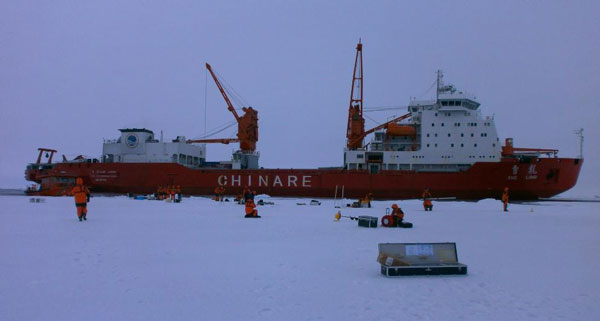
    The Snow Dragon

    The journey of the icebreaker Xue Long from Iceland to China, via the Arctic Ocean, has been successful so far. With the decreasing sea ice extent, the research ice-breaker has been able to sail through the Central Arctic Shipping Route without a support from nuclear powered vessel.

    Due to such an ice conditions, the research ice-breaker was able to operate via Fram Strait and carry on a high Arctic region to the east.

    Arctic sea ice extent fell to 4.10 million square kilometers on August 26, 2012. This was 70,000 square kilometers below the September 18, 2007 daily extent of 4.17 million square kilometers.
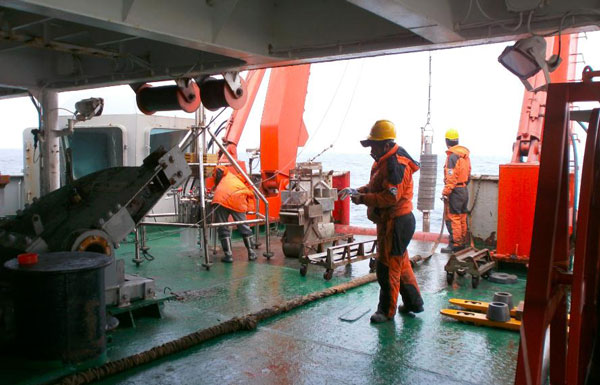
    Geological research: Gravity core launched in the Iceland Sea.

    Oceanographic, biological, geological and geophysical research was carried out in the Iceland Sea and Greenland Sea on the route north and meteorological observations are maintained throughout the expedition.

    Various satellite images are received for navigation through the sea ice.

    Benthic samples, from the shore lines of Icelandic waters were taken in order to prove benthos great increase in region that extends away from the land mass.

    Benthic sampling techniques are essential to habitat mapping studies since they provide the ‘truth’ data on the actual composition of the seafloor. When they are commonly used in conjunction with either a remote sensing or an acoustic technique, they are said to ‘ground truth’ seafloor classifications.

    Benthic sample from the Iceland Sea

    If samples are collected in high enough densities over survey areas they can be used to establish distributions and define habitats.

    Biological and geological/physical samples taken by the Geological Team from the Xue Long are to be taken separately from different grabs.

    Sailing out from Iceland, the Snow Dragon reached the region east of Jan Mayen, where in the good weather it was possible to see the Beerenberg volcano.

    It is the world’s northernmost sub aerial active volcano. The volcano is topped by a mostly ice-filled crater about 1 km (0.6 mi) wide, with numerous peaks along its rim including the highest summit, Haakon VII Toppen, on its western side.

    The upper slopes of the volcano were observed to be largely ice-covered, with several major glaciers including five which reach the sea.

    No scientific research was conducted by teams, nevertheless the elevation was difficult to be missed.

    Currently the vessel is heading up North, aiming to cross the North Pole. The ice conditions were reported as being almost 3 meters thick. The Snow Dragon is partly being followed by the Norwegian coast guard.

    Please, see the route of the Chinese research ice breaker on Interactive Mapping System.

    Source
    CHINARE5

  • Fastest journey to Antarctica confirmed

    Fastest journey to Antarctica confirmed

    Antarctic arctic trucks

    Icelandic company Arctic Trucks announced today that a new world record of the fastest overland journey to the South Pole has been officially recognized by Guinness World Records.

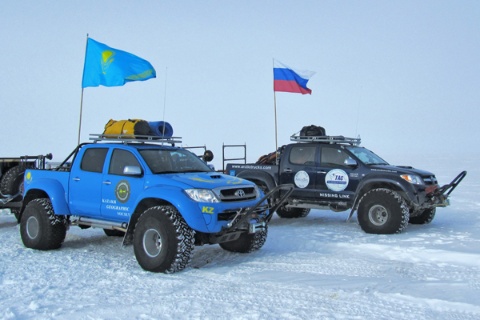
    In December 2010 two Arctic Trucks vehicles crossed 2308km of the Antarctica High Plateau from Novolazarevskaya station (Novo) to the South Pole in 108 hours (4.5 days). The purpose-built AT Expedition vehicles, based around a Toyota Hilux platform, traveled at an average speed to South Pole of 21.4km/h and average fuel efficiency of 2.2km/per liter, with only a single refueling stop on the way.

    An unofficial improvement on the record itself was achieved for the return journey, which was faster still at only 3.5 days, averaging 27.5km/h. No comparable speed or fuel efficiency has ever been recorded for high plateau expeditions in Antarctica. Arctic Trucks built vehicles have now clocked over eighty thousand kilometers on the plateau, proving new benchmarks for speed, range, reliability and fuel efficiency for overland travel in this area.

    “This route to the South Pole is extremely challenging. Our vehicles are operating at altitudes up to almost 3500m, in ultra-low temperatures and in very difficult snow conditions. The vast distance is a challenge in itself, with up to 1500km between fuel depots. We are delighted to celebrate this new world record with the team, which also marks a growing recognition of the power of Arctic Trucks solutions for expedition use,” commented Emil Grímsson, Executive Chairman of Arctic Trucks.

    “There is a fast growing interest from customers who are looking to supplement slower, less fuel-efficient tracked vehicles with faster, lighter and cleaner vehicles. We have great respect for the fragility of Antarctica and our vehicles have opened up new possibilities for scientific research programs to operate more efficiently in this environment.”

    The two Arctic Trucks vehicles used for this round trip were both Arctic Trucks Expedition AT44 models. Arctic Trucks designs and builds these vehicles based around the Toyota Hilux 3.0 liter turbo diesel.

    The expedition was organized by the Kazakhstan National Geographic Society (KNGS) and The Antarctica Company (TAC). The core expedition team consisted of Konstantin Orlov and Stanislav Makarenko from KNGS, Andrey Myller from TAC and Hlynur Sigurðsson from Arctic Trucks.

    Four further expeditions to the South Pole using Arctic Trucks vehicles are planned for the season of 2011, three starting from Novo and one from Patriot Hills.

    Source: ArcticTrucks and Guiness World Records.