Tag: little ice age

  • Life found in the Little Ice Age

    Life found in the Little Ice Age

    Arctic trees are older than many thought

    Many established scientist thought that trees were wiped off in the north in the Little Ice Age, which started some 115.000 years ago. That is not the case according to Danish scientist.

    Their newly published study claims that that conifer grew in northern Scandinavia in the glacial period despite several kilometer thick ice sheets.

    A huge ice sheet covered the Northern region of the world, melting some 9000 years ago. But the research show that the conifers protruded from the enormous ice sheet, on islands and in coastal areas.

    “This means that we need to rethink how life reacts to global climate changes and that life on Earth is a lot more robust than we think,” says Professor Eske Willerslev, of the Centre for Geogenetics at the University of Copenhagen, who headed the research.

    The scientist used DNA technology to determine that the trees did not have to completely emerge from the south around 9000 years ago, some actually survived.

    The Swedish professor of physical geography at Umeå University, Leif Kullman, caused a heated debate among scientist when he claimed that he found remains of trees throughout Scandinavia that dated back before the time the ice melted away. That suggested that ice free areas did exist, causing a stir in the scientific community. Now the new proof supports Kullmans theory.

    After researching over 100 European spruces the researchers found two gneric types, one of which is only found in Scandinavia. The other specie migrated from the south.

    Sediments at the bottom of a lake in Trøndelag in central Norway revealed samples of 10,300 year-old DNA, which indicate that the indigenous Scandinavian spruce type was located in central Norway, while the country was supposed to have been covered by a thick layer of ice.

    From samples dating back some 20,000 years, they also managed to identify DNA from both pine and spruce on the island of Andøya in northwestern Norway. “This means that Kullman, who everyone though was mad, was probably right,” says Willerslev.

    Sources
    Science Nordic

    BBC

  • Little Ice Age caused by volcanic eruptions

    Little Ice Age caused by volcanic eruptions

    University of Colorado Boulder Professor Gifford Miller

    The Little Ice Age is a cold period that scientist have debated when begun, and how it started. New research sheds new light on this important time in question.

    A new study published in the Geophysical Research Letters, states that the Little Ice Age was caused by the cooling effect of several volcanic eruptions and sustained by changes in the Arctic ice cover.

    The research team conducted its work in Iceland and Canada, both in and near glaciers, and in ancient plants.

    The eruptions happened earlier then many have predicted the ice age began, just before 1300. Nasa for example says that it happened around 1550.

    This resulted in the Earth getting colder for centuries. The global dip was around 1°C, but parts of Europe cooled even more. The Thames River in London even froze.

    Disputes have arisen over what caused the cooling, but the new study concludes it was the volcanic eruptions. The four eruptions between 1250 and 1300 blasted huge clouds of sulphate particles into the upper atmosphere which cooled the Earth, because the sun´s beamc was reflected back into space.

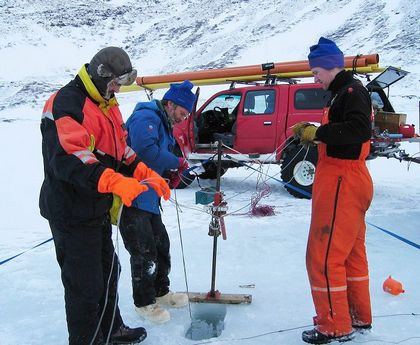
    Researchers in Hvítárvatn Iceland

    “This is the first time we can put an almost specific dates to the Little Ice Age,” Icelandic researcher Áslaug Geirsdóttir said. She was one of the partners in the project.

    “Key elements were the cores taken from the bottom of Hvítárvatn lake,” she said. The lake is near Langjökull in Iceland.

    The scientists studied several sites in north-eastern Canada and in Iceland where small icecaps have expanded and contracted over the centuries. When the ice spreads, plants underneath are killed and “entombed” in the ice. Carbon-dating can determine how long ago this happened, according to the BBC.

    These plants provide a record of the icecaps’ sizes at various times – and therefore, indirectly, of the local temperature.

    An additional site at Hvítarvatn in Iceland yielded records of how much sediment was carried by a glacier in different decades, indicating changes in its thickness.

    When the researchers plugged in the sequence of eruptions into a computer model of climate, they found that the short but intense burst of cooling was enough to initiate growth of summer ice sheets around the Arctic Ocean, as well as glaciers.

    The extra ice in turn reflected more solar radiation back into space, and weakened the Atlantic Ocean circulation commonly known as the Gulf Stream.

    The eruptions are known to cool the earth for a short period of time, not 8000 years, but the scientists have discovered how this happened.

    Sources

    Geophysical Research Letters

    BBC

    NASA

    Fréttablaðið


    The tags below provide an opportunity to view previously posted related news within the selected category