Tag: melt

  • Greenland´s ice cap melt rapid spread

    Greenland´s ice cap melt rapid spread

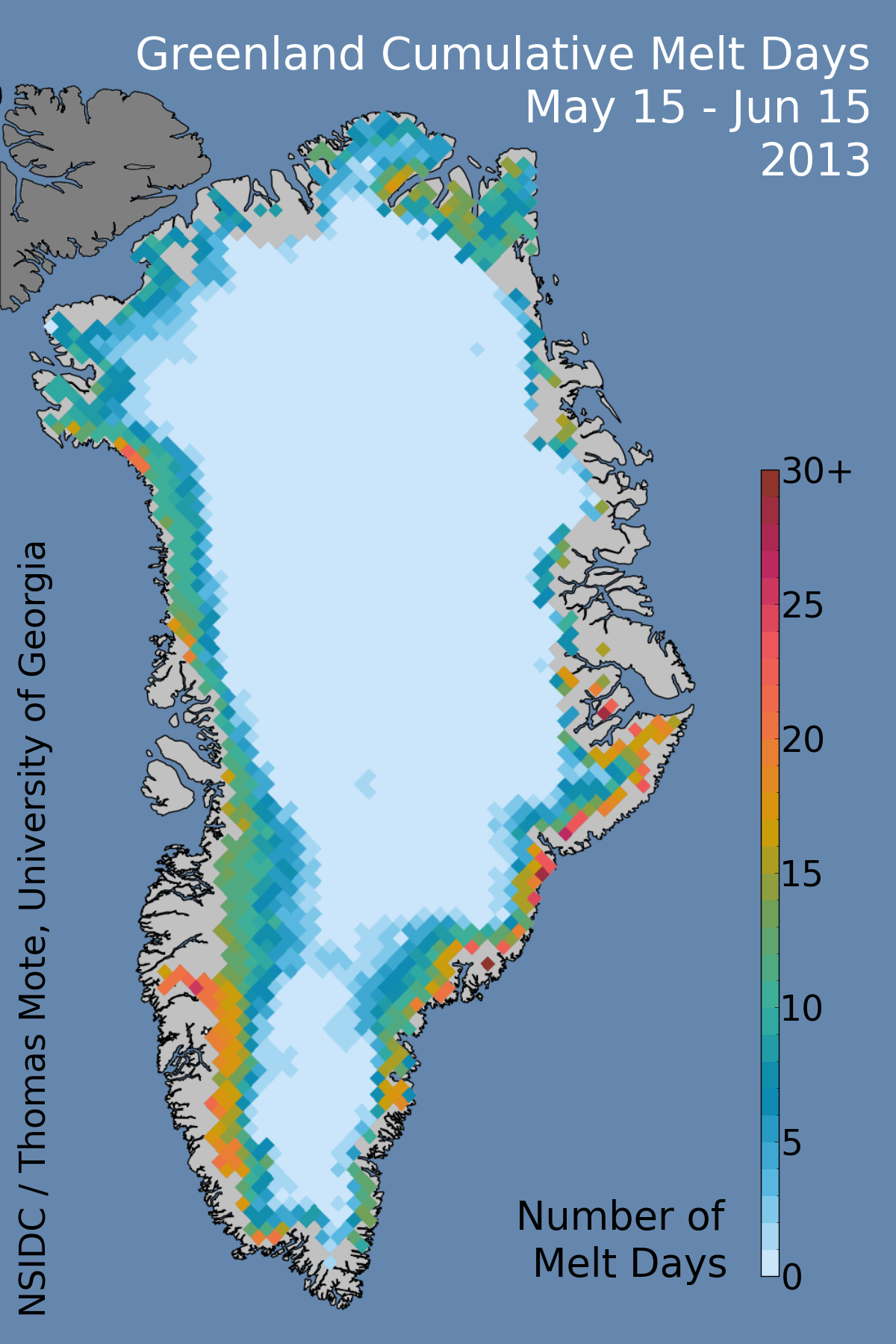
    Cumulative surface melt days for mid-May to mid-June in Greenland.

    Summer melt on Greenland ice sheet had slightly late start this summer but the surface has been now melting very quickly.

    In the last three months the melt has been spreading rapidly over the significant area, extending over more than 20% of the ice sheet in early June and reaching above 2000 meters elevation in some areas.

    The satellite used for the research reported small lakes that started to form on the ice sheet.

    After the annual re-calibration of the melt algorithm in mid March, very little melt was detected until May.

    A few southern coastal areas began melting in mid-May, followed by inland higher-elevation ice and all remaining coastal areas about June 3, when warmer conditions arrived.

    Surface melting reached the “Saddle” region of the ice sheet on June 11 and 13. Only the central eastern coast remains relatively melt free.

    Cool conditions in April and May shifted to warmer-than-average weather along both coasts in early June, which initiated more widespread melt on the ice sheet.

    The sea ice on both sides of Greenland remained at near-normal extent through the period.

    More information about this year´s melt of Greenlandic ice sheet is available at National Snow and Ice Data Center, University of Georgia.

    Source

    National Snow and Ice Data Center

  • Greenlandic ice sheet to melt completely?

    Satellite image of Greenland

    The Greenlandic ice sheet may completely melt in 2000 years as it is more vulnerable to global warming than previously thought. This is the results of a study released this week.

    The conductors were scientist from the Potsdam Institute for Climate Impact Research (PIK) and the Universidad Complutense de Madrid.

    The temperature threshold for melting the ice sheet completely is in the range of 0.8 to 3.2 degrees Celsius of global warming, with a best estimate of 1.6 degrees above pre-industrial levels. Today, already 0.8 degrees global warming has been observed. The time it takes before most of the ice in Greenland is lost strongly depends on the level of warming.

    “The more we exceed the threshold, the faster it melts,” says Alexander Robinson, lead-author of the study now published in Nature Climate Change.

    In a business-as-usual scenario of greenhouse-gas emissions, in the long run humanity might be aiming at 8 degrees Celsius of global warming. This would result in one fifth of the ice sheet melting within 500 years and a complete loss in 2000 years, according to the study.

    “This is not what one would call a rapid collapse,” says Robinson. “However, compared to what has happened in our planet’s history, it is fast. And we might already be approaching the critical threshold.”

    In contrast, if global warming would be limited to 2 degrees Celsius, complete melting would happen on a timescale of 50.000 years. Still, even within this temperature range often considered a global guardrail, the Greenland ice sheet is not secure.

    Previous research suggested a threshold in global temperature increase for melting the Greenland ice sheet of a best estimate of 3.1 degrees, with a range of 1.9 to 5.1 degrees. The new study’s best estimate indicates about half as much.

    “Our study shows that under certain conditions the melting of the Greenland ice sheet becomes irreversible. This supports the notion that the ice sheet is a tipping element in the Earth system,” says team-leader Andrey Ganopolski of PIK.

    “If the global temperature significantly overshoots the threshold for a long time, the ice will continue melting and not regrow – even if the climate would, after many thousand years, return to its preindustrial state.”

    Sources

    PIK Potsdam

  • Greenland rises after melt

    Greenland rises after melt

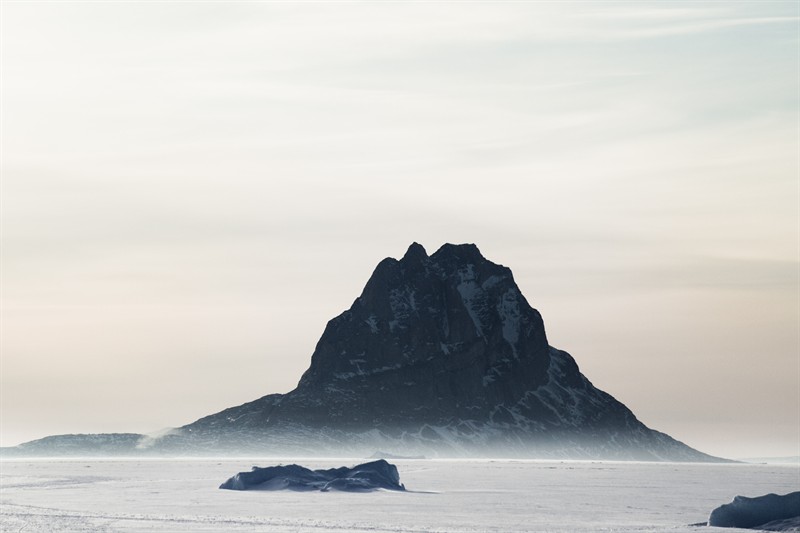
    Foggy peak in Uummannaq, Greenland

    Greenland is rising from the sea. A new study released on Friday shows a startling revelation to scientists who study global warming.

    Scientist from Ohio State University used a network of high profile GPS stations to measure the uplift. The results show that the rate of ice loss has accelerated in southern Greenland by 100 billion tons.

    Michael Bevis led the exploration. “Pulses of extra melting and uplift imply that we’ll experience pulses of extra sea level rise,” he said about the results.

    This means the sea has risen and splashed further, and with more power, on the ice which then melts faster. He states that this is partly due to global warming.

    Previous studies have recorded measurements indicating that as that ice melted away, the bedrock beneath it rose. In some places the land rose 5cm in only 5 months. The medium rise was 0.5 cm.

    Source: The State Column