Tag: melting

  • Antarctica airstrip melting fast

    Antarctica airstrip melting fast

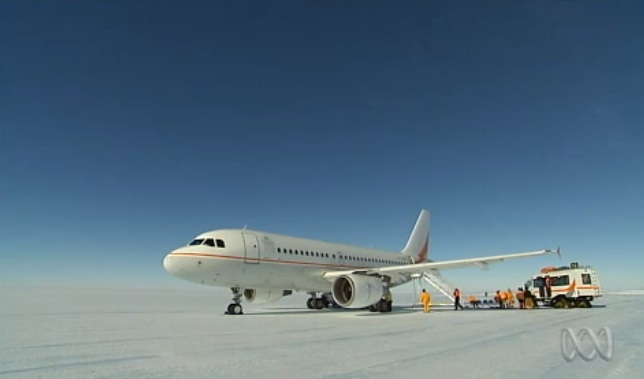
    Australian plane in Antarctica

    The Australian runway on Antarctica is melting fast. The melting is causing problems in transport and there will be no flights from Australia to January.

    Australia will seek help from China with transport if needed.

    It is possible that a new airstrip of gravel will be made in the future.

    The $46 million Antarctic air link opened four years ago with the expectation of 20 flights to the Wilkins runway near Casey Station each season.

    Antarctic flights in 2009-2010 were supposed to be 20 for each season, but were 14 in the earlier season and only two in the latter. In 2011-2012 season all four planned flights were achieved and now for 2012-2013 there are six flights scheduled.

    Australian Antarctic Division chief Tony Fleming says that safety issues are very strict. “Once it gets to above minus five degrees in the ice, then there are safety parameters which mean we can’t [land] aircraft on that. Some way down in the ice, if it becomes above that temperature, we can’t guarantee the structural integrity of the surface.”

    The Wilkins runway is used to get vital equipment, medical supplies, people and food to the continent.

    Source:
    ABC

    See also:
    Video about the story

  • Western Greenlands melts fast

    Greenland heat map

    The melting of the Greenlandic glacier is rapid. The record of 2010 was not broken this year, yet it was over the long term average melt.

    The National Oceanic and Athmospheric Administration (NOAA) has compiled the melting days in an image which shows where the melting occurs.

    Melting was exceptionally high over the western mid-elevations, and the map shows the area swathed in orange.

    In some places, the melt season lasted up to 30 days longer than average (the top of the scale corresponds to anomalies 25 days or more), and it affected 31 percent of the ice sheet surface, making 2011 one of just three years since 1979 where melt area exceeded 30 percent.

    According to the Arctic Report Card, ice mass loss from Greenland in 2011 was about 430 gigatons, enough ice to raise global sea level by just over 1 millimeter.

    Source: NOAA

  • Icelandic glaciers melting fast

    Icelandic glaciers melting fast

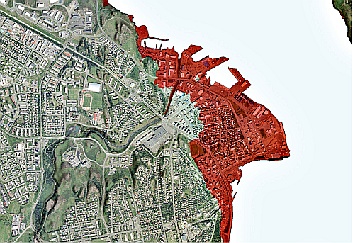
    Reykjavík if sea levels rise 6m.

    Iceland could lose all its glaciers in a few hundred years. A glacier expert predicts a 6m rise of the sea.

    DV newspaper reports that climate change is melting the glaciers and in about 200 years the glaciers could all be gone.

    “Climate change has hit us with full force. This is very visible in the Arctic,” glacier expert Tómas Jóhannesson told DV.

    It is only 6000-8000 years ago Iceland was glacier free.

    Rise of sea levels will continue but in the 20th century the levels rose of about 2mm each years, around 20cm the whole year.

    Akureyri if sea levels rise 6m.

    “Now the rise if about 3mm a year,” Tómas said and this will continue to rise.

    Naturally this is of great importance in Holland and the Dutch predict 1m rise of sea levels in the 21st century.

    If the Greenlandic glacier would melt it would raise the sea levels of about 6m. DV had expert draw maps of how towns in Iceland would look like if the sea levels rise the whole 6m.

    Source: DV

  • Melting the Vitruvian Man

    Melting the Vitruvian Man

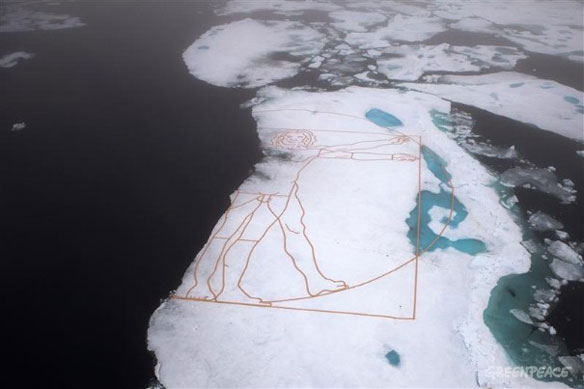
    Vitruvian man greenpeace

    “Climate change is literally eating into the body of our civilisation,” artist and activist John Quigley explained his newest art piece. It is no ordinary drawing; it is a remake of Leonardo Da Vinci’s famous drawing, Vitruvian Man, at the size of four Olympic-sized swimming pools.

    The Vitruvian Man is based on the correlations of ideal human proportions with geometry described by the ancient Roman architect Vitruvius.

    The art piece is melting, it is located 800 kilometers from the North Pole, as a call for urgent action on climate change.

    Quigley used copper strips normally used to create solar panels to construct the giant copy of da Vinci’s 500 year-old drawing. All
    materials were removed after construction
    and the copper will be reused.

    “When he did this sketch it was the Enlightenment, the Renaissance, the dawn of this innovative age that continues to this day, but our use of fossil fuels is threatening that,” Quigley said.