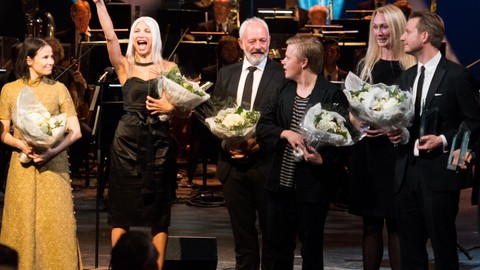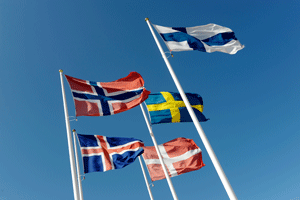
The cornerstone of Nordic cooperation is the Nordic Council, which represents Denmark, Finland, Iceland, Norway, Sweden, the Faroe Islands, Greenland and Åland.
The “Norden” consists of two separate but interoperable entities, The Nordic Council, an official inter-parliamentary body, and the Nordic Council of Ministers, a forum for Nordic inter-governmental cooperation. In addition to the Council and the Council of Ministers, there are more than 20 official Nordic institutions – and about the same number of unofficial ones. The Nordic Innovation Centre (NICe), NordForsk, Nordic Culture Point, Nordic Project Fund (NOPEF), the Nordic Centre for Welfare and Social Issues and the Nordic School of Public Health (NHV) are full Nordic institutions, as are the Nordic houses in Iceland and the Faroe Islands. One of the main institutions in the second category is the Nordic Investment Bank (NIB), which has been jointly owned by the five Nordic and three Baltic states since 2005. Another key organisation is the Nordic Cultural Fund, which supports culture in the Region as well as Nordic projects elsewhere in the world.

The Nordic Council is the official inter-parliamentary body. Formed in 1952, it has 87 elected members from Denmark, Finland, Iceland, Norway and Sweden, as well as the three autonomous territories (Greenland, the Faroe Islands and Åland). The members are all national MPs nominated by the party groups in their home parliaments. There are no direct elections to the Council. It is run by a Presidium and convenes for an annual autumn meeting called the Session, which passes recommendations to the national governments. The main priorities in the work of the Nordic Council are: climate, environment and energy; education and research; and welfare and culture.
The cornerstone of the cooperation is The Helsinki Treaty, which regulates official cooperation between Denmark, Finland, Iceland, Norway and Sweden. It was signed on 23 March 1962 and came into force on 1 July 1962. The main objective of the treaty is to maintain and develop further co-operation between the Nordic countries in the legal, cultural, social and economic fields, as well as in those of transport and communications and environmental protection. In addition, the treaty establishes a foundation for joint positioning in matters of common interest which are dealt with by European and other international organisations and conferences.
The Council of Ministers is the official inter-governmental body. The prime ministers have overall responsibility for its work. In practice, this responsibility is delegated to the ministers for Nordic cooperation and the Nordic Co-operation Committee, which co-ordinates the day-to-day work. Despite its name, the Council of Ministers, which was founded in 1971, consists of several councils. These councils meet a couple of times a year. At present, there are 11 of them.
On of the areas of Nordic cooperation is the Arctic. The Nordic countries cooperate to improve the quality of life for the indigenous peoples in the northern areas and to promote social and cultural development for the Arctic people. Nordic cooperation also strives to protect the sensitive and characteristic Arctic nature, and to ensure sustainable use of the region’s resources, and protection of its biological diversity.
An Advisory Expert Committee was established in conjunction with the adoption of the new Arctic Co-operation Programme in 2002. The Arctic Expert Committee is made up of Nordic members of the Arctic Council and representatives from the autonomous territories. In Nordic Council terms the Arctic Expert Committee will offer advice to the Ministers for Co-operation and the Nordic Co-operation Committee on matters relating to the Arctic.
Following the increasing importance of the Arctic region in international politics, the Nordic Council will discuss the controversial question of a Nordic strategy for the Arctic Region in its meeting in Reykjavik, 21-23 March, 2012 . The meeting will also discuss oil extraction in the Arctic and recommendations for allocating responsibilities in the event of environmental incidents. A plenary session will be in the Icelandic parliament on Friday 23 March, 08:30-11:45 local time.
Sources: Norden.org, Nordic Co-operation