Tag: north

  • Towards the North – Xuelong to reach Akureyri on Monday the 20th

    Towards the North – Xuelong to reach Akureyri on Monday the 20th

    Xuelong statistics

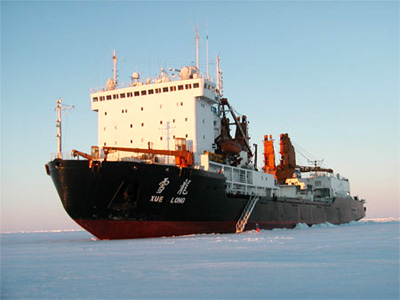
    On Monday, 20th of August 2012, the Snow Dragon, research ice – breaker from Polar Research Institute of China, is expected to anchorage in Akureyri in the northern part of Iceland.

    The venue will open for participants at 9.00 (Icelandic local time) with the speech given by the Chairman of Akureyri Town Council Geir Kristinn Aðalsteinsson and the Chinese Ambassador to Iceland – Su Ge.

    Recently, China has achieved dimensional developments of Arctic linkage, especially in understanding of the earth system and global climate change. To raise public and governmental awareness and interests Dr. Huigen Yang and Prof. Deyi Ma will give a presentation on “Chinese Polar Research and CHINARE 5” to highlight the main features of Chinese contribution to the Arctic science and promote international cooperation with regards to science and technology of polar research activities.

    The Icelandic Chinese science cooperation will be further discussed under the chairmanship of Dr. Thorsteinn Gunnarsson from Icelandic Centre for Research (RANNIS).

    China makes big efforts to understand Arctic environmental changes and nature´s evolution, therefore conjugate observation of dayside aurora and new Icelandic – Chinese Joint Aurora Observatory project will be presented and explained by Dr. Hu and Dr. Björnsson to encourage the exploration of unknown frontiers in the deep universe.

    The Snow Dragon on the way to Iceland

    New perspectives on Arctic shipping cooperation will be given by Mr. Egill Nielsson and Prof. Zhang Xia from Polar Research Institute of China jointly with Ms. Embla Oddsdottir from Stefansson Arctic Institute who will introduce the harmonious culture of sustainable Arctic Shipping.

    The rector of the University of Akureyri – Dr. Stefán B. Sigurðsson will be given his closing remarks before whole group will participate the working lunch hosted by the Town of Akureyri.

    The Xuelong will be open for external visitors on Monday, 20th of August from 12.00 – 16.00 p.m. Introduction to the open day will be conducted by the mayor of Akureyri and Chinese ambassador. The visitors will get a chance to meet the staff from Akureyri town council, University of Akureyri,Stefansson Arctic Institute, Arctic Portal and Icelandic Arctic Cooperation Network.

    CHINARE 5 will leave northern Iceland on Monday´s evening, turning its rudder towards Shanghai.

    Please, see the full schedule of Chinare5 Open Day.

    Source

    Chinare5

  • UArctic reaches further north

    UArctic reaches further north

    Arkhangelsk on a map

    The University of the Arctic has opened a research center in Russian city Arkhangelsk.

    The Northern Arctic Federal University (NArFU) is seen as a critical step in creating a collective capacity for UArctic members to coordinate northern research, says UArctic president Lars Kullerud.

    The office will strengthen both the University and Russia. Kullerud notes that many UArctic members in the North are perceived as smaller actors, and risk being marginalized by larger institutions from outside the region when it comes to high level research projects.

    The new office will help to promote the collective capacity of these members and strengthen the role of northern institutions in Arctic research.

    The Research Office will be officially opened during the Arctic Forum in Arkhangelsk organized by the Russian Geographical Society The Research Office will first host a small seminar the previous day with UArctic and key external partners to discuss
    potential opportunities.

    UArctic

  • High Temperature in the North – Cold in the south

    High Temperature in the North – Cold in the south

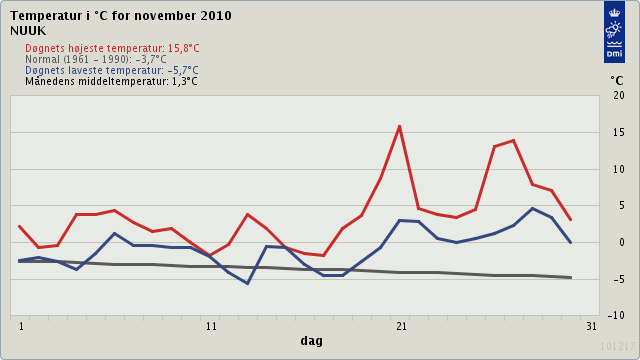
    temperature in Nuuk

    During November and the beginning of December, there has been unusual weather phenomenon over Greenland and Iceland causing unusual high temperature in the area. It is reported on the 29th of November that in the capital of Greenland, Nuuk, that the temperature was as high as 16° C (61°). According to the Danish Meteorological office, the mean temperature in November 2010 in Nuuk was 1,6° C (36° F), while the annual mean temperature in November is -3,7°C (25° F). So far in December, the mean temperature has been 1° C (34° F), which is seven degrees over the annual mean temperature, which is -6,2°C (21° F). This unusual high temperature has though not occurred in Iceland were the mean temperature was close to the annual mean. Still, the temperature went as high as 12, 4°C (11 °F) along the south coast. In December, the temperature at the south coast of the island went as high as 15° C (59 °F). Such high numbers in Iceland are not common in Iceland even though for the mean temperature is quite high, due to the Gulf Stream. However, this is unusual in Greenland.

    This unusual weather conditions might be explained with the so called North Atlantic Oscillation (NAO). This weather phenomenon in the North Atlantic Ocean is fluctuation in the difference of atmospheric pressure at sea level between Iceland in the north and the Azores in the south. There is a correlation between those two areas, meaning that when there is a high pressure over Iceland, there is a low pressure over the Azores and vice versa. The east-west oscillation motion of this pressure difference then controls the strength of the direction of the westerly winds which are the main cause for abnormal weather activity in the North Atlantic region and in Central Europe.
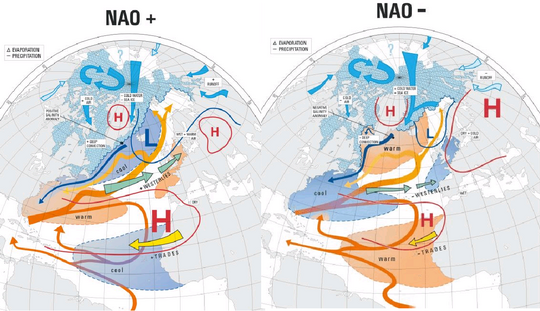
    NAO positive/negative effects on the weather

    In November till April, the NAO is responsible for much of the variability of weather in the North Atlantic region, causing wind speed and direction to change, which further cause changes in temperature and moisture. When the NAO is positive it causes mild temperature in West and Central Europe and cool climate in Greenland and Labrador. When the NAO is negative it causes a shift, meaning that West and Central Europe becomes colder when it warms up in Greenland, Labrador and Iceland.

    The winter of 2009-10 in Europe was unusually cold, especially during December, January and February and caused many inconveniences in the continent. It is theorized that this may be due to solar activity but this cold winter is also coincided with an exceptionally negative phase of the NAO.
    Sea ice

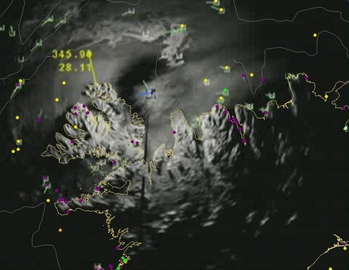
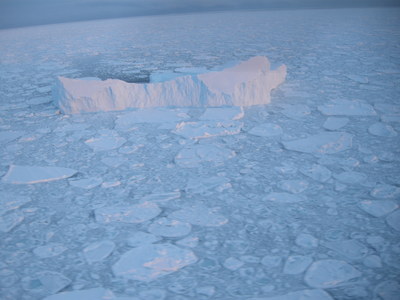
    The NAO also causes changes in sea ice distribution at the east coast of Greenland. The NAO is in negative position, causing more westerly wind to blow. Also, the NAO generates better conditions for the sea is to formulate at the north east coast of Greenland. Du to this, a sea ice warning has been issued by the Icelandic Metrological Office in Iceland. According to surveillance of the Icelandic Coast Guard on the 9th of December the sea ice edge was around 20 nautical miles from the North west coast of Iceland. A day later, on the 10th of December, the sea ice edge was only 10 nautical miles from the shore. This is caused by a strong westerly wind, caused by the NAO, which blows sea ice into Icelandic waters. The sea ice has drifted further west into Icelandic waters but away from shore. However, with strong northern winds, the ice might reach shore at some northern peninsulas. This can cause inconvenience for sea-farers and fishermen since the sea ice can block the sea route North West of Iceland. Due to this, transportation of fish needs to be on land since vessels can be shut from the home harbour. The Ice is however sparse with denser ice in between. Five large icebergs have been also spotted and is the highest one estimated to be around 110 meters (360 feet). Such large icebergs are as not usual in this area. A reason for increased icebergs might be due to warmer climate. Warmer climate causes the ice-shelf around Greenland to weaken and break up, causing increased icebergs in adjunct waters.

    The NAO phenomenon is negative position now, causing unusual weather in Greenland and somewhat in Iceland. However, the most of the inconvenience caused by the NAO occurs in Central Europe. The winter in Europe has been very cold so far in 2010 and is predicted to stay so until the beginning of the new year of 2011. This has been linked to the NAO, however, there might be another reason. For example, the Icelandic low pressure – which normally sits between to the west of Iceland and Greenland – has appeared regularly to the east of Iceland and so allowed exceptionally cold air into Europe from the Arctic. Together those two form a unusual weather conditions in the area. However, there is no doubt of an unusual and or a changing climate.
    Iceberg in Icelandic waters

    Sources:

    Icelandic Meteorological Office
    Danish Meteorological Institute
    The Icelandic Coastguard

  • Dinosaurs in the Arctic

    Dinosaurs in the Arctic

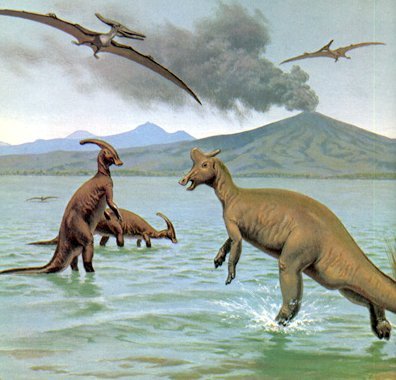
    T-RexIt may come as a surprise to many that dinosaurs are known to have lived in the high north. Paleontologists have over the years found remains in Canada’s and Alaska’s Arctic regions establishing that the region once had a Jurassic era. And possibly challenging existing theories claiming that dinosaurs died out due to a meteorite causing darkness witch led to the dinosaurs demise.

    Alaska’s North Slope was home to eight types of dinosaurs during the period they lived there, from 75 million to 70 million years ago, say paleontologists including UAF’s Roland Gangloff and Tony Fiorillo of The Dallas Museum of Natural History. Four of the dinosaurs ate plants, and four others ate the plant eaters and other creatures, Fiorillo wrote in a recent Scientific American article. The most common far-north dinosaur was the duck-billed Edmontosaurus, a plant-eating hadrosaur that weighed between 3,000 and 4,000 pounds.

    How could these cold-blooded creatures have survived on Alaska’s North Slope? As I type this in early February, it’s -20 F at the weather station closest to the fossil beds on the Colville River. By examining fossil pollen, leaves, and wood, scientists have found that northern Alaska was a much warmer place at the time of the dinosaurs, possibly with average annual temperatures well above freezing, Fiorillo wrote.

    dinosaursEven though northern Alaska was warmer then, it was still probably cold enough for occasional snow and was farther north than it is today, so the sun didn’t rise for weeks in midwinter. Today, the North Slope’s grizzly bears are tucked away in hillside dens, but it’s tough to picture a 35-foot hadrosaur hibernating, Fiorillo wrote. Dinosaurs may have dialed down their metabolism to require less food, and some researchers have suggested they might have migrated south during the deep dark of midwinter. To check the migration hypothesis, Fiorillo and Gangloff compared bone length and body masses of hadrosaurs to the north’s master of migration, the caribou. They decided that juvenile hadrosaurs were relatively much smaller than juvenile caribou, and that it was unlikely the hadrosaurs migrated.

    If dinosaurs remained on the North Slope during the winter, biologists expect their bodies would show some adaptations to darkness. Numerous scattered teeth of the meat-eating Troodon found in Alaska suggest it was a common dinosaur, and one of Troodon’s main characteristics was a set of very large eyes, possibly an adaptation to low light.

  • Understanding Migration in the Circumpolar North, Social Science Forum at the University of Akureyri

    University of Akureyri

    In the Social Science Forum at the University of Akureyri, Professor Lee Huskey will discuss research being done around the circumpolar north and draws general lessons from the different experiences of northern migration in the Arctic nations. Similarities and interesting differences among patterns and determinants of migration will be discussed. The lecture is held by the University of Akureyri and the Stefanson Arctic Institute.

    Migration is a major influence on the size and demographic structure of the population in Arctic regions. The patterns of migration differ significantly across countries and between indigenous and non-indigenous people. Migration patterns also differ across demographic groups in the North; rates of migration differ by gender, age, and education level. Migration involves long-term social and cultural consequences for communities in the north as well as for the migrants themselves.

    Material necessity is a major determinant of population movement, so the creation or loss of income earning opportunities in the north will affect migration decisions. Migration decisions will also reflect more general estimates of the quality of life offered by different communities. The pursuit of jobs, education, family, and bright lights will each influence migration in the north.

    Public policy will also affect migration. While migration in most Arctic nations is a decision made by households or individuals, in some past periods migration decisions have been a matter of public policy. Public choices about transfer payments and the provision of services and infrastructure influence migration decisions today.

    Lee Huskey is a Professor of Economics at the University of Alaska Anchorage (UAA). He holds a Ph.D. in economics from Washington University in St. Louis.  At the UAA Lee has served as Chairman of the Department of Economics, Director of the Center for Economic Education, and Director of the Experimental Economics program. He was elected President of the Western Regional Science Association in 2005. He has been active in a number of northern pursuits including the Arctic Social Indicators project, the University of the Arctic, and the Northern Research Forum.

    Lee’s current research examines the patterns and determinants of rural-urban migration in Alaska. He is currently the principal investigator for two projects on northern migration funded by the US National Research Foundation and the European Science Foundation which involve social scientists from a number of countries and disciplines. More generally his research has examined economic development in rural regions and particularly the influence of institutions on this development. For further information, see http://exchweb/bin/redir.asp?URL=http://www.cbpp.uaa.alaska.edu/aflh.asp