Tag: Norway

  • Call for SCF applications

    Call for SCF applications

    Earth globe, polar view

    Science Cooperation Fund – the Agreement between Iceland and Norway to promote the Arctic studies and help with students and staff mobility between those two Arctic countries, encourages to apply for exchange scholarships and staff mobility grants before tomorrow´s deadline.

    The purpose of the fund is to encourage scientific cooperation between higher education institutions, research organizations and research groups in Norway and Iceland in the field of Arctic science or other activities as decided by the joint Icelandic-Norwegian Committee.

    Grants are awarded for travel and accommodation cost in relation to the participation of individuals or groups in scientific conferences and/or joint meetings in Norway and Iceland.

    In this context Arctic science encompasses research, monitoring, education and dissemination of knowledge that relate to both distinctive and common denominators of nature, culture, economy and history of the Arctic region with a bilateral and/or international perspective.

    Grants will be awarded according to lump sums for travel and subsistence costs.

    For more information, please visit the Science Cooperation Fund website.

  • New center established in Tromsø

    New center established in Tromsø

    Tromsø port during the winter

    University of Tromsø in northern Norway has now announced the establishment of new Law of the Sea center.

    Global climate change and melting sea ice, offers more and more opportunities for international transportation networks.

    Notably, the trend of receding ice cap around the North Pole could possibly make the Arctic more reliable for scheduled navigation, at least during the summer months.

    Asia’s and EU’s increased interest in the Arctic will likely enlarge the group of the Arctic Council Observers at the upcoming meeting in Kiruna, northern Sweden on May 15th.

    Last Friday, the representatives of Tromso University announced the establishment of a dedicated center for research on questions related to the law of the sea and other juridical topics regarding the role of international and national jurisdictions in the Arctic.

    Fifteen experts on Arctic issues and Law of the Seas will be working with the new center. The Fridtjof Nansen Institute is a partner. Funding comes from the Kristian Gerhard Jebsen Foundation, also branding the name of the new initiative; KG Jebsen Center for Ocean Law.

    Professor Tore Henriksen with the Law faculty at the University of Tromsø will be the head of the new canter.

    Source

    University of Tromsø

  • More scholarships for High North Studies

    More scholarships for High North Studies

    Port Tromso - Northern Norway

    Students from the US, Canada and Russia have for five years been able to apply for scholarships for studies at seven universities and colleges in Northern Norway. In the program period for 2013-2016 also students from Japan and South Korea will have this opportunity.

    The goal of the Fellowship Programme for Studies in the High North is to contribute to increased academic collaboration and student mobility in the High North.

    The programme is open to the higher education institutions in northern Norway only: Finnmark University College, Harstad University College, Narvik University College, Nesna University College, Sami University College, University of Nordland, University of Tromsø and The University Centre at Svalbard (UNIS).

    These institutions will invite students at partner institutions in Canada, Japan, Russia, South Korea and the US to apply for High North Fellowships.

    The programme is mainly targeted at students at Master’s and Bachelor’s level but is also open to PhD students. Bachelor’s and Master’s students must take for-credit courses in Norway, while PhD students can come as research fellows.

    To learn more about the Program, please click here.

    Source

    Study in Norway

  • Iceland and Norway advertise funds

    Iceland and Norway advertise funds

    Ducks swimming in Reykjavík pond

    The foreign ministries of Iceland and Norway have established two funds as a part of their cooperation in the field of Arctic studies and Arctic scientific research.

    The ministers of foreign affairs signed a three year Memorandum of Understanding in Akureyri on September 29, 2011, concerning co-operation. It indicated key activities, including the establishment of a Nansen Professorship in Arctic Studies at the University of Akureyri, Norwegian and Icelandic Arctic Science Cooperation Fund and Exchange scholarships for Icelandic and Norwegian Students in Arctic Studies.

    Exchange scholarships for Icelandic and Norwegian Students in Arctic Studies are one of the key activities in this co-operation. The purpose of the exchange scholarship program is to encourage the exchange of students between higher education institutions in Norway and Iceland in the field of Arctic science.

    Students at all levels (bachelor, master, doctoral) can apply if they are enrolled at Icelandic and Norwegian higher educational institutions. Priority will be given to Master and Ph.D. students and students wishing to study at Norwegian and Icelandic universities that are members of the University of the Arctic network.

    The purpose of the science fund is to encourage scientific cooperation between higher education institutions, research organizations and research groups in Norway and Iceland in the field of Arctic science or other activities as decided by the joint Icelandic-Norwegian Committee. Grants are awarded for travel and accommodation cost in relation to the participation of individuals or groups in scientific conferences and/or joint meetings in Norway and Iceland. In this context Arctic science encompasses research, monitoring, education and dissemination of knowledge that relate to both distinctive and common denominators of nature, culture, economy and history of the Arctic region with a bilateral and/or international perspective.

    More information can be found here.

    Sources

    Arctic Studies

    Foreign Ministry of Norway

    Foreign Ministry of Iceland

  • Science Section begins today!

    Science Section begins today!

    The audience during science session at Arctic Frontiers 2013

    After 2 days of policy related discussions, the Arctic Frontiers conference that is being held in Tromso, Norway, opens the science section.

    This part will address the issues of security, energy and interstate relations in the Arctic. An overall aim is to identify conditions for continued stability in light of new developments in the region.

    A warming Arctic with less ice may involve opportunities in terms of economic activity and increased interstate cooperation, but it may also present Arctic stakeholders with new challenges in terms of how best to meet their interests and at the same time interact with other stakeholders through mutually beneficiary relations.

    Arctic Frontiers is organised as an independent network and a leading meeting place for pan-arctic issues. The network was established in 2006 and later extended. The science section that start today will end on Friday, 25th of January.

    HMM

  • Arctic Frontiers 2013

    Arctic Frontiers 2013

    Arctic Frontiers

    The 2013 Arctic Frontiers in Tromso Norway is just about to start. This years themes are Geopolitics & Marine Production in a Changing Arctic.

    The organizers will be broadcasting the whole of the policy section on Monday 21 January live on the internet in English and Russian and on Tuesday 22 January in English and Norwegian.

    To connect to the online stream, please follow this link.
    Here are the links for the 22nd of January:

    Here is the full program of the conference.

    Source

    Arctic Frontiers

  • Norway takes part in exploration in Iceland

    Norway takes part in exploration in Iceland

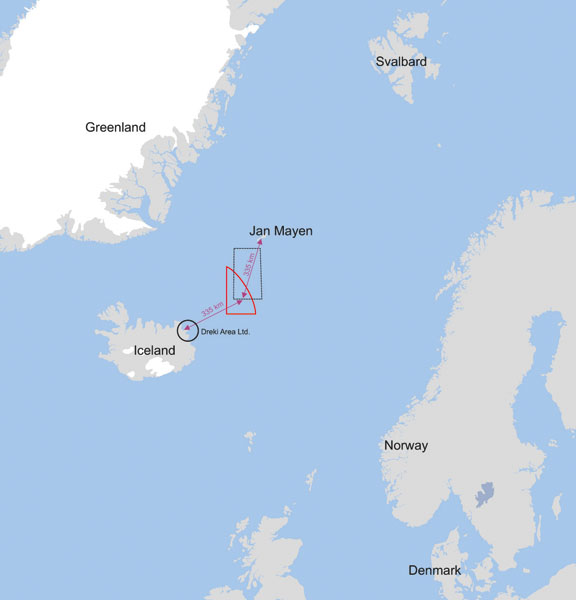
    The Dreki area on a map

    The National Energy Authority of Iceland (NEA) has today finished processing two applications for licences for exploration and production of hydrocarbons in the Dreki Area. The Ministry of Petroleum and Energy in Norway has today, 3 December 2012, notified NEA of their decision to participate in both licences to a 25 % share in accordance with the agreement between Iceland and Norway.

    NEA sought the opinions of the Ministry for the Environment and the Ministry of Fisheries and Agriculture in accordance with the hydrocarbons act and evaluated the opinions based on the applications and the work programmes involved.

    Furthermore, NEA made a careful evaluation of the technical and geological capacity of the applicants to handle the extensive activities associated with the licence. Finally, NEA studied the financial capacity of the parent companies of the applicants in order to ensure that the applicants have sufficient financial strength to conduct the activities for the long-term and can handle the corresponding environmental and safety elements.

    Following the processing of NEA of the applications

    Blue: Valiant Petroleum ehf. and Kolvetni ehf.  Red: Faroe Petroleum Norge AS, Branch in Iceland and Iceland Petroleum ehf.

    at the end of October, NEA made a decision to grant licences to Faroe Petroleum Norge AS, Branch in Iceland and Iceland Petroleum ehf., on the one hand, and Valiant Petroleum ehf. and Kolvetni ehf., on the other.

    Furthermore, the Norwegian authorities were notified of the decision, draft licences sent for their perusal and a formal answer requested on whether they intended to participate in the licences in accordance with the agreement between Iceland and Norway from 1981, which entails the right of Norway to participate in licences within the area of the agreement up to a 25 % share.

    The anticipated licensees have read the draft licences and submitted their comments, which NEA has taken into account as has been agreed by the parties involved. Norway has also participated in this process through the Ministry of Petroleum and Energy, i.e. gone through the draft licences and submitted comments to NEA.

    The Ministry of Petroleum and Energy in Norway has today, 3 December 2012, notified NEA of Norway’s decision to participate in both licences to a 25 % share in accordance with the agreement between Iceland and Norway.

    The licences cannot by issued before the Norwegian Parliament has approved the decision on the participation by the Kingdom of Norway through the State-owned oil company Petoro AS. Following this and the signing of the parties to the licences of their joint operating agreements, NEA will grant the licences, probably in the beginning of January of next year.

    A third application was received from Eykon Energy ehf. The processing of this application was delayed and the applicant given a respite until 1 May 2013 to find an additional participant in the licence that receives approval by NEA on having sufficient expertise, experience and capacity to undertake the licenced activities. NEA will take the application for final processing subsequent to receiving information on such a new participant in the application.

    Sources

    NEA

    Map of potential oil and gas areas

  • Big grant for Russian-Norwegian projects

    Big grant for Russian-Norwegian projects

    Arctic research

    Norway and Russia have strengthened their joint research ventures by putting around €1,5 million Euros to three projects.

    “The projects will enhance public knowledge of Norway and Russia. In the long term knowledge to facilitate better management of areas and benefit including petroleum industry,” according to the Research Council of Norway.

    The three projects that have received grants are “4DARCTIC: Structure and evolution of Arctic crust and mantle based on multi-scale Geophysical studies”, which is a joint project between the University of Oslo and the Institute of Petroleum Geology and Geophysics; “CLIMate variability and change in the Eurasian ARCtic in the 21st century”, a cooperation project between the Nansen Center and Voeikov Main Geophysical Observatory; “Combined effects of Petroleum and the Environment in bivalves from the Norwegian-Russian Arctic”, a joint project between the University of Tromsø and the Karelian Research Centre, RAS Institute of Biology.

    All the three projects are cooperation projects between scientists in Norway and Russia. The project partners are covering half of the expenses, the rest is covered by the Russian research foundation Russian Foundation for Basic Research (RFBR) and the Research Council of Norway is covering the Norwegian part, the BarentsObserver reports.

    “This research cooperation will give an important contribution to a holistic management of the sea and the resources in Arctic areas through a common knowledge base”, says the Research Council of Norway’s Director Arvid Hallén to the council’s web site.
    Source:
    BarentsObserver

    Research Council of Norway

  • Norway shows military presence

    Norway shows military presence

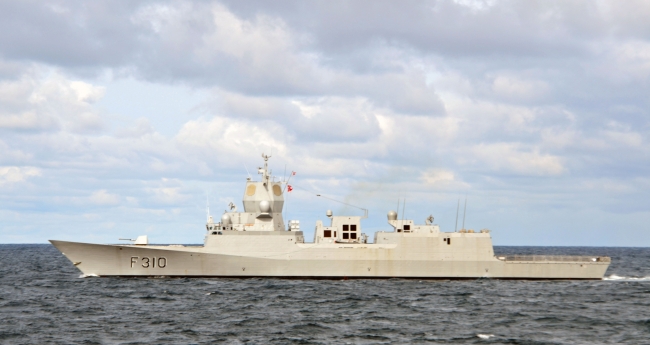
    KNM Thor Heyerdahl.

    Norway has decided to strengthen its security around Svalbard by sending its most modern warship to the archipelago.

    “Our main task is to show presence on Svalbard and in the surrounding waters”, Captain Per Rostad says to the Armed Forces’ web site.

    During the mission the frigate will conduct a series of drills, with other military units and the Norwegian Sea Rescue.

    Norway will send their best ship to Svalbard at least once a year but it has previously shown its presence when the Chinese icebreaker Xuelong sailed near Svalbard this summer.

    Source

    Barentsobserver

  • Over 300 people evacuated from oil rig

    Over 300 people evacuated from oil rig

    Oil rig in the northern sea

    Norway’s state-owned energy giant Statoil on Wednesday evacuated around 330 people from a North Sea platform off the coast of Norway after it began listing.

    “Around 330 people were evacuated and we’re halting the evacuation at this stage,” said Einar Knudsen, a spokesman for the Joint Rescue Coordination Centre Southern Norway. Just over 40 people were to stay on the rig for security work, he added.

    The Floatel Superior, effectively a floating hotel for staff working on the neighbouring Njord A production platform, was evacuated after the rig had tilted four degrees due to a leak in one of the ballast tanks, Statoil said.

    The rupture appeared to have been caused by a collision with an anchor.

    The Njord A itself, which lies about 50 nautical miles from land, is currently closed for maintenance, according to the Norwegian Petroleum Directorate.

    The rig was stabilized an hour later after other ballast tanks were partially flooded to balance it, but as a safety precaution all non-essential personnel, meaning the vast majority of the 374 people on board, were evacuated.

    “We normally have two layers of protection against leaks, and since there remained only one, we decided to bring non-essential personnel to safety,” group spokesman Ola Anders Skauby told AFP.

    “We take the situation seriously,” he said, adding that it was normal to prepare for a worst case scenario.

    Six helicopters were deployed to the area, in difficult weather, according to the rescue centre. Employees were airlifted from the Floatel to Njord A, Knudsen said.

    Source:
    The Local