Tag: Nuuk

  • Polar bear shot near Nuuk

    Polar bear shot near Nuuk

    The polar bear shot caught the attention of the people in Nuuk

    A polar bear was shot near Nuuk in Greenland this week. It is rare that polar bear come this close to the capital.

    Two brothers spotted the bear, at first they thought it was a huge dog. A closer look identified the bear.

    The male polar bear smelled the brothers who ran to safety. The bear clawed the house but then moved away, and approached Nuuk.

    He was shot due to safety of the inhabitants.

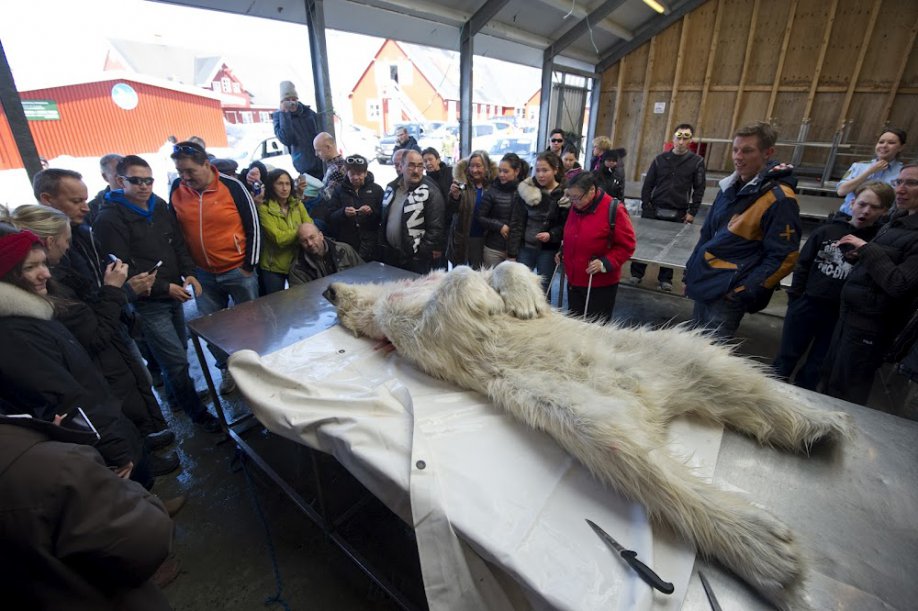
    Many people have looked at the bear since it was shot, as can be seen on the pictures with the story below.

    Sources

    Sermitsiaq

  • A new port in Nuuk

    A new port in Nuuk

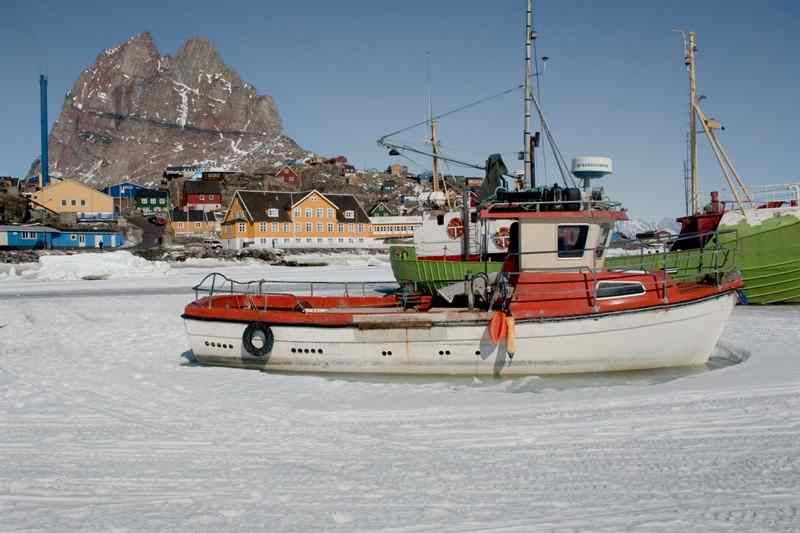
    Ships in Greenlandic ice.

    The government of Greenland is building a new port in the capital, Nuuk. The old port is too small for the future activities in Greenlandic waters.

    The new port, to be opened in 2014, will be both a container port with storage facilities and a hub-port for service of oil exploration.

    The new port will be run by a company owned by four partners, the government of Greenland, the municipality of Sermersooq, the Royal Arctic Line shipping company and the port of Ålborg in Denmark.

  • Arctic Search and Rescue Agreement

    Arctic Search and Rescue Agreement

    The first international agreement made exclusively for the Arctic region was signed at the ministerial meeting in Nuuk, May 12 2011. The agreement, which deals with search and rescue of aeronautical and maritime vessels and passengers, is also the first international agreement made under the auspices of the Arctic Council. The Arctic Council is now planning another international agreement for adoption which will deal with oil pollution in the Arctic.

    Arctic Search and Rescue Agreement - Areas of Application Illustrative Map

    The Agreement on cooperation on Aeronautical and Maritime Search and Rescue in the Arctic (Agreement) was made in accordance with the 1979 International Convention on Maritime Search and Rescue (SAR) and the 1944 Convention on International Civil Aviation, both of which are established and widely recognized international law. The objective of the Agreement is, however, to further strengthen aeronautical and maritime search and rescue cooperation and coordination in the Arctic. In order for that to be clear, each member state was given a particular Search and Rescue area which it is responsible for.

    The main emphasis of the Agreement is to develop swift and efficient measures when accidents occur in the harsh Arctic region and to ensure, as much as possible, proper search and rescue operations. This is done by the clauses where the member states commit themselves to nominate certain national institutions in each state that will have full discretion in the field of search and rescue in the area. These national institutions are not only bound to take efficient measures, but also to notify other relevant national institutions when appropriate.

    The most significant clause of the Agreement is Art. 8 where member states obligate themselves to send a permission request to another member state when e.g. a rescue vessel enters the Search and Rescue area of another State. This is obviously not unconventional, but the article also states that the receiving national institution “shall immediately confirm such receipt” and, as soon as possible, let the member state of the requesting vessel know if the request is permitted and under which conditions, if any.

    Needless to say, the Agreement is only the beginning of a specific cooperation among the Arctic states and, as clearly stated in the Agreement, it will develop and be subject of amendments as search and rescue operation in the region become more apparent. The idea is then to make the Agreement more effective and cooperation more efficient. These objectives might be reached by the statements made in Art. 9 of the Agreement, where signatories oblige to maintain widespread cooperation on search and rescue. The most important cooperative measures of the member states is exchange of information on e.g. communication details, information about search and rescue facilities, lists of available airfields and ports and their refueling and resupply capabilities, knowledge of fueling, supply and medical facilities and information useful for training search and rescue personnel.

    The Agreement will without any doubt strengthen cooperation between the Arctic states and improve the way Arctic countries respond to emergency calls in the region. The necessity of such an agreement and cooperation is great, as accidents in the region rely on swift responses and efficient operations, as much as fully qualified rescue personnel and equipment. It is hoped that the Agreement will not just work as an important instrument for saving properties and lives, but also to further forge the cooperation of the Arctic states.

  • Arctic Council Nuuk Ministerial Meeting

    Arctic Council Nuuk Ministerial Meeting

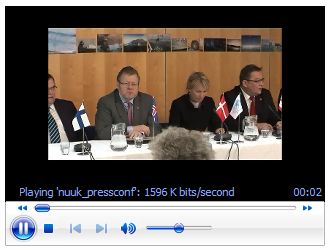
    The Arctic Council Nuuk Ministerial Meeting participants

    The Arctic Council Nuuk Ministerial Meeting participants held a press conference at the end of the meeting, where they expressed their satisfaction with the results of the meeting.

    The Search and Rescue Agreement was considered ground-breaking, as it is the first legally binding agreement negotiated under the auspices of the Arctic Council and an important step towards safe shipping in the Arctic. The shipping and resource management will be a priority in the Swedish chairmanship agenda Swedish Foreign Minister Carl Bildt stating, that “Arctic Countries need enhanced cooperation on many future challenges in the Arctic, not least prevention, preparedness and response to oil spills. As incoming chair we will press forward with this agenda.”

    Arctic Council Permanent Participants had a different perspective, stating that the environmental issues are the most important for their communities. To maintain a healthy Arctic environment is a prerequisite for the survival of their culture and livelihoods. In the coming Swedish chairmanship period they will also “commit to working on improving health by establishing adaptive measures to protect our traditional food sources and to support and strengthen indigenous languages”, stated Rodion Sulyandziga, Chairman of the Indigenous Peoples Secretariat.

    Sources: AC, IPS

  • Historical Agreement signed today at the Arctic Council Nuuk Ministerial Meeting

    The foreign Ministers of the Arctic countries and leaders of the Arctic Indigenous Peoples witnessed a historical moment today at the Nuuk Ministerial Meeting, when the first legally binding agreement established under the auspices of the Arctic Council was signed.

    The Agreement on Cooperation on Aeronautical and Maritime Search and Rescue in the Arctic lays down a framework to strengthen search and rescue cooperation and coordination in the Arctic airspace and waters.

    The Parties commit themselves to broad cooperation and agree to seek cooperation also with other countries who may be able to contribute to the Arctic search and rescue operations. The agreement further delimits operational regions for the Parties, who each will bear their own costs deriving from the implementation of the Agreement.

    For the full text of the Agreement click the Agreement name here above or go to the Arctic Council.

    The Nuuk Declaration

    The Ministers also gave out a Declaration marking the policy for the next biennial period. The ministers decided to strengthen the capacity of the Arctic Council to respond to the challenges and opportunities facing the Arctic by establishing a permanent Arctic Council secretariat in Tromsø, Norway. They also call for an assessment of the current state of human development in the Arctic and its relationship with climate change and recognize the need for an integrated assessment of multiple drivers of Arctic change as a tool for Indigenous Peoples, Arctic residents, governments and industry to prepare for the future.

    In above photos are Hillary Clinton, the Secretary of State of the US and Össur Skarphéðinsson, the Minister of Foreign Affairs of Iceland at the SAR signing.

  • High Temperature in the North – Cold in the south

    High Temperature in the North – Cold in the south

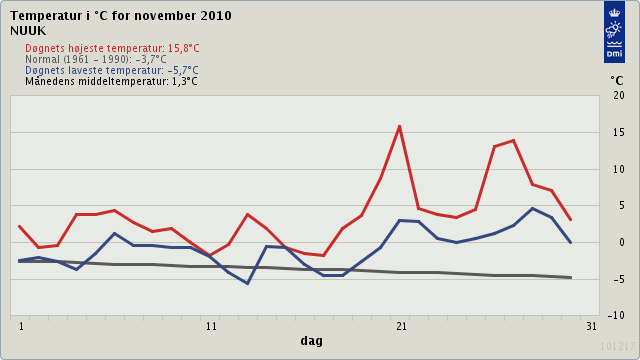
    temperature in Nuuk

    During November and the beginning of December, there has been unusual weather phenomenon over Greenland and Iceland causing unusual high temperature in the area. It is reported on the 29th of November that in the capital of Greenland, Nuuk, that the temperature was as high as 16° C (61°). According to the Danish Meteorological office, the mean temperature in November 2010 in Nuuk was 1,6° C (36° F), while the annual mean temperature in November is -3,7°C (25° F). So far in December, the mean temperature has been 1° C (34° F), which is seven degrees over the annual mean temperature, which is -6,2°C (21° F). This unusual high temperature has though not occurred in Iceland were the mean temperature was close to the annual mean. Still, the temperature went as high as 12, 4°C (11 °F) along the south coast. In December, the temperature at the south coast of the island went as high as 15° C (59 °F). Such high numbers in Iceland are not common in Iceland even though for the mean temperature is quite high, due to the Gulf Stream. However, this is unusual in Greenland.

    This unusual weather conditions might be explained with the so called North Atlantic Oscillation (NAO). This weather phenomenon in the North Atlantic Ocean is fluctuation in the difference of atmospheric pressure at sea level between Iceland in the north and the Azores in the south. There is a correlation between those two areas, meaning that when there is a high pressure over Iceland, there is a low pressure over the Azores and vice versa. The east-west oscillation motion of this pressure difference then controls the strength of the direction of the westerly winds which are the main cause for abnormal weather activity in the North Atlantic region and in Central Europe.
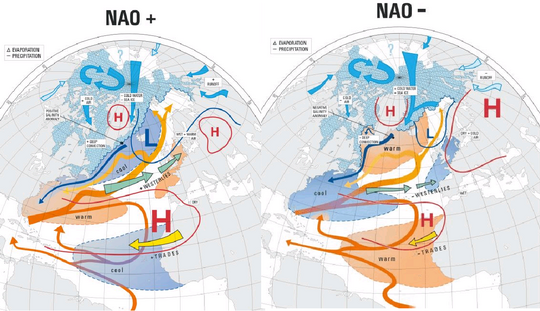
    NAO positive/negative effects on the weather

    In November till April, the NAO is responsible for much of the variability of weather in the North Atlantic region, causing wind speed and direction to change, which further cause changes in temperature and moisture. When the NAO is positive it causes mild temperature in West and Central Europe and cool climate in Greenland and Labrador. When the NAO is negative it causes a shift, meaning that West and Central Europe becomes colder when it warms up in Greenland, Labrador and Iceland.

    The winter of 2009-10 in Europe was unusually cold, especially during December, January and February and caused many inconveniences in the continent. It is theorized that this may be due to solar activity but this cold winter is also coincided with an exceptionally negative phase of the NAO.
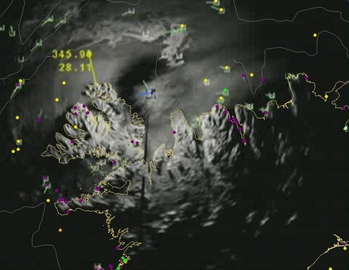
    Sea ice

    The NAO also causes changes in sea ice distribution at the east coast of Greenland. The NAO is in negative position, causing more westerly wind to blow. Also, the NAO generates better conditions for the sea is to formulate at the north east coast of Greenland. Du to this, a sea ice warning has been issued by the Icelandic Metrological Office in Iceland. According to surveillance of the Icelandic Coast Guard on the 9th of December the sea ice edge was around 20 nautical miles from the North west coast of Iceland. A day later, on the 10th of December, the sea ice edge was only 10 nautical miles from the shore. This is caused by a strong westerly wind, caused by the NAO, which blows sea ice into Icelandic waters. The sea ice has drifted further west into Icelandic waters but away from shore. However, with strong northern winds, the ice might reach shore at some northern peninsulas. This can cause inconvenience for sea-farers and fishermen since the sea ice can block the sea route North West of Iceland. Due to this, transportation of fish needs to be on land since vessels can be shut from the home harbour. The Ice is however sparse with denser ice in between. Five large icebergs have been also spotted and is the highest one estimated to be around 110 meters (360 feet). Such large icebergs are as not usual in this area. A reason for increased icebergs might be due to warmer climate. Warmer climate causes the ice-shelf around Greenland to weaken and break up, causing increased icebergs in adjunct waters.

    The NAO phenomenon is negative position now, causing unusual weather in Greenland and somewhat in Iceland. However, the most of the inconvenience caused by the NAO occurs in Central Europe. The winter in Europe has been very cold so far in 2010 and is predicted to stay so until the beginning of the new year of 2011. This has been linked to the NAO, however, there might be another reason. For example, the Icelandic low pressure – which normally sits between to the west of Iceland and Greenland – has appeared regularly to the east of Iceland and so allowed exceptionally cold air into Europe from the Arctic. Together those two form a unusual weather conditions in the area. However, there is no doubt of an unusual and or a changing climate.
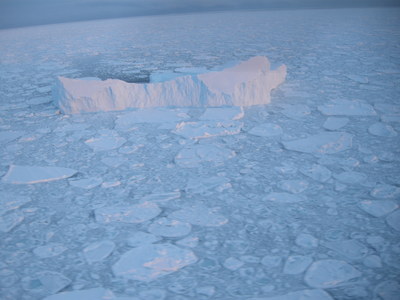
    Iceberg in Icelandic waters

    Sources:

    Icelandic Meteorological Office
    Danish Meteorological Institute
    The Icelandic Coastguard
  • Inuit Leaders Meet in Nuuk, Greenland

    Inuit Leaders Meet in Nuuk, Greenland

    Inuit leaders from Canada, Russia, USA and Greenland

    During the 28. June to July 2. The ICC holds it’s general assembly in Nuuk, Greenland.

    Inuit Leaders from Canada, Russia, USA & Greenland come together every four years to discuss the development in the arctic and their common concerns- and the meeting now is especially focused on during the meeting:

    • Environment, including Climate Change
    • Political and economic development
    • Health and Well-being
    • Hunting and Food Security
    • Governance
    • Inuit Arctic Policy

    Climate change and many other issues that are effecting the arctic, and thereby the Inuit, need to be discussed and a common policy or guidelines formulated.

    Further information can be found on Http://www.inuit.org

    Source: Arctic Council news